
Join Our JEE Preparation Group
Prep with like-minded aspirants; Get access to free daily tests and study material.
Sign in
Please select an account to continue using cracku.in
↓ →
Join Our JEE Preparation Group
Prep with like-minded aspirants; Get access to free daily tests and study material.
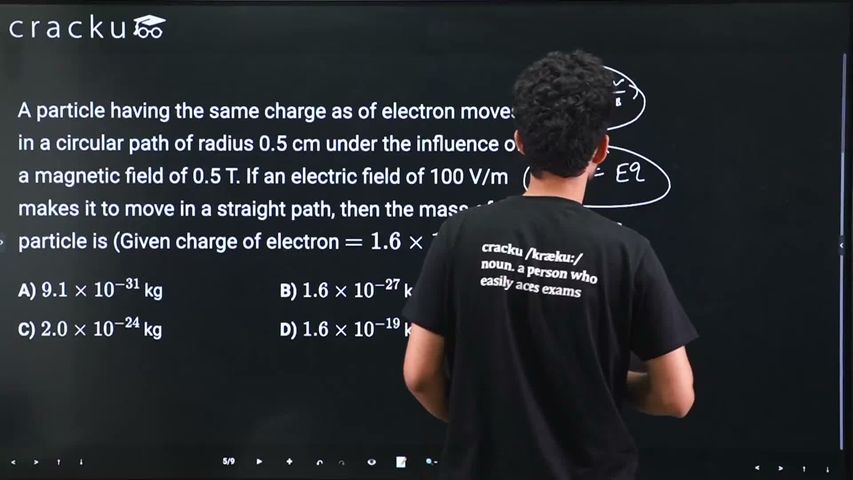
A particle having the same charge as of electron moves in a circular path of radius 0.5 cm under the influence of a magnetic field of 0.5 T. If an electric field of 100 V/m makes it to move in a straight path, then the mass of the particle is (Given charge of electron $$= 1.6 \times 10^{-19}$$ C)
We are told that the particle carries the same charge as an electron, so its charge is
$$q = 1.6 \times 10^{-19}\ \text{C}.$$
Under only the magnetic field, the particle executes uniform circular motion of radius
$$r = 0.5\ \text{cm} = 0.5 \times 10^{-2}\ \text{m} = 5 \times 10^{-3}\ \text{m}.$$
The magnetic field magnitude is
$$B = 0.5\ \text{T}.$$
For a charged particle moving perpendicular to a uniform magnetic field, the magnetic force supplies the centripetal force. We first state this relationship:
Magnetic force: $$F_B = q v B.$$ Centripetal force: $$F_C = \dfrac{m v^{2}}{r}.$$
Because the motion is circular under the magnetic field alone, these two forces are equal:
$$q v B = \dfrac{m v^{2}}{r}.$$
We can cancel one factor of the speed $$v$$ from both sides to find an expression for $$v$$:
$$q B = \dfrac{m v}{r}\quad \Longrightarrow\quad v = \dfrac{q B r}{m}.$$
Next, an electric field of magnitude
$$E = 100\ \text{V m}^{-1}$$
is switched on simultaneously with the magnetic field. The problem states that, under the simultaneous action of $$ \mathbf{E} $$ and $$ \mathbf{B} $$, the particle now moves in a straight line. A straight-line trajectory in crossed, perpendicular electric and magnetic fields implies that the net force is zero. The electric force and magnetic force must therefore cancel:
Electric force: $$F_E = q E.$$ Magnetic force (already written): $$F_B = q v B.$$
For cancellation, we must have
$$q E = q v B.$$
Because $$q \neq 0$$, we divide both sides by $$q$$ to obtain the standard crossed-fields condition:
$$E = v B \quad\Longrightarrow\quad v = \dfrac{E}{B}.$$
We now have two independent expressions for the speed $$v$$:
$$v = \dfrac{q B r}{m}\qquad\text{and}\qquad v = \dfrac{E}{B}.$$
Since both describe the same speed, we equate them:
$$\dfrac{q B r}{m} = \dfrac{E}{B}.$$
Solving this equation for the mass $$m$$, we first cross-multiply:
$$q B r \, B = m E.$$
This simplifies to
$$m = \dfrac{q B^{2} r}{E}.$$
Now we substitute the numerical values, keeping all factors explicit:
$$m = \dfrac{(1.6 \times 10^{-19}\ \text{C})\,(0.5\ \text{T})^{2}\,(5 \times 10^{-3}\ \text{m})}{100\ \text{V m}^{-1}}.$$
First calculate the square of the magnetic field:
$$(0.5\ \text{T})^{2} = 0.25\ \text{T}^{2}.$$
Multiply $$q$$ and $$B^{2}$$:
$$1.6 \times 10^{-19} \times 0.25 = 0.4 \times 10^{-19} = 4.0 \times 10^{-20}.$$
Now include the radius $$r$$:
$$4.0 \times 10^{-20} \times 5 \times 10^{-3} = 20.0 \times 10^{-23} = 2.0 \times 10^{-22}.$$
Finally, divide by the electric field magnitude $$E = 100 = 1.0 \times 10^{2}$$:
$$m = \dfrac{2.0 \times 10^{-22}}{1.0 \times 10^{2}} = 2.0 \times 10^{-24}\ \text{kg}.$$
This value exactly matches option C.
Hence, the correct answer is Option C.
Was this solution helpful?
Click on the Email ☝️ to Watch the Video Solution
Create a FREE account and get:
_1.webp)

Educational materials for JEE preparation

Ask our AI anything

AI can make mistakes. Please verify important information.
AI can make mistakes. Please verify important information.


