
Join Our JEE Preparation Group
Prep with like-minded aspirants; Get access to free daily tests and study material.
Sign in
Please select an account to continue using cracku.in
↓ →
Join Our JEE Preparation Group
Prep with like-minded aspirants; Get access to free daily tests and study material.
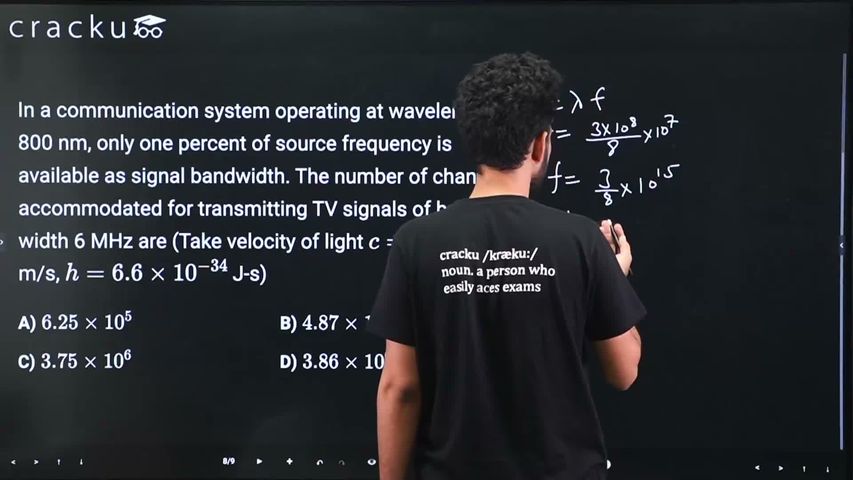
In a communication system operating at wavelength 800 nm, only one percent of source frequency is available as signal bandwidth. The number of channels accommodated for transmitting TV signals of band width 6 MHz are (Take velocity of light $$c = 3 \times 10^8$$ m/s, $$h = 6.6 \times 10^{-34}$$ J-s)
We have been given the operating wavelength of the optical communication system as $$\lambda = 800 \text{ nm}$$. First of all, we convert this into metres because the speed of light $$c$$ is expressed in metres per second.
$$800 \text{ nm} = 800 \times 10^{-9} \text{ m} = 8.0 \times 10^{-7} \text{ m}$$
Now we recall the basic relation that connects the speed of light, wavelength and frequency:
$$c = \lambda \, f$$
Solving for the frequency $$f$$, we write
$$f = \dfrac{c}{\lambda}$$
Substituting the numerical values $$c = 3 \times 10^{8}\ \text{m/s}$$ and $$\lambda = 8.0 \times 10^{-7}\ \text{m}$$, we get
$$f = \dfrac{3 \times 10^{8}}{8.0 \times 10^{-7}}$$
Dividing the powers of ten and the coefficients separately,
$$f = \left(\dfrac{3}{8}\right) \times 10^{8 - (-7)} = \dfrac{3}{8} \times 10^{15}$$
Simplifying the fraction $$\dfrac{3}{8} = 0.375$$, we obtain
$$f = 0.375 \times 10^{15} \text{ Hz} = 3.75 \times 10^{14} \text{ Hz}$$
The question tells us that only one percent of this source frequency is made available as the signal bandwidth. In symbols,
$$\text{Available bandwidth} = 0.01 \times f$$
Hence, substituting the value of $$f$$ just calculated,
$$\text{Available bandwidth} = 0.01 \times 3.75 \times 10^{14} \text{ Hz}$$
Multiplying,
$$\text{Available bandwidth} = 3.75 \times 10^{12} \text{ Hz}$$
Each television (TV) channel is specified to occupy a bandwidth of $$6 \text{ MHz}$$. Converting megahertz into hertz, we write
$$6 \text{ MHz} = 6 \times 10^{6} \text{ Hz}$$
To find the number of such channels that can fit into the total available bandwidth, we divide the total available bandwidth by the bandwidth required per TV channel:
$$\text{Number of channels} = \dfrac{3.75 \times 10^{12}}{6 \times 10^{6}}$$
Separating the numerical coefficients and the powers of ten, we get
$$\text{Number of channels} = \dfrac{3.75}{6} \times 10^{12 - 6}$$
Evaluating the fraction $$\dfrac{3.75}{6} = 0.625$$ and the exponent $$10^{12-6} = 10^{6}$$, we arrive at
$$\text{Number of channels} = 0.625 \times 10^{6}$$
Finally we shift the decimal to express the answer in standard scientific notation:
$$\text{Number of channels} = 6.25 \times 10^{5}$$
Hence, the correct answer is Option A.
Was this solution helpful?
Click on the Email ☝️ to Watch the Video Solution
Create a FREE account and get:
_1.webp)

Educational materials for JEE preparation

Ask our AI anything

AI can make mistakes. Please verify important information.
AI can make mistakes. Please verify important information.


