Group
Group
 Group
Group


 Preferred Source

 Google Discover

JEE Circular Motion PYQ
Solving JEE Circular Motion PYQ problems helps students understand how forces produce motion along a circular path. Questions from this chapter commonly involve centripetal acceleration, centripetal force, banking of roads, vertical circular motion, conical pendulums, rotating platforms and circular tracks.
Circular motion can be uniform or non-uniform. In uniform circular motion, the speed remains constant, but the velocity changes continuously because its direction changes. Therefore, the object still has acceleration directed towards the center of the circular path.
In non-uniform circular motion, both the magnitude and direction of velocity change. Students must then analyze radial and tangential components separately. Each JEE Circular Motion questions should begin with a clear diagram showing the center, radius, velocity and forces acting on the object.
Circular motion is closely connected with Newton’s laws, friction, work and energy, gravitation and rotational mechanics. A strong understanding of these connections helps students solve multi-concept JEE problems more efficiently.
JEE Circular Motion Important PYQ PDF
The JEE Circular Motion Important PYQ PDF provided below contains selected previous-year questions for structured chapter-wise practice. It covers horizontal circular motion, vertical circles, banking of roads, conical pendulums, rotating platforms, circular tracks and motion over curved surfaces.
Attempt every question independently before checking the answer or explanation. Begin by drawing a free-body diagram and marking the direction towards the centre. Resolve all forces into radial and tangential components before applying the required physical principle.
While reviewing your attempt, identify whether the error occurred while selecting the radial direction, resolving forces, applying an incorrect contact condition or confusing speed with velocity. Add these questions to your JEE Study Material and reattempt difficult problems after revising the relevant concept.
Important Topics Covered in Circular Motion PYQs
Circular Motion PYQs include both direct conceptual questions and problems combining multiple mechanics chapters. Important topics include:
- Angular displacement and angular velocity
- Linear and angular quantities
- Uniform circular motion
- Non-uniform circular motion
- Centripetal acceleration
- Centripetal force
- Radial and tangential acceleration
- Circular motion on a horizontal surface
- Friction as a centripetal force
- Banking of roads
- Motion on a curved road
- Conical pendulum
- Rotating platforms
- Blocks connected by strings
- Vertical circular motion
- Motion of a particle tied to a string
- Motion inside a circular track
- Motion over a smooth sphere
- Normal reaction at different points
- Minimum speed conditions
- Loss of contact
- Work-energy applications
- Circular motion under gravity
Centripetal force is not a separate force. It is the name given to the net inward force that keeps an object moving along a circular path. Depending on the situation, tension, friction, gravity, normal reaction, or a combination of these forces may provide the required inward force.
In vertical circular motion, speed generally changes because gravity does work on the object. The speed is usually higher at the bottom and lower at the top. Students must analyse the forces separately at the top, bottom and side points.
Banking questions may involve frictionless roads or roads where friction also acts. The direction of friction depends on whether the vehicle tends to move up or down the banked surface. It should not be assigned automatically.
A concise JEE Mains Formula Sheet can help students revise standard results for acceleration, force, banking and vertical circles. However, formulas should be applied only after identifying the inward direction and drawing the correct free-body diagram.
How to Solve Circular Motion PYQs Effectively
Begin by marking the centre of the circular path. Draw a radial line from the object towards the centre and resolve every force along radial and tangential directions.
Follow these steps while solving circular-motion problems:
- Draw the circular path and locate its centre.
- Mark the instantaneous direction of velocity.
- Identify the inward radial direction.
- Draw all real forces acting on the object.
- Resolve forces into radial and tangential components.
- Determine which forces provide the inward net force.
- Use energy conservation when speed changes with height.
- Check tension or normal-reaction conditions at critical points.
- Identify the condition for maintaining contact.
- Verify whether the final speed or force is physically possible.
Students often treat centripetal force as an additional force and include it separately in the free-body diagram. This results in double-counting. Only real forces such as tension, gravity, friction and normal reaction should appear in the diagram.
Another common mistake is assuming that the speed remains constant in every circular-motion problem. In a vertical circle, gravity usually changes the speed unless an external mechanism maintains it.
For contact problems, the normal reaction cannot become negative. When the calculated normal reaction reaches zero, the object is at the point of losing contact. Similarly, a string can pull an object but cannot push it, so tension cannot be negative.
After completing chapter-wise practice, attempt a JEE Mains Mock Test to evaluate speed, accuracy and question selection. Maintain an error log for incorrect force diagrams, wrong radial directions, missed energy changes and invalid contact conditions.
List of JEE Circular Motion PYQs
The questions listed below can be attempted as a timed JEE Chapter-wise PYQ test. They cover horizontal circles, vertical circles, banked roads, conical pendulums, rotating systems and contact conditions.
Solve the questions without checking the answers. After completing the test, review every incorrect, guessed and skipped problem. Revise the required concept using your JEE Study Material and attempt the question
Question 1
If the angular velocity of earth's spin is increased such that the bodies at the equator start floating, the duration of the day would be approximately :
(Take : $$g = 10$$ ms$$^{-2}$$, the radius of earth, $$R = 6400 \times 10^3$$ m, Take $$\pi = 3.14$$)
correct answer:- 4
Question 2
Given below are two statements : one is labelled as Assertion (A) and the other is labelled as Reason (R).
Assertion (A) : The angular speed of the moon in its orbit about the earth is more than the angular speed of the earth in its orbit about the sun.
Reason (R) : The moon takes less time to move around the earth than the time taken by the earth to move around the sun.
In the light of the above statements, choose the most appropriate answer from the options given below :
correct answer:- 2
Question 3
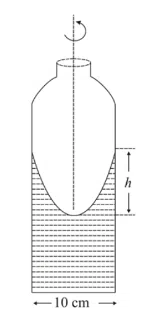
A cylindrical vessel containing a liquid is rotated about its axis so that the liquid rises at its sides as shown in the figure. The radius of vessel is 5 cm and the angular speed of rotation is $$\omega$$ rad s$$^{-1}$$. The difference in the height, h (in cm) of liquid at the Centre of vessel and at the sides of the vessel will be:
correct answer:- 3
Question 4
correct answer:- 2
Question 5
Two planets $$A$$ and $$B$$ of equal mass are having their period of revolutions $$T_A$$ and $$T_B$$ such that $$T_A = 2T_B$$. These planets are revolving in the circular orbits of radii $$r_A$$ and $$r_B$$ respectively. Which out of the following would be the correct relationship of their orbits?
correct answer:- 3

Question 6
A small block of mass 100 g is tied to a spring of spring constant 7.5 N m$$^{-1}$$ and length 20 cm. The other end of spring is fixed at a particular point A. If the block moves in a circular path on a smooth horizontal surface with constant angular velocity 5 rad s$$^{-1}$$ about point A, then tension in the spring is
correct answer:- 1
Question 7
Two small balls with masses m and 2m are attached to both ends of a rigid rod of length d and negligible mass. If angular momentum of this system is L about an axis (A) passing through its centre of mass and perpendicular to the rod then angular velocity of the system about A is :
correct answer:- 2
Question 8
A curved in a level road has a radius $$75$$ m. The maximum speed of a car turning this curved road can be $$30$$ m s$$^{-1}$$ without skidding. If radius of curved road is changed to $$48$$ m and the coefficient of friction between the tyres and the road remains same, then maximum allowed speed would be ______ m s$$^{-1}$$.
correct answer:- 24
Question 9
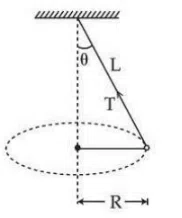
A string of length $$L$$ is fixed at one end and carries a mass of $$M$$ at the other end. The mass makes $$\left(\frac{3}{\pi}\right)$$ rotations per second about the vertical axis passing through end of the string as shown. The tension in the string is $$\underline{\hspace{2cm}} ML.$$
correct answer:- 36
Question 10
A man carrying a monkey on his shoulder does cycling smoothly on a circular track of radius $$9$$ m and completes 120 revolutions in 3 minutes. The magnitude of centripetal acceleration of monkey is (in $$m/s^2$$) :
correct answer:- 4
.webp)
Question 11
A car moving with a speed of 54 km/h takes a turn of radius 20 m. A simple pendulum is suspended from the ceiling of the car. Determine the angle made by the string of the pendulum with the vertical during the turning. (Take $$g = 10$$ m/s$$^2$$)
correct answer:- 3
Question 12
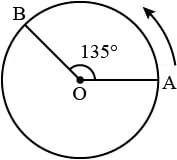
A person moved from $$A$$ to $$B$$ on a circular path as shown in figure. If the distance travelled by him is $$60 \text{ m}$$, then the magnitude of displacement would be: (Given $$\cos 135° = -0.7$$)
correct answer:- 2
Question 13
One end of a massless spring of spring constant $$k$$ and natural length $$l_0$$ is fixed while the other end is connected to a small object of mass $$m$$ lying on a frictionless table. The spring remains horizontal on the table. If the object is made to rotate at an angular velocity $$\omega$$ about an axis passing through fixed end, then the elongation of the spring will be
correct answer:- 3
Question 14
A string of area of cross-section 4 mm$$^2$$ and length 0.5 is connected with a rigid body of mass 2 kg. The body is rotated in a vertical circular path of radius 0.5 m. The body acquires a speed of 5 m s$$^{-1}$$ at the bottom of the circular path. Strain produced in the string when the body is at the bottom of the circle is _____ $$\times 10^{-5}$$. (Use Young's modulus $$10^{11}$$ N m$$^{-2}$$ and $$g = 10 \ m s^{-2}$$)
correct answer:- 30
Question 15
A metal wire of length 0.5 m and cross-sectional area $$10^{-4}$$ m$$^2$$ has breaking stress $$5 \times 10^8$$ N m$$^{-2}$$. A block of 10 kg is attached at one end of the string and is rotating in a horizontal circle. The maximum linear velocity of block will be _____ m s$$^{-1}$$
correct answer:- 50
.webp)
Question 16
Consider two satellites $$S_1$$ and $$S_2$$ with periods of revolution 1hr and 8hr respectively revolving around a planet in circular orbits. The ratio of angular velocity of satellite $$S_1$$ to the angular velocity of satellite $$S_2$$ is:
correct answer:- 1
Question 17
A block of 200 g mass moves with a uniform speed in a horizontal circular groove, with vertical side walls of radius 20 cm. If the block takes 40 s to complete one round, the normal force by the side walls of the groove is:
correct answer:- 4
Question 18
A satellite is launched into a circular orbit of radius $$R$$ around earth, while a second satellite is launched into a circular orbit of radius 1.02 $$R$$. The percentage difference in the time periods of the two satellites is:
correct answer:- 4
Question 19
A particle of mass $$m$$ is suspended from a ceiling through a string of length $$L$$. The particle moves in a horizontal circle of radius $$r$$ such that $$r = \frac{L}{\sqrt{2}}$$. The speed of particle will be:
correct answer:- 1
Question 20
The minimum and maximum distances of a planet revolving around the Sun are $$x_1$$ and $$x_2$$. If the minimum speed of the planet on its trajectory is $$v_0$$, then its maximum speed will be:
correct answer:- 4
.webp)
Question 21
A box weighs 196 N on a spring balance at the north pole. Its weight recorded on the same balance if it is shifted to the equator is close to (Take g = 10 ms$$^{-2}$$ at the north pole and the radius of the earth = 6400 km):
correct answer:- 4
Question 22
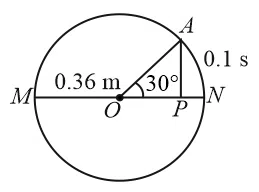
A clock has a continuously moving second's hand of $$0.1\,\text{m}$$ length. The average acceleration of the tip of the hand (in units of $$\text{ms}^{-2}$$) is of the order of:
correct answer:- 1
Question 23
The mass density of a spherical galaxy varies as $$\frac{K}{r}$$ over a large distance $$r$$ from its center. In that region, a small star is in a circular orbit of radius R. Then the period of revolution, T depends on R as:
correct answer:- 1
Question 24
A satellite is in an elliptical orbit around a planet $$P$$. It is observed that the velocity of the satellite when it is farthest from the planet is 6 times less than that when it is closest to the planet. The ratio of distances between the satellite and the planet at closest and farthest points is:
correct answer:- 1
Question 25
A body is moving in a low circular orbit about a planet of mass M and radius R. The radius of the orbit can be taken to be R itself. Then the ratio of the speed of this body in the orbit to the escape velocity from the planet is:
correct answer:- 1
Question 26
A satellite is revolving in a circular orbit at a height h from the earth surface, such that $$h \ll R$$ where R is the radius of the earth. Assuming that the effect of earth's atmosphere can be neglected the minimum increase in the speed required so that the satellite could escape from the gravitational field of earth is
correct answer:- 4
Question 27
If the angular momentum of a planet of mass $$m$$, moving around the Sun in a circular orbit is $$L$$, about the center of the Sun, its areal velocity is:
correct answer:- 3
Question 28
A body A of mass $$m$$ is moving in a circular orbit of radius $$R$$ about a planet. Another body B of mass $$\frac{m}{2}$$ collides with A with a velocity which is half $$\left(\frac{v}{2}\right)$$ the instantaneous velocity $$\vec{v}$$ of A. The collision is completely inelastic. Then, the combined body:
correct answer:- 4
Question 29
A car is moving on a horizontal curved road with radius $$50$$ m. The approximate maximum speed of car will be, if friction between tyres and road is $$0.34$$. [Take $$g = 10$$ m s$$^{-2}$$]
correct answer:- 3
Question 30
An object moves at a constant speed along a circular path in a horizontal plane with centre at the origin. When the object is at $$x = +2$$ m, its velocity is $$-4\hat{j}$$ m s$$^{-1}$$. The object's velocity ($$v$$) and acceleration ($$a$$) at $$x = -2$$ m will be
correct answer:- 2
Question 31
A coin placed on a rotating table just slips when it is placed at a distance of 1 cm from the centre. If the angular velocity of the table is halved, it will just slip when placed at a distance of _______ from the centre:
correct answer:- 2
Question 32
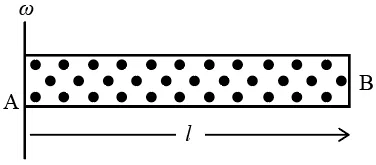
A cylindrical tube $$AB$$ of length $$l$$, closed at both ends contains an ideal gas of 1 mol having molecular weight $$M$$. The tube is rotated in a horizontal plane with constant angular velocity $$\omega$$ about an axis pe1pendicular to $$AB$$ and passing through the edge at end $$A$$ , as shown in the figure. If $$P_{A}$$ and $$P_{B}$$ are the pressures at $$A$$ and $$B$$ respectively, then
(Consider the temperature is same at all points in the tube)
correct answer:- 2
Question 33
A circular disc has radius $$R_{1}$$ and thickness $$T_{1}$$. Another circular disc made of the same material has radius $$R_{2} and thickness $$T_{2}. If the moment of inertia of both discs are same and $$ \frac{R_{1}}{R_{2}}=2 \text { then }\frac{T_{1}}{T_{2}}=\frac{1}{\alpha} $$. The value of $$\alpha$$ is__________.
correct answer:- 16
Question 34
If a satellite orbiting the Earth is 9 times closer to the Earth than the Moon, what is the time period of rotation of the satellite? Given rotational time period of Moon =27 days and gravitational attraction between the satellite and the moon is neglected.
correct answer:- 2
Question 35
A satellite is launched into a circular orbit of radius $$R$$ around the earth. A second satellite is launched into an orbit of radius $$1.03R.$$ The time period of revolution of the second satellite is larger than the first one approximately by:
correct answer:- 3
Question 36
Four particles, each of mass $$1$$ kg are placed at four corners of a square of side $$2$$ m. The moment of inertia of the system about an axis perpendicular to its plane and passing through one of its vertex is ______ kg m$$^2$$.
correct answer:- 16
Question 37
A ball suspended by a thread swings in a vertical plane so that its magnitude of acceleration in the extreme position and lowest position are equal. The angle ($$\theta$$) of thread deflection in the extreme position will be :
correct answer:- 2
Question 38
If the radius of curvature of the path of two particles of same mass are in the ratio $$3 : 4$$, then in order to have constant centripetal force, their velocities will be in the ratio of:
correct answer:- 1
Question 39
A car of $$800 \text{ kg}$$ is taking turn on a banked road of radius $$300 \text{ m}$$ and angle of banking $$30°$$. If coefficient of static friction is $$0.2$$ then the maximum speed with which car can negotiate the turn safely: $$(g = 10 \text{ m/s}^2, \sqrt{3} = 1.73)$$
correct answer:- 2
Question 40
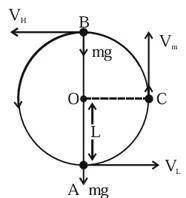
A bob of mass $$m$$ is suspended by a light string of length $$L$$. It is imparted a minimum horizontal velocity at the lowest point $$A$$ such that it just completes half circle reaching the top most position $$B$$. The ratio of kinetic energies $$\frac{(K.E.)_A}{(K.E.)_B}$$ is:
correct answer:- 2