JEE WhatsApp Group



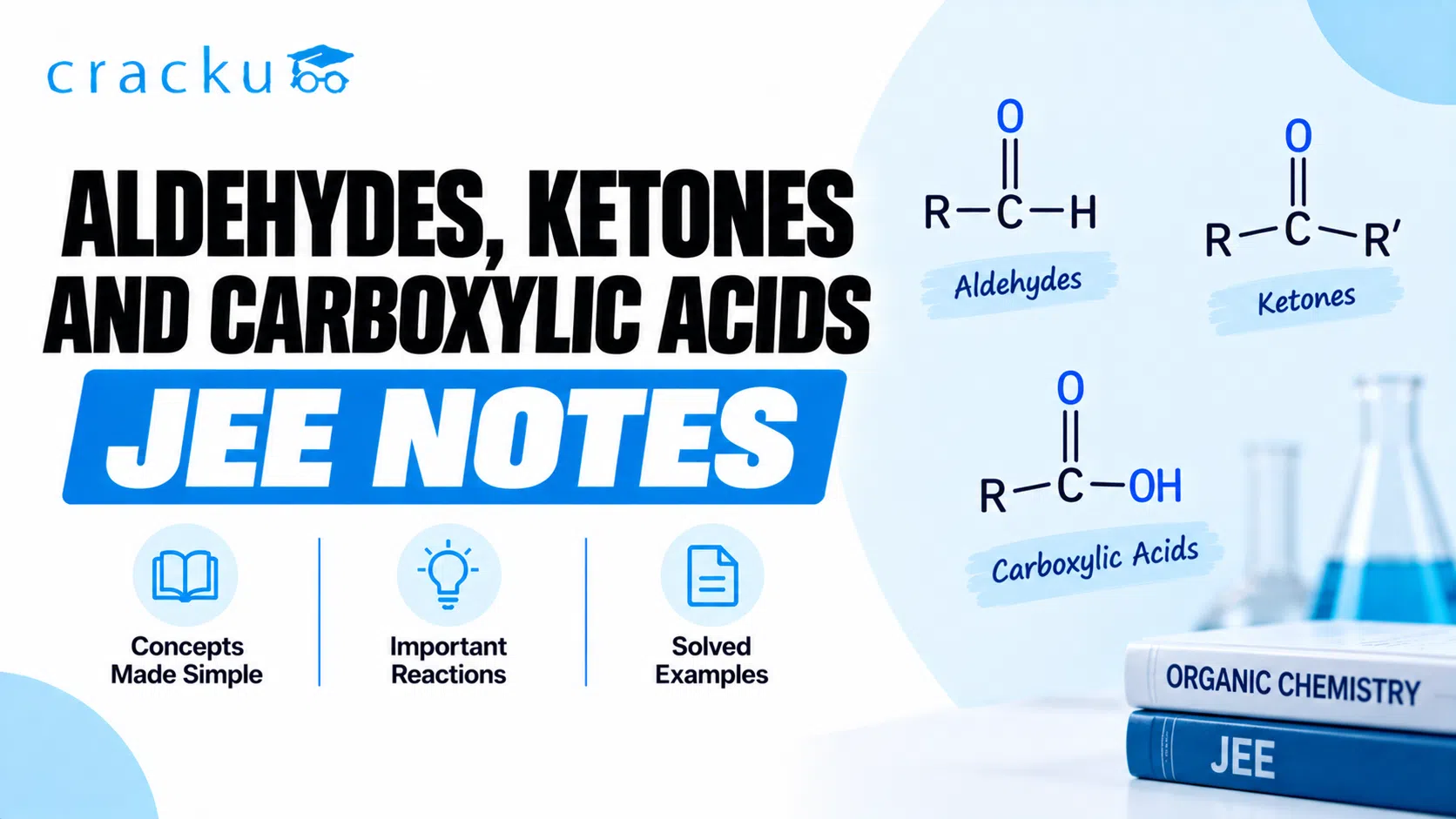
Aldehydes, ketones and carboxylic acids form one of the highest-weightage portions of organic chemistry in JEE. These JEE Chemistry Notes walk you through nomenclature, preparation methods, reaction mechanisms, acidity trends, important name reactions and problem-solving tips that regularly feature in the paper.
Aldehydes, Ketones and Carboxylic Acids JEE Notes
The chapter can be split into three logical parts:
- Structure and physical properties: hybridisation, polarity, boiling points, spectral features.
- Synthesis routes: oxidation of alcohols, ozonolysis, nitrile/acid halide hydration, etc.
- Chemical behaviour: nucleophilic addition to the carbonyl, acid–base equilibria, substitution on the α-carbon, and the unique reactions of carboxylic acids and their derivatives.
In recent JEE Main papers 2–3 questions (8–12 marks) have come from these topics, while JEE Advanced often blends them with aldehyde–ketone mechanisms or acidic strength comparisons in multi-concept problems.
Nomenclature, Structure and Physical Properties
IUPAC and common naming tips
- Aldehydes: replace the terminal “e” of the parent alkane with “al”; the carbonyl carbon is always C-1. Example: CH3CH2CHO is propanal.
- Ketones: longest chain containing $$\mathrm{C{=}O}$$ gets the suffix “one” with position number. Example: CH3COCH2CH3 is butan-2-one.
- Carboxylic acids: suffix “oic acid”. For dicarboxylic species use “dioic acid”. Example: HOOC-CH2-COOH is propane-1,3-dioic acid (malonic acid).
- When carbonyl is a substituent: “oxo-” for aldehyde/ketone, “carboxy-” for –COOH on a ring.
Electronic structure
The carbonyl carbon is $$sp^{2}$$ hybridised, planar and strongly electrophilic because of $$\pi$$ back-bonding toward oxygen. Resonance gives a partial positive charge on carbon and partial negative on oxygen.
Trends you must know for data-based questions
| Property | Aldehyde | Ketone | Carboxylic Acid |
|---|---|---|---|
| Boiling point order (similar Mr) | Intermediate | Intermediate | Highest (H-bonding) |
| Solubility in water | Up to C-4 miscible | Up to C-3 miscible | Up to C-5 miscible; forms dimers in liquid |
| IR peak (cm-1) | ~1730 | ~1715 | $$\sim$$1710 (C=O) and broad 2500–3300 (O–H) |
Preparation and Important Reactions
Laboratory synthesis pathways
- Oxidation of 1° alcohol $$\rightarrow$$ aldehyde (PCC) or acidified $$\mathrm{K_{2}Cr_{2}O_{7}}$$ (to acid).
- Oxidation of 2° alcohol $$\rightarrow$$ ketone (any Jones or KMnO4 reagent).
- Ozonolysis of alkenes $$\rightarrow$$ mixture of aldehydes/ketones.
- Nitrile hydrolysis $$\rightarrow$$ carboxylic acid (acidic or basic media).
- Grignard on $$\mathrm{CO_{2}}$$ followed by acid work-up $$\rightarrow$$ carboxylic acid.
- Rosenmund reduction (acid chloride + $$\mathrm{H_{2}/Pd/BaSO_{4}}$$) $$\rightarrow$$ aldehyde.
- Stephen reduction (RCN + SnCl2/HCl) $$\rightarrow$$ aldehyde.
Name reactions that appear repeatedly
- Cannizzaro: Disproportionation of non-enolisable aldehydes in strong base.
- Aldol condensation: Enolisable aldehyde/ketone gives $$\beta$$-hydroxy carbonyl, yields $$\alpha,\beta$$-unsaturated enone on heating.
- Perkin: Aromatic aldehyde + acetic anhydride + base $$\rightarrow$$ cinnamic acid derivative.
- Hell–Volhard–Zelinsky (HVZ): α-Halogenation of carboxylic acids via PBr3/Br2.
- Schmidt & Curtius: Conversion of acids/acid chlorides to amines with one carbon fewer via azide intermediates.
Nucleophilic addition spectrum
Order of reactivity: $$\text{HCHO} \gt \text{RCHO} \gt \text{R}_{2}\text{CO}$$ due to bulk and +I effect. Key additions:
- Cyanide: $$\text{RCHO} + \text{HCN} \rightarrow \text{RCH(OH)CN}$$.
- Hydride reagents: NaBH4 (mild), LiAlH4 (strong) reduce $$\mathrm{C{=}O}$$ to alcohol.
- Grignard: $$\text{R}^{\prime}\text{MgX}$$ adds to carbonyl → alcohol after H3O+.
- Derivatisations: 2,4-DNPH, semicarbazone, oxime – useful for purification and detection.
Acidic strength and substitution in carboxylic acids
The –COOH proton’s $$pK_{a}$$ is affected by substituents through –I and –R effects. Electron withdrawing (–NO2, –Cl) increases acidity, donating (–CH3, –OCH3) decreases.
At the α-position, halogen increases acidity dramatically; hence chloroacetic acid (pKa ≈ 2.8) is much stronger than acetic acid (4.76).
Important Formulas and Results at a Glance
| Concept | Key Expression / Result |
|---|---|
| Formaldehyde polymerisation | $$n \, \text{HCHO} \rightarrow ( \text{CH}_{2}\text{O} )_{n}$$ paraformaldehyde |
| Fehling’s test for aldehyde | Red ppt of $$\mathrm{Cu_{2}O}$$ forms when $$\text{RCHO}$$ is warmed with Fehling A+B. |
| Tollens’ reagent | $$\text{RCHO} + 2[Ag(NH_{3})_{2}]^{+} + 3OH^{-} \rightarrow RCOO^{-} + 2Ag + 4NH_{3} + 2H_{2}O$$; silver mirror. |
| Keto–enol tautomerism | % enol $$\propto$$ extent of conjugation + H-bonding; acetylacetone has ≈72 % enol at room T. |
| Acidic α-H of 1,3-dicarbonyl | $$pK_{a}$$ ≈ 9 – 11; forms resonance-stabilised enolate. |
| Carboxylate decarboxylation | $$\text{RCOONa} + \text{NaOH}$$ (solid) $$\xrightarrow{CaO,\;\Delta} \text{RH} + \text{Na}_{2}\text{CO}_{3}$$ (Soda-lime) |
JEE Important Points, Common Mistakes and Quick Revision
Important Points
- Tollens and Fehling’s give positive test only for aldehydes, not for ketones except $$\alpha$$-hydroxy ketones (because of enediol formation).
- Iodoform test (yellow $$\text{CHI}_{3}$$) is positive for $$\text{CH}_{3}$$–CO– group and $$\text{CH}_{3}\text{CH}(OH)$$– as in ethanol.
- During aldol, at least one reactant must have α-H; otherwise Cannizzaro takes place.
- Acidic hydrolysis of nitrile gives acid, whereas basic hydrolysis first gives carboxylate.
- Reactivity order to nucleophiles: $$\text{Acid\;chloride} \gt \text{Acid\;anhydride} \gt \text{Aldehyde} \gt \text{Ketone} \gt \text{Ester} \gt \text{Amide}$$.
- Enamine formation (ketone + secondary amine) is reversible and used in Stork alkylation.
Common Mistakes
- Forgetting that NaBH4 cannot reduce carboxylic acids or esters- only LiAlH4 can.
- Writing direct nucleophilic substitution on the carbonyl carbon of carboxylic acid; remember –OH is a poor leaving group without acid chloride formation.
- Misplacing product carbon count in Rosenmund and Stephen reductions (both retain carbon count).
- Assuming all ketones are resistant to oxidation. $$\alpha$$-Hydroxy ketones and methyl ketones oxidise under specific reagents (iodoform, Baeyer–Villiger).
- Missing stereochemistry in nucleophilic additions to aldehydes - racemic mixture forms when a chiral centre is generated.
Quick Revision
- Identify functional group → decide mechanism type.
- Check for α-hydrogen → Aldol vs Cannizzaro.
- See if reagent is nucleophile (CN-, RMgX) or electrophile (Br2, PCl5).
- Count carbon atoms before & after reaction to avoid losing/adding carbons inadvertently.
- Look for specific test reagents to finalise answer quickly.
For timed practice, solve mixed organic JEE Questions sets and observe how often these checks remove trap options.
Exam pattern pointers
- In JEE Main you often face 1 integer-type question on reaction completion and 1 MCQ on acidity/order.
- JEE Advanced loves multi-step interconversions mixing carbonyl chemistry with amines or alkanes; clarity on reagent role saves time.
- Past papers show that roughly one year in three includes an aldol/cross-aldol mechanism; reviewing solved JEE Mains Previous Papers helps catch these cycles.
Aldehydes, Ketones and Carboxylic Acids JEE Notes: Conclusion
Aldehydes, ketones and carboxylic acids are important topics in JEE organic chemistry. Understanding preparation methods, reaction mechanisms, acidity trends and diagnostic tests helps you approach both direct and multi-step questions confidently. Use these JEE Chemistry Notes to revise key concepts, memorise essential reagents and avoid common mistakes.
Strengthen your preparation by practising JEE Mains Mock Test. Review incorrect answers and revisit challenging reactions to improve your accuracy and speed.
.webp)