
 Group
Group
 Group
Group
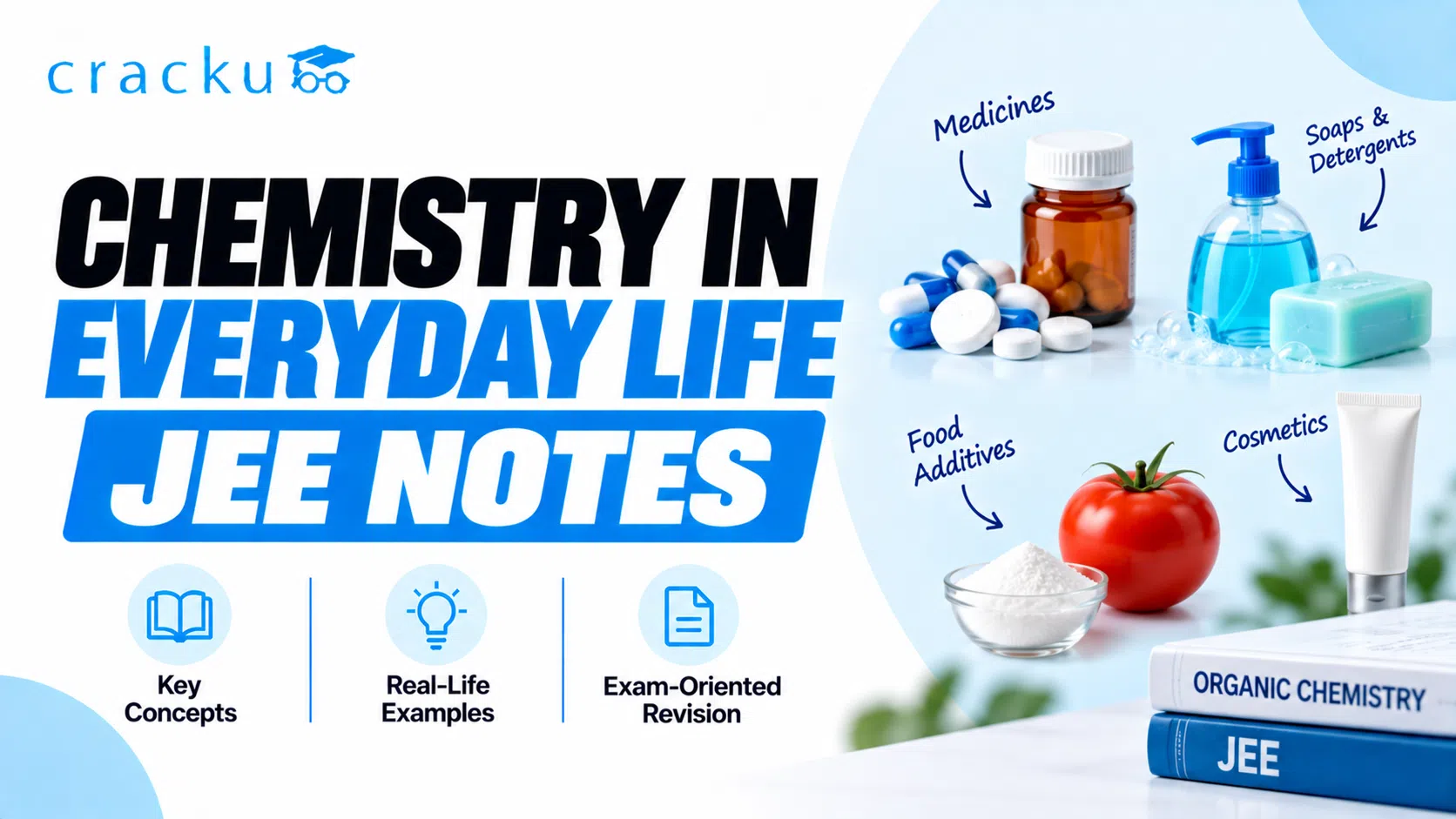
The chapter Chemistry in Everyday Life describes how molecules around you-medicines, soaps, detergents, food additives-work at the molecular level. These notes give you crisp definitions, mechanisms and exam-oriented facts that you can revise within an hour.
This overview highlights the scope of the chapter in JEE, typical question patterns and high-yield facts. It forms part of our JEE Chemistry Notes series and covers drug action, classification, food additives, cleansing agents and a rapid summary of key data you must memorise.
Chemistry in Everyday Life JEE Notes
In JEE Main the chapter usually carries one MCQ (4 marks) or one Numerical Value question. Problems test your memory of definitions (e.g., difference between antiseptic and disinfectant), classification by structure (sulpha drugs, cationic detergents) and understanding of how a drug interacts with receptors. Questions rarely involve calculations but may ask you to identify the correct pair or arrange chemicals in increasing order of activity.
Direct statement questions are frequent in the integer section of JEE Advanced as well. Because the chapter is light on equations, an accurate recall of terms is essential. Quickly revisit these notes before attempting a JEE Mains Mock Test or past paper to improve retention.
Drugs and Medicines
How drugs act
A drug is any chemical that alters physiological or biochemical processes. Two principal mechanisms appear in questions:
- Enzyme inhibition: The drug competes with the natural substrate (competitive) or binds elsewhere (non-competitive), deactivating the enzyme.
- Receptor interaction: Drugs fit into receptor sites on cell membranes, either activating them (agonists) or blocking them (antagonists).
Classification by therapeutic action
| Category | Example | Key Point for JEE |
|---|---|---|
| Analgesics (pain killers) | Aspirin, Morphine | Aspirin is antipyretic as well |
| Antipyretics (fever) | Paracetamol | Acts on brain’s heat-regulating centre |
| Antihistamines | Diphenhydramine | Counter histamine-triggered allergy |
| Tranquillisers | Diazepam | Relief from anxiety, insomnia |
| Antimicrobials | Chloramphenicol | Broad-spectrum antibiotic |
| Antiseptics | 0.2 % phenol, H2O2 | Safe on living tissues |
| Disinfectants | 1 % phenol, Cl2 | Used on inert objects |
| Antacids | Aluminium hydroxide, Omeprazole | Neutralise excess gastric acid or block H+ pumps |
Notes on specific drug classes
- Sulpha drugs: First synthetic antibiotics; sulphanilamide core. Compete with $$p$$-aminobenzoic acid in folic acid synthesis of bacteria.
- Barbiturates: Act as hypnotics; prolonged use causes addiction.
- Anticancer (chemotherapy): Cisplatin, Taxol. Act by inhibiting DNA replication in rapidly dividing cells.
Direct statement questions such as “Which of the following is not an antihistamine?” appear often in JEE Questions. Memorise at least two examples for every therapeutic class.
Food Additives, Cleansing Agents and Other Everyday Chemicals
Food additives
| Type | Common Compounds | JEE Trigger Word |
|---|---|---|
| Preservatives | Sodium benzoate, NaHSO3 | Prevent microbial growth in jams, juices |
| Artificial sweeteners | Saccharin, Aspartame, Sucralose | Zero calories; question on stability at cooking temperature |
| Antioxidants | BHA (butylated hydroxy anisole), BHT | Delay rancidity in fats |
| Flavour enhancers | Monosodium glutamate | Umami taste, “Ajinomoto” |
Remember: Saccharin is heat-stable; Aspartame decomposes on heating, hence used only in cold foods.
Cleansing agents
Soaps
Soaps are sodium or potassium salts of long-chain fatty acids, e.g., sodium stearate. They form micelles in water above critical micelle concentration, encapsulating greasy dirt.
Limitations: Ineffective in hard water due to formation of scum (insoluble calcium/magnesium salts).
Synthetic detergents
Designed to overcome hard-water drawback. Three varieties are important for JEE:
Anionic detergents: $$\mathrm{R–O–SO_3^- Na^+}$$, e.g., sodium lauryl sulphate. Excellent foaming.
Cationic detergents: Quaternary ammonium salts $$\mathrm{[CH_3(CH_2)_{17}N^+(CH_3)_3]Br^-}$$. Also bactericidal; used in hair conditioners.
Non-ionic detergents: Polyethylene glycol esters. No ionic charge, thus mild.
Biodegradability: Branched-chain alkyl benzene sulphonates resist degradation; linear ones are eco-friendly. JEE often asks which is biodegradable.
Dyes, polymers and miscellaneous
- Dyes: Methyl orange (acid–base indicator), Malachite green (fabric dye).
- Polymer additives: Plasticisers (phthalates) improve flexibility; stabilisers delay photo-degradation.
- Explosives: TNT (trinitrotoluene) occasionally appears in match-the-pair questions.
Important Formulas and Results at a Glance
Although the chapter is light on mathematical formulae, a few quantitative relations and definitions do recur.
| Concept / Expression | What to Remember |
|---|---|
| Therapeutic Index $$= \dfrac{\text{Lethal Dose (LD}_{50})}{\text{Effective Dose (ED}_{50})}$$ | Higher value ⇒ safer drug |
| pH range of stomach | 1.5 – 3.5; antacids raise it toward 4+ |
| Micelle formation temperature | Called Kraft temperature; soaps form micelles only above this value |
| Concentration of phenol acting as antiseptic | ≈ 0.2 % |
| Concentration of phenol acting as disinfectant | ≈ 1 % |
Pupils often mislabel antiseptic and disinfectant concentrations, so the table makes the distinction precise.
JEE Important Points, Common Mistakes and Quick Revision
Important Points
- Aspirin: Also known as acetylsalicylic acid, aspirin reduces pain, fever and inflammation by inhibiting prostaglandin synthesis.
- Sulphonamides: These were among the earliest effective synthetic antibacterial drugs.
- Artificial sweeteners: Sucralose is approximately 600 times sweeter than sucrose and is commonly classified as a heat-stable sweetener.
- Soaps and hard water: Calcium and magnesium ions react with soap to form insoluble scum, reducing its cleaning efficiency.
- Cationic detergents: Certain quaternary ammonium detergents also act as germicides by disrupting microbial cell membranes.
Common Mistakes to Avoid
- Confusing antiseptics with disinfectants: Antiseptics are used on living tissues, while disinfectants are generally applied to non-living surfaces. The concentration can influence how a substance is used.
- Assuming all sweeteners are suitable for cooking: Aspartame breaks down on heating and is unsuitable for high-temperature cooking.
- Mixing up detergent types: Anionic detergents have negatively charged head groups, commonly sulphate or sulphonate groups. Cationic detergents have positively charged head groups.
- Classifying paracetamol as an antibiotic: Paracetamol is an analgesic and antipyretic, meaning it relieves pain and reduces fever.
- Overgeneralising biodegradability: Detergents with linear hydrocarbon chains are generally more readily biodegradable than those with highly branched chains. Biodegradability alone does not make a detergent environmentally harmless.
Quick Revision Checklist
Before attempting previous-year questions, check whether you can:
- Name two analgesics, two antacids and one antihistamine.
- Identify the structures of a soap and an anionic detergent.
- Explain why calcium and magnesium ions reduce soap efficiency.
- Compare the heat stability of saccharin, aspartame and sucralose.
- Define the therapeutic index as the ratio of a drug’s median toxic dose to its median effective dose.
Now solve a set of past questions from the chapter (available in JEE Mains Previous Papers) to cement the facts.
Chemistry in Everyday Life JEE Notes: Conclusion
Chemistry in Everyday Life connects chemical concepts with medicines, food additives and cleansing agents. Focus on the classification and examples of drugs, the roles of preservatives and sweeteners, and the differences between soaps and detergents. Understanding these connections makes important facts easier to remember.
Use these Chemistry in Everyday Life JEE Notes to revise definitions, compare similar terms and review common mistakes. Reinforce your learning through practice questions and short revision sessions to improve recall and accuracy.
.webp)