JEE WhatsApp Group



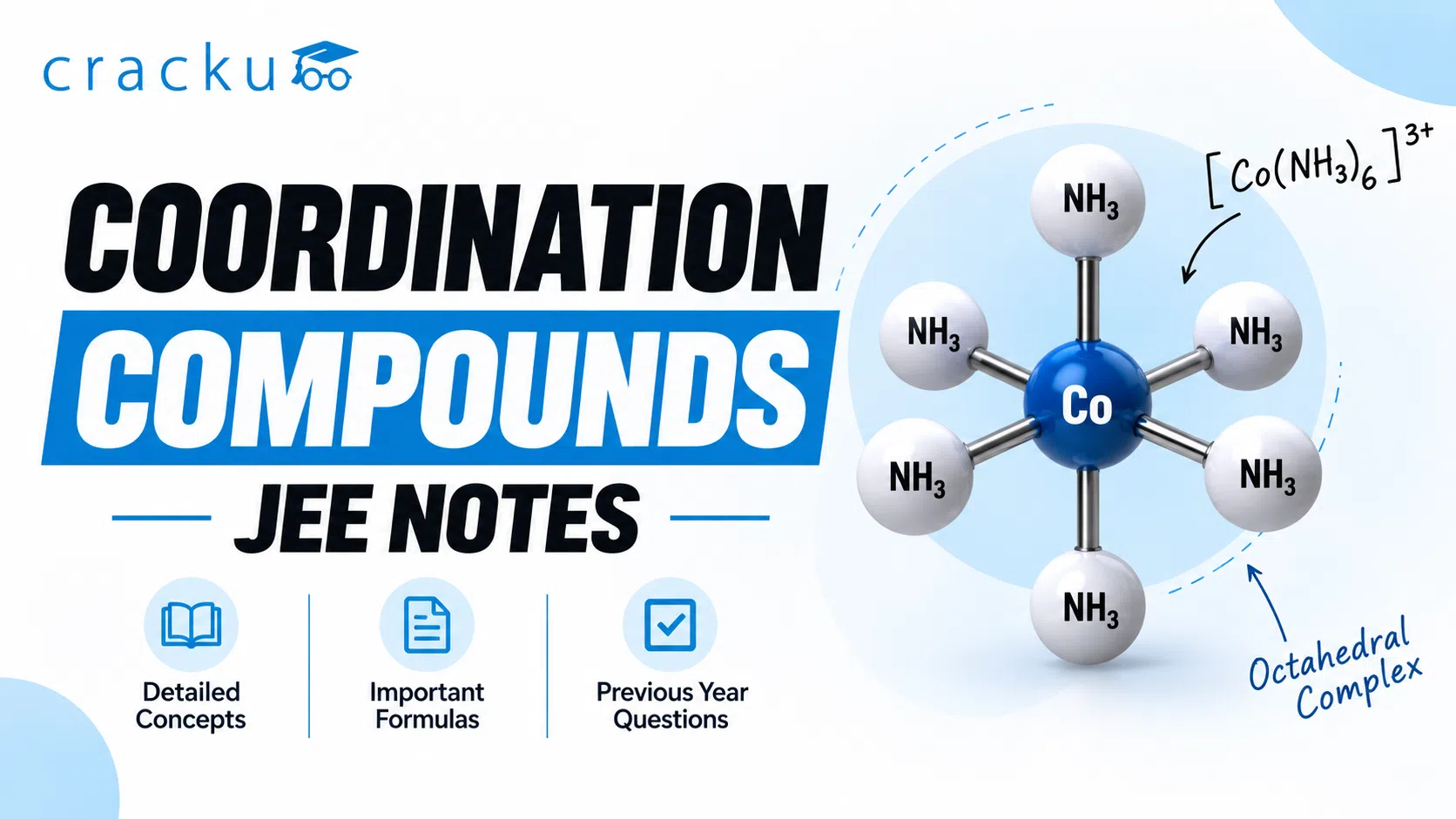
Coordination Compounds JEE Notes
Coordination chemistry studies compounds in which a transition metal atom or ion (Lewis acid) accepts lone-pair electrons from surrounding ligands (Lewis bases). The resulting entity, the coordination complex is written inside square brackets, for example, $$[\text{Cu(NH}_3)_4]^{2+}$$. Key ideas include:
- Coordination number – total donor atoms directly bonded to the metal.
- Ligand denticity – the number of donor sites in a single ligand.
- Isomerism – structural and stereochemical variants such as linkage, ionisation, and geometrical isomers.
- Bonding models – Valence Bond Theory (VBT), Crystal Field Theory (CFT) and the qualitative Molecular Orbital (MO) approach.
Nomenclature, Isomerism and Bonding Theories
1. IUPAC Nomenclature Essentials
The name starts with ligands (alphabetical, ignoring multiplicative prefixes) followed by the metal centre. For example, $$[\text{Co(en)}_2\text{Cl}_2]^+$$ is diammine-dichlorido-bis(ethane-1,2-diamine)cobalt(III) ion.
- Aqua, ammine, carbonyl, nitrosyl are neutral ligand names.
- Use prefixes: mono, di, tri, etc.; for polydentate ligands use bis, tris inside parentheses.
- For anionic complexes, append “ate” to the metal (ferrate, cuprate).
2. Types of Isomerism
| Class | Sub-type | Illustration | JEE pointer |
|---|---|---|---|
| Structural | Ionisation | $$[\text{CoBr(NH}_3)_5]\text{SO}_4$$ vs $$[\text{CoSO}_4(\text{NH}_3)_5]\text{Br}$$ | Exchange inside vs outside bracket |
| Linkage | $$[\text{Co(NH}_3)_5(\text{NO}_2)]^{2+}$$ vs $$[\text{Co(NH}_3)_5(\text{ONO})]^{2+}$$ | $$\text{NO}_2^-$$ binds through N or O | |
| Coordination | $$[\text{Cr(H}_2\text{O})_6][\text{Fe(CN)}_6]$$ and $$[\text{Fe(H}_2\text{O})_6][\text{Cr(CN)}_6]$$ | Swap of central metals | |
| Stereoisomerism | Geometrical (cis-trans, fac-mer) | cis and trans $$[\text{PtCl}_2(\text{NH}_3)_2]$$ | Square planar and octahedral only |
| Optical | $$[\text{Cr(en)}_3]^{3+}$$ | No symmetry plane, shows d/l forms |
3. Valence Bond Theory (VBT)
VBT explains hybridisation and predicts magnetic moment qualitatively. $$[\text{Fe(CN)}_6]^{4-}$$ uses $$d^2sp^3$$ hybridisation, is low-spin and diamagnetic. Limitation: cannot explain colour or exact energy splitting.
4. Crystal Field Theory (CFT)
CFT treats ligand–metal interaction as electrostatic. In octahedral fields, the $$d$$-orbitals split into lower $$t_{2g}$$ and higher $$e_g$$ sets separated by $$\Delta_o$$. High-spin means pairing energy $$P$$ > splitting; low-spin means $$\Delta_o \gt P$$. For tetrahedral fields $$\Delta_t = \frac{4}{9}\Delta_o$$.
Stability Constants, Colour and Magnetic Properties
1. Stepwise and Overall Stability
For $$\text{M}^{2+} + n\text{L} \rightleftharpoons [\text{ML}_n]^{2+}$$ the overall formation constant is
$$\beta_n = \frac{[\text{ML}_n]}{[\text{M}][\text{L}]^n}$$
Higher $$\beta$$ means greater stability. Chelating ligands such as en, EDTA show the chelate effect: $$\beta$$ increases dramatically because of entropy gain.
2. Factors Affecting Stability
- Charge density on metal (higher charge, smaller size → higher $$\beta$$).
- Ligand basicity and denticity.
- Crystal Field Stabilisation Energy (CFSE).
3. Colour of Complexes
Colour arises from $$d$$–$$d$$ transitions across $$\Delta$$. The absorbed wavelength obeys $$E = h\nu = \Delta$$. Strong field ligands (CN−, CO) cause large $$\Delta$$, shifting absorption to shorter wavelengths giving intense colours.
4. Magnetic Moment
Spin-only formula:
$$\mu = \sqrt{n(n+2)} \, \text{BM}$$
where $$n$$ = unpaired electrons calculated from the electronic configuration produced by CFT.
5. Biological and Industrial Applications
- Haemoglobin (Fe–porphyrin), Vitamin B12 (Co) illustrate bio-coordination.
- Wilkinson’s catalyst $$[\text{RhCl(PPh}_3)_3]$$ for hydrogenation.
- EDTA in water softening by complexation of Ca2+, Mg2+.
Important Formulas and Results at a Glance
| Concept | Formula / Expression | Remarks |
|---|---|---|
| Overall stability constant | $$\beta_n = \frac{[\text{ML}_n]}{[\text{M}][\text{L}]^n}$$ | Log$$\beta$$ used for comparing ligands |
| CFSE (octahedral) | $$\text{CFSE} = (-0.4 \, n_{t_{2g}} + 0.6 \, n_{e_g})\Delta_o + P_{\text{pair}}$$ | Ignore $$P$$ if only relative |
| Magnetic moment | $$\mu = \sqrt{n(n+2)} \, \text{BM}$$ | Valid for first-row transition metals |
| Splitting energy | $$\Delta_t = \frac{4}{9}\Delta_o$$ | Tetrahedral complexes |
| Effective atomic number | $$\text{EAN} = Z_{\text{metal}} - \text{oxidation state} + 2 \times (\text{donor atoms})$$ | Stability if EAN equals noble gas |
Worked JEE-Type Example
Question: Identify whether $$[\text{FeF}_6]^{3-}$$ and $$[\text{Fe(CN)}_6]^{3-}$$ are high or low spin and calculate their magnetic moments.
Solution:
- Fe in both complexes is +3 so $$d^5$$.
- F−: weak field, high-spin, $$n = 5$$ unpaired ⇒ $$\mu = \sqrt{5(5+2)} = \sqrt{35} \approx 5.92 \, \text{BM}$$.
- CN−: strong field, low-spin, $$n = 1$$ ⇒ $$\mu = \sqrt{1(1+2)} = \sqrt{3} \approx 1.73 \, \text{BM}$$.
JEE Important Points, Common Mistakes and Quick Revision
- Square planar (dsp2) complexes are almost always diamagnetic except $$\text{Ni}^{2+}$$ in weak fields.
- Don’t count coordination number by atoms present outside the bracket – check only donor atoms bonded.
- Cis-platin ($$[\text{PtCl}_2(\text{NH}_3)_2]$$) is an anticancer drug; the trans form is inactive – a favourite assertion-reason pair.
- Naming order is alphabetical ignoring numerical prefixes – chloro before ethylendiamine.
- For chelates, stability increases with ring size up to five; beyond that steric strain reduces $$\beta$$.
- Practise previous year numericals directly from JEE Mains Previous Papers and JEE Advanced Previous Papers to master tricky hybridisation-magnetic moment combos.
- Keep a personal sheet of ligand field strengths; you can download compiled lists from the JEE Formula Sheets resource page.
- Coordination number, oxidation state and charge balance are three different quantities – know how to calculate each rapidly.
- High-spin/low-spin decision depends on both ligand strength and metal’s $$d$$ electron count.
- Ionisation isomers change the counter-ion; linkage isomers change the donor atom of the ligand.
- Spin-only magnetic moment works for 3d metals; for heavier ions orbital contribution matters.
- Overall stability constants multiply the stepwise constants: $$\beta_n = K_1K_2…K_n$$.
Coordination Compounds JEE Notes: Conclusion
Coordination compounds unite bonding theories, thermodynamics and spectroscopy, so they can test multiple skills in a single JEE question. Master names, recognise isomer patterns, apply CFT to deduce spin state, and memorise core formulae like $$\mu$$ and CFSE. Regular practice of numerical problems and past papers will ensure you quickly secure the 4-8 marks this chapter typically offers.
.webp)