

 Group
Group
 Group
Group


 Preferred Source

 Google Discover
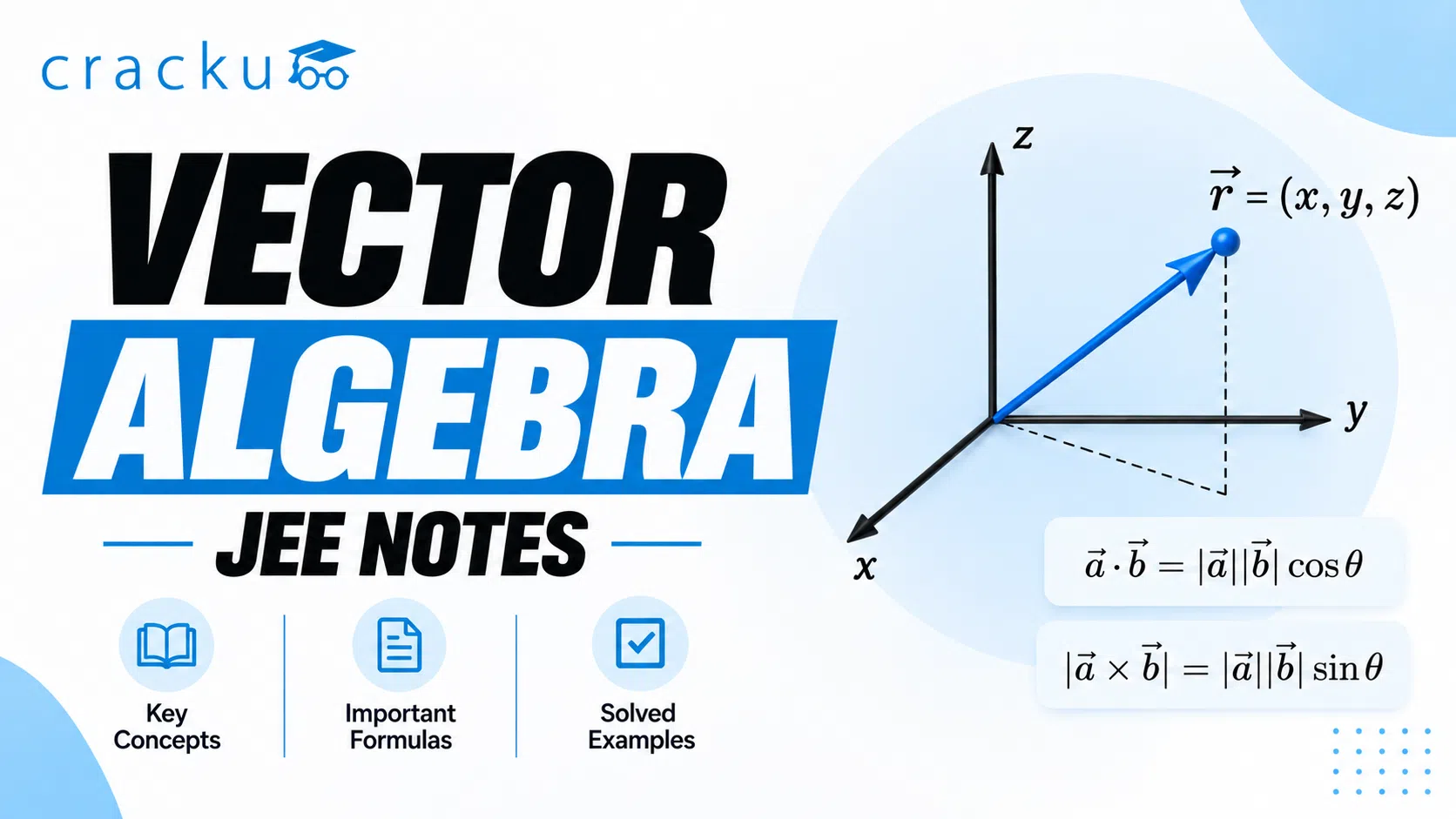
Vector Algebra is the first encounter with three-dimensional geometry for most JEE aspirants. In these notes you will revise the definitions, operations and identities that repeatedly feature in JEE Main as well as Advanced problems.
These condensed JEE Maths Notes walk you through the syllabus, show the weightage trend, list every must-know formula and close with a checklist of common traps.
Vector Algebra JEE Notes
From position vectors to scalar triple products, this chapter converts geometry into algebra, letting you treat directions as ordered triples $$(x, y, z)$$ and manipulate them just like numbers. Around 1–2 questions (4–8 marks) are asked every year, typically testing:
- Basic operations – addition, subtraction, scalar multiplication
- Dot, cross and scalar triple products
- Section formula, collinearity, coplanarity
- Applications in lines, planes and shortest distance
Mastering vector identities simplifies 3-D geometry and gives you rapid calculation tools for Physics as well.
Vector Representation and Fundamental Operations
Position and Displacement Vectors
A point $$P(x, y, z)$$ is represented by the position vector $$\mathbf r = x\hat i + y\hat j + z\hat k$$ with respect to the origin. The vector joining $$P$$ to $$Q(x_2, y_2, z_2)$$ is $$\overrightarrow{PQ} = (x_2 - x_1)\hat i + (y_2 - y_1)\hat j + (z_2 - z_1)\hat k$$.
Magnitude and Unit Vector
$$|\mathbf a| = \sqrt{a_x^2 + a_y^2 + a_z^2}$$ and the corresponding unit vector is $$\hat a = \frac{\mathbf a}{|\mathbf a|}$$.
Addition, Subtraction and Scalar Multiplication
Component-wise operations: $$\mathbf a \pm \mathbf b = (a_x \pm b_x)\hat i + (a_y \pm b_y)\hat j + (a_z \pm b_z)\hat k$$. Scalar $$\lambda\mathbf a = (\lambda a_x, \lambda a_y, \lambda a_z)$$.
Section Formula (Internal & External)
Point dividing $$AB$$ in ratio $$m:n$$ internally: $$\mathbf r = \frac{n\mathbf a + m\mathbf b}{m + n}$$; externally: $$\mathbf r = \frac{n\mathbf a - m\mathbf b}{n - m}$$.
Collinearity & Coplanarity Tests
- Vectors $$\mathbf a, \mathbf b$$ are collinear if $$\mathbf a = k\mathbf b$$.
- Vectors $$\mathbf a, \mathbf b, \mathbf c$$ are coplanar if $$[\mathbf a, \mathbf b, \mathbf c] = 0$$ (scalar triple product zero).
Vector Products and Their Applications
Dot (Scalar) Product
Defined as $$\mathbf a\cdot\mathbf b = a_x b_x + a_y b_y + a_z b_z = |\mathbf a||\mathbf b|\cos\theta$$.
Key uses: angle between vectors, projection, work done in Physics.
Cross (Vector) Product
Defined as $$\mathbf a \times \mathbf b = \begin{vmatrix}\hat i & \hat j & \hat k\\ a_x & a_y & a_z\\ b_x & b_y & b_z\end{vmatrix}$$. Magnitude $$|\mathbf a||\mathbf b|\sin\theta$$, direction given by right-hand rule.
Key uses: area of parallelogram/triangle, torque.
Scalar Triple Product (STP)
$$[\mathbf a, \mathbf b, \mathbf c] = \mathbf a\cdot(\mathbf b \times \mathbf c)$$ equals volume of the parallelepiped formed by the three vectors. Zero STP implies coplanarity.
Vector Triple Product
$$(\mathbf a \times \mathbf b) \times \mathbf c = (\mathbf a\cdot\mathbf c)\mathbf b - (\mathbf b\cdot\mathbf c)\mathbf a$$. Frequently used to simplify nested crosses.
Application to Lines and Planes
- Line through $$\mathbf a$$ parallel to $$\mathbf b$$: $$\mathbf r = \mathbf a + \lambda \mathbf b$$.
- Plane through $$\mathbf a$$ with normal $$\mathbf n$$: $$(\mathbf r - \mathbf a)\cdot \mathbf n = 0$$.
- Shortest distance between two skew lines with direction vectors $$\mathbf b_1, \mathbf b_2$$ and points $$\mathbf a_1, \mathbf a_2$$: $$d = \frac{|(\mathbf a_2 - \mathbf a_1)\cdot (\mathbf b_1 \times \mathbf b_2)|}{|\mathbf b_1 \times \mathbf b_2|}$$.
Worked Example
Question: Find the angle between lines $$\mathbf r = (2\hat i - \hat j + 3\hat k) + \lambda(3\hat i + 2\hat j - \hat k)$$ and $$\mathbf r = (4\hat i + \hat j) + \mu(-\hat i + 4\hat j + 2\hat k)$$.
Direction vectors: $$\mathbf b_1 = (3, 2, -1)$$ and $$\mathbf b_2 = (-1, 4, 2)$$.
Cosine of angle $$\theta$$: $$\cos\theta = \frac{\mathbf b_1\cdot\mathbf b_2}{|\mathbf b_1||\mathbf b_2|} = \frac{3(-1) + 2(4) + (-1)(2)}{\sqrt{3^2+2^2+1^2}\sqrt{1^2+4^2+2^2}} = \frac{-3+8-2}{\sqrt{14}\sqrt{21}} = \frac{3}{\sqrt{294}}$$.
Therefore $$\theta \approx \cos^{-1}\left(\frac{3}{\sqrt{294}}\right) \approx 79.1^\circ$$.
Important Formulas and Results at a Glance
| Category | Formula / Result |
|---|---|
| Magnitude | $$|\mathbf a| = \sqrt{a_x^2 + a_y^2 + a_z^2}$$ |
| Dot product | $$\mathbf a\cdot\mathbf b = |\mathbf a||\mathbf b|\cos\theta$$ |
| Cross product | $$|\mathbf a\times\mathbf b| = |\mathbf a||\mathbf b|\sin\theta$$ |
| STP (Volume) | $$V = |[\mathbf a,\mathbf b,\mathbf c]|$$ |
| Lagrange Identity | $$(\mathbf a\times\mathbf b)^2 + (\mathbf a\cdot\mathbf b)^2 = |\mathbf a|^2|\mathbf b|^2$$ |
| Projection of $$\mathbf a$$ on $$\mathbf b$$ | $$\operatorname{proj}_{\mathbf b}\mathbf a = \frac{\mathbf a\cdot\mathbf b}{|\mathbf b|}$$ |
| Area of triangle $$ABC$$ | $$\frac12|\overrightarrow{AB}\times\overrightarrow{AC}|$$ |
| Distance of point $$\mathbf r_0$$ from plane $$(\mathbf r\cdot\mathbf n = d)$$ | $$\frac{|\,\mathbf r_0\cdot\mathbf n - d\,|}{|\mathbf n|}$$ |
JEE Important Points, Common Mistakes and Quick Revision
- Always convert angles to radians while differentiating or integrating vector expressions.
- Remember $$\mathbf a\times\mathbf a = \mathbf 0$$ but $$\mathbf a\cdot\mathbf a = |\mathbf a|^2$$ – a frequent silly error.
- Use component form for dot product questions to save time; switch to determinant form for cross products.
- Check coplanarity via STP equals zero instead of visualising geometry faster under exam pressure.
- While computing shortest distance, never forget absolute value in numerator.
- Keep a pocket list of identities; last-minute recall helps in Physics cross-product problems as well.
For additional practice, solve past year problems on vectors from JEE Mains Previous Papers and JEE Advanced Previous Papers. Try timed quizzes under the JEE Mains Mock Test section and log doubts in our JEE Questions forum.
- Key Takeaways
- Memorise dot, cross and scalar triple product definitions.
- Translate geometric problems into vector form for uniform treatment.
- Practise determinant evaluation for quick cross products.
- Keep STP test handy for coplanarity.
- Revisit area, volume and distance formulas a day before the exam.
Vector Algebra JEE Notes: Conclusion
Vector Algebra supplies the algebraic toolkit for 3-D geometry, mechanics and electromagnetism. Once you are fluent with operations and identities, most line-plane questions boil down to two-minute computations. Revise the formulas table daily, attempt application problems from previous papers and quiz yourself on unit vector conversions; you will secure those easy 4–8 marks in the JEE paper.
.webp)