
 Group
Group
 Group
Group


 Preferred Source

 Google Discover
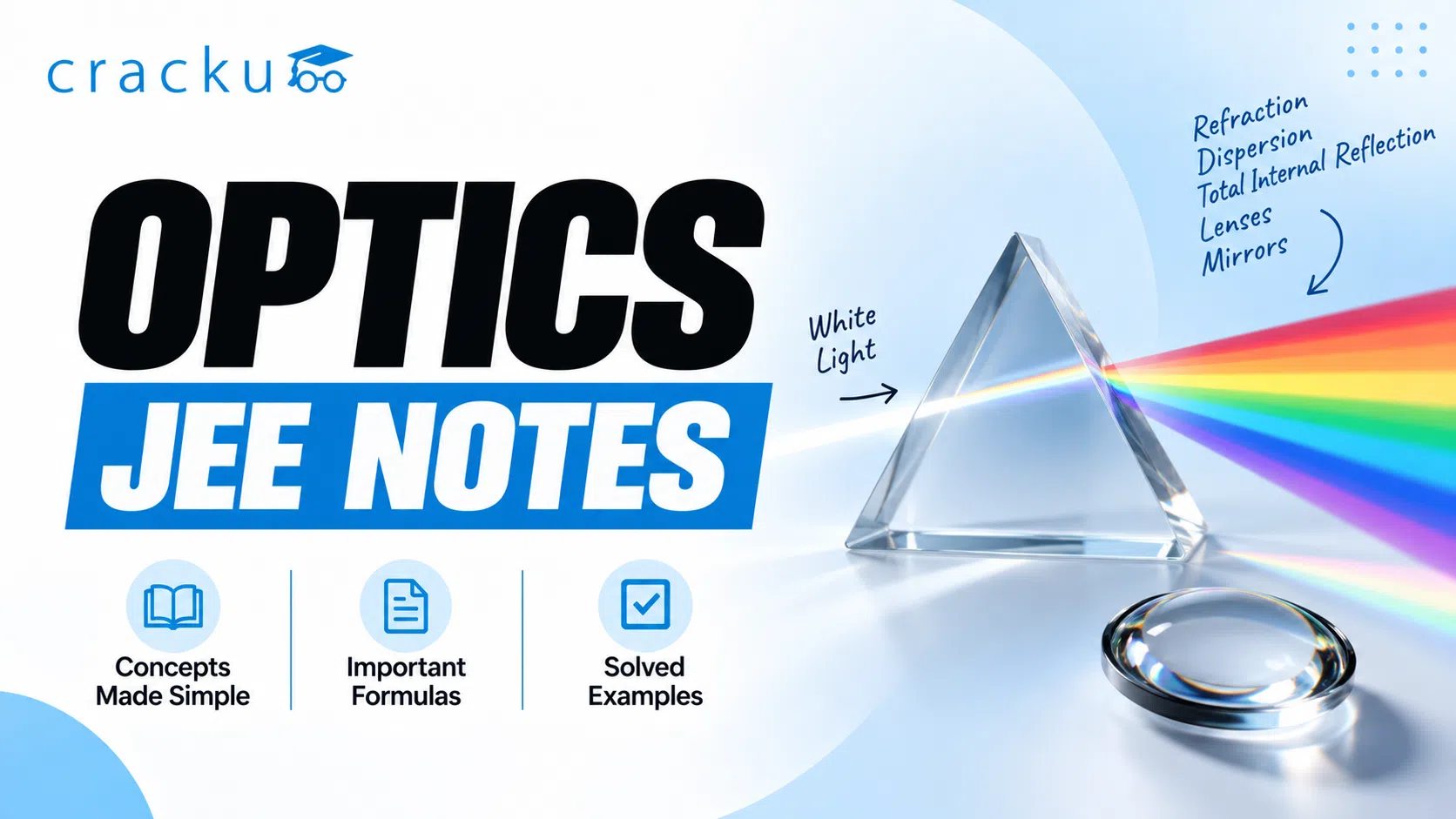
These Optics notes condense the entire chapter into one read-through source you can rely on during JEE revision. All core concepts, formulas and examiner-favourite problem types are laid out with solved examples so that you can switch directly from theory to practice.
Optics is tested every year in the Physics section through questions spanning ray, wave and modern optics. This article of concise JEE Physics Notes covers chapter weightage, sign conventions, lens & mirror formulae, interference, diffraction, quick tricks, and the mistakes students most often make.
Optics JEE Notes
What the chapter includes
Optics is the study of light and its interaction with matter. In JEE, the syllabus is divided into two broad parts:
- Geometrical (Ray) Optics: Reflection, refraction, mirrors, lenses, prisms, optical instruments.
- Wave & Modern Optics: Interference, diffraction, polarisation, dispersion, resolving power, photoelectric effect.
Weightage trend
| Exam | Average marks from Optics | Typical question count |
|---|---|---|
| JEE Main | 8–12 | 2–3 MCQ/Numerical |
| JEE Advanced | 10–14 | 2–3 problems (may be paragraph type) |
Attempting the previous year papers on Optics from our JEE Mains Previous Papers and JEE Advanced Previous Papers collections will show that questions are often conceptual with light calculation.
Geometrical Optics
Reflection from Plane and Spherical Mirrors
- Law of reflection: Angle of incidence $$i$$ equals angle of reflection $$r$$.
- Mirror formula: $$\frac1f=\frac1v+\frac1u$$ with the Cartesian sign convention.
- Magnification $$m=\frac{h'}{h}=-\frac{v}{u}$$.
Worked example – Spherical mirror
A concave mirror of focal length $$15\text{ cm}$$ forms a real image three times the size of the object. Find the object distance.
- Real image, magnification $$m=-3 = -\frac{v}{u}\Rightarrow v=3u$$.
- Mirror formula $$\frac{1}{f}=\frac{1}{v}+\frac{1}{u}=\frac{1}{3u}+\frac{1}{u}=\frac{4}{3u}$$.
- So $$u=\frac{4f}{3}= \frac{4\times15}{3}=20\text{ cm}$$ in front of the mirror.
Refraction and Lenses
- Snell’s law: $$n_1\sin i=n_2\sin r$$.
- Lens maker’s formula: $$\frac1f=(n-1)\left(\frac1{R_1}-\frac1{R_2}\right)$$.
- Thin lens formula: $$\frac1f=\frac1v-\frac1u$$ (sign convention similar to mirrors).
- Combination of lenses in contact: $$\frac1{f_{\text{eq}}}=\frac1{f_1}+\frac1{f_2}+\dots$$.
Optical Instruments
The key formulae for each device:
| Instrument | Angular magnification (approx.) | Special points |
|---|---|---|
| Simple microscope | $$M=1+\frac{D}{f}$$ | Object within focal length. |
| Compound microscope | $$M=\left(1+\frac{D}{f_e}\right)\frac{L}{f_o}$$ | $$L$$ is tube length. |
| Telescope (astronomical) | $$M=\frac{f_o}{f_e}$$ | Large $$f_o$$, small $$f_e$$. |
Wave & Modern Optics
Interference
- Path difference $$\Delta x = d\sin\theta$$ for double-slit with slit separation $$d$$.
- Fringe width: $$\beta = \frac{\lambda D}{d}$$ where $$D$$ is distance to screen.
- Intensity pattern: $$I=I_0\cos^2\left(\frac{\pi\Delta x}{\lambda}\right)$$.
Diffraction
- Single slit minima: $$a\sin\theta = m\lambda\;(m=±1,±2,\dots)$$.
- Width of central maximum $$\approx \frac{2\lambda D}{a}$$.
- Resolving power of grating $$R=mN$$, where $$N$$ is number of lines illuminated.
Polarisation
- Only transverse waves can be polarised.
- Malus’ law: $$I=I_0\cos^2\theta$$.
- Brewster’s law for polarising angle $$\theta_p$$: $$\tan\theta_p = n$$.
Dispersion & Resolving Power
- Angular dispersion of a prism $$=\frac{d\theta}{d\lambda}$$ is proportional to $$\frac{A}{\cos r}$$.
- Rayleigh's criterion: Two sources are just resolved when central maximum of one coincides with first minimum of other.
Important Formulas and Results at a Glance
| Concept | Formula |
|---|---|
| Mirror formula | $$\frac1f=\frac1v+\frac1u$$ |
| Lens formula | $$\frac1f=\frac1v-\frac1u$$ |
| Critical angle | $$\sin C=\frac{1}{n_{21}}$$ |
| Magnification (lens) | $$m=\frac{v}{u}$$ |
| Fringe width (YDSE) | $$\beta=\frac{\lambda D}{d}$$ |
| Diffraction minima | $$a\sin\theta=m\lambda$$ |
| Malus’ law | $$I=I_0\cos^2\theta$$ |
| Brewster angle | $$\theta_p = \tan^{-1} n$$ |
Download printable JEE Formula Sheets to keep these results handy.
JEE Important Points, Common Mistakes and Quick Revision
- Always stick to the Cartesian sign convention. A wrong sign is the #1 reason for incorrect mirror/lens answers.
- For lens maker’s formula, remember radii are positive if the centre of curvature is to the right of the surface you are considering.
- In YDSE, bright and dark fringes swap only when one slit is closed – not when the source is shifted slightly.
- For interference versus diffraction, check whether two coherent sources exist (interference) or a single aperture (diffraction).
- Total internal reflection can appear in tricky ray-tracing problems inside glass blocks – sketch ray directions before using Snell’s law.
- When you revise, solve 15–20 mixed JEE Questions immediately after reading each concept; active recall cements memory.
- Simulate full-length papers on our JEE Mains Mock Test portal to master time management.
- If you get stuck on theory, live mentoring in JEE Mains Online Coaching can clarify doubts quickly.
Optics JEE Notes: Conclusion
Mastering Optics hinges on three pillars: a rock-solid grasp of sign conventions, clarity on wave phenomena like interference and diffraction, and constant practice of mixed difficulty problems. Keep the important formulas list within reach, attempt recent papers regularly, and revisit errors after every mock. With focused revision and timed practice, Optics can become a guaranteed scoring area in both JEE Main and Advanced.