
 Group
Group
 Group
Group


 Preferred Source

 Google Discover
Current Electricity JEE Notes: Important Concepts
Electric current $$I$$: the rate of flow of charge, $$I=\dfrac{dq}{dt}$$, SI unit ampere (A). Positive conventional direction is the direction of motion of positive charge.
- Current density $$\mathbf J$$: $$\mathbf J=\dfrac{I}{A}\,\hat n$$, where $$A$$ is the cross-section area perpendicular to the flow. Vector points along the flow.
- Drift velocity $$v_d$$: the average slow velocity acquired by conduction electrons in an electric field. $$v_d=\dfrac{I}{nAe}$$ with $$n$$ free electron density and $$e$$ elementary charge.
- Mobility $$\mu$$: $$\mu=\dfrac{|v_d|}{E}$$. Metals: $$10^{-3}\ \text{m}^2\text{V}^{-1}\text{s}^{-1}$$ order.
- Microscopic form of Ohm’s law: $$\mathbf J=\sigma\mathbf E$$ or equivalently $$\mathbf E=\rho\mathbf J$$, where $$\sigma$$ is conductivity, $$\rho$$ resistivity ($$\rho=1/\sigma$$).
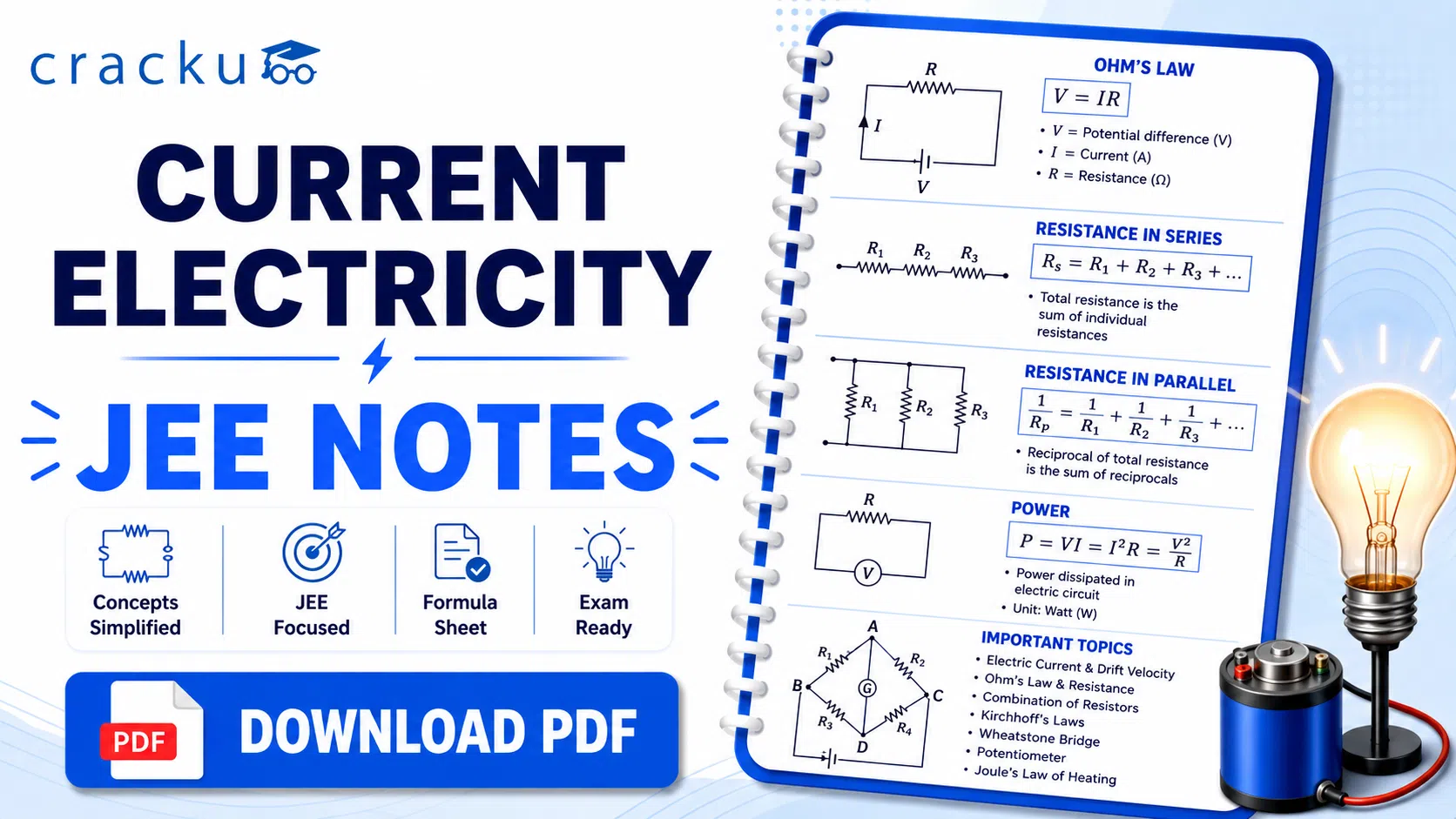
- Macroscopic Ohm’s law: $$V=IR$$ linking potential difference $$V$$ across a conductor and the steady current through it with resistance $$R$$.
- Resistance and resistivity: $$R=\rho\dfrac{l}{A}$$, $$\rho$$ depends only on material and temperature.
- Temperature coefficient of resistance $$\alpha$$: $$R_T=R_0(1+\alpha\Delta T)$$ for small ranges. For metals $$\alpha\gt0$$, for semiconductors $$\alpha\lt0$$.
Resistive Networks and Temperature Dependence
Standard Combinations
- Series: current same, $$R_{\text{eq}}=R_1+R_2+\dots$$, voltage divides.
- Parallel: voltage same, $$\dfrac1{R_{\text{eq}}}=\dfrac1{R_1}+\dfrac1{R_2}+\dots$$, current divides.
- For two resistors only: $$R_{\text{eq,\,parallel}}=\dfrac{R_1R_2}{R_1+R_2}$$ remembers faster.
- Mixed networks: reduce block-wise; redraw circuit to spot obvious series or parallel parts.
Temperature & Power Care
When a resistor heats up, use $$R(T)=R_0[1+\alpha(T-T_0)]$$ before applying $$P=\dfrac{V^2}{R}$$ or $$P=I^2R$$. Fuse questions frequently hinge on this.
Maintain a personal shortlist of network tricks in your notebook. The downloadable JEE Formula Sheets keep all reductions and star-delta conversions on one page.
Worked Example 1 — Ladder Network
A ladder of four identical $$2\ \Omega$$ resistors is built as shown. Find the equivalent resistance between the two end points if each rung is in parallel with the next rung.
Solution: Two rungs in parallel give $$R_{\text{eq1}}=1\ \Omega$$. The second pair is identical, giving another $$1\ \Omega$$. These two resultant resistances are in series, so $$R_{\text{total}}=1+1=2\ \Omega$$.
Kirchhoff’s Laws, Bridge Circuits and Potentiometer
Kirchhoff Current Law (KCL)
At any node the algebraic sum of currents is zero: $$\sum I_{\text{in}}=\sum I_{\text{out}}$$, consequence of charge conservation.
Kirchhoff Voltage Law (KVL)
For every closed loop the algebraic sum of emf’s and potential drops is zero: $$\sum \text{emf}-\sum IR =0$$, energy conservation.
Wheatstone Bridge
Bridge is balanced when $$\dfrac{R_1}{R_2}=\dfrac{R_3}{R_4}$$, giving zero galvanometer current. JEE loves finding the unknown resistance or spotting which resistor can be removed (reduces to a simple parallel pair).
Meter Bridge
Uses Wheatstone principle on a wire of uniform resistivity. If jockey contact balances at length $$l$$, $$\dfrac{R_x}{R_s}=\dfrac{l}{100-l}$$.
Potentiometer
- Emf comparison: $$\dfrac{E_1}{E_2}=\dfrac{l_1}{l_2}$$ (no current drawn).
- Internal resistance of a cell: $$r=R\left(\dfrac{l_{\text{open}}}{l_{\text{closed}}}-1\right)$$.
Advanced questions often couple KVL with bridge balance in the same network. After finishing this section, try at least five multi-loop problems from the last five years’ JEE Advanced Previous Papers.
Worked Example 2 — Unbalanced Bridge
In a Wheatstone bridge $$R_1=5\ \Omega,\ R_2=10\ \Omega,\ R_3=4\ \Omega,\ R_4=8\ \Omega$$ with a $$2\ \text{V}$$ cell. Calculate current through the galvanometer of resistance $$50\ \Omega$$.
- Bridge ratio difference: $$\dfrac{5}{10}=0.5$$ and $$\dfrac{4}{8}=0.5$$ – actually balanced!
- Hence $$I_G=0\ \text{A}$$. JEE throws such “trick” numbers frequently.
Source of EMF, Internal Resistance and Electrical Power
Cell Parameters
- Open-circuit emf $$E$$: work done per unit charge when no current flows.
- Internal resistance $$r$$: $$V=E-Ir$$ under load current $$I$$.
- Maximum power transfer when $$R_{\text{load}}=r$$; resultant efficiency $$50\%$$.
Grouping of Cells
| Grouping | Effective emf | Effective resistance |
|---|---|---|
| Series $$n$$ cells | $$nE$$ | $$nr$$ |
| Parallel $$n$$ cells | $$E$$ | $$\dfrac r n$$ |
| Mixed $$m$$ rows, $$n$$ columns | $$nE$$ | $$nr\dfrac m n $$ (apply carefully) |
Power Relations
$$P=VI=I^2R=\dfrac{V^2}{R}$$
Heat produced in time $$t$$: $$H=I^2Rt$$ (Joule’s law). Fuse selection or bulb rating numericals rely on this.
Instruments
- Galvanometer: deflection current $$I_G$$, resistance $$G$$.
- Ammeter: low resistance. Shunt $$S$$ needed: $$S=\dfrac{I_GG}{I-I_G}$$.
- Voltmeter: high resistance. Series resistor $$R_s$$: $$R_s=\dfrac{V}{I_G}-G$$.
If you face difficulty in converting a galvanometer, attempt 8-10 mixed practice items in the JEE Questions immediately after reading the formulas.
Worked Example 3 — Cell & Ammeter
A $$1.5\ \text{V}$$ cell with internal resistance $$0.5\ \Omega$$ is connected to a resistor $$2.5\ \Omega$$. Find the current and terminal voltage.
- $$I=\dfrac{E}{R+r}=\dfrac{1.5}{3}=0.5\ \text{A}$$.
- $$V=E-Ir=1.5-0.5(0.5)=1.25\ \text{V}$$.
Answer: $$0.5\ \text{A}$$, $$1.25\ \text{V}$$.
Important Formulas and Results at a Glance
| Concept | Formula | Typical Units |
|---|---|---|
| Current | $$I=\dfrac{dq}{dt}$$ | A |
| Drift velocity | $$v_d=\dfrac{I}{nAe}$$ | m s-1 |
| Ohm’s law (macro) | $$V=IR$$ | V, A, Ω |
| Resistance of wire | $$R=\rho\dfrac{l}{A}$$ | Ω |
| Temperature dependence | $$R_T=R_0(1+\alpha\Delta T)$$ | Ω |
| Series resistors | $$R_s=\sum R_i$$ | Ω |
| Parallel resistors | $$\dfrac1{R_p}=\sum\dfrac1{R_i}$$ | Ω |
| Balanced Wheatstone | $$\dfrac{R_1}{R_2}=\dfrac{R_3}{R_4}$$ | dimensionless |
| Cell terminal voltage | $$V=E-Ir$$ | V |
| Electrical power | $$P=I^2R=VI=\dfrac{V^2}{R}$$ | W |
| Joule heat | $$H=I^2Rt$$ | J |
| Galvanometer to ammeter | $$S=\dfrac{I_GG}{I-I_G}$$ | Ω |
| Galvanometer to voltmeter | $$R_s=\dfrac{V}{I_G}-G$$ | Ω |
Print this table and tape it above your study desk. After a quick visual pass, solve 15 earlier-year numericals from ohmic circuits to cement memory.
JEE Important Points, Common Mistakes and Quick Revision
- Do not confuse drift velocity (few mm s-1) with speed of signal propagation (≈ speed of light in the wire).
- Remember: ammeter always in series, voltmeter in parallel. A single wrong placement spoils the sign in KVL.
- While applying KVL, stick to one sign convention throughout the loop. Swap midway and you lose negative signs.
- Total heat in series bulbs: higher resistance bulb glows brighter at same current because $$P=I^2R$$.
- Temperature coefficient questions often hide units; keep $$\alpha$$ in K-1, not °C-1.
- Finish the chapter with a two-hour timed session of selected questions from the last decade’s JEE Mains Previous Papers. This exposes recurring trap patterns.
60-Second Final Checklist
- Write the microscopic and macroscopic forms of Ohm’s law from memory.
- Reduce a random mixed network to a single resistance under 90 s.
- Balance a Wheatstone bridge mentally.
- Convert a galvanometer into 10 A ammeter and a 5 V voltmeter.
- Derive maximum power transfer condition.