
 Group
Group
 Group
Group


 Preferred Source

 Google Discover
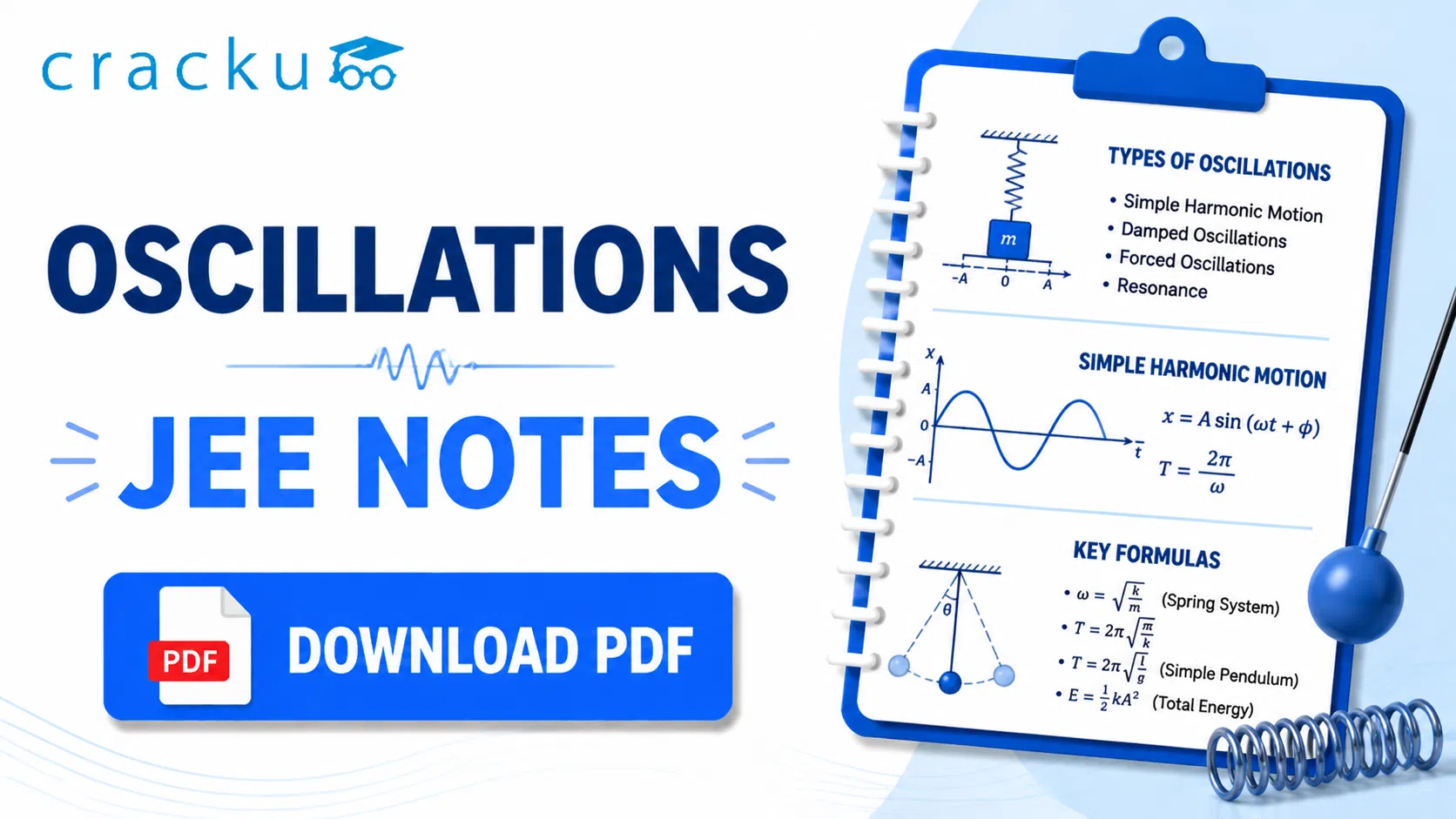
Oscillations JEE Notes give you every result, graph, and trick you need for the last-week sprint. Read the key ideas once, copy the formula table to your sheet, then drill questions. That is enough to score full marks from this chapter.
Oscillations JEE Notes: Important Concepts
Oscillation is any motion that repeats itself about an equilibrium position. For JEE, you deal almost entirely with one-dimensional repetitive motion where the restoring factor tries to pull the system back towards equilibrium.
- Time period (T): time for one complete cycle, unit: second.
- Frequency (ν): number of cycles per second, ν = 1/T, unit: hertz.
- Angular frequency (ω): $$\omega = 2\pi\nu = 2\pi/T$$, unit: rad s-1.
- Displacement (x): signed distance from equilibrium.
- Amplitude (A): maximum value of |x| in one cycle.
- Phase (ϕ): argument of the sine/cosine that fixes where the cycle starts.
Three physical systems form 90 % of JEE questions:
- Horizontal spring–mass system
- Vertical spring–mass system (same ω but new equilibrium)
- Small-angle simple pendulum
Before you touch mixed concepts, make sure you can write the differential equation, get ω, and read energy graphs for every one of the above.
Simple Harmonic Motion Core Theory
Mathematical definition
An SHM is defined by the second-order linear ODE:
$$\frac{d^2x}{dt^2}+ \omega^{2}x = 0$$
Its general solution is
$$x(t)=A\cos(\omega t+\phi) = A\sin(\omega t+\phi + \frac{\pi}{2})$$
Velocity and acceleration
| Quantity | Expression | Max magnitude |
|---|---|---|
| Velocity | $$v=-A\omega\sin(\omega t+\phi)$$ | $$A\omega$$ |
| Acceleration | $$a=-A\omega^{2}\cos(\omega t+\phi)$$ | $$A\omega^{2}$$ |
Energy in SHM
Total mechanical energy stays constant (if no damping). The split is:
- Potential: $$U=\frac{1}{2}k x^{2} = \frac{1}{2}m\omega^{2}x^{2}$$
- Kinetic: $$K=\frac{1}{2}mv^{2} = \frac{1}{2}m\omega^{2}(A^{2}-x^{2})$$
At extreme positions K = 0, U = E; at mean position U = 0, K = E.
Standard physical models
| System | Restoring torque/force | Small-angle / Hooke’s law form | ω |
|---|---|---|---|
| Horizontal spring-mass (m, k) | $$F=-kx$$ | Already linear | $$\sqrt{k/m}$$ |
| Vertical spring-mass | Same Hooke’s law, new equilibrium shifted by mg/k | Equation identical | $$\sqrt{k/m}$$ |
| Simple pendulum (length l) | $$\tau=-mg\sin\theta\cdot l$$ | For small θ, $$\sin\theta\approx\theta$$ | $$\sqrt{g/l}$$ |
| Torsion pendulum (I, C) | Restoring torque Cθ | Linear | $$\sqrt{C/I}$$ |
Solved Example 1 – Horizontal spring
A 0.5 kg block on a frictionless table is attached to a spring (k = 200 N m-1) pulled 3 cm and released from rest. Find (a) period, (b) speed at mean position.
- $$\omega=\sqrt{k/m}=\sqrt{200/0.5}=20\text{ rad s}^{-1}$$, so $$T=2\pi/\omega=0.314\text{ s}$$
- Maximum speed occurs at x = 0:
$$v_{\max}=A\omega = 0.03\times20 = \mathbf{0.60\ m\ s^{-1}}$$
After practising 15–20 mixed formulas, move to actual JEE Questions so that the steps above become muscle memory.
Damped, Forced Oscillations and Resonance
Damped oscillations
When a resistive force proportional to velocity, $$F_{d}=-b v$$, acts, the equation becomes
$$m\frac{d^{2}x}{dt^{2}} + b\frac{dx}{dt} + kx = 0$$
- Light (underdamped): $$\zeta=\frac{b}{2\sqrt{mk}}<1$$ leads to $$x=Ae^{-\beta t}\cos(\omega' t +\phi)$$ where $$\beta=b/2m$$ and $$\omega'=\sqrt{\omega^{2}-\beta^{2}}$$
- Critical: $$\zeta=1$$ fastest non-oscillatory return.
- Overdamped: $$\zeta>1$$ slow non-oscillatory decay.
Driven (forced) oscillations
Add a driving force $$F_{0}\cos(\omega_{d} t)$$:
$$m\ddot x + b\dot x + kx = F_{0}\cos(\omega_{d} t)$$
Steady-state amplitude:
$$A(\omega_{d})=\frac{F_{0}/m}{\sqrt{(\omega^{2}-\omega_{d}^{2})^{2} + (2\beta\omega_{d})^{2}}}$$
Resonance
- Occurs when $$\omega_{d}\approx\omega'$$ for small damping.
- Amplitude shoots up as denominator minimises.
- Quality factor Q measures sharpness: $$Q=\omega \frac{\text{Energy stored}}{\text{Power loss per cycle}} = \frac{\omega}{2\beta}$$
Solved Example 2 – Forced oscillation peak
For a damped oscillator m = 1 kg, k = 100 N m-1, b = 1 kg s-1, find driving frequency for maximum steady-state amplitude and that amplitude when F0 = 5 N.
- $$\omega=\sqrt{k/m}=10\text{ rad s}^{-1},\quad \beta=b/2m=0.5$$
Resonance at $$\omega_{res}=\sqrt{\omega^{2}-2\beta^{2}}=\sqrt{100-0.5}=9.97\text{ rad s}^{-1}$$ - Amplitude: $$A=\frac{F_{0}/m}{2\beta\omega_{res}}=\frac{5}{1\times 2\times0.5\times9.97}\approx\mathbf{0.50\ m}$$
The resonance section is a favourite in JEE Advanced, so scroll through last decade’s JEE Advanced Previous Papers and spot how often the examiner tweaks β and Q.
Energy Analysis, Superposition and Phase
Energy curve and average values
Average over one time period:
- $$\langle K \rangle = \langle U \rangle = \frac{E}{2}$$
- Root-mean-square speed: $$v_{rms}= \frac{A\omega}{\sqrt{2}}$$
Superposition of two SHMs in the same line
Let $$x_{1}=A_{1}\sin\omega t$$ and $$x_{2}=A_{2}\sin(\omega t+\delta)$$.
Resultant amplitude:
$$A_{R}=\sqrt{A_{1}^{2}+A_{2}^{2}+2A_{1}A_{2}\cos\delta}$$
Special cases:
- In-phase (δ = 0): amplitude adds.
- Opposite phase (δ = π): amplitude subtracts; total can cancel.
Lissajous figures (different perpendicular frequencies)
Comes rarely but fast marks: x = A sin ωxt, y = B sin ωyt. Ratio ωx:ωy decides closed/ open curve.
Phase diagram
Plotting x versus v gives an ellipse for damped systems and a circle for ideal SHM with radius A.
Solved Example 3 – Superposition resulting amplitude
Two collinear SHMs of equal frequency have A1 = 3 cm, A2 = 4 cm and phase difference 60°. Find resultant amplitude and its percentage change if the phase suddenly changes to 120°.
- With δ = 60°:
$$A_{R}= \sqrt{3^{2}+4^{2}+2(3)(4)\cos60^{\circ}}=\sqrt{9+16+12}= \sqrt{37}\approx 6.08\text{ cm}$$ - With δ = 120°:
$$A'_{R}= \sqrt{9+16+12\cos120^{\circ}}= \sqrt{25-6}= \sqrt{19}\approx4.36\text{ cm}$$ - Percentage change: $$\frac{6.08-4.36}{6.08}\times100\approx \mathbf{28\%}$$ decrease.
Keep a compact sheet of these identities. The Physics section of our JEE Formula Sheets already lists them in two pages—print it and stick on your wall.
Important Formulas and Results at a Glance
| Topic | Result | Note |
|---|---|---|
| General SHM | $$x=A\cos(\omega t+\phi)$$ | φ fixed by initial conditions |
| Time period (spring–mass) | $$T=2\pi\sqrt{\frac{m}{k}}$$ | horizontal & vertical (shifted) |
| Time period (simple pendulum) | $$T=2\pi\sqrt{\frac{l}{g}}$$ | small-angle only, θ < 15° |
| Maximum acceleration | $$a_{max}=A\omega^{2}$$ | extreme position |
| Total energy | $$E=\frac{1}{2}kA^{2}= \frac{1}{2}m\omega^{2}A^{2}$$ | constant in ideal SHM |
| Damped angular frequency | $$\omega'=\sqrt{\omega^{2}-\beta^{2}}$$ | β = b/2m |
| Quality factor | $$Q=\frac{\omega}{2\beta}$$ | Higher Q: sharper resonance |
| Beat frequency | $$|ν_{1}-ν_{2}|$$ | superposition of close ν |
| Superposition amplitude | $$A_{R}=\sqrt{A_{1}^{2}+A_{2}^{2}+2A_{1}A_{2}\cos\delta}$$ | same ω only |
Copy this table into your notebook right after solving today’s assignment so you can revise it in under 60 seconds.
JEE Important Points, Common Mistakes and Quick Revision
- Dimensions first: Always cross-check whether the question wants T, ω or ν. Students lose marks by plugging l/g when they need √(g/l).
- Vertical spring equilibrium shift is mg/k. Use it; do not set origin at the ceiling.
- Small-angle limit: If θ > 15°, JEE rarely calls it SHM. Either approximate numerically or use energy conservation.
- Phase vs. time graphs: The slope gives angular frequency, not 2π/T; watch units.
- Energy bar chart trick: In multiple-choice, compare K and U as functions of x rather than writing full equations—it is 5 times faster.
- Practice pathway: Finish 40 single-concept problems, then mix them into 10 integer-type questions taken from JEE Mains Previous Papers. Time yourself: 1.5 min per mark.
60-second recap
- Write $$\omega$$ for the system.
- Put $$x=A\cos(\omega t+\phi)$$, derive v and a.
- Check energy: if damping present, multiply A by $$e^{-\beta t}$$.
- If forced, set driving force and use amplitude formula.
- For combined motions, use vector addition in the phasor diagram.