

 Group
Group
 Group
Group


 Preferred Source

 Google Discover
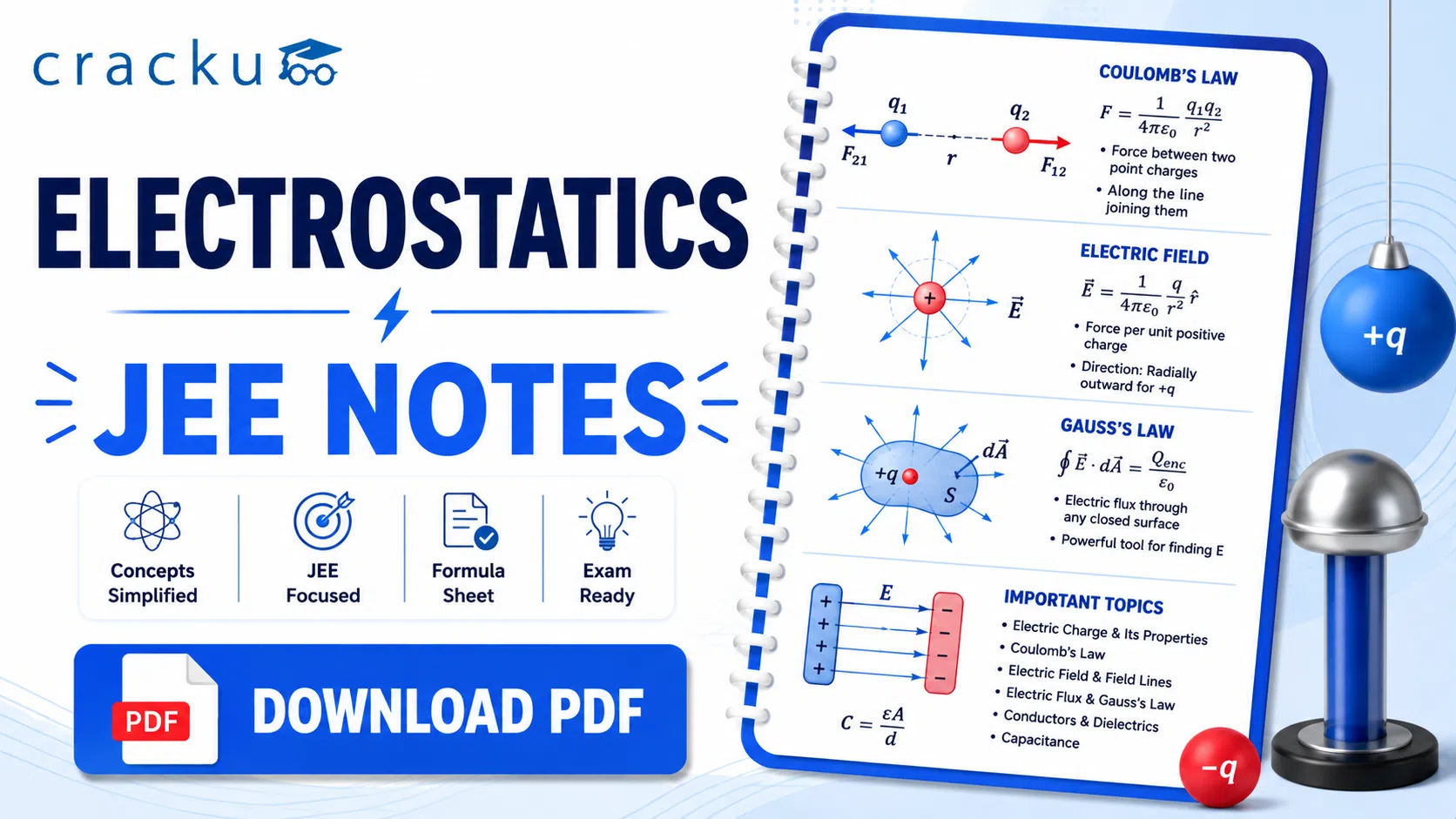
Electrostatics JEE Notes give you the entire chapter in one place for last-minute revision. Every definition, formula, trick and question type that JEE repeatedly asks is packed below in a compact, scroll-friendly format.
Electrostatics JEE Notes: Important Concepts
Electric charge: intrinsic property causing electrostatic interaction. Quantised: $$q = n e$$ with $$e = 1.602 \times 10^{-19}\,\text{C}$$. Conserved in every process.
Coulomb’s law (in free space):
$$|\mathbf F| = k \dfrac{|q_1 q_2|}{r^{2}}, \quad k = \dfrac{1}{4\pi\varepsilon_0}=9\times10^{9}\ \text{N m}^2\text{/C}^2$$
- Vector form: $$\mathbf F_{12}=k\dfrac{q_1q_2}{r^{2}}\hat r_{12}$$ (repulsive if product positive, attractive if negative).
- Medium of relative permittivity $$\varepsilon_r$$: replace $$k$$ with $$k/\varepsilon_r$$.
- Principle of superposition: net force or field is the vector sum due to all charges.
Charge density types: linear $$\lambda = dq/dl$$, surface $$\sigma = dq/dA$$, volume $$\rho = dq/dV$$.
Gauss theorem:
$$\oint_S \mathbf E\cdot d\mathbf S = \dfrac{q_\text{enc}}{\varepsilon_0}$$
Choose symmetric Gaussian surfaces to evaluate $$\mathbf E$$ quickly.
- Infinite line: $$E = \dfrac{\lambda}{2\pi\varepsilon_0 r}$$ (radially outward).
- Infinite plane sheet: $$E = \dfrac{\sigma}{2\varepsilon_0}$$ (constant).
- Solid non-conducting sphere of uniform charge density $$\rho$$: $$E(r)=\dfrac{\rho r}{3\varepsilon_0}$$ for $$r\lt R$$, $$E(r)=\dfrac{\rho R^{3}}{3\varepsilon_0 r^{2}}$$ for $$r\gt R$$.
For a neat consolidated equation list refer to the JEE Formula Sheets after reading this section.
Worked Example 1 - Force using superposition
Three equal charges $$+6\,\mu\text C$$ are placed at the corners of an equilateral triangle of side $$12\ \text{cm}$$. Find the magnitude of force on any one charge.
Solution
- Force due to one neighbour: $$F_1=kq^{2}/r^{2}=9\times10^{9}\times(6\times10^{-6})^{2}/(0.12)^{2}=22.5\ \text N$$.
- Since the two forces are at $$60^{\circ}$$, resultant $$F=2F_1\cos30^{\circ}=2(22.5)(0.866)=39.0\ \text N$$.
Answer: 39 N
Electric Field, Flux, Potential and Their Applications
Electric field lines
- Tangent gives direction of $$\mathbf E$$, density gives magnitude.
- Lines never cross and originate from positive, terminate on negative charge or at infinity.
Electric flux
For a small area $$d\mathbf S$$, $$d\phi_E = \mathbf E\cdot d\mathbf S$$. Total flux through closed surface relates to enclosed charge via Gauss law.
Electric potential (scalar)
- Definition: $$V(\mathbf r)=-\int_{\infty}^{\mathbf r}\mathbf E\cdot d\mathbf l$$.
- Point charge: $$V = k q/r$$.
- Electric field–potential relation: $$\mathbf E=-\nabla V$$. In one dimension $$E=-dV/dr$$.
- Equipotential surface: work done in moving charge along it is zero, hence $$\mathbf E$$ ⟂ equipotential.
Important standard potentials
| Configuration | Potential at axial point O |
|---|---|
| Electric dipole, distance $$r\gg a$$ | $$V = k p \cos\theta / r^{2}$$ |
| Ring radius $$R$$ carrying charge $$q$$, on axis distance $$x$$ | $$V = k q/\sqrt{R^{2}+x^{2}}$$ |
| Uniformly charged disc radius $$R$$, on axis distance $$x$$ | $$V = k\,2\pi\sigma\left(\sqrt{R^{2}+x^{2}}-x\right)$$ |
Struggling with derivations? In live doubt-clearing of our JEE Mains Online Coaching these proofs are worked out step by step.
Worked Example 2 - Electric field from potential
The potential in a region is $$V = 6x - 2yz$$ volts. Find $$\mathbf E$$ at point $$(1, -1, 2)\,$m.
Solution
$$\mathbf E = -\nabla V = -\left(\dfrac{\partial V}{\partial x}\hat i + \dfrac{\partial V}{\partial y}\hat j + \dfrac{\partial V}{\partial z}\hat k\right) = -(6\hat i - 2z\hat j - 2y\hat k)$$.
At the point, $$z=2,\ y=-1$$.
$$\mathbf E = -(6\hat i -4\hat j +2\hat k)= -6\hat i +4\hat j -2\hat k\ \text{V/m}$$.
Answer: $$\mathbf E = (-6\hat i +4\hat j -2\hat k)\ \text{V m}^{-1}$$
Worked Example 3 - Flux through a cube
A point charge $$+Q$$ is placed at one corner of a cube. What is the electric flux through the three faces meeting at that corner?
Solution
Imagine eight such cubes surrounding the charge; total flux $$=Q/\varepsilon_0$$. Through the three faces meeting at the corner, fraction is $$\dfrac{3}{24}$$ (each corner contributes to three faces of one cube among total 24 faces).
$$\phi = \dfrac{Q}{\varepsilon_0}\times\dfrac{3}{24}= \dfrac{Q}{8\varepsilon_0}$$.
Answer: $$Q/(8\varepsilon_0)$$
Capacitance, Dielectrics and Electrostatic Energy
Capacitance basics
Definition: $$C = q/V$$. SI unit: farad (F).
| Capacitor | Capacitance | Comments |
|---|---|---|
| Parallel plate, air | $$C = \dfrac{\varepsilon_0 A}{d}$$ | Neglect fringing when $$d\ll \sqrt A$$. |
| Parallel plate, dielectric $$\kappa$$ | $$C = \dfrac{\kappa\varepsilon_0 A}{d}$$ | Slab fully filling gap. |
| Coaxial cylinder $$r_1,r_2,l$$ | $$C = \dfrac{2\pi\varepsilon_0 l}{\ln(r_2/r_1)}$$ | Used in cables. |
| Spherical, concentric $$R_1,R_2$$ | $$C = 4\pi\varepsilon_0\dfrac{R_1 R_2}{R_2-R_1}$$ | Isolated sphere: $$C=4\pi\varepsilon_0 R$$. |
Series and parallel combinations
- Series: $$1/C_\text{eq}=1/C_1+1/C_2+\ldots$$, charge same, voltages add.
- Parallel: $$C_\text{eq}=C_1+C_2+\ldots$$, voltage same, charges add.
Energy stored
$$U = \dfrac{1}{2}CV^{2} = \dfrac{q^{2}}{2C} = \dfrac{1}{2}qV$$
Energy density in field: $$u = \dfrac{1}{2}\varepsilon E^{2}$$.
Dielectric slab partially filling capacitor
For a slab of thickness $$t$$ inserted, treat as two capacitors in series: $$C = \dfrac{\varepsilon_0 A}{d-t+\dfrac{t}{\kappa}}$$.
Polarisation P, electric displacement D
- $$\mathbf P = \chi_e \varepsilon_0 \mathbf E$$, $$\kappa = 1+\chi_e$$.
- $$\mathbf D = \varepsilon_0 \mathbf E + \mathbf P = \varepsilon \mathbf E$$ with $$\varepsilon=\kappa\varepsilon_0$$.
Practice mixed-concept numericals from our tagged JEE Questions section to master capacitor tricks JEE loves.
Electrostatic energy of continuous charge distribution
$$U = \dfrac{1}{2}\int \rho V\,d\tau = \dfrac{\varepsilon_0}{2}\int E^{2}\,d\tau$$.
Conductors in electrostatics
- Inside conductor $$\mathbf E=0$$, charge resides on outer surface.
- Surface just outside: $$E = \sigma/\varepsilon_0$$ normal to surface.
- Potential is constant throughout conductor.
- Electrostatic shielding: cavity inside a conductor is field-free.
Method of images (JEE Advanced favourite)
Replace conductor boundary with imaginary charges to satisfy boundary conditions. Classic case: point charge $$q$$ above earthed conducting plane behaves as if image charge $$-q$$ placed symmetrically below plane.
Worked Example 4 - Capacitor energy change
A $$6 \,\mu\text F$$ capacitor charged to $$12 \text V$$ is disconnected from the battery. A dielectric $$\kappa = 4$$ completely fills the gap. Find new voltage and energy.
Solution
- Initial charge $$q = C V = 6\times10^{-6}\times12 = 7.2\times10^{-5}\,\text C$$.
- New capacitance $$C' = \kappa C = 24\,\mu\text F$$ (charge unchanged).
- New voltage $$V' = q/C' = 7.2\times10^{-5}/(24\times10^{-6}) = 3 \text V$$.
- Initial energy $$U_i = \tfrac12 C V^{2}=0.5 \times6\times10^{-6}\times144 =4.32\times10^{-4}\,\text J$$.
- Final energy $$U_f = 0.5\times24\times10^{-6}\times9 =1.08\times10^{-4}\,\text J$$.
Answer: Voltage 3 V, Energy $$1.08\times10^{-4}\,$$J
Important Formulas and Results at a Glance
| Topic | Formula | Conditions / Notes |
|---|---|---|
| Coulomb force in medium | $$F = \dfrac{1}{4\pi\varepsilon_0 \varepsilon_r}\dfrac{|q_1 q_2|}{r^{2}}$$ | Vector acts along line joining charges. |
| Electric field point charge | $$E = k |q|/r^{2}$$ | Radially outward for $$q\gt0$$. |
| Dipole field (axial) | $$E = 2k p/r^{3}$$ | $$p = q\,2a$$ dipole moment. |
| Dipole torque | $$\tau = pE\sin\theta$$ | Stable equilibrium at $$\theta = 0^{\circ}$$. |
| Work on dipole | $$W = -pE(\cos\theta_2-\cos\theta_1)$$ | Used in rotation problems. |
| Potential difference | $$\Delta V = -\int_{A}^{B} \mathbf E\cdot d\mathbf l$$ | Path independent. |
| Capacitance series | $$1/C_\text{eq}=\sum 1/C_i$$ | Charge constant. |
| Capacitance parallel | $$C_\text{eq}=\sum C_i$$ | Voltage constant. |
| Energy of capacitor | $$U=\dfrac12 CV^{2}$$ | Energy density $$u=\dfrac12 \varepsilon E^{2}$$. |
| Gauss law | $$\oint \mathbf E\cdot d\mathbf S = q_\text{enc}/\varepsilon_0$$ | Works for any closed surface. |
| Surface field of conductor | $$E = \sigma/\varepsilon_0$$ | Normal outward just outside. |
| Force between plates | $$F = \dfrac12 \varepsilon_0 A E^{2}$$ | At constant charge. |
JEE Important Points, Common Mistakes and Quick Revision
- Write Coulomb’s law in vector form in the exam to earn unit-vector marks.
- Check units: field in $$\text{N/C}$$ or $$\text{V/m}$$, potential in volts, energy in joules.
- For Gauss law numericals always state symmetry argument before flux calculation.
- When a dielectric is inserted after disconnecting the battery, charge stays constant; when battery remains connected, voltage stays constant. Nearly a dozen JEE Mains questions hinge on that line.
- Inside a hollow sphere with surface charge, $$E=0$$. Many students wrongly plug $$r$$ into point-charge formula.
- Do not round off $$1/4\pi\varepsilon_0$$ to $$9\times10^{9}$$ before final step; keeps intermediate error small.
- Practise past conceptual traps from the last ten years of JEE Advanced Previous Papers to cement edge cases such as non-uniform shells or partial dielectrics.
- For revision one day before the paper: recite the formula table above, attempt three mixed problems on coulombic force, three on Gauss law and three on capacitors, then sleep.
30-Second Final Checklist
- Coulomb, superposition, Gauss law derivation.
- Field and potential of ring, disc, dipole.
- Series/parallel capacitor and energy shifts.
- Conductor properties and shielding.
- Dielectric slab formulas.
Worked Example 5 - Series capacitor with dielectric
Two parallel-plate capacitors each of area $$100\ \text{cm}^2$$ and separation $$1\ \text{mm}$$ are connected in series. One has air, the other a dielectric $$\kappa=5$$. Calculate equivalent capacitance.
Solution
Air capacitor $$C_1=\varepsilon_0 A/d = 8.85\times10^{-12}\times10^{-2}/10^{-3}=8.85\times10^{-11}\,\text F$$.
Dielectric capacitor $$C_2=\kappa C_1 = 5C_1 = 4.43\times10^{-10}\,\text F$$.
Series: $$1/C_\text{eq}=1/C_1+1/C_2 = \dfrac{1}{8.85\times10^{-11}}+\dfrac{1}{4.43\times10^{-10}}$$
Compute: $$1/C_\text{eq}=1.13\times10^{10}+2.26\times10^{9}=1.356\times10^{10}$$
Hence $$C_\text{eq}=7.37\times10^{-11}\,\text F\ (0.0737\ \text{nF})$$.
Answer: $$7.4\times10^{-11}\,$$F
Worked Example 6 - Field energy density
The electric field between plates of a parallel-plate capacitor is $$3\times10^{5}\ \text{V/m}$$. Calculate energy density and energy stored if area is $$200\ \text{cm}^2$$ and separation $$0.5\ \text{mm}$$.
Solution
Energy density $$u=\tfrac12\varepsilon_0 E^{2}=0.5\times8.85\times10^{-12}\times(3\times10^{5})^{2}=3.99\times10^{-1}\,\text{J/m}^3$$.
Volume $$V=A d=200\times10^{-4}\times0.5\times10^{-3}=1\times10^{-5}\,\text m^3$$.
Total energy $$U=uV=0.399\times1\times10^{-5}=3.99\times10^{-6}\,\text J$$.
Answer: Energy density 0.40 J m-3, energy $$4.0\times10^{-6}\,$$J