
 Group
Group
 Group
Group


 Preferred Source

 Google Discover
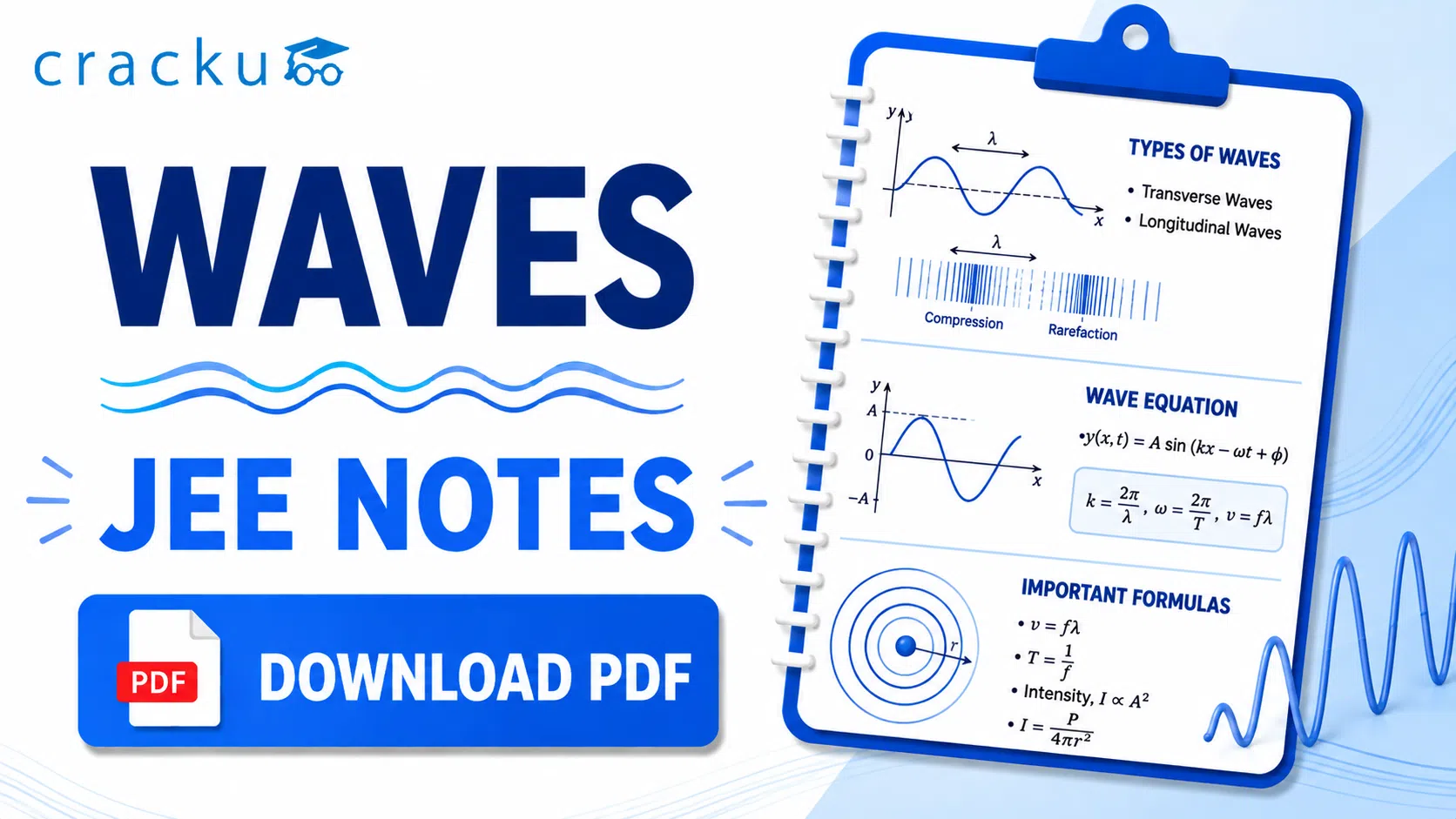
Waves JEE Notes gives you all the definitions, equations and tricks you need in one place. Use it as a 24-hour revision sheet before the exam or while practising mixed problems. Every formula is cross-checked, every example freshly solved.
Waves JEE Notes: Important Concepts
The JEE syllabus treats wave motion as a bridge topic between mechanics and sound/light. Five ideas dominate the questions: the basic wave equation, energy transport, superposition, formation of stationary waves, and the Doppler effect. Master these and you can handle almost any derivation or numerical the paper throws up.
- Mechanical wave: Disturbance that travels through a medium due to particle interaction. Needs material medium for propagation.
- Transverse vs longitudinal: Particle displacement perpendicular or parallel to propagation respectively.
- Progressive wave: Carries energy forward without permanent particle transport.
- Wave function: $$y(x,t)=A\sin(kx-\omega t+\phi)$$ where $$k=\frac{2\pi}{\lambda}$$ and $$\omega=2\pi f$$.
- Intensity: Power transmitted per unit area, $$I=\frac{1}{2}\rho v \omega^{2}A^{2}$$ for a sinusoidal wave on a string of linear density $$\rho$$.
- Sound level (dB): $$L=10\log_{10}\left(I/I_{0}\right)$$ with $$I_{0}=10^{-12}\,{\rm W\,m^{-2}}$$.
Wave Motion Fundamentals
General Equation of a Progressive Wave
For a right-traveling harmonic wave:
$$y(x,t)=A\sin\left(2\pi\left(\frac{t}{T}-\frac{x}{\lambda}\right)+\phi\right)$$
Velocity of propagation $$v=\frac{\omega}{k}=f\lambda$$. Remember that phase velocity does not equal particle velocity; JEE loves to catch students on this.
Speed of Mechanical Waves
| Medium | Expression |
|---|---|
| String under tension $$T$$, linear density $$\mu$$ | $$v=\sqrt{\dfrac{T}{\mu}}$$ |
| Sound in ideal gas | $$v=\sqrt{\gamma RT/M}= \sqrt{\gamma P/\rho}$$ |
| Sound in rod (longitudinal) | $$v=\sqrt{Y/\rho}$$ (Y: Young’s modulus) |
Energy Transport in a String Wave
- Average kinetic energy per wavelength equals average potential energy.
- Energy flux $$P=\frac{1}{2}\mu \omega^{2}A^{2}v$$. Double the amplitude and power goes up by four times.
Solved Example 1 – Basic Wave Parameters
A wave on a string is described by $$y=0.02\sin(40x-800t)$$ in SI units. Find (a) amplitude, (b) wavelength, (c) frequency, (d) speed.
- Amplitude $$A=0.02\;{\rm m}=2\;{\rm cm}$$.
- $$k=40\;{\rm rad\,m^{-1}}\Rightarrow\lambda=\dfrac{2\pi}{k}=0.157\;{\rm m}$$.
- $$\omega=800\;{\rm rad\,s^{-1}}\Rightarrow f=\dfrac{\omega}{2\pi}=127.3\;{\rm Hz}$$.
- Speed $$v=\dfrac{\omega}{k}=20\;{\rm m\,s^{-1}}$$.
Answer: 2 cm, 15.7 cm, 127 Hz, 20 m s-1.
After revising the definitions, test yourself with mixed numericals from the JEE Questions database; filter for “waves” to keep the practice laser-focused.
Superposition, Interference and Beats
Principle of Superposition
When two or more waves meet, displacement is the algebraic sum: $$y=y_{1}+y_{2}+\dots$$. Valid only for linear media. Non-linearity breaks the principle, a favourite conceptual MCQ.
Constructive and Destructive Interference
- Path difference $$\Delta s$$ leads to phase difference $$\Delta\phi=\dfrac{2\pi}{\lambda}\Delta s$$.
- Constructive: $$\Delta\phi=2m\pi$$. Resultant amplitude $$A= A_{1}+A_{2}$$ (if equal amp then $$2A$$).
- Destructive: $$\Delta\phi=(2m+1)\pi$$. Resultant amplitude $$A=|A_{1}-A_{2}|$$.
Beats
| Quantity | Formula | Notes |
|---|---|---|
| Beat frequency | $$f_{\text{beat}}=|f_{1}-f_{2}|$$ | Audible if difference <≈ 7 Hz |
| Time between successive maxima | $$T_{\text{beat}}=\dfrac{1}{f_{\text{beat}}}$$ | Often asked when forks are mistuned |
Solved Example 2 – Beats with Moving Source
Two organ pipes of frequencies 512 Hz and 510 Hz are sounded together. One is taken away quickly so that only one pipe remains. How many beats will be heard in 5 s after removal?
When both sound: 2 beats s-1. Once removed, zero beats. The remaining 512 Hz pipe persists. Beats heard only during the decay of the departing sound; assume negligible decay time so beats last roughly one second.
Answer: About 2 beats heard in the first second and none afterwards.
Stationary Interference vs Standing Waves
Do not confuse interference fringes (space variation) with standing waves (nodes/antinodes in space but oscillation energy is stored, not transported). JEE has asked to pick statements distinguishing the two.
Standing Waves & Resonance in Strings and Air Columns
Mathematical Form
$$y(x,t)=2A\sin kx\cos\omega t$$
Nodes at $$k x=n\pi$$; antinodes at $$(2n+1)\pi/2$$.
String Fixed at Both Ends
| Mode (n) | Wavelength $$\lambda_{n}$$ | Frequency $$f_{n}$$ |
|---|---|---|
| 1 (Fundamental) | $$2L$$ | $$\dfrac{v}{2L}$$ |
| n | $$\dfrac{2L}{n}$$ | $$\dfrac{nv}{2L}$$ |
Organ Pipes
- Open pipe: Both ends antinodes. Harmonics: $$f_{n}=n\dfrac{v}{2L}$$.
- Closed pipe: One end node, other antinode. Only odd harmonics survive: $$f_{n}=(2n-1)\dfrac{v}{4L}$$.
Quality Factor and Sharpness
Quality factor $$Q=\dfrac{\omega_{0}}{2\beta}=\dfrac{2\pi \times \text{Energy stored}}{\text{Energy dissipated per cycle}}$$. High Q means narrow resonance peak, important in acoustic resonance tubes.
Solved Example 3 – End Correction
An open organ pipe has first resonance with a tuning fork of 320 Hz at an air column length of 25 cm and the next resonance at 77 cm. Calculate (a) speed of sound and (b) end correction.
- For successive resonances in open pipe, length differs by $$\lambda/2$$. $$\lambda=2(77-25)=104\;{\rm cm}=1.04\;{\rm m}$$.
- Speed $$v=f\lambda=320\times1.04=333\;{\rm m\,s^{-1}}$$.
- Effective length $$L_{\text{eff}}=25+e= \lambda/2 =0.52\;{\rm m}\Rightarrow e=0.27\;{\rm m}$$.
Answer: Speed 333 m s-1, end correction 2.7 cm at each open end.
Finish this section by solving tenor problems from previous year papers. The wave chapter appears with one assured 4-mark numeral in JEE Main; scan the relevant section in the JEE Mains Previous Papers booklets to verify frequency of resonance-tube questions.
Doppler Effect & Wave Speed in Moving Media
Doppler Formulae (Low Speeds, $$v_{s},v_{o}\ll v$$)
| Scenario | Observed frequency $$f'$$ |
|---|---|
| General | $$f' = f\dfrac{v\pm v_{o}}{v\mp v_{s}}$$ (top signs toward each other) |
| Source moves, observer at rest | $$f'=f\dfrac{v}{v\mp v_{s}}$$ |
| Observer moves, source at rest | $$f'=f\dfrac{v\pm v_{o}}{v}$$ |
Where $$v$$ is wave speed in medium, $$v_{s}$$ speed of source, $$v_{o}$$ speed of observer. Remember no Doppler shift when both move together with same velocity relative to medium.
Doppler Effect for Light (Relativistic)
Rare in JEE Main but common in Advanced comprehension sets. Formula:
$$\dfrac{\lambda_{o}}{\lambda_{s}}=\sqrt{\dfrac{1+\beta}{1-\beta}},\qquad \beta=v/c$$
If asked, stick to approximation $$\Delta f/f \approx -v/c$$ for $$v\ll c$$.
Effect of Wind
Wind adds vectorially to wave velocity but leaves the frequency in medium frame unchanged. JEE sometimes embeds this in a tricky echo question.
Solved Example 4 – Triple Doppler
A car (observer) moving at 20 m s-1 approaches a factory siren emitting 600 Hz. A steady 10 m s-1 wind blows from siren to car. Speed of sound in still air is 330 m s-1. What frequency does the driver hear?
Effective speed of sound with wind $$v'=330+10=340\;{\rm m\,s^{-1}}$$ (toward car).
Use formula with wind-adjusted $$v'$$:
$$f' = 600 \dfrac{v' + v_{o}}{v'} = 600 \dfrac{340+20}{340}=600 \times 1.0588 = 635.3\;{\rm Hz}$$.
Answer: The driver hears approximately 635 Hz.
You can cement Doppler problems by re-creating graphs of apparent frequency vs time as objects cross each other. Refer to concise physics pages in JEE Formula Sheets for quick lookup during mocks.
Important Formulas and Results at a Glance
| Topic | Formula | Key Units |
|---|---|---|
| Wave number | $$k=\dfrac{2\pi}{\lambda}$$ | rad m-1 |
| Angular frequency | $$\omega=2\pi f$$ | rad s-1 |
| String wave speed | $$v=\sqrt{T/\mu}$$ | m s-1 |
| Gas sound speed | $$v=\sqrt{\gamma P/\rho}$$ | m s-1 |
| Intensity | $$I=\dfrac{1}{2}\rho v \omega^{2}A^{2}$$ | W m-2 |
| Decibel level | $$L=10\log_{10}(I/I_{0})$$ | dB |
| Power on string | $$P=\dfrac{1}{2}\mu A^{2}\omega^{2}v$$ | W |
| Beat frequency | $$|f_{1}-f_{2}|$$ | Hz |
| Doppler general | $$f' = f\dfrac{v\pm v_{o}}{v\mp v_{s}}$$ | Hz |
| Closed pipe nth harmonic | $$f_{n}=(2n-1)\dfrac{v}{4L}$$ | Hz |
| Open pipe nth harmonic | $$f_{n}=n\dfrac{v}{2L}$$ | Hz |
| Quality factor | $$Q=2\pi\dfrac{\text{Energy stored}}{\text{Energy lost per cycle}}$$ | dimensionless |
| Phase difference | $$\Delta\phi=\dfrac{2\pi}{\lambda}\Delta x$$ | rad |
| End correction (open pipe) | $$e\approx0.6r$$ | m |
Memorise the two boxed formulas without fail: $$v=\sqrt{T/\mu}$$ and $$f' = f\dfrac{v\pm v_{o}}{v\mp v_{s}}$$. They unlock at least half the wave questions in a typical JEE paper.
JEE Important Points, Common Mistakes and Quick Revision
- Amplitude doubles, energy goes up fourfold: watch units when converting cm to m.
- Wave speed in gas depends on temperature only if pressure and density vary together (adiabatic). Many students plug P or ρ separately and get dependence wrong.
- Beats require nearly equal amplitudes for complete silence at minima. JEE sometimes asks conceptually.
- In standing waves, particles at nodes have zero amplitude but maximum strain; the inverse is true at antinodes.
- Doppler formula signs: write source term in denominator, observer in numerator; mix-ups cost quick marks.
- For resonance tubes, add end correction to both open ends if the tube is open at both ends.
- Use JEE Advanced Previous Papers to see how multi-concept questions combine Doppler with relative motion graphs.