
 Group
Group
 Group
Group


 Preferred Source

 Google Discover
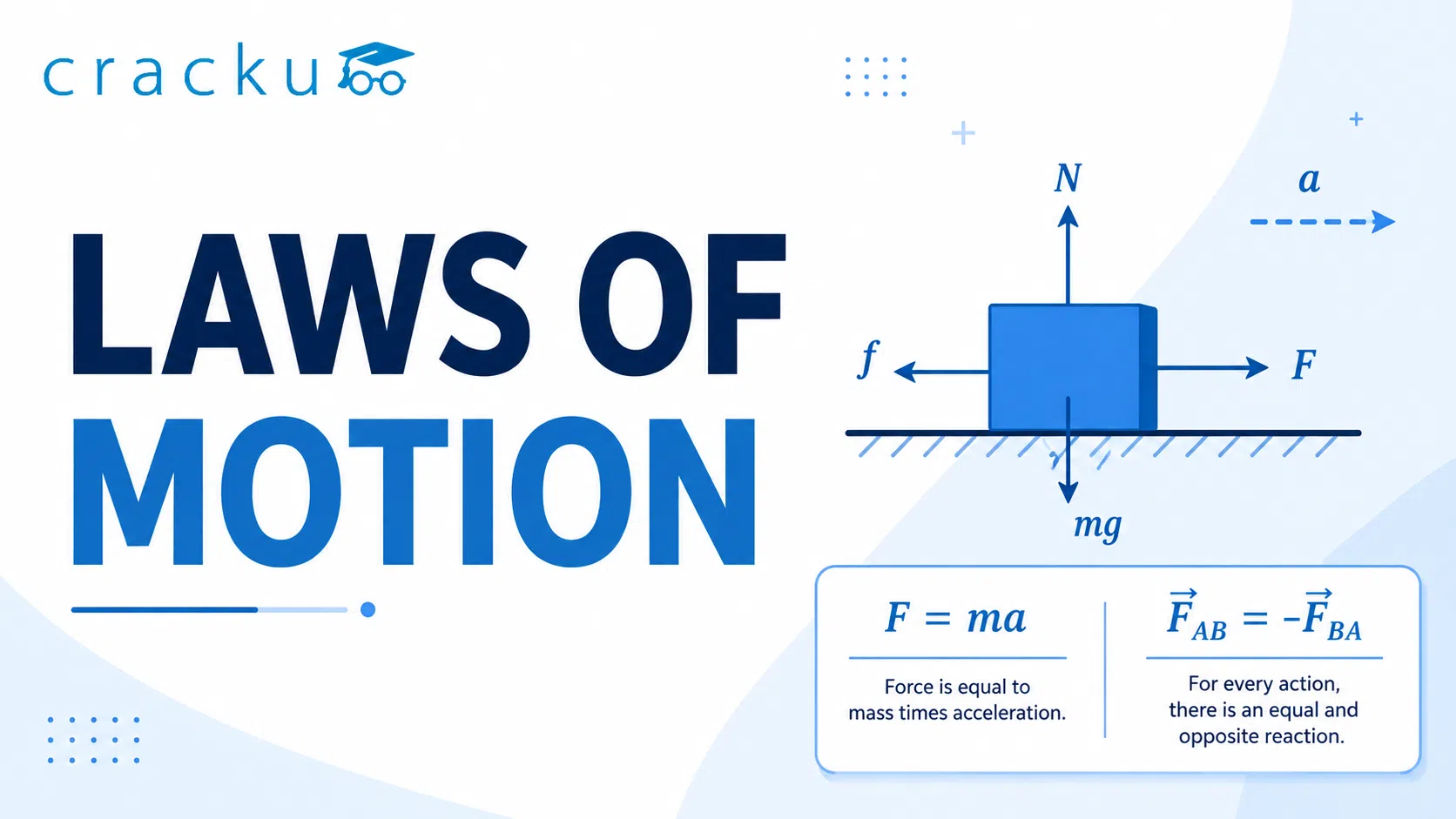
Kinematics answers how objects move. Laws of Motion answers why objects speed up, slow down or change direction. The answer is force, and Newton's three laws form the foundation of classical mechanics. These concepts directly connect with work and energy, circular motion and rotational dynamics. Practising JEE questions on Laws of Motion helps students understand how Newton's laws, free body diagrams, friction, momentum and force equations are applied in numerical problems. These Laws of Motion notes cover Newton's three laws, momentum and impulse, free body diagrams, friction, inclined planes, pulley systems, circular motion and banking of roads in a format built for quick JEE revision.
Laws of Motion JEE Notes: Newton's Three Laws
Force is a push or pull that can change the state of rest or motion of an object. It is a vector quantity measured in newtons.
$$1N = 1kg\cdot m/s^2$$
A force can change the velocity of an object by changing its speed, direction or both.
Newton's First Law (Law of Inertia)
Newton's first law states that an object remains at rest or continues moving with constant velocity unless acted upon by a net external force.
$$F_{net}=0 \Rightarrow a=0$$
This means if the net force acting on a body is zero, its velocity does not change.
Inertia is the tendency of an object to resist any change in its state of motion. Mass is the measure of inertia, which is why heavier objects are harder to accelerate or stop.
Types of inertia:
- Inertia of rest: tendency of an object to remain at rest.
- Inertia of motion: tendency of a moving object to continue moving.
- Inertia of direction: tendency to resist change in direction.
Worked example: Why do passengers move forward when a moving bus suddenly applies brakes?
The bus stops because of the braking force, but the passengers' bodies continue moving forward due to inertia of motion. Their bodies try to maintain the original velocity.
Newton's Second Law
Newton's second law gives the quantitative relationship between force, mass and acceleration.
$$F_{net}=ma$$
where:
- $$F_{net}$$ = net force acting on the object
- $$m$$ = mass of the object
- $$a$$ = acceleration produced
The acceleration produced is directly proportional to the net force and inversely proportional to the mass.
Important points:
- More force produces more acceleration for the same mass.
- More mass produces less acceleration for the same force.
- Acceleration always acts in the direction of the net force.
Worked example: A 5 kg block is pushed with a force of 20 N on a frictionless surface. Find acceleration.
Using:
$$F=ma$$
$$20=5a$$
$$a=4m/s^2$$
Worked example: A 2 kg object experiences 10 N force towards right and 4 N force towards left.
Net force:
$$F_{net}=10-4=6N$$
Therefore:
$$a=\frac{6}{2}=3m/s^2$$
The acceleration is towards the right.
Newton's Third Law
Newton's third law states that for every action, there is an equal and opposite reaction.
$$F_{AB}=-F_{BA}$$
where $$F_{AB}$$ is the force exerted by A on B and $$F_{BA}$$ is the force exerted by B on A.
Important points for JEE:
- Action and reaction forces act on different objects.
- They are equal in magnitude and opposite in direction.
- They act simultaneously.
- They never cancel each other because they act on different bodies.
Worked example: A person standing on the ground.
- The person pushes the Earth downward.
- The Earth pushes the person upward with an equal force.
- The Earth attracts the person downward gravitationally.
- The person attracts the Earth upward with an equal gravitational force.
Momentum, Impulse and Free Body Diagrams
Linear Momentum
Momentum represents the quantity of motion possessed by a moving object. A heavier object or a faster object has greater momentum.
$$p=mv$$
Momentum is a vector quantity and its direction is the same as velocity.
SI unit of momentum:
$$kg\cdot m/s$$
Newton's second law can also be written in momentum form:
$$F_{net}=\frac{dp}{dt}$$
For constant mass:
$$F_{net}=m\frac{dv}{dt}=ma$$
Impulse and Impulse-Momentum Theorem
Impulse is the product of force and the time interval for which it acts. It represents the change in momentum.
$$J=F\Delta t=\Delta p=mv-mu$$
Impulse increases when:
- Force increases.
- Contact time increases.
Worked example: A 0.15 kg cricket ball moving at 30 m/s is hit back with velocity 40 m/s in the opposite direction. The contact time is 0.01 s. Find average force.
Taking initial direction as positive:
$$\Delta p=0.15(-40-30)$$
$$\Delta p=-10.5kg\cdot m/s$$
Therefore:
$$F=\frac{\Delta p}{\Delta t}$$
$$F=\frac{-10.5}{0.01}=-1050N$$
The magnitude of force is 1050 N.
JEE tip: In rebound questions, remember that velocity changes direction. A ball hitting a wall and returning with the same speed has change in momentum:
$$\Delta p=2mv$$
Free Body Diagrams (FBD)
A free body diagram is a representation of a single object with all forces acting on it shown separately. It is the first step before applying Newton's laws.
Steps to draw an FBD:
- Isolate the object under consideration.
- Draw all external forces acting on the object.
- Choose suitable coordinate axes.
- Resolve forces if required.
- Apply $$F_{net}=ma$$ along each axis.
Common forces in an FBD:
- Weight (mg): acts vertically downward.
- Normal force (N): acts perpendicular to the contact surface.
- Friction (f): acts opposite to relative motion or tendency of motion.
- Tension (T): acts along a string pulling the object.
- Applied force: external force mentioned in the problem.
Important: Include only forces acting on the selected object. Never include reaction forces acting on another body in the same free body diagram.
Friction and Motion on an Inclined Plane
Laws of Friction
Friction is a force that acts along the contact surface and opposes relative motion or the tendency of motion between two surfaces. It is responsible for everyday activities like walking, driving and holding objects.
There are two main types of friction:
- Static friction: Acts when the object is at rest and prevents motion from starting.
- Kinetic friction: Acts when the object is already sliding over a surface.
Static friction adjusts itself according to the applied force until it reaches its maximum value.
$$f_s \leq \mu_sN$$
The maximum value of static friction is:
$$f_{s,max}=\mu_sN$$
For a moving object:
$$f_k=\mu_kN$$
where:
- $$\mu_s$$ = coefficient of static friction
- $$\mu_k$$ = coefficient of kinetic friction
- N = normal reaction
Important points for JEE:
- $$\mu_k<\mu_s$$, therefore starting motion is harder than maintaining motion.
- Friction does not depend on the area of contact for dry surfaces.
- The value of coefficient of friction depends on the nature of the surfaces.
Worked example: A 10 kg block rests on a horizontal surface with $$\mu_s=0.4$$ and $$\mu_k=0.3$$. Find the minimum force required to start motion and the acceleration when a 50 N force is applied.
Given:
$$N=mg=10\times10=100N$$
Maximum static friction:
$$f_{s,max}=0.4\times100=40N$$
The block starts moving when force exceeds:
40 N
Once moving:
$$f_k=0.3\times100=30N$$
Net force:
$$F_{net}=50-30=20N$$
Acceleration:
$$a=\frac{20}{10}=2m/s^2$$
Motion on an Inclined Plane
When an object is placed on an inclined plane, the weight of the object acts vertically downward. This weight can be resolved into two components:
- Component along the incline: $$mg\sin\theta$$
- Component perpendicular to the incline: $$mg\cos\theta$$
| Situation | Formula |
|---|---|
| Normal force | $$N=mg\cos\theta$$ |
| Acceleration on smooth incline | $$a=g\sin\theta$$ |
| Sliding down with friction | $$a=g(\sin\theta-\mu_k\cos\theta)$$ |
| Moving up with friction | $$a=g(\sin\theta+\mu_k\cos\theta)$$ |
| Condition for no sliding | $$\tan\theta\leq\mu_s$$ |
The maximum angle at which the object remains stationary is called the angle of repose.
$$\theta_{repose}=\tan^{-1}(\mu_s)$$
Worked example: A 5 kg block slides down a 30° rough incline with $$\mu_k=0.2$$. Find acceleration. Take $$g=10m/s^2$$.
Using:
$$a=g(\sin\theta-\mu_k\cos\theta)$$
$$a=10(0.5-0.2\times0.866)$$
$$a=10(0.327)$$
$$a=3.27m/s^2$$
JEE tip: To check whether an object slides, compare:
$$\tan\theta \text{ and } \mu_s$$
- If $$\tan\theta>\mu_s$$, the object slides.
- If $$\tan\theta\leq\mu_s$$, the object remains at rest.
Connected Bodies: Pulley Systems and Strings
Problems involving multiple blocks connected by strings are solved by drawing separate free body diagrams for each object and applying Newton's second law.
For an ideal string and pulley:
- The string is massless and inextensible.
- Tension remains the same throughout the string.
- An ideal pulley only changes the direction of tension, not its magnitude.
Atwood's Machine
Atwood's machine consists of two masses connected by a string passing over a pulley. If $$m_1>m_2$$, the heavier mass moves downward and the lighter mass moves upward.
$$a=\frac{(m_1-m_2)g}{m_1+m_2}$$
Tension in the string:
$$T=\frac{2m_1m_2g}{m_1+m_2}$$
Worked example: Two masses 5 kg and 3 kg are connected over an ideal pulley. Find acceleration and tension.
Acceleration:
$$a=\frac{(5-3)}{5+3}\times10$$
$$a=2.5m/s^2$$
Tension:
$$T=\frac{2\times5\times3\times10}{8}$$
$$T=37.5N$$
Mass on Table Connected to Hanging Mass
Consider a block of mass $$m_1$$ on a smooth horizontal table connected to a hanging mass $$m_2$$.
Both objects have the same acceleration because they are connected by the same string.
$$a=\frac{m_2g}{m_1+m_2}$$
Tension:
$$T=\frac{m_1m_2g}{m_1+m_2}$$
Worked example: A 4 kg block on a smooth table is connected to a 2 kg hanging mass. Find acceleration.
$$a=\frac{2}{4+2}\times10$$
$$a=3.33m/s^2$$
Circular Motion Forces and Banking of Roads
Centripetal Force and Acceleration
An object moving in a circular path constantly changes direction, even if its speed remains constant. Therefore, it experiences acceleration towards the centre of the circle.
$$a_c=\frac{v^2}{r}=\omega^2r$$
The force responsible for this acceleration is called centripetal force.
$$F_c=\frac{mv^2}{r}=m\omega^2r$$
Important: Centripetal force is not a new force. It is provided by existing forces like tension, friction, gravity or normal reaction.
| Situation | Centripetal Force Provided By |
|---|---|
| Stone tied to string | Tension |
| Car on flat road | Friction |
| Satellite orbit | Gravitational force |
| Banked road | Horizontal component of normal force |
Important: There is no real centrifugal force in an inertial frame. It is a fictitious force observed only from a rotating frame.
Worked example: A 1000 kg car moves on a flat circular road of radius 50 m. If coefficient of friction is 0.5, find maximum speed.
Friction provides centripetal force:
$$\mu_smg=\frac{mv^2}{r}$$
Mass cancels:
$$v=\sqrt{\mu_srg}$$
$$v=\sqrt{0.5\times50\times10}$$
$$v=\sqrt{250}$$
$$v=15.8m/s$$
Banking of Roads
Roads are banked at curves so that the normal reaction provides part of the centripetal force. This reduces dependence on friction.
$$\tan\theta=\frac{v^2}{rg}$$
Ideal speed on a banked road:
$$v=\sqrt{rg\tan\theta}$$
Worked example: A road is banked at 30° with radius 100 m. Find ideal speed.
$$v=\sqrt{100\times10\times\tan30^\circ}$$
$$v=\sqrt{577}$$
$$v\approx24m/s$$
Laws of Motion Formula Sheet at a Glance
| Concept | Formula |
|---|---|
| Newton's Second Law | $$F_{net}=ma$$ |
| Force in momentum form | $$F_{net}=\frac{dp}{dt}$$ |
| Linear momentum | $$p=mv$$ |
| Impulse | $$J=F\Delta t=\Delta p$$ |
| Coefficient of static friction | $$f_s\leq\mu_sN$$ |
| Maximum static friction | $$f_{s,max}=\mu_sN$$ |
| Kinetic friction | $$f_k=\mu_kN$$ |
| Friction on horizontal surface | $$f=\mu mg$$ |
| Normal reaction on inclined plane | $$N=mg\cos\theta$$ |
| Acceleration on smooth incline | $$a=g\sin\theta$$ |
| Acceleration on rough incline | $$a=g(\sin\theta-\mu\cos\theta)$$ |
| Angle of repose | $$\theta=\tan^{-1}\mu_s$$ |
| Atwood machine acceleration | $$a=\frac{(m_1-m_2)g}{m_1+m_2}$$ |
| Atwood machine tension | $$T=\frac{2m_1m_2g}{m_1+m_2}$$ |
| Centripetal acceleration | $$a_c=\frac{v^2}{r}=\omega^2r$$ |
| Centripetal force | $$F_c=\frac{mv^2}{r}=m\omega^2r$$ |
| Maximum speed on flat road | $$v_{max}=\sqrt{\mu rg}$$ |
| Banking angle | $$\tan\theta=\frac{v^2}{rg}$$ |
| Speed on ideal banked road | $$v=\sqrt{rg\tan\theta}$$ |
JEE Important Points, Common Mistakes and Quick Revision
Points JEE Repeatedly Tests
- Newton's first law explains inertia, while Newton's second law gives the quantitative relation between force and acceleration.
- Net force determines acceleration, not individual forces acting separately.
- Action and reaction forces always act on different objects and therefore never cancel each other.
- Momentum is a vector quantity, and its direction is the same as velocity.
- Impulse is equal to the change in momentum and is useful in collision and impact problems.
- Static friction adjusts itself until it reaches maximum static friction.
- Kinetic friction is generally less than maximum static friction: $$\mu_k<\mu_s$$
- On an inclined plane, resolve weight into components parallel and perpendicular to the surface.
- In connected body problems, all objects connected by an ideal string have the same magnitude of acceleration.
- Centripetal force is not an additional force; it is provided by existing forces like friction, tension or gravity.
- For circular motion, acceleration is always directed towards the centre.
- Banking of roads reduces dependence on friction by using the horizontal component of normal force.
Common Mistakes to Avoid
- Confusing action-reaction pairs. Action and reaction forces act on different objects. They cannot be cancelled while solving the motion of a single object.
- Using individual forces instead of net force. Always calculate the resultant force before applying $$F=ma$$.
- Taking friction in the wrong direction. Friction opposes relative motion or the tendency of motion, not always the applied force.
- Assuming friction always equals $$\mu N$$. Static friction can have any value from zero to its maximum value: $$f_s\leq\mu_sN$$.
- Forgetting to resolve forces on inclined planes. Use $$mg\sin\theta$$ along the incline and $$mg\cos\theta$$ perpendicular to the incline.
- Applying centripetal force as a separate force. Identify which real force provides the required centripetal force.
- Ignoring direction signs in momentum problems. Velocity direction must be considered while calculating change in momentum.
- Using wrong acceleration constraints in pulley problems. Objects connected by the same ideal string have related accelerations.
- Confusing centrifugal force with centripetal force. Centrifugal force is a pseudo force observed only from a rotating frame.
Quick Revision Notes for Laws of Motion
- Force is the cause of acceleration and is measured in newtons.
- Newton's first law explains inertia: $$F_{net}=0\Rightarrow a=0$$
- Newton's second law: $$F_{net}=ma$$
- Newton's third law: $$F_{AB}=-F_{BA}$$
- Momentum: $$p=mv$$
- Impulse: $$J=\Delta p$$
- Static friction: $$f_s\leq\mu_sN$$
- Maximum static friction: $$f_{max}=\mu_sN$$
- Kinetic friction: $$f_k=\mu_kN$$
- On an inclined plane: $$N=mg\cos\theta$$
- Acceleration down rough incline: $$a=g(\sin\theta-\mu\cos\theta)$$
- Angle of repose: $$\tan\theta=\mu_s$$
- Atwood machine: $$a=\frac{(m_1-m_2)g}{m_1+m_2}$$
- Centripetal force: $$F_c=\frac{mv^2}{r}$$
- Flat road circular motion: $$\mu mg=\frac{mv^2}{r}$$
- Banking without friction: $$\tan\theta=\frac{v^2}{rg}$$
Problem-solving routine: Start every Laws of Motion question by drawing a clear free body diagram and identifying all forces acting on the object. Resolve forces along suitable axes, calculate the net force and then apply Newton's second law. For friction, first determine whether the body is at rest or moving before choosing the correct friction formula. Use a JEE formula sheet during revision to quickly recall force equations, friction formulas, momentum relations and circular motion formulas.