Group
Group
 Group
Group


 Preferred Source

 Google Discover

Laws of Motion Formulas For JEE 2027
The Laws of Motion is one of the most important and frequently tested chapters in JEE Physics, as it forms the base for many other topics in mechanics. This chapter explains Newton’s three laws of motion and helps students understand how forces act on objects in different situations. It also covers important concepts such as friction, momentum, impulse, and the use of free body diagrams to study forces clearly. While preparing for JEE Mains, students should focus on understanding how forces behave in problems involving inclined planes, pulley systems, and bodies under different constraints. A clear understanding of these ideas makes it much easier to solve a wide range of mechanics problems.
In JEE Mains, this chapter usually contributes around 2–4 questions every year, which makes it a very important and scoring topic for students. Many numerical problems in mechanics depend on a strong understanding of force analysis and Newton’s laws. Questions often involve concepts like friction, circular motion forces, and systems of connected bodies, so practicing different types of problems is essential. To revise quickly and remember important formulas, students can use a well-organized JEE Mains Physics Formula PDF, which helps in fast revision and improves accuracy while solving exam-level questions.
What Are Newton's Laws?
In the Kinematics chapter, we learned how objects move. Now we ask the deeper question: why do objects move, speed up, slow down, or change direction? The answer lies in forces. Sir Isaac Newton formulated three laws that explain how forces affect motion. These three laws form the foundation of all of classical mechanics.
Force: A push or pull that can change the state of rest or motion of an object. Force is a vector quantity. SI unit: newton (N), where $$1 \text{ N} = 1 \text{ kg} \cdot \text{m/s}^2$$.
Newton's First Law (Law of Inertia)
Imagine a book lying on a table. It stays at rest until you push it. Now imagine a hockey puck sliding on ice — it keeps moving in a straight line until something (friction, a wall) stops it. Newton's first law captures this observation.
Newton's First Law
An object at rest remains at rest, and an object in motion continues to move with constant velocity (same speed, same direction), unless acted upon by a net external force.
$$$\text{If } \vec{F}_{\text{net}} = 0, \text{ then } \vec{a} = 0 \quad (\text{velocity is constant})$$$Inertia: The natural tendency of an object to resist any change in its state of rest or uniform motion. The mass of an object is a measure of its inertia — heavier objects are harder to start moving or to stop.
Worked Example
Why do passengers lurch forward when a bus suddenly brakes?
When the bus brakes, the bus slows down due to the braking force. But the passengers' bodies, due to inertia, tend to continue moving forward at the original speed. Since no backward force acts on the passengers immediately, they lurch forward relative to the bus.
Newton's Second Law
The first law tells us that a net force is needed to change an object's velocity. The second law tells us exactly how much the velocity changes — it gives the precise relationship between force, mass, and acceleration.
Newton's Second Law
The net force on an object equals its mass times its acceleration:
$$$\vec{F}_{\text{net}} = m\vec{a}$$$where $$\vec{F}_{\text{net}}$$ = vector sum of all forces acting on the object (N), $$m$$ = mass (kg), $$\vec{a}$$ = acceleration (m/s$$^2$$).
This means:
- More force $$\Rightarrow$$ more acceleration (for the same mass).
- More mass $$\Rightarrow$$ less acceleration (for the same force).
- The acceleration is in the same direction as the net force.
Worked Example
A 5 kg block is pushed with a force of 20 N on a frictionless surface. Find the acceleration.
$$F_{\text{net}} = ma$$
$$20 = 5 \times a$$
$$a = \dfrac{20}{5} = 4$$ m/s$$^2$$.
Worked Example
Two forces act on a 2 kg object: 10 N to the right and 4 N to the left. Find the acceleration.
Net force $$= 10 - 4 = 6$$ N to the right.
$$a = \dfrac{F_{\text{net}}}{m} = \dfrac{6}{2} = 3$$ m/s$$^2$$ to the right.
Newton's Third Law
Forces always come in pairs. You cannot push something without it pushing back on you. When you press your hand against a wall, the wall pushes back on your hand with equal force. This is Newton's third law.
Newton's Third Law
For every action, there is an equal and opposite reaction:
$$$\vec{F}_{AB} = -\vec{F}_{BA}$$$where $$\vec{F}_{AB}$$ = force exerted by A on B, and $$\vec{F}_{BA}$$ = force exerted by B on A.
Key points:
- Action and reaction act on different objects.
- They are equal in magnitude and opposite in direction.
- They act simultaneously (neither one comes first).
- They never cancel each other because they act on different bodies.
Worked Example
A person weighing 60 kg stands on the ground. Identify the action-reaction pairs.
Pair 1: The person pushes the Earth downward with a force of $$60 \times 9.8 = 588$$ N (weight). The Earth pushes the person upward with a normal force of 588 N.
Pair 2: The Earth pulls the person downward with gravitational force 588 N. The person pulls the Earth upward with gravitational force 588 N (the Earth's acceleration is negligible due to its enormous mass).
Momentum and Impulse Formulas
Newton actually stated his second law in terms of momentum, not directly as $$F = ma$$. Momentum is a measure of how hard it is to stop a moving object — a heavy truck moving slowly can be just as hard to stop as a light car moving fast.
Linear Momentum ($$\vec{p}$$): The product of mass and velocity: $$\vec{p} = m\vec{v}$$. It is a vector in the direction of velocity. SI unit: kg·m/s.
Newton's Second Law (Momentum Form)
$$$\vec{F}_{\text{net}} = \frac{d\vec{p}}{dt} = \frac{d(m\vec{v})}{dt}$$$If mass is constant: $$\vec{F}_{\text{net}} = m\dfrac{d\vec{v}}{dt} = m\vec{a}$$ (the familiar form).
Impulse ($$\vec{J}$$): The product of force and the time interval during which it acts. Impulse equals the change in momentum.
Impulse-Momentum Theorem
$$$\vec{J} = \vec{F} \cdot \Delta t = \Delta \vec{p} = m\vec{v} - m\vec{u}$$$where $$\vec{u}$$ = initial velocity, $$\vec{v}$$ = final velocity, $$\Delta t$$ = time of contact.
For a variable force: $$\vec{J} = \int_{t_1}^{t_2} \vec{F}\,dt$$
Worked Example
A 0.15 kg cricket ball moving at 30 m/s is hit back by a bat at 40 m/s. The bat is in contact for 0.01 s. Find the average force.
Taking the initial direction as positive:
$$\Delta p = m(v - u) = 0.15 \times (-40 - 30) = 0.15 \times (-70) = -10.5$$ kg·m/s.
$$F = \dfrac{\Delta p}{\Delta t} = \dfrac{-10.5}{0.01} = -1050$$ N.
The magnitude of the average force is 1050 N (opposite to the initial direction).
Tip: When a ball bounces off a wall, the change in momentum is $$\Delta p = m(v - (-v)) = 2mv$$ (if it bounces back at the same speed). Don't forget the sign reversal!
Free Body Diagrams (FBD)
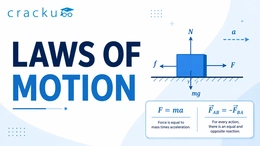
A Free Body Diagram is the most important problem-solving tool in mechanics. It is a sketch showing a single object isolated from its surroundings, with all the forces acting on it drawn as arrows. You must draw an FBD before applying Newton's second law.
Steps to Draw an FBD
- Isolate the object: Draw it as a simple shape (dot, box, circle).
- Identify all forces acting on the object:
- Weight ($$mg$$) — always acts downward.
- Normal force ($$N$$) — perpendicular to the contact surface, away from the surface.
- Friction ($$f$$) — along the surface, opposing relative motion or tendency of motion.
- Tension ($$T$$) — along the string/rope, pulling the object.
- Applied force ($$F$$) — as given in the problem.
- Draw each force as an arrow starting from the object, showing direction and label.
- Choose a convenient coordinate system (usually along and perpendicular to motion).
- Apply $$\vec{F}_{\text{net}} = m\vec{a}$$ along each axis.
Note: Include only forces acting on the chosen object. Do not include forces that the object exerts on others. A common mistake is to include both the action and reaction on the same body.
Friction Formulas Static and Kinetic
When two surfaces are in contact and one tries to slide over the other, a force arises along the contact surface that opposes the sliding. This is friction. Without friction, you could not walk, drive, or even hold a pen.
Static Friction ($$f_s$$): The friction that acts when the object is at rest relative to the surface. It adjusts its value to match the applied force, up to a maximum limit.
Kinetic Friction ($$f_k$$): The friction that acts when the object is sliding over the surface. It has a constant value (for a given pair of surfaces).
Laws of Friction
Static friction:
$$$f_s \leq \mu_s N$$$where $$\mu_s$$ = coefficient of static friction, $$N$$ = normal force.
The maximum static friction (just before the object starts to move) is:
$$$f_{s,\max} = \mu_s N$$$Kinetic friction:
$$$f_k = \mu_k N$$$where $$\mu_k$$ = coefficient of kinetic friction.
Key facts:
- $$\mu_k < \mu_s$$ always (it is easier to keep an object moving than to start it).
- Friction does not depend on the area of contact (for dry surfaces).
- $$\mu$$ depends on the nature of the two surfaces in contact.
Worked Example
A 10 kg block sits on a horizontal surface with $$\mu_s = 0.4$$ and $$\mu_k = 0.3$$. A horizontal force $$F$$ is gradually increased. Find: (a) the force needed to just start motion, (b) the acceleration if $$F = 50$$ N. ($$g = 10$$ m/s$$^2$$)
Normal force: $$N = mg = 10 \times 10 = 100$$ N.
(a) Maximum static friction: $$f_{s,\max} = \mu_s N = 0.4 \times 100 = 40$$ N.
The block just starts moving when $$F = 40$$ N.
(b) Once moving, kinetic friction applies: $$f_k = \mu_k N = 0.3 \times 100 = 30$$ N.
Net force $$= 50 - 30 = 20$$ N.
$$a = \dfrac{20}{10} = 2$$ m/s$$^2$$.
Inclined Plane Formulas
An inclined plane (ramp) is one of the most important setups in JEE physics. When an object is placed on a tilted surface making angle $$\theta$$ with the horizontal, its weight $$mg$$ has two components: one along the incline (pulling it down the slope) and one perpendicular to the incline (pressing it into the surface).
Forces on an Inclined Plane
For an object of mass $$m$$ on a smooth (frictionless) incline at angle $$\theta$$:
Component along the incline (causes sliding):
$$$mg\sin\theta$$$Component perpendicular to the incline (balanced by normal force):
$$$N = mg\cos\theta$$$Acceleration down a smooth incline:
$$$a = g\sin\theta$$$Inclined Plane with Friction
Object sliding down: Friction acts up the incline.
$$$a = g\sin\theta - \mu_k g\cos\theta = g(\sin\theta - \mu_k \cos\theta)$$$Object pushed up: Friction acts down the incline (opposing upward motion).
$$$a = g\sin\theta + \mu_k g\cos\theta = g(\sin\theta + \mu_k \cos\theta) \quad \text{(deceleration)}$$$Condition for the object to remain stationary on the incline:
$$$\tan\theta \leq \mu_s$$$The maximum angle before sliding begins is called the angle of repose: $$\theta_{\text{repose}} = \tan^{-1}(\mu_s)$$.
Worked Example
A 5 kg block is placed on an incline of $$30°$$ with $$\mu_k = 0.2$$. Find the acceleration down the incline. ($$g = 10$$ m/s$$^2$$)
$$a = g(\sin\theta - \mu_k \cos\theta)$$
$$= 10(\sin 30° - 0.2 \cos 30°)$$
$$= 10(0.5 - 0.2 \times 0.866)$$
$$= 10(0.5 - 0.173) = 10 \times 0.327 = 3.27$$ m/s$$^2$$.
Tip: To check whether a block will slide on an incline, compare $$\tan\theta$$ with $$\mu_s$$. If $$\tan\theta > \mu_s$$, the block slides. If $$\tan\theta \leq \mu_s$$, the block stays put.
Pulley and String Formulas: Atwood Machine
Many JEE problems involve two or more objects connected by strings, often passing over pulleys. To solve these, we draw separate FBDs for each object and use the constraint that a taut, inextensible string has the same tension throughout (if the string is massless) and the connected objects have related accelerations.
Ideal String: A string that is massless and inextensible. Tension is the same at every point along it.
Ideal Pulley: A pulley that is massless and frictionless. It only changes the direction of the tension; it does not change its magnitude.
Atwood's Machine
The simplest pulley setup: two masses $$m_1$$ and $$m_2$$ ($$m_1 > m_2$$) connected by a string over a single fixed pulley. The heavier mass accelerates downward; the lighter one accelerates upward.
Atwood's Machine
Acceleration:
$$$a = \frac{(m_1 - m_2)}{(m_1 + m_2)} \, g$$$Tension in the string:
$$$T = \frac{2m_1 m_2}{m_1 + m_2} \, g$$$where $$m_1 > m_2$$.
Worked Example
Two masses of 5 kg and 3 kg are connected over an ideal pulley. Find the acceleration and tension. ($$g = 10$$ m/s$$^2$$)
$$a = \dfrac{(5 - 3)}{(5 + 3)} \times 10 = \dfrac{2}{8} \times 10 = 2.5$$ m/s$$^2$$.
$$T = \dfrac{2 \times 5 \times 3}{5 + 3} \times 10 = \dfrac{30}{8} \times 10 = 37.5$$ N.
Mass on Table with Hanging Mass
A common setup: mass $$m_1$$ on a frictionless horizontal table, connected by a string over a pulley at the edge to a hanging mass $$m_2$$.
Table-Pulley System
Both masses have the same acceleration $$a$$ and the string has the same tension $$T$$:
$$$a = \frac{m_2}{m_1 + m_2} \, g$$$ $$$T = \frac{m_1 m_2}{m_1 + m_2} \, g$$$Worked Example
A 4 kg block on a smooth table is connected to a 2 kg hanging mass. Find $$a$$ and $$T$$. ($$g = 10$$ m/s$$^2$$)
$$a = \dfrac{2}{4 + 2} \times 10 = \dfrac{2}{6} \times 10 = 3.33$$ m/s$$^2$$.
$$T = \dfrac{4 \times 2}{4 + 2} \times 10 = \dfrac{8}{6} \times 10 = 13.33$$ N.
Circular Motion and Centripetal Force Formulas
When an object moves in a circle (like a car turning a corner or a stone whirled on a string), it is constantly changing direction. This means it has an acceleration directed toward the centre of the circle, called centripetal acceleration. By Newton's second law, this requires a centripetal force directed toward the centre.
Centripetal Force: The net force directed toward the centre of the circular path that keeps an object moving in a circle. It is not a new type of force — it is provided by tension, friction, gravity, normal force, or some combination.
Circular Motion Formulas
For an object of mass $$m$$ moving with speed $$v$$ in a circle of radius $$r$$:
Centripetal acceleration:
$$$a_c = \frac{v^2}{r} = \omega^2 r$$$Centripetal force:
$$$F_c = \frac{mv^2}{r} = m\omega^2 r$$$where $$\omega$$ = angular velocity (rad/s), $$v = \omega r$$.
Note: There is no outward "centrifugal force" in an inertial frame. The object tends to go straight (inertia), and the centripetal force pulls it inward. "Centrifugal force" is a fictitious force that appears only in a rotating (non-inertial) frame.
Common Examples of Centripetal Force
Sources of Centripetal Force
| Situation | Centripetal Force Provided By |
|---|---|
| Stone on a string (horizontal circle) | Tension in the string |
| Car on a flat circular road | Friction between tyres and road |
| Car on a banked road (no friction) | Component of normal force |
| Satellite orbiting Earth | Gravitational force |
| Electron orbiting nucleus | Electrostatic force |
Worked Example
A 1000 kg car takes a flat circular turn of radius 50 m. If $$\mu_s = 0.5$$, find the maximum speed. ($$g = 10$$ m/s$$^2$$)
Friction provides the centripetal force: $$f_s = \dfrac{mv^2}{r}$$
Maximum friction $$= \mu_s mg = 0.5 \times 1000 \times 10 = 5000$$ N.
$$5000 = \dfrac{1000 \times v^2}{50}$$
$$v^2 = \dfrac{5000 \times 50}{1000} = 250$$
$$v = \sqrt{250} \approx 15.8$$ m/s $$\approx 56.9$$ km/h.
Banking of Roads
On a banked road (tilted inward), the normal force has a horizontal component that helps provide centripetal force. This reduces (or eliminates) the need for friction.
Banked Road (No Friction)
For a road banked at angle $$\theta$$, the ideal speed (no friction needed) is:
$$$\tan\theta = \frac{v^2}{rg}$$$ $$$v = \sqrt{rg\tan\theta}$$$Worked Example
A road is banked at $$30°$$ for a curve of radius 100 m. Find the ideal speed. ($$g = 10$$ m/s$$^2$$)
$$v = \sqrt{rg\tan\theta} = \sqrt{100 \times 10 \times \tan 30°} = \sqrt{1000 \times 0.577} = \sqrt{577} \approx 24$$ m/s.
Summary of Key Formulas
Laws of Motion Formula Sheet
| Concept | Formula |
|---|---|
| Newton's Second Law | $$F_{\text{net}} = ma$$ |
| Momentum | $$p = mv$$ |
| Impulse | $$J = F \Delta t = \Delta p$$ |
| Static friction (max) | $$f_{s,\max} = \mu_s N$$ |
| Kinetic friction | $$f_k = \mu_k N$$ |
| Normal force on incline | $$N = mg\cos\theta$$ |
| Acceleration down incline | $$a = g(\sin\theta - \mu_k\cos\theta)$$ |
| Angle of repose | $$\theta_r = \tan^{-1}(\mu_s)$$ |
| Atwood acceleration | $$a = \frac{(m_1 - m_2)g}{m_1 + m_2}$$ |
| Atwood tension | $$T = \frac{2m_1 m_2 g}{m_1 + m_2}$$ |
| Centripetal force | $$F_c = \frac{mv^2}{r}$$ |
| Banking angle | $$\tan\theta = \frac{v^2}{rg}$$ |
Tip: For any problem involving forces: (1) Draw the FBD for each object. (2) Choose axes (along motion and perpendicular). (3) Write $$F_{\text{net}} = ma$$ along each axis. (4) Use constraints (same string $$\Rightarrow$$ same tension, same acceleration). This systematic approach solves virtually every JEE mechanics problem.
Laws of Motion Formulas For JEE 2027: Conclusion
The Laws of Motion chapter is one of the most fundamental topics in JEE Physics, as it explains how forces influence the motion of objects. Concepts such as Newton’s three laws, friction, momentum, impulse, and centripetal force are widely used to solve many mechanics problems. Understanding the Laws Of Motion Formulas For JEE 2027 helps students analyze force systems, draw accurate free body diagrams, and apply equations correctly while solving numerical questions in JEE Main and Advanced.
For effective preparation, students should regularly revise key formulas and practice different types of problems related to inclined planes, pulley systems, and circular motion. Using a well-structured JEE Mains Physics Formula PDF can make revision faster and more efficient. With a clear understanding of the concepts and consistent practice, students can improve their problem-solving skills and score better in the JEE Physics section.