JEE WhatsApp Group



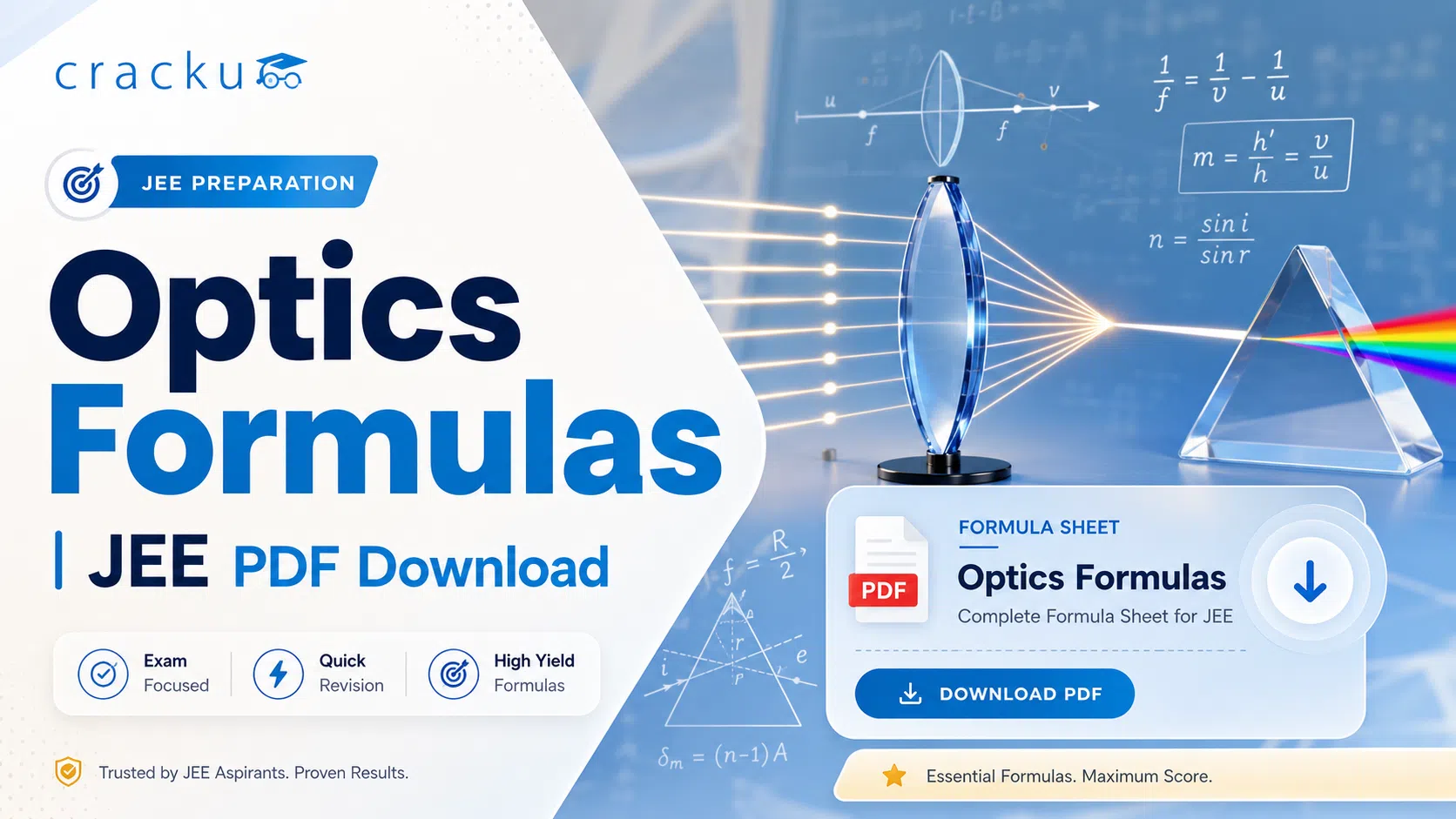
Optics Formulas For JEE 2027
Optics is one of the most important and high-weightage chapters in JEE Physics, consistently contributing several questions in both JEE Main and JEE Advanced. It is a crucial topic for JEE 2027 aspirants because many questions are based on direct formula application and conceptual understanding. The chapter is broadly divided into Ray Optics and Wave Optics. Ray Optics covers reflection, refraction, mirrors, lenses, prisms, and optical instruments, while Wave Optics includes interference, diffraction, and polarization. A strong grasp of these concepts and the related JEE Physics Formulas 2027 can help students solve problems more accurately and efficiently.
For quick and effective revision, many students prefer using consolidated formula sheets. Referring to JEE Formulas 2027 helps aspirants revise important optics formulas, standard results, and key concepts in less time. A well-organized formula resource can improve conceptual clarity, boost problem-solving speed, and support better performance during mock tests as well as the actual examination.
Reflection of Light: Mirror Formula
When light hits a surface and bounces back into the same medium, it is called reflection. Think of a ball bouncing off a wall — light behaves similarly. Reflection is how mirrors work, and it follows two simple laws that apply to all reflecting surfaces.
Angle of Incidence ($$i$$): The angle between the incoming ray and the normal (perpendicular) to the surface at the point where the ray hits.
Angle of Reflection ($$r$$): The angle between the reflected ray and the normal to the surface.
Laws of Reflection
- The angle of incidence equals the angle of reflection: $$i = r$$
- The incident ray, reflected ray, and normal all lie in the same plane
These laws hold for all types of reflecting surfaces — flat or curved.
Plane Mirror
A plane mirror is a flat reflecting surface. It forms an image that is the same size as the object, the same distance behind the mirror as the object is in front, and laterally inverted (left becomes right).
Properties of a Plane Mirror Image
- Image is virtual (cannot be captured on a screen), erect, and same size as the object
- Image distance = Object distance (from the mirror)
- The image is laterally inverted (left-right reversed)
- If the mirror rotates by angle $$\theta$$, the reflected ray rotates by $$2\theta$$
- Minimum mirror height needed to see full body $$= \frac{\text{height of person}}{2}$$
Spherical Mirrors
A spherical mirror is a piece of a sphere that has been made reflective. If the reflecting surface is on the inside (like the inside of a spoon), it is a concave mirror. If the reflecting surface is on the outside, it is a convex mirror.
Centre of Curvature ($$C$$): The centre of the sphere of which the mirror is a part.
Radius of Curvature ($$R$$): The radius of the sphere; the distance from the centre of curvature to the mirror surface.
Focus ($$F$$): The point where rays parallel to the principal axis converge (concave) or appear to diverge from (convex) after reflection. For spherical mirrors: $$f = R/2$$.
Mirror Formula and Magnification
Mirror formula:
$$$\frac{1}{v} + \frac{1}{u} = \frac{1}{f}$$$Magnification:
$$$m = \frac{h_i}{h_o} = -\frac{v}{u}$$$where:
- $$u$$ = object distance (from the mirror), $$v$$ = image distance
- $$f$$ = focal length ($$= R/2$$)
- $$h_o$$ = object height, $$h_i$$ = image height
- $$m > 0$$: erect image; $$m < 0$$: inverted image
- $$|m| > 1$$: magnified; $$|m| < 1$$: diminished
Sign convention (New Cartesian):
- All distances measured from the pole (centre of mirror)
- Direction of incident light is taken as positive ($$+$$ve)
- Distances opposite to incident light are negative
- Concave mirror: $$f < 0$$; Convex mirror: $$f > 0$$
Worked Example
An object is placed 30 cm in front of a concave mirror of focal length 20 cm. Find the image position and magnification.
Using sign convention: $$u = -30$$ cm, $$f = -20$$ cm
$$\frac{1}{v} + \frac{1}{u} = \frac{1}{f} \Rightarrow \frac{1}{v} = \frac{1}{f} - \frac{1}{u} = \frac{1}{-20} - \frac{1}{-30} = -\frac{1}{20} + \frac{1}{30}$$
$$\frac{1}{v} = \frac{-3 + 2}{60} = \frac{-1}{60} \Rightarrow v = -60$$ cm
The image is 60 cm in front of the mirror (real, since $$v < 0$$).
$$m = -\frac{v}{u} = -\frac{-60}{-30} = -2$$
The image is real, inverted, and magnified (twice the size).
Worked Example
A convex mirror has a focal length of 15 cm. An object is placed 20 cm from the mirror. Find the image.
$$u = -20$$ cm, $$f = +15$$ cm
$$\frac{1}{v} = \frac{1}{f} - \frac{1}{u} = \frac{1}{15} - \frac{1}{-20} = \frac{1}{15} + \frac{1}{20} = \frac{4+3}{60} = \frac{7}{60}$$
$$v = \frac{60}{7} \approx +8.57$$ cm (positive means behind the mirror — virtual)
$$m = -\frac{v}{u} = -\frac{8.57}{-20} = +0.43$$
The image is virtual, erect, and diminished.
Tip: Convex mirrors always form virtual, erect, and diminished images regardless of object position. This is why they are used as rear-view mirrors in vehicles — they give a wider field of view.
Refraction of Light: Snell's Law
When light passes from one transparent medium to another (e.g., from air into water), it changes speed and usually changes direction. This bending of light is called refraction. Light slows down when entering a denser medium and speeds up when entering a rarer medium.
Refractive Index ($$n$$): A measure of how much a medium slows down light compared to vacuum. $$n = c/v$$, where $$c$$ is the speed of light in vacuum and $$v$$ is the speed in the medium. A higher $$n$$ means a "denser" optical medium.
Snell's Law of Refraction
$$$n_1 \sin\theta_1 = n_2 \sin\theta_2$$$where:
- $$n_1, n_2$$ = refractive indices of medium 1 and medium 2
- $$\theta_1$$ = angle of incidence (in medium 1)
- $$\theta_2$$ = angle of refraction (in medium 2)
When light goes from a rarer to a denser medium ($$n_2 > n_1$$), it bends toward the normal ($$\theta_2 < \theta_1$$). When going from denser to rarer, it bends away from the normal.
Worked Example
A light ray passes from air ($$n = 1$$) into glass ($$n = 1.5$$) at an angle of incidence of $$45^\circ$$. Find the angle of refraction.
$$n_1 \sin\theta_1 = n_2 \sin\theta_2$$
$$1 \times \sin 45^\circ = 1.5 \times \sin\theta_2$$
$$\sin\theta_2 = \frac{\sin 45^\circ}{1.5} = \frac{0.707}{1.5} = 0.471$$
$$\theta_2 = \sin^{-1}(0.471) \approx 28.1^\circ$$
The light bends toward the normal (as expected when entering a denser medium).
Total Internal Reflection
When light travels from a denser medium to a rarer medium, it bends away from the normal. As the angle of incidence increases, the refracted ray bends more and more. At a certain angle, called the critical angle, the refracted ray goes along the surface ($$\theta_2 = 90^\circ$$). Beyond this angle, no refraction occurs — all the light is reflected back into the denser medium. This is total internal reflection (TIR).
Critical Angle ($$\theta_c$$): The angle of incidence in the denser medium at which the angle of refraction equals $$90^\circ$$.
Critical angle:
$$$\sin\theta_c = \frac{n_2}{n_1} \quad (n_1 > n_2)$$$For a medium of refractive index $$n$$ with air ($$n_2 = 1$$):
$$$\sin\theta_c = \frac{1}{n}$$$Conditions for TIR:
- Light must travel from denser to rarer medium
- Angle of incidence must be greater than the critical angle ($$\theta > \theta_c$$)
Worked Example
Find the critical angle for glass ($$n = 1.5$$) to air.
$$\sin\theta_c = \frac{1}{n} = \frac{1}{1.5} = 0.667$$
$$\theta_c = \sin^{-1}(0.667) \approx 41.8^\circ$$
Any light ray inside the glass hitting the surface at an angle greater than $$41.8^\circ$$ will undergo total internal reflection.
Tip: TIR is the principle behind optical fibres (used for high-speed internet) and the sparkling of diamonds (critical angle is very small, about $$24.4^\circ$$, due to high refractive index $$n = 2.42$$).
Refraction at Spherical Surfaces Formula
When light refracts at a curved (spherical) surface separating two media, we can derive a formula relating the object distance, image distance, and the radius of curvature.
Refraction at a Single Spherical Surface
$$$\frac{n_2}{v} - \frac{n_1}{u} = \frac{n_2 - n_1}{R}$$$where:
- $$n_1$$ = refractive index of the medium the light comes from
- $$n_2$$ = refractive index of the medium the light enters
- $$u$$ = object distance, $$v$$ = image distance
- $$R$$ = radius of curvature of the surface (positive if centre of curvature is on the refracted ray side)
Thin Lens and Lens Maker's Formula
A lens is a piece of transparent material (usually glass) with two refracting surfaces. A convex (converging) lens is thicker in the middle and brings parallel rays to a focus. A concave (diverging) lens is thinner in the middle and spreads parallel rays apart.
Thin Lens Formula
$$$\frac{1}{v} - \frac{1}{u} = \frac{1}{f}$$$Magnification:
$$$m = \frac{h_i}{h_o} = \frac{v}{u}$$$Sign convention:
- Distances measured from the optical centre of the lens
- Convex lens: $$f > 0$$; Concave lens: $$f < 0$$
- Object on the left: $$u < 0$$
Power of a Lens ($$P$$): The ability of a lens to converge or diverge light, measured in dioptres (D). $$P = 1/f$$, where $$f$$ is in metres. Convex lens has $$P > 0$$; concave lens has $$P < 0$$.
Lens Maker's Equation
$$$\frac{1}{f} = (n - 1)\left(\frac{1}{R_1} - \frac{1}{R_2}\right)$$$where:
- $$n$$ = refractive index of the lens material (relative to the surrounding medium)
- $$R_1$$ = radius of curvature of the first surface (the surface light hits first)
- $$R_2$$ = radius of curvature of the second surface
Worked Example
An object is placed 40 cm from a convex lens of focal length 15 cm. Find the image position and nature.
$$u = -40$$ cm, $$f = +15$$ cm
$$\frac{1}{v} = \frac{1}{f} + \frac{1}{u} = \frac{1}{15} + \frac{1}{-40} = \frac{1}{15} - \frac{1}{40} = \frac{8 - 3}{120} = \frac{5}{120}$$
$$v = 24$$ cm (positive: real image on the other side of the lens)
$$m = \frac{v}{u} = \frac{24}{-40} = -0.6$$ (inverted, diminished)
Worked Example
A biconvex lens has radii of curvature 20 cm and 30 cm, and $$n = 1.5$$. Find its focal length and power.
$$R_1 = +20$$ cm (first surface convex ⇒ centre of curvature on the right)
$$R_2 = -30$$ cm (second surface convex ⇒ centre of curvature on the left)
$$\frac{1}{f} = (1.5 - 1)\left(\frac{1}{20} - \frac{1}{-30}\right) = 0.5\left(\frac{1}{20} + \frac{1}{30}\right) = 0.5 \times \frac{5}{60} = \frac{5}{120}$$
$$f = 24$$ cm $$= 0.24$$ m
$$P = \frac{1}{f} = \frac{1}{0.24} \approx 4.17$$ D
Combination of Thin Lenses
When two thin lenses are placed in contact, the system behaves like a single lens whose power is the sum of the individual powers.
Combination of Lenses in Contact
$$$\frac{1}{f_{\text{eq}}} = \frac{1}{f_1} + \frac{1}{f_2}$$$or equivalently:
$$$P_{\text{eq}} = P_1 + P_2$$$For lenses separated by distance $$d$$:
$$$\frac{1}{f_{\text{eq}}} = \frac{1}{f_1} + \frac{1}{f_2} - \frac{d}{f_1 f_2}$$$A convex lens of focal length 20 cm is placed in contact with a concave lens of focal length 30 cm. Find the focal length of the combination.
$$\frac{1}{f} = \frac{1}{20} + \frac{1}{-30} = \frac{3 - 2}{60} = \frac{1}{60}$$
$$f = 60$$ cm (positive: the combination acts as a converging lens)
$$P = \frac{1}{0.6} \approx 1.67$$ D
Prism: Deviation and Dispersion Formulas
A prism is a transparent triangular block that refracts light. When white light enters a prism, different colours bend by different amounts (because the refractive index depends slightly on wavelength). This separates white light into its component colours — a phenomenon called dispersion.
Angle of Deviation ($$\delta$$): The angle between the incoming ray and the outgoing ray after passing through the prism.
Angle of Prism ($$A$$): The angle between the two refracting surfaces of the prism.
Prism Formulas
General deviation:
$$$\delta = (i_1 + i_2) - A$$$where $$i_1$$ = angle of incidence, $$i_2$$ = angle of emergence.
At the prism: $$r_1 + r_2 = A$$ (where $$r_1, r_2$$ are angles of refraction at the two surfaces)
Minimum deviation ($$\delta_m$$): occurs when $$i_1 = i_2$$ and $$r_1 = r_2 = A/2$$
$$$n = \frac{\sin\!\left(\frac{A + \delta_m}{2}\right)}{\sin\!\left(\frac{A}{2}\right)}$$$For a thin prism (small $$A$$):
$$$\delta = (n - 1)A$$$Dispersion by a Prism
Angular dispersion: $$\theta = \delta_V - \delta_R = (n_V - n_R)A$$ (for thin prism)
Dispersive power:
$$$\omega = \frac{n_V - n_R}{n_Y - 1} = \frac{\theta}{\delta_Y}$$$where $$n_V, n_R, n_Y$$ are refractive indices for violet, red, and yellow (mean) light.
Worked Example
A prism of angle $$60^\circ$$ and refractive index 1.5 is in the minimum deviation position. Find $$\delta_m$$.
$$n = \frac{\sin\!\left(\frac{A + \delta_m}{2}\right)}{\sin\!\left(\frac{A}{2}\right)}$$
$$1.5 = \frac{\sin\!\left(\frac{60 + \delta_m}{2}\right)}{\sin 30^\circ} = \frac{\sin\!\left(\frac{60 + \delta_m}{2}\right)}{0.5}$$
$$\sin\!\left(\frac{60 + \delta_m}{2}\right) = 0.75$$
$$\frac{60 + \delta_m}{2} = \sin^{-1}(0.75) = 48.59^\circ$$
$$60 + \delta_m = 97.18^\circ \Rightarrow \delta_m \approx 37.2^\circ$$
Optical Instruments — Microscope and Telescope Formulas
Optical instruments use lenses and/or mirrors to extend the capability of the human eye — to see very small objects (microscope) or very distant objects (telescope).
Simple Microscope (Magnifying Glass)
A single convex lens held close to the eye acts as a magnifying glass. The object is placed within the focal length, producing a virtual, erect, magnified image.
Simple Microscope
Magnifying power:
- Image at near point ($$D = 25$$ cm): $$M = 1 + \frac{D}{f}$$
- Image at infinity (relaxed eye): $$M = \frac{D}{f}$$
Compound Microscope
A compound microscope uses two convex lenses — the objective (short focal length, near the object) and the eyepiece (near the eye). The objective creates a real, magnified image, which the eyepiece further magnifies like a simple microscope.
Magnifying power:
$$$M = m_o \times m_e$$$- Image at near point: $$M = -\frac{v_o}{u_o}\left(1 + \frac{D}{f_e}\right)$$
- Image at infinity: $$M = -\frac{L}{f_o} \times \frac{D}{f_e}$$
where $$L$$ = tube length (distance between the two lenses), $$f_o$$ = focal length of the objective, $$f_e$$ = focal length of the eyepiece, and $$D = 25$$ cm (least distance of distinct vision).
Telescope
A telescope is used to view distant objects. An astronomical telescope uses two convex lenses. The objective (large focal length) collects light from a distant object and forms a real image at its focus. The eyepiece magnifies this image.
Astronomical Telescope
Magnifying power (in normal adjustment, image at infinity):
$$$M = -\frac{f_o}{f_e}$$$Tube length: $$L = f_o + f_e$$
When the image is at the near point:
$$$M = -\frac{f_o}{f_e}\left(1 + \frac{f_e}{D}\right)$$$Worked Example
A telescope has an objective of focal length 100 cm and eyepiece of focal length 5 cm. Find the magnifying power and tube length in normal adjustment.
$$M = -\frac{f_o}{f_e} = -\frac{100}{5} = -20$$
The magnitude is 20 (the negative sign indicates an inverted image).
Tube length: $$L = f_o + f_e = 100 + 5 = 105$$ cm
Tip: In a telescope, larger $$f_o$$ and smaller $$f_e$$ give higher magnification. In a microscope, both $$f_o$$ and $$f_e$$ should be small for high magnification. JEE commonly asks you to distinguish between these two instruments.
Wave Optics: Huygens' Principle
So far we have treated light as rays (ray optics). But light is actually a wave, and to explain phenomena like interference and diffraction, we need wave optics. Huygens' principle provides the foundation for wave optics.
Wavefront: A surface over which the wave has the same phase. For a point source, wavefronts are spheres. For a distant source, wavefronts are planes.
Huygens' Principle
- Every point on a wavefront acts as a source of secondary spherical wavelets
- The new wavefront at a later time is the forward envelope of all these secondary wavelets
- This principle explains reflection, refraction, and diffraction of waves
Young's Double Slit Experiment: Fringe Width Formula
In 1801, Thomas Young demonstrated that light is a wave by showing interference — when light from two slits overlaps, it produces alternating bright and dark bands (called fringes) on a screen. This happens because the waves from the two slits can add up (constructive interference) or cancel out (destructive interference).
Path Difference ($$\Delta x$$): The difference in the distances travelled by light from the two slits to a point on the screen. It determines whether that point is bright or dark.
Young's Double Slit Experiment
For two slits separated by distance $$d$$, with a screen at distance $$D$$:
Path difference at a point at height $$y$$ from the centre:
$$$\Delta x = \frac{yd}{D}$$$Bright fringes (constructive): $$\Delta x = n\lambda$$ ($$n = 0, 1, 2, …$$)
$$$y_n = \frac{n\lambda D}{d}$$$Dark fringes (destructive): $$\Delta x = \left(n + \frac{1}{2}\right)\lambda$$ ($$n = 0, 1, 2, …$$)
$$$y_n = \frac{(2n+1)\lambda D}{2d}$$$Fringe width (distance between consecutive bright or dark fringes):
$$$\beta = \frac{\lambda D}{d}$$$Worked Example
In a YDSE, the slit separation is 0.5 mm, the screen distance is 1 m, and the wavelength is 600 nm. Find the fringe width and the position of the 3rd bright fringe.
$$\beta = \frac{\lambda D}{d} = \frac{600 \times 10^{-9} \times 1}{0.5 \times 10^{-3}} = \frac{6 \times 10^{-7}}{5 \times 10^{-4}} = 1.2 \times 10^{-3}$$ m $$= 1.2$$ mm
Position of 3rd bright fringe: $$y_3 = \frac{3\lambda D}{d} = 3\beta = 3 \times 1.2 = 3.6$$ mm
Worked Example
In a YDSE with $$d = 1$$ mm and $$D = 1$$ m, the 5th bright fringe is at 3 mm from the centre. Find the wavelength.
$$y_5 = \frac{5\lambda D}{d}$$
$$3 \times 10^{-3} = \frac{5\lambda \times 1}{1 \times 10^{-3}}$$
$$\lambda = \frac{3 \times 10^{-3} \times 10^{-3}}{5} = 6 \times 10^{-7}$$ m $$= 600$$ nm
Note: If YDSE is performed in a medium of refractive index $$n$$, the wavelength becomes $$\lambda' = \lambda/n$$, and the fringe width becomes $$\beta' = \beta/n$$. The fringes become narrower.
Single Slit Diffraction Formula
When light passes through a single narrow slit, it spreads out and creates a pattern of bright and dark bands on a screen. This spreading of light around obstacles is called diffraction. The central bright fringe is the widest and brightest, with progressively dimmer fringes on both sides.
Single Slit Diffraction
For a slit of width $$a$$ with screen at distance $$D$$:
Condition for dark fringes (minima):
$$$a\sin\theta = n\lambda \quad (n = \pm 1, \pm 2, \pm 3, …)$$$Position on screen: $$y_n = \frac{n\lambda D}{a}$$
Central maximum width:
$$$W_0 = \frac{2\lambda D}{a}$$$(The central maximum is twice as wide as the other maxima.)
Width of secondary maxima:
$$$W = \frac{\lambda D}{a}$$$Worked Example
Light of wavelength 500 nm passes through a slit of width 0.1 mm. The screen is 2 m away. Find the width of the central maximum.
$$W_0 = \frac{2\lambda D}{a} = \frac{2 \times 500 \times 10^{-9} \times 2}{0.1 \times 10^{-3}} = \frac{2 \times 10^{-6}}{10^{-4}} = 0.02$$ m $$= 2$$ cm
Tip: Key difference: In double slit interference, all fringes have equal width $$\beta$$. In single slit diffraction, the central maximum has width $$2\lambda D/a$$ (double the others). JEE often tests this distinction.
Polarization: Brewster's Law and Malus's Law
Light is a transverse wave — its electric field oscillates perpendicular to the direction of travel. In ordinary light, the electric field vibrates in all directions perpendicular to the ray. Polarized light has its electric field vibrating in only one direction. Polarization proves that light is a transverse wave.
Polarization: The phenomenon of restricting the vibrations of a transverse wave to a single plane.
Malus's Law
When polarized light of intensity $$I_0$$ passes through a polarizer (analyser) with its axis at angle $$\theta$$ to the polarization direction:
$$$I = I_0 \cos^2\theta$$$- $$\theta = 0^\circ$$: $$I = I_0$$ (full transmission)
- $$\theta = 90^\circ$$: $$I = 0$$ (complete blocking)
When unpolarized light passes through a polarizer, the transmitted intensity is $$I_0/2$$.
When light reflects off a transparent surface (like glass or water) at a particular angle, the reflected light becomes fully polarized. This special angle is called the Brewster angle.
Brewster Angle ($$\theta_B$$): The angle of incidence at which the reflected light is completely polarized. At this angle, the reflected and refracted rays are perpendicular.
Brewster's Law
$$$\tan\theta_B = n$$$where $$n$$ is the refractive index of the reflecting medium.
At Brewster's angle: $$\theta_B + \theta_r = 90^\circ$$ (reflected and refracted rays are perpendicular).
Worked Example
Find the Brewster angle for glass ($$n = 1.5$$).
$$\tan\theta_B = n = 1.5$$
$$\theta_B = \tan^{-1}(1.5) \approx 56.3^\circ$$
At this angle of incidence, the reflected light is completely polarized.
Worked Example
Unpolarized light of intensity $$I_0$$ passes through two polarizers. The first transmits half the intensity. The second is at $$60^\circ$$ to the first. Find the final intensity.
After first polarizer: $$I_1 = \frac{I_0}{2}$$ (unpolarized ⇒ polarized)
After second polarizer (Malus's law): $$I_2 = I_1 \cos^2 60^\circ = \frac{I_0}{2} \times \left(\frac{1}{2}\right)^2 = \frac{I_0}{8}$$
Summary of Key Formulas: Ray Optics
Quick Reference: Ray Optics
| Quantity | Formula |
|---|---|
| Mirror formula | $$\frac{1}{v} + \frac{1}{u} = \frac{1}{f}$$ |
| Mirror magnification | $$m = -\frac{v}{u}$$ |
| Snell's law | $$n_1\sin\theta_1 = n_2\sin\theta_2$$ |
| Critical angle | $$\sin\theta_c = \frac{1}{n}$$ |
| Lens formula | $$\frac{1}{v} - \frac{1}{u} = \frac{1}{f}$$ |
| Lens maker's equation | $$\frac{1}{f} = (n-1)\!\left(\frac{1}{R_1} - \frac{1}{R_2}\right)$$ |
| Power of lens | $$P = \frac{1}{f}$$ (in dioptres, $$f$$ in metres) |
| Lenses in contact | $$\frac{1}{f} = \frac{1}{f_1} + \frac{1}{f_2}$$ |
| Prism (min. deviation) | $$n = \frac{\sin\!\left(\frac{A+\delta_m}{2}\right)}{\sin(A/2)}$$ |
| Thin prism deviation | $$\delta = (n-1)A$$ |
Summary of Key Formulas Wave Optics
Quick Reference: Wave Optics
| Quantity | Formula |
|---|---|
| YDSE fringe width | $$\beta = \frac{\lambda D}{d}$$ |
| YDSE bright fringe | $$y_n = \frac{n\lambda D}{d}$$ |
| Single slit central max | $$W_0 = \frac{2\lambda D}{a}$$ |
| Single slit minima | $$a\sin\theta = n\lambda$$ |
| Malus's law | $$I = I_0\cos^2\theta$$ |
| Brewster's law | $$\tan\theta_B = n$$ |
Optics Formulas For JEE 2027: Conclusion
Optics is one of the most scoring and high-weightage chapters in JEE Physics. Mastering all ray and wave optics formulas is essential for solving questions on mirrors, lenses, prisms, interference, diffraction, and polarization. Using a consolidated JEE 2027 Optics formulas sheet allows students to revise quickly, strengthen conceptual clarity, and boost problem-solving speed before exams. Regular practice and worked examples help aspirants apply the formulas confidently and accurately.
For effective preparation, aspirants should combine formula revision with problem-solving from previous year questions and mock tests. Understanding the practical applications of formulas, such as Brewster’s law, YDSE fringe calculations, and lens combinations, ensures both accuracy and speed during the exam. Structured daily practice and consistent revision make Optics a chapter where students can secure high marks in JEE Main and Advanced 2027.
.webp)