JEE WhatsApp Group




JEE Mains Formulas Sheet 2027
We all know the competition for JEE Mains will be in Lakhs. But you must also notice that the formulas will also be in hundreds, which most of them you use and have to remember them across Maths, Physics, and Chemistry, right?
First thing, while studying and during classes, you must take notes, and go through them and note them on the sheet. This is a common practice for any exam preparation, not just JEE Mains 2027. But the problem here is what if you miss something? That is why you should print the formula sheet prepared by experts and use it. Let’s see what formulas you generally have and from where to download the JEE Mains formula sheet PDF.
Subject-Wise JEE Mains Formulas PDF
A JEE Main formula sheet combines important equations, identities, laws, and shortcuts from all three subjects in one document. It saves time and helps you revise important concepts before tests and exams. It mirrors your requirement and helps you in peak time. Check the table below to get the links to download pdfs.
The following table provides quick access to important formula sheets for all three subjects.
Subjects | PDF Links |
| JEE Mains Physics Formulas | |
| JEE Mains Chemistry Formulas | |
| JEE Mains Maths Formulas |
Students should download the formula sheets and keep them accessible during revision. Regular review of these formulas helps improve speed and accuracy in solving problems.
JEE Mains Physics Formulas 2027
Preparation with JEE Mains Physics formulas is essential because a large number of questions require the direct application of concepts and equations. Important topics such as Mechanics, Electricity, Thermodynamics, Optics, and Modern Physics contain numerous formulas that students must remember. Having all the key formulas in one place helps with quick revision, improves problem-solving speed, and boosts accuracy during the exam.
Kinematics
| Concept | Formula |
| Average Velocity | Total Displacement / Total Time |
| Displacement | s = ut + ½at² |
| Final Velocity | v = u + at |
| Equation of motion | v² = u² + 2as |
Laws of Motion
| Concept | Formula |
| Force | F = ma |
| Weight | W = mg |
| Friction Force | f = μN |
| Momentum | p = mv |
Work, Energy and Power
| Concept | Formula |
| Work Done | W = F × d × cosθ |
| Kinetic Energy | KE = ½mv² |
| Potential Energy | PE = mgh |
| Mechanical Energy | KE + PE |
| Power | P = W/t |
Electrostatics and Electric Fields
| Concept | Formula |
| Electric Field | E = F/q |
| Coulomb’s Law | F = k(q₁q₂/r²) |
| Electric Potential | V = W/q |
| Electric Potential Energy | U = kq₁q₂/r |
| Electric Dipole Energy | U = −pE cosθ |
Current Electricity
| Concept | Formula |
| Electric Current | I = Q/t |
| Current Density | J = I/A |
| Ohm’s Law | V = IR |
| Resistivity | ρ = RA/L |
| Electric Power | P = VI |
Gravitation and Projectile Motion
| Concept | Formula |
| Universal Gravitation | F = GMm/r² |
| Projectile Range | R = u² sin2θ / g |
| Time of Flight | T = 2u sinθ / g |
| Maximum Height | H = u² sin²θ / 2g |
Simple Harmonic Motion
| Concept | Formula |
| Restoring Force | F = −kx |
| Time Period (Mass-Spring System) | T = 2π√(m/k) |
| Angular Frequency | ω = √(k/m) |
Students should practice applying these formulas in numerical problems. Frequent practice improves speed and reduces mistakes.
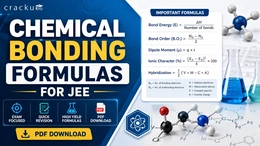
JEE Mains Chemistry Formulas 2027
Preparing with JEE Mains Chemistry formulas is particularly important for Physical Chemistry, where many questions are numerical and formula-based. Topics such as Gaseous State, Thermodynamics, Electrochemistry, Chemical Kinetics, and Solutions require a strong understanding of formulas for accurate problem-solving. Regular formula revision helps students improve speed, reduce calculation errors, and perform better in the exam.
Basic Chemistry Relations
| Concept | Formula |
| Atomic Number | Number of Protons |
| Mass Number | Protons + Neutrons |
| Molecular Mass | Vapour Density × 2 |
Gas Laws
| Law | Formula |
| Ideal Gas Law | PV = nRT |
| Boyle’s Law | P₁V₁ = P₂V₂ |
| Charles’s Law | V₁/T₁ = V₂/T₂ |
| Avogadro’s Law | V ∝ n |
Concentration Terms
| Term | Formula |
| Molarity | M = moles of solute/volume of solution |
| Molality | m = moles of solute/kg of solvent |
| Mole Fraction | moles of component / total moles |
Thermodynamics
| Concept | Formula |
| First Law | ΔU = q + w |
| Enthalpy | ΔH = ΔU + ΔnRT |
Electrochemistry
| Concept | Formula |
| Faraday’s First Law | m ∝ Q |
| Faraday’s Second Law | m₁/m₂ = E₁/E₂ |
| Nernst Equation | E = E° − (0.0591/n) logQ |
Chemical Equilibrium
| Concept | Formula |
| Henderson-Hasselbalch | pH = pKa + log([salt]/[acid]) |
| Henry’s Law | S = kH × P |
Students who regularly revise these formulas find Chemistry calculations much easier during exams.
JEE Mains Maths Formulas 2027
Preparing with JEE Mains Maths formulas is essential for solving questions quickly and accurately during the exam. Important topics such as Algebra, Calculus, Trigonometry, Coordinate Geometry, and Vectors contain numerous formulas, identities, and standard results that students must remember. Keeping all key formulas in one place makes revision easier, improves problem-solving speed, and helps boost overall performance in JEE Main.
Complex Numbers
| Concept | Formula |
| General Form | z = a + ib |
| Modulus | || |
| Argument | θ = tan⁻¹(b/a) |
Quadratic Equations
| Concept | Formula |
| Standard Form | ax² + bx + c = 0 |
| Roots | x = [−b ± √(b² − 4ac)] / 2a |
| Sum of Roots | −b/a |
| Product of Roots | c/a |
Trigonometric Identities
| Identity | Formula |
| Fundamental Identity | sin²θ + cos²θ = 1 |
| Tan Relation | 1 + tan²θ = sec²θ |
| Cot Relation | 1 + cot²θ = cosec²θ |
Limits
| Concept | Formula |
| Limit of Constant | lim c = c |
| Limit of Sum | lim (f + g) = lim f + lim g |
| Limit of Product | lim (fg) = (lim f)(lim g) |
Derivatives
| Rule | Formula |
| Power Rule | d/dx (xⁿ) = nxⁿ⁻¹ |
| Product Rule | (fg)' = f'g + fg' |
| Quotient Rule | (f/g)' = (f'g − fg')/g² |
Integration
| Formula | Expression |
| ∫ xⁿ dx | xⁿ⁺¹/(n+1) + c |
| ∫ 1/x dx | ln |x| + c |
Consistent practice of these formulas improves speed while solving maths questions.
Probability
| Formula | Expression |
| P (A U B) | P (A) + P (B) - P (A ∩ B ) |
| P (A ∩ B ) | P (A) * P (B/A) |
How to Use JEE Mains Formulas PDF for Effective Revision
A formula sheet is useful only when used correctly. Many students download PDFs but rarely revise them.
Smart Revision Strategy
Activity | Recommended Time |
Morning Formula Revision | 20 Minutes |
Chapter-Wise Review | 15 Minutes |
Formula-Based Questions | 30 Minutes |
Weekly Formula Test | 1 Hour |
Mock Test Analysis | After Every Test |
Follow these simple steps:
- Revise formulas before starting problem-solving.
- Highlight formulas you forget often.
- Create short notes from the PDF.
- Solve questions immediately after revision.
- Review weak formulas every weekend.
This method improves retention and reduces JEE Mains exam pressure.
Why the JEE Mains Formulas PDF is Important for Preparation
This JEE Main formula sheet helps in revising entire chapters repeatedly, and you can focus on key equations and concepts.
Benefits of Formula PDFs
Benefit | How It Helps |
Faster Revision | Saves Time |
Better Retention | Improves Memory |
Easy Access | One Place for All Formulas |
Mock Test Support | Quick Review Before Tests |
Error Reduction | Improves Accuracy |
Students often discover weak areas faster when using formula sheets regularly.
Tips to Memorize JEE Mains Formulas Quickly
Remembering formulas becomes easier when you connect them with practice questions.
Quick Memorization Techniques
Method | Benefit |
Flashcards | Faster Recall |
Formula Notebook | Better Retention |
Daily Revision | Long-Term Memory |
Formula Quizzes | Active Learning |
PYQ Practice | Practical Application |
Additional tips:
- Revise formulas before sleeping.
- Write difficult formulas repeatedly.
- Use color coding for different chapters.
- Practice formulas through numerical questions.
- Keep a printed formula sheet near your study desk.
Consistency matters more than memorizing everything in one day.
JEE Mains Formula Sheet 2027: Conclusion
The JEE Mains Formula Sheet PDF 2027 is one of the simplest tools for effective revision. It helps you revise important equations, improve speed, and strengthen your memory before exams. Physics formulas support numerical solving, Chemistry formulas improve direct question accuracy, and Maths formulas build problem-solving confidence.
Instead of collecting multiple resources, focus on one reliable formula sheet and revise it regularly. Combine formula revision with PYQs, mock tests, and concept learning. With daily practice and smart revision, you can improve accuracy and perform better in JEE Main 2027.