JEE WhatsApp Group



JEE Main Syllabus 2027
JEE Main is one of the most competitive undergraduate entrance examinations in India. It serves as the qualifying exam for admission to B.E./B.Tech, B.Arch, and B.Planning programmes at NITs, IIITs, GFTIs, and other centrally funded institutions. It also acts as the qualifying examination for JEE Advanced, which is the gateway to IITs.
If you are preparing for JEE Main 2027, your first step should be to download and study the official NTA syllabus PDF from the NTA/JEE Main portal. The preparation strategy, chapter priorities, and time allocation you choose should all be grounded in the official syllabus
JEE Main Syllabus PDF 2027
NTA periodically updates the JEE Main syllabus. In recent years, the syllabus has been revised to be more concept-focused, with some chapters reorganised or reduced in scope. Students should always prepare using the latest official NTA syllabus PDF, not older coaching materials or notes from previous years, as outdated resources may include chapters or topics that are no longer part of the exam.
Once NTA publishes the official JEE Main 2027 notification and syllabus, you can download it directly from the official NTA portal at nta.ac.in.
Note: Attached is the previous year's PDF, as the syllabus for this year is expected to remain largely unchanged.
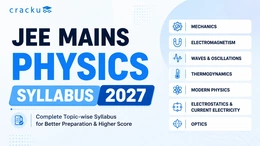
JEE Main Physics Syllabus 2027
Physics in JEE Main requires a well-balanced preparation strategy, as both high-weightage and shorter chapters can contribute important questions in the exam. While some topics consistently carry more weightage, smaller units can also produce multiple questions in certain sessions. Therefore, students should avoid completely skipping any major topic and prepare according to the JEE Mains Physics Syllabus 2027 to ensure comprehensive coverage and maximize their scoring potential.
JEE Mains Physics Chapter Wise Weightage 2027
Physics Chapter |
Estimated Weightage |
Typical Question Range |
Modern Physics |
14%–16% |
3–4 Questions |
Electrostatics & Current Electricity |
12%–14% |
3 Questions |
Thermodynamics & KTG |
8%–10% |
2 Questions |
Optics |
8%–10% |
2 Questions |
Magnetic Effects of Current & Magnetism |
6%–8% |
2 Questions |
Units, Dimensions & Errors |
5%–6% |
1–2 Questions |
Wave Optics & EM Waves |
4%–5% |
1 Question |
Semiconductors |
4%–5% |
1 Question |
Work, Power & Energy |
3%–4% |
1 Question |
Gravitation |
2%–3% |
1 Question |
Experimental Skills |
4%–5% |
1 Question |
Also Read: JEE Mains 2027
JEE Main Chemistry Syllabus 2027
Chemistry can have a major impact on your overall JEE Main percentile, making it one of the most important subjects to prepare well. A common mistake many students make is focusing only on question banks while ignoring the NCERT textbooks, especially for Inorganic Chemistry. Since NTA often asks questions directly from NCERT concepts, students should thoroughly study the JEE Mains Chemistry Syllabus 2027, revise NCERT regularly, and combine it with consistent practice to maximize their scores.
Chemistry is best approached in three parts: Physical, Organic, and Inorganic.
JEE Mains Chemistry Chapter Wise Weightage 2027
Chemistry Chapter |
Estimated Weightage |
Typical Question Range |
Coordination Compounds |
8%–10% |
2–3 Questions |
Chemical Bonding & MOT |
7%–9% |
2 Questions |
Aldehydes, Ketones & Carboxylic Acids |
6%–8% |
2 Questions |
Equilibrium |
6%–8% |
2 Questions |
d- and f-Block Elements |
6%–7% |
2 Questions |
Thermodynamics & Thermochemistry |
5%–6% |
1–2 Questions |
Solutions |
4%–5% |
1 Question |
General Organic Chemistry (GOC) |
5%–6% |
1–2 Questions |
Periodicity |
3%–4% |
1 Question |
Practical Chemistry |
3%–4% |
1 Question |
JEE Main Maths Syllabus 2027
Mathematics is often considered the most time-consuming section in JEE Main because many questions involve lengthy calculations and multiple steps, even when the underlying concepts are straightforward. To perform well, students should focus on smart chapter prioritization, regular practice, and improving calculation speed. Following the JEE Mains Maths Syllabus 2027 can help aspirants identify important topics, plan their preparation effectively, and maximize their score in the Mathematics section.
JEE Mains Maths Chapter Wise Weightage 2027
Maths Chapter |
Estimated Weightage |
Typical Question Range |
Coordinate Geometry |
18%–20% |
4–5 Questions |
Calculus |
18%–20% |
4–5 Questions |
Vectors & 3D Geometry |
12%–14% |
3–4 Questions |
Matrices & Determinants |
7%–8% |
2 Questions |
Probability & Statistics |
6%–7% |
2 Questions |
Sequence & Series |
4%–5% |
1–2 Questions |
Binomial Theorem |
4%–5% |
1 Question |
Complex Numbers & Quadratic Equations |
5%–6% |
1–2 Questions |
Differential Equations |
3%–4% |
1 Question |
Trigonometry |
3%–5% |
1–2 Questions |
Is the JEE Main 2027 Syllabus the Same as 2026?
The official JEE Main 2027 syllabus has not yet been released. Based on current trends, many education experts anticipate that NTA will continue with the revised, leaner syllabus introduced in recent years. However, no official confirmation of 2027-specific changes is available at this time. If you are preparing now, use the most recently published official NTA syllabus as your guide. Do not assume deletions or additions based on coaching material or third-party sources. Any topic not clearly listed in the official syllabus should be approached with caution.
The JEE Mains study material plays a very important role in building a strong foundation for the exam. The syllabus is based mainly on the NCERT Class 11 and 12 patterns. However, for better preparation, you can always refer to the Cracku JEE Daily Target to stay consistent and improve accuracy
Common Preparation Mistakes to Avoid
Many students invest significant effort but lose marks due to strategy gaps rather than knowledge gaps. The table below summarises the most common pitfalls and why they matter.
Mistake |
Why It Hurts Your Preparation |
Preparing from outdated material |
Older coaching modules may include topics no longer in the current syllabus. Always cross-check against the latest official syllabus. |
Neglecting NCERT in Chemistry |
NCERT concepts form the basis of many Chemistry questions, especially in Inorganic Chemistry. Reading NCERT thoroughly is essential. |
Skipping shorter chapters |
Topics like Units & Dimensions or Experimental Skills appear regularly and can be prepared with modest effort. |
Theory without timed practice |
JEE Main rewards speed and accuracy under exam conditions. Regular mock tests are essential alongside conceptual study. |
Ignoring previous year questions |
NTA papers show consistent patterns in topic selection. Solving PYQs is one of the most efficient preparation strategies available. |
Rushing into high-difficulty units |
Chapters like Rotational Motion need strong prerequisites. Attempting them without the groundwork consumes time better spent elsewhere. |
Insufficient revision cycles |
A single read-through rarely aids retention under exam pressure. Multiple short revision cycles throughout preparation are more effective. |
JEE Main Syllabus 2027: Conclusion
Effective JEE Main 2027 preparation comes down to three principles: working from the correct official syllabus, prioritising high-impact chapters without ignoring the rest, and maintaining consistent practice through previous year papers and mock tests.
Check the NTA website regularly for official updates on the JEE Main 2027 notification, syllabus PDF, and examination schedule. Base your preparation plan on official sources, and use trend-based guidance like the chapter weightage tables in this article as supplementary context, not as a substitute for official information.
.webp)