
 Group
Group
 Group
Group


 Preferred Source

 Google Discover
JEE Mains Physics Syllabus 2027
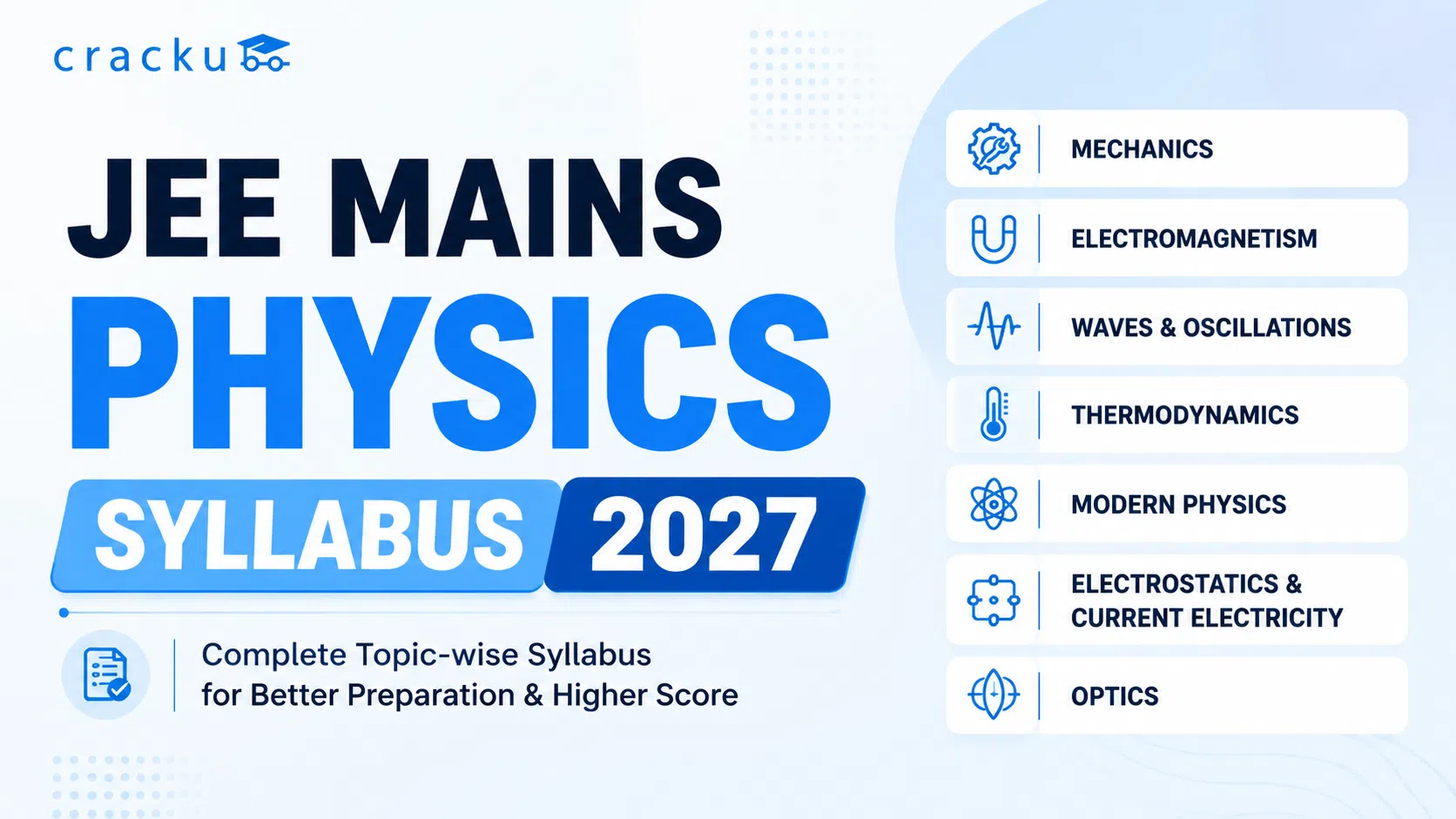
Physics is considered one of the most challenging subjects for JEE Main aspirants, but with the right preparation strategy, it can also become one of the highest-scoring sections. The Physics section includes 20 multiple-choice questions carrying 4 marks each, making concept clarity and accuracy very important. Referring to the JEE Mains Syllabus 2027 helps students understand the important chapters and prepare in a more structured way.
To score well in Physics, students should focus on high-weightage topics, practice previous year questions regularly, and revise formulas consistently. Using a proper formula sheet for quick revision before exams can also improve speed and confidence during the actual test.
JEE Mains Physics Syllabus PDF
To help the students score more, the JEE Main physics syllabus PDF is a perfect choice. This PDF offers a syllabus, subtopics you must concentrate on, and formulas you can revise at the last moment. The official JEE Main 2026 Physics syllabus is based on NCERT Classes 11 and 12.
JEE Mains Physics Chapter-Wise Syllabus 2026
Chapter | Key Topics | Expected Questions |
Units & Measurements | SI Units · Errors · Dimensions | 1 |
Kinematics | Projectile Motion · Relative Motion | 1-2 |
Laws of Motion | Friction · Free Body Diagram · Circular Motion | 1 |
Work, Energy & Power | Conservation of Energy · Collisions | 1 |
Rotational Motion | Torque · MOI · Angular Momentum | 1 |
Gravitation | Satellites · Escape Velocity | 1 |
Properties of Solids & Liquids | Elasticity · Surface Tension · Viscosity | 1 |
Thermodynamics | First Law · Carnot Engine · Heat Transfer | 1-2 |
Kinetic Theory of Gases | RMS Velocity · Degrees of Freedom | 1 |
Oscillations & Waves | SHM · Doppler Effect · Standing Waves | 1 |
Electrostatics | Coulomb's Law · Capacitors · Gauss's Law | 1-2 |
Current Electricity | Kirchhoff's Laws · Wheatstone Bridge | 2 |
Magnetic Effects of Current | Biot-Savart · Ampere's Law | 1 |
Electromagnetic Induction | Faraday's Law · Self-Induction | 1 |
Alternating Current | LCR Circuit · Transformers · RMS Value | 1 |
Electromagnetic Waves | EM Spectrum · Wave Properties | 1 |
Optics | Mirrors · Lenses · YDSE · Diffraction | 2 |
Dual Nature of Matter | Photoelectric Effect · de Broglie Equation | 1 |
Atoms & Nuclei | Bohr Model · Radioactivity · Nuclear Reactions | 1 |
Semiconductor Electronics | Diodes · Logic Gates · Transistors | 1-2 |
JEE Mains Physics Topic-Wise Weightage
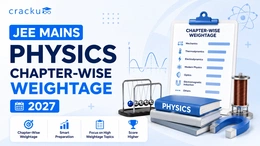
Based on past years trends and JEE Main 2025 data, here is the consolidated unit-wise weightage:
Important Chapter | Approx. Weightage |
Mechanics | 30-35% |
Electromagnetism | 20-25% |
Modern Physics | 15-18% |
Optics | 8-10% |
Heat & Thermodynamics | 5-7% |
Oscillations & Waves | 4-5% |
Mechanics and Electromagnetism together cover nearly 55% of the paper - these two areas deserve the most preparation time. Modern Physics questions are usually direct and formula-based, making it an easy scoring zone despite its shorter syllabus.
Chapters with Highest Scoring Potential
These chapters appear consistently across sessions and tend to have straightforward, formula-based questions:
- Current Electricity
- Ray Optics
- Modern Physics (Dual Nature + Atoms & Nuclei)
- Semiconductor Electronics
- Electrostatics
- Thermodynamics
Prepare these early, practice multiple PYQ, and revisit them before every mock test.
Also Read: JEE Mains Physics Formulas PDF
Best Books for JEE Mains Physics Preparation
Book | Author | Why Use It |
Concepts of Physics Vol 1 & 2 | H C Verma | Best for concepts and beginner-to-intermediate numericals |
Problems in General Physics | I E Irodov | Advanced numerical practice for 95+ percentile targets |
Physics Galaxy Set | Ashish Arora | Structured chapter-wise JEE Main & Advanced practice |
NCERT Physics Class 11 & 12 | NCERT | Essential for theory, definitions, and direct questions |
Cracku JEE Physics Question Bank | Cracku | Topic-wise PYQ practice with difficulty filters |
Cracku JEE Main Mock Tests | Cracku | Full-length mocks to build speed and exam accuracy |
Start with NCERT, build concepts through H C Verma, then use Cracku's topic-wise question bank to drill each chapter before moving to full mocks. Cracku mock tests are especially useful for identifying weak areas and improving time management under exam conditions.
Also Read: JEE Mains Formula Sheet PDF
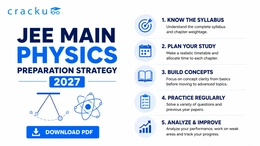
Preparation Tips for JEE Mains Physics
Strategy | How It Helps |
Complete NCERT First | Builds strong base; many questions are directly from NCERT |
Revise Formulas Daily | Improves speed in numerical questions |
Solve PYQs Chapter-Wise | Reveals question patterns and difficulty trends |
Take Weekly Mock Tests | Improves time management and exam temperament |
Maintain an Error Notebook | Prevents repeating the same mistakes |
Focus on High-Weightage Areas | Maximises marks in limited preparation time |
A simple daily plan that works: 2 hours for concept revision, 2 hours for numericals, 1 hour for mock analysis, and 30 minutes for formula revision.
Also Read: JEE Mains Chemistry Syllabus
JEE Mains Physics Syllabus 2026: Conclusion
Mastering JEE Mains Physics 2027 requires strong conceptual clarity, especially in high-weightage chapters like Mechanics, Electromagnetism, and Modern Physics. NCERT forms the foundation, while H.C. Verma, I.E. Irodov, and topic-wise practice sets from Cracku reinforce problem-solving skills. Daily formula revision, PYQs, and mock tests ensure confidence and speed during exams.
Focusing on weekly revision, maintaining an error notebook, and practising numericals strategically maximises marks. With consistent preparation and targeted practice across chapters like Optics, Thermodynamics, and Semiconductor Electronics, students can achieve high scores in JEE Mains Physics 2027.maximise