
 Group
Group
 Group
Group


 Preferred Source

 Google Discover
JEE Mains Maths Syllabus 2027
JEE Main Maths is considered one of the most scoring sections of the exam, but many students find it difficult because of the vast syllabus. In reality, Mathematics becomes much easier when students prepare chapter by chapter with regular practice and proper formula revision. Referring to the JEE Mains Syllabus 2027 can help students understand important topics and prepare in a more organized way.
The JEE Main Maths syllabus includes major topics such as Algebra, Calculus, Coordinate Geometry, Trigonometry, Vectors & 3D Geometry, and Statistics & Probability. Based on previous year trends, some chapters carry higher weightage every year, so smart preparation and consistent practice are more important than trying to study everything at once.
JEE Mains Maths Syllabus PDF
The official JEE Main Maths syllabus 2027 will be released by the National Testing Agency (NTA) along with the information brochure. The syllabus covers Class 11 and Class 12 NCERT Maths topics. Questions test formulas, concepts and graphs. You can download the 2026 official pdf for reference.
JEE Mains Maths Chapter Wise Syllabus
The syllabus spans 14 official units across Class 11 and Class 12. Here is a concise topic-wise breakdown:
Unit | Topics Covered |
Sets, Relations and Functions | Sets and representation, union/intersection/complement, power set, types of relations, one-one/onto functions, composition of functions |
Complex Numbers and Quadratic Equations | Argand plane, modulus and argument, algebra of complex numbers, nature of roots, formation of quadratic equations |
Matrices and Determinants | Types of matrices, algebra of matrices, determinants up to order 3, adjoint and inverse, solving linear equations using matrices |
Permutations and Combinations | Fundamental counting principle, P(n,r) and C(n,r), simple applications |
Binomial Theorem | Binomial theorem for positive integral index, general term, middle term |
Sequence and Series | AP, GP, insertion of AM and GM, relation between AM and GM |
Limit, Continuity and Differentiability | Limits, continuity, differentiation of all function types, derivatives up to order two, maxima and minima, rate of change |
Integral Calculus | Indefinite and definite integrals, integration by substitution/parts/partial fractions, standard integral types, area under curves |
Differential Equations | Order and degree, separation of variables, homogeneous and linear differential equations |
Coordinate Geometry | Straight lines (all forms), circles (standard and general form), parabola, ellipse, hyperbola in standard forms |
Three Dimensional Geometry | Coordinates in space, direction ratios and cosines, equation of a line, skew lines, shortest distance |
Vector Algebra | Scalars and vectors, addition of vectors, scalar and vector products |
Statistics and Probability | Mean, median, mode, standard deviation, variance, Baye's theorem, probability distribution |
Trigonometry | Trigonometric identities and functions, inverse trigonometric functions and properties |
Also Read: JEE Mains Maths Formulas PDF
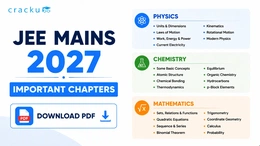
JEE Mains Maths Important Chapters
Based on the past 5-year trend analysis, these are the most frequently and heavily tested chapters in JEE Main Maths:
Chapter | Why It Matters |
Three-Dimensional Geometry | Single highest-weightage chapter consistently; 3-4 questions every session |
Matrices and Determinants | Can expect 3-4 questions; mix of direct and application-based |
Sequence and Series | Formula-heavy but predictable; appears in almost every paper |
Differential Equations | Consistent appearance; method-based questions are scoring |
Definite Integration | Frequently tested; properties of definite integrals are key |
Binomial Theorem | 2-3 questions every year; general term is the most tested concept |
Vector Algebra | Usually paired with 3D Geometry in practice; direct scoring |
Probability | Baye's theorem and probability distribution are regularly asked |
Complex Numbers | 1-2 questions per session; Argand plane and modulus problems are common |
Permutations and Combinations | Counting principle-based questions appear every year |
Calculus-related chapters (Limits, Integration, Differential Equations, Applications of Derivatives) together form nearly one-third of the paper. Algebra chapters including Matrices, Sequence & Series, Binomial Theorem, and Complex Numbers form another large chunk.
Also Read: JEE Mains Chemistry Syllabus 2027
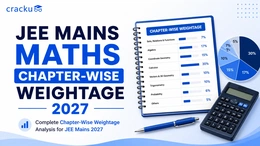
JEE Mains Maths Syllabus With Weightage
Based on the 5-year question paper trend, here is the approximate broad-area weightage for Maths:
Broad Area | Chapters Covered | Approx. Weightage |
Calculus | Limits, Differentiation, Integration, Differential Equations, Applications of Derivatives | 30 - 35% |
Algebra | Matrices, Determinants, Sequence & Series, Binomial Theorem, Complex Numbers, Quadratic Equations, P&C; | 25 - 30% |
Coordinate Geometry | Straight Lines, Circles, Parabola, Ellipse, Hyperbola | 15 - 20% |
3D Geometry & Vectors | Three-Dimensional Geometry, Vector Algebra | 10 - 15% |
Trigonometry & Others | Trigonometric Identities, Inverse Trigonometry, Statistics & Probability | 8 - 10% |
Also Read: JEE Mains Previous Papers
Best Books to Cover JEE Main Maths Syllabus 2027
Avoid studying from too many books at once. Pick one primary resource per topic and practice it thoroughly.
Resource | Author(s) | Best For |
NCERT Maths (Class 11 & 12) | NCERT | Concepts and fundamentals - always start here |
Objective Mathematics for JEE Mains and Advanced | R D Sharma | Preparatory level problems |
Cengage Mathematics Set for JEE Advanced | G. Tewani | Concepts + advanced problems |
Advanced Problems in Mathematics for JEE | Vikas Gupta, Pankaj Joshi | Advanced problem-solving |
Mock Tests and PYQs | Cracku’s JEE Mains Question Paper | Exam-level question practice |
Chapter Wise Preparation | Cracku’s Practice Tests | Topic-Wise Practice |
Your starting point must always be NCERT - many direct concept questions come straight from NCERT examples and exercises. Once concepts are clear, move to R D Sharma for practice, then Cengage or Arihant for harder problems. For testing your preparation, Cracku's test series and previous year question sets are a great resource to build exam-level speed and accuracy. Solve mock tests every week.
Also Read: JEE Mains Physics Syllabus 2027
JEE Mains Maths Syllabus 2027: Conclusion
The JEE Mains Maths Syllabus 2027 is comprehensive but manageable with chapter-wise preparation. Focus on high-weightage chapters like Calculus, Algebra, Coordinate Geometry, and 3D Geometry, along with Trigonometry and Probability, to maximize scoring potential. Consistent practice, formula revision, and solving previous year questions form the backbone of effective preparation.
Using the right resources, such as NCERT, RD Sharma, and Cracku’s JEE Mains Question Bank, along with regular mock tests, helps aspirants build speed, accuracy, and conceptual clarity. Strategic planning, focused practice, and time management are crucial for achieving top marks in Maths.