
 Group
 Group


 Preferred Source

 Google Discover
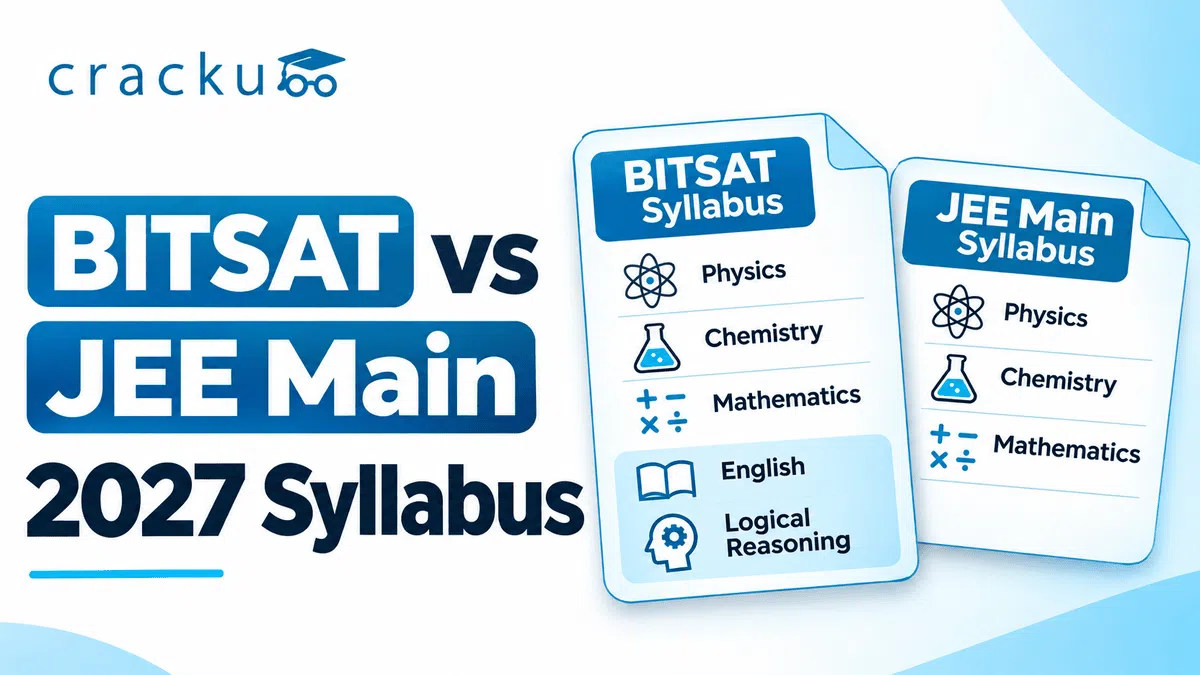
BITSAT and JEE Main are the exams which are considered by many students aspiring to take admission into reputed engineering institutions. While both BITSAT and JEE Main are conducted based on Physics, Chemistry, and Mathematics, the syllabi, examination pattern, type of questions, and difficulty level of the exams differ. Knowing the syllabus of BITSAT vs JEE Main 2027 is beneficial for students to prepare efficiently for the examination. While JEE Main assesses the conceptual knowledge, numerical ability, and problem-solving aptitude of the candidates, BITSAT evaluates conceptual knowledge, speed and accuracy, English proficiency, and logical reasoning of the candidates. The syllabus of physics, chemistry, and mathematics of both BITSAT and JEE Main 2027 partially overlaps, while the rest needs to be prepared separately. Students willing to appear for both examinations must first know about the differences between the two before making the study schedule. In this article, we will cover the BITSAT and JEE Main 2027 syllabus, examination pattern, difficulty level, subject-wise differences, and important chapters.
BITSAT vs JEE Main 2027 Syllabus
One of the key differences between the BITSAT syllabus and the JEE Main Syllabus 2027 is that BITSAT Syllabus comprises English Proficiency and Logical Reasoning, but JEE Main Paper 1 is solely based on Physics, Chemistry, and Mathematics. Both tests incorporate knowledge from classes 11 and 12. However, the topics covered and question types in both tests are slightly different. Candidates can look at the syllabus for BITSAT 2027 and JEE Main 2027 to understand the topics covered in each test. Some differences include:
Particulars | BITSAT 2027 | JEE Main 2027 |
Conducting body | BITS Pilani | National Testing Agency |
Subjects | Physics, Chemistry, Mathematics, English and Logical Reasoning | Physics, Chemistry and Mathematics |
Syllabus basis | Class 11 and 12 curriculum | Class 11 and 12 curriculum |
Additional sections | English Proficiency and Logical Reasoning | No separate English or Logical Reasoning section |
Exam mode | Computer-based test | Computer-based test |
Duration | 3 hours | 3 hours |
Question approach | Speed, accuracy and conceptual understanding | Conceptual understanding and application-based problem-solving |
Admission purpose | BITS Pilani campuses | NITs, IIITs and other participating institutions |
BITSAT Exam Pattern & Difficulty Level
BITSAT is an online test taken by candidates aspiring to pursue their undergraduate courses at BITS Pilani. The test consists of five sections, namely, Physics, Chemistry, Mathematics, English Proficiency, and Logical Reasoning. The test mainly concentrates on concept clarity, time management, and accuracy. As the candidates have to answer questions from various subjects in three hours, having a good pace of answering the questions becomes essential.
BITSAT Exam Pattern 2027
The following table is based on the latest available 2026 examination structure. Candidates should check the BITSAT 2027 notification for any changes.
Particulars | Details |
Exam mode | Computer-based test |
Duration | 3 hours |
Total questions | 130 |
Total marks | 390 |
Physics | 30 questions |
Chemistry | 30 questions |
Mathematics | 40 questions |
English Proficiency | 10 questions |
Logical Reasoning | 20 questions |
Correct answer | +3 marks |
Incorrect answer | -1 mark |
Unattempted question | 0 marks |
BITSAT Difficulty Level
The BITSAT test is normally perceived to be moderately difficult when compared to the JEE Main test. Nevertheless, because of the limited time allowed, the test is quite tough for candidates to complete.
- Physics: The questions focus on concepts, formulae, and numerical.
- Chemistry: Concepts, reactions, equations, and factual knowledge related to NCERT are important.
- Mathematics: Consists of algebra, calculus, and coordinate geometry among others.
- English Proficiency: Tests grammar, vocabulary, reading ability, and sentence structuring.
- Logical Reasoning: Comprises of verbal and non-verbal reasoning, series, analogies, and pattern-related questions.
Students should practise mock tests and chapter-wise questions to improve their speed. They can also refer to BITSAT Chapterwise Weightage 2027 to identify important topics based on previous examination trends.
Also Read: BITSAT Exam Pattern 2027: Check Section-Wise Details Now
JEE Main Exam Pattern & Difficulty Level
JEE Main is an exam for admissions to engineering colleges conducted by the National Testing Agency (NTA). JEE Main is conducted for admission to NITs, IIITs, and other participating institutions offering courses in engineering.
Unlike BITSAT, the questions asked in JEE Main Paper 1 are only from Physics, Chemistry, and Mathematics. JEE Main Paper 1 tests the candidates’ conceptual clarity, numerical, and problem-solving skills.
JEE Main Exam Pattern 2027
Particulars | Details |
Exam mode | Computer-based test |
Duration | 3 hours |
Subjects | Physics, Chemistry and Mathematics |
Total questions | 75 |
Total marks | 300 |
Questions per subject | 25 |
Correct answer | +4 marks |
Incorrect answer | -1 mark |
Unattempted question | 0 marks |
Each subject contains 20 multiple-choice questions and 5 numerical-value questions. Candidates should follow the official examination instructions regarding question selection and marking.
JEE Main Difficulty Level
JEE Main is normally said to be of moderate difficulty depending on the shifts and types of questions asked in the examination. The test demands the candidate to comprehend the concept and solve problems numerically.
- Physics: Conceptual clarity, formulae, numerical, and application-based problems.
- Chemistry: Deals with Physical, Organic, and Inorganic Chemistry with NCERT based concepts.
- Mathematics: Problem solving is demanded in all areas like calculus, algebra, coordinate geometry, etc.
Students should regularly solve JEE Main Important Topics 2027 and previous-year questions to understand question trends and improve their examination performance.
Also Read: JEE Main Exam Pattern 2027: Marks, Questions & Duration
Subject-Wise Syllabus Difference
BITSAT and JEE Main 2027 share much in common in terms of syllabus in Physics, Chemistry, and Mathematics. Nevertheless, there are certain subjects which differ from each other by the degree of detail and coverage. There is also English Proficiency and Logical Reasoning in BITSAT which do not form part of JEE Main Paper 1.
Subject | BITSAT 2027 | JEE Main 2027 |
Physics | Mechanics, Thermodynamics, Electrostatics, Current Electricity, Optics, Modern Physics and Electronic Devices | Mechanics, Thermodynamics, Electrostatics, Current Electricity, Magnetism, Optics, Modern Physics and Experimental Skills |
Chemistry | Physical, Organic and Inorganic Chemistry, including Chemical Bonding, Equilibrium, Hydrocarbons and Coordination Compounds | Physical, Organic and Inorganic Chemistry, including Atomic Structure, Chemical Bonding, Electrochemistry, Organic Compounds and Practical Chemistry |
Mathematics | Algebra, Trigonometry, Calculus, Coordinate Geometry, Vectors, Probability, Linear Programming and Mathematical Modelling | Algebra, Trigonometry, Calculus, Coordinate Geometry, Vectors, 3D Geometry, Probability and Statistics |
English Proficiency | Grammar, Vocabulary, Reading Comprehension and Sentence Completion | Not included |
Logical Reasoning | Verbal Reasoning, Non-Verbal Reasoning, Analogies, Classification and Series | Not included |
Which Chapters Should You Prioritise for Both Examinations?
Students preparing for both examinations should first complete the overlapping chapters in Physics, Chemistry, and Mathematics. This approach helps cover a major portion of both syllabi without repeating the same preparation. The following chapters are useful starting points based on previous-year trends and the prescribed syllabus.
Subject | Important Chapters to Prioritise |
Physics | Laws of Motion, Work and Energy, Rotational Motion, Thermodynamics, Current Electricity, Electrostatics, Optics and Modern Physics |
Chemistry | Chemical Bonding, Atomic Structure, Thermodynamics, Equilibrium, Electrochemistry, Chemical Kinetics, Coordination Compounds and Organic Chemistry |
Mathematics | Calculus, Matrices and Determinants, Complex Numbers, Coordinate Geometry, Vectors, 3D Geometry and Probability |
BITSAT vs JEE Main 2027 Syllabus: Conclusion
Understanding the BITSAT vs JEE Main 2027 syllabus is important for students planning to appear for both engineering entrance examinations. Although both exams cover Physics, Chemistry and Mathematics from Classes 11 and 12, their examination patterns, question approaches and additional sections differ. While JEE Main focuses on conceptual understanding and application-based problem-solving, BITSAT evaluates speed, accuracy, English Proficiency and Logical Reasoning along with subject knowledge. Students should identify the overlapping chapters in both syllabi and prioritise important topics to make their preparation more effective.
Candidates preparing for BITSAT and JEE Main 2027 should create a balanced study schedule that covers the common topics first, followed by the exam-specific sections. Regular practice of previous-year questions, chapter-wise questions and mock tests can help improve accuracy, speed and time management. Understanding the differences between the BITSAT and JEE Main exam patterns and difficulty levels will also help students plan their preparation strategically and perform better in both examinations. Candidates should refer to the respective official notifications for the final 2027 syllabus and examination details.