JEE WhatsApp Group



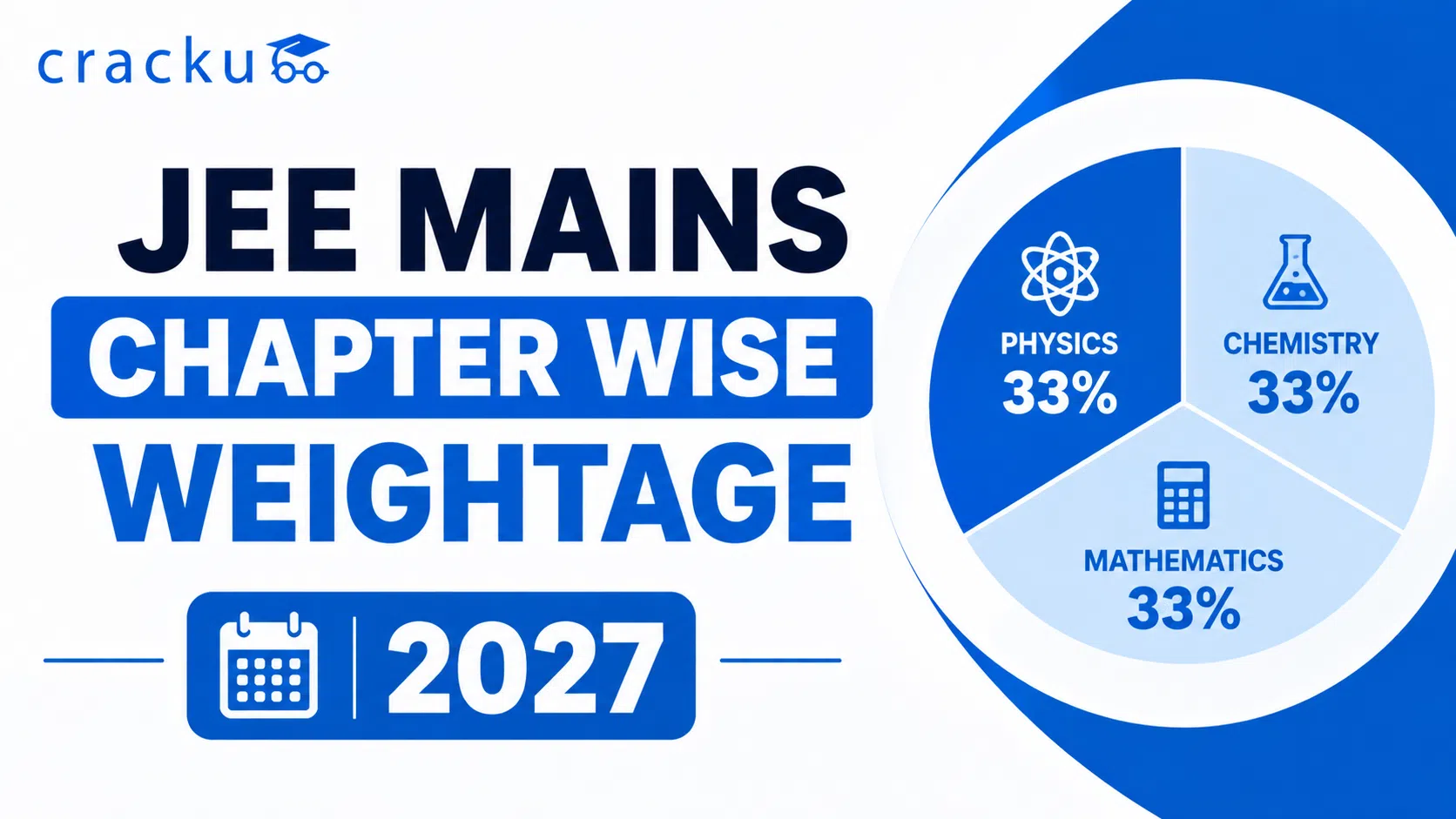
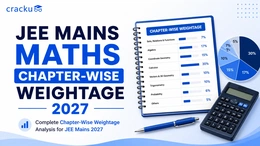
JEE Mains Chapter Wise Weightage 2027
The Joint Entrance Examination (JEE) Main 2027 is one of the most competitive engineering entrance tests in India, conducted by the National Testing Agency (NTA). Understanding the chapter-wise weightage is crucial for aspirants who want to maximize their scores. A well-planned study approach based on topic weightage can significantly improve your rank and open doors to premier institutions like NITs, IIITs, and GFTIs.
Here, we have also discussed the chapter-wise weightage in detail. The percentage of questions expected from each chapter has been included to help you identify important topics. This analysis can help you prioritise high-weightage chapters and create a more effective preparation strategy.
Physics Chapter-Wise Weightage
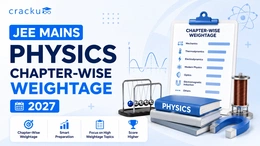
Physics has 25 questions in JEE Main, and the JEE Physics Chapter-Wise Weightage shows that Mechanics and Electromagnetism together account for more than half of the section. Prioritising these two areas helps aspirants build a strong foundation before covering the remaining chapters.
Chapter | Expected Questions | Chapter Share (%) | Priority |
|---|---|---|---|
Mechanics (Kinematics, Laws of Motion, Work-Energy, Rotational Motion) | 6-7 | 24-28% | High |
Electrostatics and Current Electricity | 4-5 | 16-20% | High |
Modern Physics (Atoms, Nuclei, Dual Nature) | 3-4 | 12-16% | High |
Magnetic Effects and Electromagnetic Induction | 2-3 | 8-12% | Medium |
Optics (Ray and Wave) | 2-3 | 8-12% | Medium |
Thermodynamics and Kinetic Theory | 2-3 | 8-12% | Medium |
Experimental Skills (Practical-Based Questions) | 2-3 | 8-12% | Medium |
Oscillations, Waves, Gravitation, Properties of Matter | 1-2 | 4-8% | Low-Medium |
Chemistry Chapter-Wise Weightage
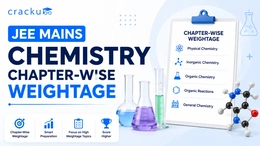
Chemistry has 25 questions divided among Organic, Physical, and Inorganic Chemistry. JEE Chemistry's Chapter-Wise Weightage indicates that Organic Chemistry contributes nearly one-third of the section. Topics such as States of Matter, Hydrogen, s-Block Elements, Polymers, and Chemistry in Everyday Life have been removed from the NTA syllabus.
Chapter | Expected Questions | Chapter Share (%) | Priority |
|---|---|---|---|
Organic Chemistry (GOC, Reactions, Functional Groups) | 7-9 | 28-36% | High |
Chemical Equilibrium and Ionic Equilibrium | 2-3 | 8-12% | High |
Electrochemistry | 2-3 | 8-12% | High |
Coordination Compounds | 2-3 | 8-12% | High |
Chemical Bonding and Molecular Structure | 2-3 | 8-12% | Medium |
p-Block, d and f Block Elements | 2-3 | 8-12% | Medium |
Thermodynamics and Chemical Kinetics | 2-3 | 8-12% | Medium |
Solutions, Surface Chemistry, Atomic Structure | 1-2 | 4-8% | Low-Medium |
Maths Chapter-Wise Weightage
Maths has the broadest syllabus among the three JEE Main subjects, with 25 questions covering Calculus, Algebra, Coordinate Geometry, and other key areas. The JEE Mains Maths Chapter-Wise Weightage shows that Calculus contributes the most questions and is becoming increasingly challenging, making it a high-risk yet high-reward section.
Chapter | Expected Questions | Chapter Share (%) | Priority |
|---|---|---|---|
Calculus (Limits, Differentiation, Integration, Diff. Eq.) | 7-8 | 28-32% | High |
Algebra (Complex Numbers, Quadratic, Matrices, Determinants) | 5-6 | 20-24% | High |
Coordinate Geometry (Straight Lines, Circles, Conics) | 4-5 | 16-20% | High |
Vectors and 3D Geometry | 2-3 | 8-12% | High |
Trigonometry and Inverse Trigonometry | 2-3 | 8-12% | Medium |
Probability and Statistics | 1-2 | 4-8% | Medium |
Sequences and Series, Binomial Theorem, P&C; | 1-2 | 4-8% | Medium |
Sets, Relations and Functions | 1 | 4% | Low-Medium |
JEE Main Subject Wise Weightage 2027
JEE Main 2027 paper consists of 75 questions divided across Physics, Chemistry, and Maths. Each subject carries 100 marks, making the total exam 300 marks. Understanding the distribution of marks and sections across subjects helps candidates plan their preparation strategically.
Subject | Section A (MCQs) | Section B (NVQs) | Total Marks |
|---|---|---|---|
Physics | 20 Questions | 5 Questions (Compulsory) | 100 Marks |
Chemistry | 20 Questions | 5 Questions (Compulsory) | 100 Marks |
Maths | 20 Questions | 5 Questions (Compulsory) | 100 Marks |
Total | 60 Questions | 15 Questions | 300 Marks |
Each subject is divided into two sections. Section A contains 20 Multiple Choice Questions (MCQs) with a -1 mark penalty for each wrong answer. Section B contains exactly 5 Numerical Value Questions (NVQs), all of which are compulsory. Importantly, NTA has extended negative marking to Section B as well: an incorrect numerical answer carries a -1 mark penalty. Students must approach Section B with the same care and accuracy as Section A.
Also Read: JEE Mains Maths Syllabus 2027, Important Chapters, Weightage
JEE Mains Important Chapters 2027
Identifying the most important chapters across all three subjects can help you focus your energy where it matters most. Based on the trend analysis of JEE Main papers from 2019 to 2024, the following chapters consistently carry higher weightage.
Subject | High Weightage Chapters | Expected Questions | Approximate Marks |
|---|---|---|---|
Physics | Mechanics, Electromagnetism, Modern Physics | 8-10 | 32-40 |
Chemistry | Organic Chemistry, Coordination Compounds, Equilibrium | 8-10 | 32-40 |
Maths | Calculus, Algebra, Coordinate Geometry | 9-11 | 36-44 |
Mechanics alone accounts for nearly 25-30% of the Physics section. Similarly, Organic Chemistry has consistently remained the most scoring area in Chemistry. In Maths, Calculus and Algebra together contribute to more than 40% of the questions.
Also Read: JEE Mains Chemistry Syllabus 2027, Important Topics, Weightage
JEE Main Trends and Weightage Analysis
Analyzing trends over the past five years provides a reliable estimate of what to expect in JEE Main 2027. The NTA has maintained a fairly consistent pattern in terms of chapter coverage and difficulty distribution.
Key observations from trend analysis include: the difficulty level has been moderately increasing year on year; Numerical Value Questions have gained more prominence and now carry negative marking, raising the stakes for accuracy; and topics like 3D Geometry, Probability, and Electrochemistry appear more frequently in recent years.
Year | Physics Difficulty | Chemistry Difficulty | Maths Difficulty | Overall Level |
|---|---|---|---|---|
2020 | Moderate | Easy | Moderate | Moderate |
2021 | Moderate | Easy-Moderate | Moderate-Hard | Moderate |
2022 | Hard | Moderate | Hard | Moderate-Hard |
2023 | Moderate-Hard | Moderate | Hard | Moderate-Hard |
2024 | Hard | Moderate-Hard | Hard | Hard |
The trend clearly indicates that Maths is becoming progressively harder. Students are advised to give extra attention to time management and practice more numerical-type problems. Remember that all 5 NVQs in Section B carry negative marking, so blind guessing is not advisable.
JEE Mains 2027 Preparation Strategy
A result-oriented preparation strategy for JEE Mains 2027 must be built around chapter-wise weightage data. Here is a structured approach to help you cover the JEE Mains 2027 syllabus effectively.
First, divide your preparation into three phases: foundation building (months 1-4), intensive revision (months 5-8), and mock test practice (months 9-12 before the exam). Allocate maximum time to high-weightage chapters during the foundation phase.
Second, solve the JEE Mains previous year questions chapter-wise. This helps you understand the type of questions asked for each topic and the difficulty level. The NTA repeats concepts, even if not exact questions, making this practice extremely valuable.
Third, focus on conceptual clarity over rote memorization, especially in Physics and Chemistry. Understanding derivations and reaction mechanisms helps tackle new types of numerical questions introduced in recent years.
Also Read: JEE Mains Physics Syllabus 2027, Important Topics, Weightage
How to Prepare Based on Chapter-Wise Weightage?
Chapter-wise weightage analysis should serve as a roadmap, not a shortcut. Here is a practical method to use this data for effective preparation:
Step 1: Categorise chapters into high, medium, and low priority based on the expected number of questions. High-priority chapters need thorough coverage; medium-priority chapters need conceptual understanding; low-priority chapters need only a quick overview.
Step 2: Create a weekly timetable that allocates 60% of study time to high-priority chapters, 30% to medium-priority chapters, and 10% to low-priority chapters. This ensures you do not neglect important topics while also covering the entire syllabus.
Step 3: Regularly test yourself with chapter-wise quizzes and full-length mock tests. Review mistakes and identify weak areas. Since all 5 NVQs in Section B now carry negative marking, build a habit of verifying your calculations before committing to an answer. As the exam approaches, shift focus to JEE Mains mock tests and revision rather than learning new topics.
Step 4: Do not ignore the NCERT books for Chemistry and Physics. A significant portion of the JEE Main paper is directly based on NCERT Solutions, especially in Physical and Inorganic Chemistry.
By following this strategy and aligning your preparation with chapter-wise weightage, you can maximise your score in JEE Main 2027 and increase your chances of securing a seat in a top engineering college.
Also Read: JEE Mains Formula Sheet PDF, Physics, Chemistry, Maths
JEE Mains Chapter Wise Weightage 2027: Conclusion
The JEE Mains Chapter Wise Weightage 2027 can help aspirants organise their preparation by identifying the most important chapters in Physics, Chemistry and Mathematics. Mechanics, Electromagnetism and Modern Physics are expected to dominate Physics, while Organic Chemistry, Equilibrium and Coordination Compounds remain important in Chemistry. In Mathematics, Calculus, Algebra and Coordinate Geometry are expected to contribute a significant number of questions.
.webp)