JEE WhatsApp Group



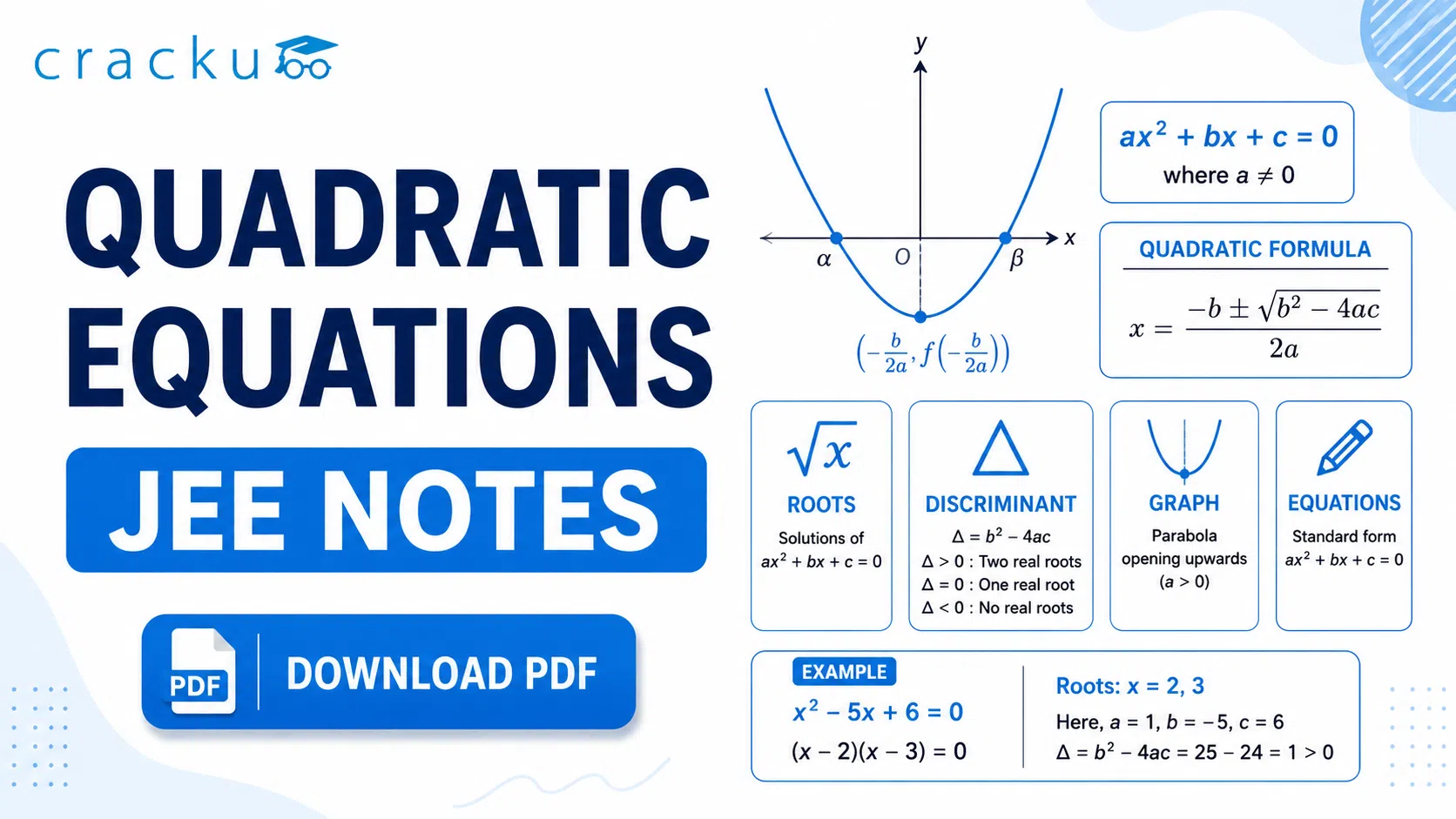
Quadratic Equations is one of the most consistently tested chapters in JEE Mathematics, and its concepts reappear in coordinate geometry, calculus, optimisation and even physics problems. Practising JEE questions on Quadratic Equations helps students apply concepts such as the discriminant, Vieta's formulas, quadratic inequalities and conditions on roots in exam-level problems. These Quadratic Equations JEE notes cover the nature of roots, quadratic formula, Vieta's formulas, equations formed from roots, common roots, maximum and minimum values, sign of quadratic expressions, inequalities and location of roots for quick JEE revision.
Quadratic Equations JEE Notes: Discriminant and Nature of Roots
Discriminant of a Quadratic Equation
The discriminant determines the nature of the roots without actually solving the quadratic equation.
$$D=b^2-4ac$$
| Discriminant | Nature of Roots |
|---|---|
| $$D>0$$ | Two distinct real roots |
| $$D=0$$ | Two equal real roots |
| $$D<0$$ | Two complex conjugate roots; no real roots |
If the coefficients are rational, the discriminant gives additional information:
- $$D>0$$ and D is a perfect square ⇒ roots are rational.
- $$D>0$$ and D is not a perfect square ⇒ roots are irrational.
- $$D<0$$ ⇒ roots occur as a complex conjugate pair.
Worked example: Determine the nature of roots of:
$$2x^2-5x+3=0$$
Here:
$$a=2,\quad b=-5,\quad c=3$$
$$D=(-5)^2-4(2)(3)=25-24=1$$
Since D is positive and a perfect square, the equation has two distinct rational roots.
Quadratic Formula and Vieta's Formulas
Quadratic Formula
The roots of a general quadratic equation can be obtained directly using the quadratic formula:
$$x=\frac{-b\pm\sqrt{b^2-4ac}}{2a}=\frac{-b\pm\sqrt D}{2a}$$
If the roots are represented by $$\alpha$$ and $$\beta$$:
$$\alpha=\frac{-b+\sqrt D}{2a}$$
$$\beta=\frac{-b-\sqrt D}{2a}$$
Worked example: Solve:
$$x^2-7x+10=0$$
$$D=(-7)^2-4(1)(10)=49-40=9$$
Therefore:
$$x=\frac{7\pm3}{2}$$
Hence:
$$x=5,\quad x=2$$
Worked example: Solve:
$$2x^2+3x+5=0$$
$$D=3^2-4(2)(5)=9-40=-31$$
Therefore:
$$x=\frac{-3\pm i\sqrt{31}}{4}$$
The roots form a complex conjugate pair.
JEE tip: When a quadratic with integer coefficients factorises easily, factorisation is generally faster than using the quadratic formula.
Vieta's Formulas
For the quadratic equation:
$$ax^2+bx+c=0$$
with roots $$\alpha$$ and $$\beta$$:
$$\alpha+\beta=-\frac ba$$
$$\alpha\beta=\frac ca$$
These relations allow many JEE questions to be solved without finding the individual roots.
Worked example: For:
$$3x^2-12x+7=0$$
Sum of roots:
$$\alpha+\beta=-\frac{-12}{3}=4$$
Product of roots:
$$\alpha\beta=\frac73$$
Important Symmetric Functions of Roots
| Expression | Identity |
|---|---|
| $$\alpha^2+\beta^2$$ | $$(\alpha+\beta)^2-2\alpha\beta$$ |
| $$\alpha^2-\beta^2$$ | $$(\alpha+\beta)(\alpha-\beta)$$ |
| $$(\alpha-\beta)^2$$ | $$(\alpha+\beta)^2-4\alpha\beta=\frac{D}{a^2}$$ |
| $$|\alpha-\beta|$$ | $$\frac{\sqrt D}{|a|}$$ |
| $$\frac1\alpha+\frac1\beta$$ | $$\frac{\alpha+\beta}{\alpha\beta}$$ |
| $$\frac\alpha\beta+\frac\beta\alpha$$ | $$\frac{\alpha^2+\beta^2}{\alpha\beta}$$ |
| $$\alpha^3+\beta^3$$ | $$(\alpha+\beta)^3-3\alpha\beta(\alpha+\beta)$$ |
Worked example: If $$\alpha$$ and $$\beta$$ are roots of:
$$x^2-5x+3=0$$
then:
$$\alpha+\beta=5,\quad\alpha\beta=3$$
Therefore:
$$\alpha^2+\beta^2=25-6=19$$
and:
$$\frac1\alpha+\frac1\beta=\frac53$$
Forming Quadratic Equations from Roots and Common Roots
Forming an Equation from Given Roots
If the roots of a quadratic equation are $$\alpha$$ and $$\beta$$, the equation can be written as:
$$x^2-(\alpha+\beta)x+\alpha\beta=0$$
or:
$$(x-\alpha)(x-\beta)=0$$
Worked example: Form a quadratic equation whose roots are 3 and −2.
Sum of roots:
$$3+(-2)=1$$
Product:
$$3(-2)=-6$$
Therefore:
$$x^2-x-6=0$$
Equation Whose Roots Are Functions of Original Roots
If $$\alpha$$ and $$\beta$$ are roots of:
$$x^2-3x+1=0$$
form the equation whose roots are $$\alpha^2$$ and $$\beta^2$$.
From Vieta's formulas:
$$\alpha+\beta=3,\quad\alpha\beta=1$$
Sum of new roots:
$$\alpha^2+\beta^2=(3)^2-2(1)=7$$
Product of new roots:
$$\alpha^2\beta^2=(\alpha\beta)^2=1$$
Therefore:
$$x^2-7x+1=0$$
Common Roots of Two Quadratic Equations
Consider:
$$a_1x^2+b_1x+c_1=0$$
and:
$$a_2x^2+b_2x+c_2=0$$
If the equations have one common root $$\alpha$$:
$$\alpha=\frac{c_1a_2-c_2a_1}{a_1b_2-a_2b_1}$$
The condition for a common root is:
$$(c_1a_2-c_2a_1)^2=(a_1b_2-a_2b_1)(b_1c_2-b_2c_1)$$
If both roots are common, the two equations are proportional:
$$\frac{a_1}{a_2}=\frac{b_1}{b_2}=\frac{c_1}{c_2}$$
Maximum, Minimum and Sign of a Quadratic Expression
Maximum and Minimum Values
A quadratic expression:
$$f(x)=ax^2+bx+c$$
represents a parabola.
- If $$a>0$$, the parabola opens upward and has a minimum.
- If $$a<0$$, the parabola opens downward and has a maximum.
The vertex occurs at:
$$x=-\frac{b}{2a}$$
The extreme value is:
$$-\frac{D}{4a}$$
| Condition | Parabola | Extreme Value | Range |
|---|---|---|---|
| $$a>0$$ | Opens upward | Minimum = $$-\frac{D}{4a}$$ | $$\left[-\frac{D}{4a},\infty\right)$$ |
| $$a<0$$ | Opens downward | Maximum = $$-\frac{D}{4a}$$ | $$\left(-\infty,-\frac{D}{4a}\right]$$ |
Worked example: Find the minimum value of:
$$f(x)=2x^2-8x+5$$
$$D=(-8)^2-4(2)(5)=64-40=24$$
Since $$a=2>0$$, a minimum exists.
$$Minimum=-\frac{24}{8}=-3$$
It occurs at:
$$x=-\frac{-8}{2(2)}=2$$
Sign of a Quadratic Expression
Suppose $$\alpha<\beta$$ are the real roots of:
$$f(x)=ax^2+bx+c$$
When $$D>0$$:
- If $$a>0$$, $$f(x)>0$$ outside the roots and $$f(x)<0$$ between them.
- If $$a<0$$, $$f(x)<0$$ outside the roots and $$f(x)>0$$ between them.
When $$D=0$$:
$$f(x)=a(x-\alpha)^2$$
Therefore, except at the repeated root, the expression has the same sign as $$a$$.
When $$D<0$$:
The parabola never meets the x-axis, so the expression always has the same sign as $$a$$.
$$a>0,\ D<0\Rightarrow f(x)>0\text{ for every real }x$$
$$a<0,\ D<0\Rightarrow f(x)<0\text{ for every real }x$$
Worked example: For what values of k is:
$$x^2+kx+4>0$$
for every real x?
Since $$a=1>0$$, we require:
$$D<0$$
$$k^2-16<0$$
Therefore:
$$-4<k<4$$
Quadratic Inequalities and Conditions on Roots
Solving Quadratic Inequalities
Quadratic inequalities are solved by first finding the critical points or roots and then checking the sign of the expression in each interval.
| Leading Coefficient | $$ax^2+bx+c>0$$ | $$ax^2+bx+c<0$$ |
|---|---|---|
| $$a>0$$ | $$(-\infty,\alpha)\cup(\beta,\infty)$$ | $$(\alpha,\beta)$$ |
| $$a<0$$ | $$(\alpha,\beta)$$ | $$(-\infty,\alpha)\cup(\beta,\infty)$$ |
For $$\geq$$ or $$\leq$$ inequalities, include the roots in the solution.
Worked example: Solve:
$$x^2-5x+6\leq0$$
Factorising:
$$(x-2)(x-3)\leq0$$
The roots are 2 and 3. Since the leading coefficient is positive, the expression is negative between the roots.
Solution:
$$x\in[2,3]$$
Worked example: Solve:
$$-2x^2+7x-3>0$$
Multiply by −1 and reverse the inequality:
$$2x^2-7x+3<0$$
The roots are:
$$x=\frac12,\quad3$$
Since the new leading coefficient is positive, the expression is negative between its roots.
Solution:
$$x\in\left(\frac12,3\right)$$
JEE tip: For $$a>0$$, remember the simple sign rule: a quadratic is negative between two real roots and positive outside them.
Conditions on Location of Roots
For:
$$f(x)=ax^2+bx+c$$
with $$a>0$$ and roots $$\alpha,\beta$$:
| Requirement | Conditions |
|---|---|
| Both roots positive | $$D\geq0,\quad\alpha+\beta>0,\quad\alpha\beta>0$$ |
| Both roots negative | $$D\geq0,\quad\alpha+\beta<0,\quad\alpha\beta>0$$ |
| Roots of opposite signs | $$\alpha\beta<0$$ |
| Both roots greater than k | $$D\geq0,\quad f(k)>0,\quad-\frac{b}{2a}>k$$ |
| Both roots less than k | $$D\geq0,\quad f(k)>0,\quad-\frac{b}{2a}<k$$ |
| k lies between roots | $$f(k)<0$$ |
Worked example: Find k if both roots of:
$$x^2-6x+k=0$$
are positive.
Real roots require:
$$36-4k\geq0$$
$$k\leq9$$
Also:
$$\alpha+\beta=6>0$$
and:
$$\alpha\beta=k>0$$
Therefore:
$$0<k\leq9$$
Worked example: Find k if 2 lies between the roots of:
$$x^2-(k+1)x+(k-1)=0$$
For $$a>0$$, 2 lies between the roots when:
$$f(2)<0$$
$$4-2(k+1)+(k-1)<0$$
$$1-k<0$$
Therefore:
$$k>1$$
JEE tip: For a quadratic with $$a>0$$, the condition that a number k lies between the roots can be checked directly using $$f(k)<0$$.
Quadratic Equations Formula Sheet at a Glance
| Concept | Formula |
|---|---|
| Standard form | $$ax^2+bx+c=0,\quad a\neq0$$ |
| Discriminant | $$D=b^2-4ac$$ |
| Quadratic formula | $$x=\frac{-b\pm\sqrt D}{2a}$$ |
| Sum of roots | $$\alpha+\beta=-\frac ba$$ |
| Product of roots | $$\alpha\beta=\frac ca$$ |
| Difference of roots | $$|\alpha-\beta|=\frac{\sqrt D}{|a|}$$ |
| Sum of squares | $$\alpha^2+\beta^2=(\alpha+\beta)^2-2\alpha\beta$$ |
| Sum of cubes | $$\alpha^3+\beta^3=(\alpha+\beta)^3-3\alpha\beta(\alpha+\beta)$$ |
| Equation from roots | $$x^2-(\alpha+\beta)x+\alpha\beta=0$$ |
| Both roots common | $$\frac{a_1}{a_2}=\frac{b_1}{b_2}=\frac{c_1}{c_2}$$ |
| Vertex | $$x=-\frac{b}{2a}$$ |
| Extreme value | $$-\frac{D}{4a}$$ |
| Always positive | $$a>0,\quad D<0$$ |
| Always negative | $$a<0,\quad D<0$$ |
| k between roots for $$a>0$$ | $$f(k)<0$$ |
JEE Important Points, Common Mistakes and Quick Revision
Points JEE Repeatedly Tests
- The discriminant decides the nature of the roots without solving the equation.
- A positive perfect-square discriminant with rational coefficients gives rational roots.
- Complex roots of a real quadratic occur as conjugate pairs.
- Vieta's formulas often eliminate the need to calculate the individual roots.
- Symmetric expressions in the roots can be expressed using $$\alpha+\beta$$ and $$\alpha\beta$$.
- The vertex of a quadratic occurs at $$x=-b/(2a)$$.
- The extreme value is $$-D/(4a)$$.
- For $$a>0$$, the quadratic is negative between two real roots and positive outside them.
- A quadratic is positive for all real x when $$a>0$$ and $$D<0$$.
- For $$a>0$$, $$f(k)<0$$ means k lies between the roots.
Common Mistakes to Avoid
- Forgetting that a ≠ 0. If the leading coefficient becomes zero, the equation is no longer quadratic.
- Dropping the negative sign in the sum of roots. Always use $$\alpha+\beta=-b/a$$.
- Not reversing an inequality when multiplying by a negative number.
- Using open intervals for ≤ or ≥. Include roots when equality is allowed.
- Confusing signs between and outside the roots. The sign pattern depends on the leading coefficient.
- Assuming $$-D/(4a)$$ is always a minimum. It is a maximum when $$a<0$$.
- Checking only D for positive or negative roots. Vieta's sum and product conditions must also be checked.
- Finding the individual roots unnecessarily. Many JEE problems are faster with Vieta's formulas.
Quick Revision Notes for Quadratic Equations
- Standard form: $$ax^2+bx+c=0,\ a\neq0$$.
- Discriminant: $$D=b^2-4ac$$.
- $$D>0$$ gives distinct real roots, $$D=0$$ gives equal roots and $$D<0$$ gives complex conjugate roots.
- Quadratic formula: $$x=\frac{-b\pm\sqrt D}{2a}$$.
- Sum of roots: $$\alpha+\beta=-b/a$$.
- Product of roots: $$\alpha\beta=c/a$$.
- $$\alpha^2+\beta^2=(\alpha+\beta)^2-2\alpha\beta$$.
- $$(\alpha-\beta)^2=D/a^2$$.
- Equation from roots: $$x^2-(\alpha+\beta)x+\alpha\beta=0$$.
- Vertex: $$x=-b/(2a)$$.
- Extreme value: $$-D/(4a)$$.
- For $$a>0$$, the quadratic is negative between roots and positive outside them.
- Always positive: $$a>0,\ D<0$$.
- Always negative: $$a<0,\ D<0$$.
- For $$a>0$$, k lies between roots when $$f(k)<0$$.
Problem-solving routine: Start most Quadratic Equations problems by calculating the discriminant if the nature or existence of roots matters. For expressions involving the roots, use Vieta's formulas before solving for $$\alpha$$ and $$\beta$$ individually. In inequality and root-location questions, determine the sign of the leading coefficient and use the parabola or sign chart carefully. Use a JEE formula sheet during revision to quickly recall discriminant rules, Vieta's formulas, quadratic inequalities and conditions on roots.