JEE WhatsApp Group



Class 12 is already packed with board exams and practicals. But JEE remains a game-changer for every B.Tech and B.Arch aspirant in IITs. Therefore, a JEE Maths course following the preparation requirements and your flexibility is the right choice to adopt. However, the right maths course can bring mock tests, PYQs, and the right preparation strategy into your hands.
If you are in Class 12 during 2026–27, it's already high time to start your JEE Main 2027 preparation.
Why Is JEE Maths Challenging for Class 12 Students?
Class 12 Maths becomes demanding because several chapters require concepts from earlier classes.
Calculus, coordinate geometry, vectors, and probability can expose gaps surprisingly quickly. You may remember a formula but still struggle to recognise when it applies.
For example, the basic trigonometric identity
$$sin²θ + cos²θ = 1$$
This looks simple, but once you are not sure where to use it inside complex algebraic expressions, then there is no use even knowing it. Similarly, the derivative rule
$$d/dx (xⁿ) = nxⁿ⁻¹$$
is easy to remember but requires proper application across different question types.
JEE Maths Area | Topics to Prioritise | What You Need to Practise |
Algebra | Quadratic Equations, Sequences, Matrices, Determinants | Formula application and calculation speed |
Calculus | Limits, Continuity, Differentiation, Integration | Multi-step questions and graph interpretation |
Coordinate Geometry | Straight Lines, Circles, Conic Sections | Equation formation and visualisation |
Vectors & 3D | Vectors, Lines, Planes | Formula recognition and spatial reasoning |
Probability | Probability, Statistics | Case formation and accurate calculation |
Trigonometry | Identities, Equations, Functions | Simplification and transformation |
The JEE Main Paper 1 model gives Mathematics 25 questions worth 100 marks. It contains 20 MCQs and five numerical-value questions within the Mathematics section.
Each correct response carries four marks, while an incorrect response attracts one negative mark. Therefore, speed without accuracy can quickly become a score-damaging habit. Your practice should target both question selection and clean mathematical execution.
How Can a JEE Maths Course Improve Problem-Solving Skills?
A useful course should not stop after explaining formulas on a digital whiteboard. It should take you through learning, application, checking, and correction.
- For example, Cracku's JEE Maths Course currently includes 150+ concept videos.
- It also provides 150+ concept tests, 400 topic tests, and 15 full-length mocks.
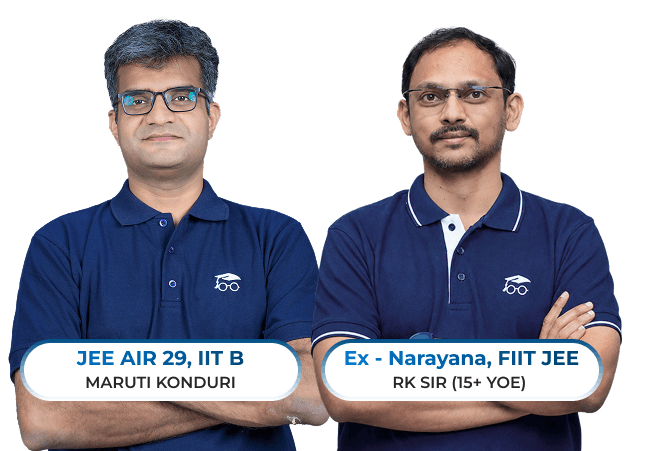
The JEE Maths faculty includes Radha Krishna Bandaru Sir, Head of Content for JEE.
He also heads the JEE Mathematics department and has extensive teaching experience.
Learning Stage | What You Do | Skill Developed |
Concept video | Understand the idea and formula | Concept clarity |
Formula revision | Recall conditions and applications | Faster recognition |
Concept test | Solve immediately after learning | Immediate checking |
Topic test | Attempt varied questions | Flexible thinking |
Study actual previous questions | Exam familiarity | |
JEE practice sets with solutions | Compare methods after attempting | Error correction |
Solve under timed conditions | Speed and accuracy | |
Mock analysis | Check wrong and skipped questions | Smarter revision |
The biggest benefit comes from following this sequence instead of watching lectures passively. After learning a concept, close your notes and attempt questions independently.
If you make an error, check whether the issue involved calculation, logic, or formula selection. That small habit can gradually improve accuracy without simply increasing study hours.
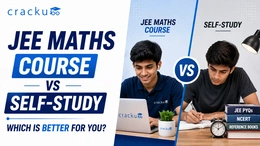
JEE Maths Course vs Self-Study for Class 12 Students
Self-study can work well when your fundamentals are already strong, and discipline remains consistent. However, Class 12 leaves little space for repeatedly figuring out what to study next.
Factor | JEE Maths Course | Self-Study |
Study sequence | Structured topic progression | You create the sequence |
Concept learning | Guided explanations | Books, videos, and notes |
Practice | Topic tests and assignments | You collect questions |
Doubt solving | Expert support can be available | Requires separate resources |
JEE PYQs | Usually organised topic-wise | Requires manual sorting |
JEE mock tests | Scheduled testing and analysis | You arrange tests yourself |
Revision | Daily tasks can guide revision | You track revision independently |
Time management | Course provides direction | Requires stronger self-discipline |
A course does not replace self-study because independent solving remains essential. Instead, it reduces the time spent searching for resources and arranging practice.
Self-study becomes especially useful after a lecture or concept test. You should still solve questions alone before checking detailed solutions.
For JEE Advanced, this distinction becomes even more important because questions can require deeper reasoning. The JEE syllabus should therefore be treated as a framework, not merely a checklist.
How to Choose the Right JEE Maths Course in Class 12?
Class 12 is not the right time to pick a course based only on attractive lectures. You need resources that support your remaining preparation window until JEE Main 2027.
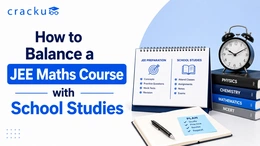
Check whether the course offers concept coverage, practice, testing, analysis, and doubt support. If your JEE daily targets should not get interrupted by school. So, plan in the following way.
Feature to Check | Why It Matters in Class 12 |
Complete JEE syllabus | Prevents important chapters from being missed |
Formula-based explanations | Revises quicker before tests |
JEE PYQs | Shows actual question styles and difficulty |
Practice sets with solutions | Builds application skills across chapters |
JEE mock tests | Improves timing and question selection |
Test analysis | Identifies repeated mistakes |
Doubt support | Prevents unresolved concepts from accumulating |
Daily study tasks | Keeps preparation moving during busy weeks |
JEE Advanced support | Helps if you target IIT-level questions |
Also check whether the course includes Maths topics across Algebra, Calculus, Coordinate Geometry, and other major areas. The official JEE Main syllabus remains the safest reference for checking prescribed topics.
A good course should also help you revise formulas without turning preparation into rote memorization. For instance, keep essential formulas beside solved examples showing their practical use.
A Simple Class 12 JEE Maths Routine
You can divide a regular preparation day into four focused stages.
- Learn: Watch one concept lesson and note important formulas.
- Apply: Solve immediate questions without checking the solution first.
- Practice: Attempt JEE PYQs and topic-wise questions from the same chapter.
- Check: Analyze mistakes and mark concepts requiring another revision.
On test days, avoid stopping after checking your score. Read every incorrect solution and identify exactly where your approach went wrong.
For JEE Main 2027, your final months should gradually shift toward mixed practice and timed papers. If JEE Advanced is also your target, add higher-level questions after completing the relevant JEE Main practice.
So, is a JEE Maths Course worth it for Class 12 students? It can be, provided the course gives structure without making preparation unnecessarily complicated. The right combination is simple: understand concepts, practice actively, test regularly, and analyze mistakes. With that rhythm, your Class 12 Maths preparation can become focused rather than chaotic.
Conclusion
A JEE Maths course can be worth joining in Class 12 when it provides structured concept learning, sufficient question practice, JEE PYQs, topic tests and full-length mock exams. It can reduce the time students spend searching for resources and deciding what to study next. However, merely watching video lessons will not improve scores unless students solve questions independently and regularly analyse their mistakes.
The right course should support both JEE Main 2027 preparation and Class 12 board studies without making the daily schedule unmanageable. Students should choose a flexible course that covers Algebra, Calculus, Coordinate Geometry, Vectors and other important topics through a clear learning sequence. When combined with consistent self-study, revision and mock analysis, a JEE Maths course can make preparation more focused, organised and effective.
.webp)