Group
Group
 Group
Group

How to Balance a JEE Maths Course with School Studies?
School-going JEE aspirants spend 6+ hours in school daily. They manage Mathematics classes, homework, assignments, unit tests, and school examinations. A JEE Maths Course adds concept lessons, question practice, doubt clearing, and revision. The workload becomes harder when students treat school Mathematics and JEE Maths as separate subjects.
A connected study routine can reduce repeated work and prevent course backlogs. What you need are proper study hours and a clear division between lessons, questions, and revision. You must also adjust your routine during school examinations. A planned routine helps students maintain JEE Maths preparation without ignoring school requirements.
How Many Hours Should You Study JEE Maths After School?
Most Class 11 and Class 12 students can study JEE Maths for 90-150 minutes. Heavy homework may reduce the session to 45 or 60 minutes. The exact time must match your workload, Maths level, and pending course tasks. These timings are flexible planning ranges and not recommended by the NTA.
Study quality matters more than the total number of recorded hours. You must learn one concept, complete the assigned lesson, and solve questions independently. Students must also review incorrect answers and revise important formulas. Passive video watching does not complete a Maths study session.
It is important to check the lesson sequence, tests, study plan, and access period of the JEE Maths Course before fixing daily study hours. A course with frequent lessons may need longer weekend sessions. A lighter course schedule may fit within shorter weekday schedules.
A Practical Study Range for School Days
Available study time changes with homework, school tests, and pending assignments. The following timings may help you to plan your JEE Maths after school without using one fixed routine.
Schedule | JEE Maths Time | Main Priority |
Normal school day | 90-150 minutes | Complete a lesson, practise questions, and review errors |
Heavy homework day | 45-60 minutes | Revise concepts |
School test day | 30-45 minutes | Review formulas and methods |
Weekend | 2.5-4 hours in separate sessions | Study new concepts and clear selected backlogs |
School holiday | 3-5 hours with breaks | Complete course tasks, tests, and weak chapters |
How to Divide Your JEE Maths Study Time
A two-hour session should include both learning and independent practice. You can divide the available time in the following way:
- Spend 40-50 minutes on a course lesson.
- Use 50-60 minutes for independent question practice.
- Keep 15-20 minutes for solution checking and error analysis.
- Use the remaining time for formulas, doubts, or incomplete questions.
You must avoid watching several lessons without solving related questions. A concept video has value only when practice follows it. Immediate practice shows whether you understood the method. It also identifies doubts before the next lesson begins.
A short completed session works better than an unrealistic 4-hour study plan. Difficult chapters may need longer weekend practice instead of longer school-night sessions. School examination weeks require maintenance tasks, not complete abandonment. You must not reduce sleep only to increase your recorded JEE Maths study hours.
How to Manage School Exams and JEE Maths Preparation Together
You must not stop JEE Maths completely during school examinations. Instead, reduce advanced practice and prioritise the current school syllabus. A short revision task can maintain contact with important formulas and methods. You can resume the regular course sequence after the examination.
School Mathematics and JEE Mathematics often share the same core concepts. But school examinations require textbook methods, written steps, and syllabus-based answers. JEE Main questions test deeper application, speed, and mixed-concept problem-solving. One preparation format cannot replace the other completely.
You must first understand the concept taught at school; then you can extend that concept through JEE-level practice. This order reduces repeated learning and supports both requirements. The required workload should change across each school examination phase.
School Phase | School Mathematics Priority | JEE Maths Adjustment |
Regular school weeks | Current chapters, homework, and class tests | Follow the normal course sequence |
Unit-test week | School syllabus revision and written practice | Reduce new lessons and maintain short revision |
Project week | Complete submissions and required school work | Solve short question sets |
Half-yearly | School syllabus, sample papers, and weak chapters | Pause heavy topic tests but retain daily contact |
Pre-board | Board-style answers and complete revision | Practise overlapping concepts through short sessions |
Post-examination week | Review school mistakes | Resume the course and clear selected backlogs |
Use Common School and JEE Maths Topics Efficiently
Students can connect school chapters with related JEE lessons. This method reduces duplication and keeps the JEE Maths study schedule manageable.
- Attend or revise the Mathematics lesson taught at school.
- Complete the required textbook examples and school homework.
- Study the related concept through the JEE Maths Course.
- Attempt a small set of application-based questions.
- Record difficult methods and incorrect answers for revision.
Students should organise notes, formulas, questions, and tests within one study system. Structured JEE Study Material can support concept revision, daily targets, previous papers, and subject-wise practice. Several disconnected sources can increase pending work during examination weeks.
Adjust JEE Maths During School Exam Weeks
You must reduce study volume before reducing continuity. The task should support revision without affecting the next school examination.
You can choose any one of these tasks:
- Revise a formula set from an overlapping chapter.
- Review errors from a completed topic test.
- Solve five to ten questions from a familiar concept.
- Reattempt selected questions that caused repeated mistakes.
- Write down one unresolved doubt for later clarification.
A temporary reduction does not show poor consistency. It represents a planned academic adjustment during school examination weeks. You can maintain limited JEE Maths preparation and return to their normal routine afterwards.
How to Stay Consistent With JEE Maths Preparation
Consistency in JEE Maths preparation does not require the same number of study hours daily. You only need a minimum task for busy days and a normal task for regular days. A weekly review should cover missed lessons, unresolved doubts, weak topics, and pending practice.
A consistent routine tracks completed work instead of time alone. You must record lessons, independent attempts, reviewed errors, revised formulas, and submitted doubts. Watching videos without question practice does not complete a Maths study task.
Students need different targets for normal and difficult school days. The following system prevents missed work from becoming a large JEE Maths backlog.
Common Problem | Minimum Action | Weekly Check |
No time for a full lesson | Revise one concept | Complete the pending lesson during the weekend |
Missed question practice | Solve a short focused set | Record and clear the missed topic |
Difficult chapter | Attempt basic application questions | Schedule a longer weak-topic session |
Unresolved doubt | Write the exact doubt | Confirm whether the doubt was resolved |
Course backlog | Complete the highest-priority task | Remove duplicated work |
Repeated test errors | Update the error log | Reattempt selected questions |
Irregular study hours | Fix a minimum daily slot | Review the number of completed study days |
Build a Minimum Daily Maths Target
A minimum target keeps you connected with Maths during busy school days. The task should remain small enough to complete without affecting urgent school work.
Busy school day
- Students can revise one formula set from a completed chapter.
- Students can solve five to ten suitable questions.
- Students can attempt one short concept test.
- Students can review errors from a previous test.
- Students can write down one unresolved doubt.
Normal school day
- Students should complete one planned course lesson.
- Students should practise the concept immediately after learning it.
- Students should review incorrect questions before ending the session.
Weekend
- Students can attempt one topic test under timed conditions.
- Students can clear one high-priority course backlog.
- Students can revise one weak chapter.
- Students can review their weekly course progress.
Review Backlogs and Errors Every Week
You must compare planned lessons with completed lessons every weekend. It is also important to check question accuracy, repeated errors, pending doubts, and weak chapters. Any backlog affecting the next course topic should receive first priority.
Students can attempt chapter-wise JEE PYQs after completing the concept and initial practice. Each attempt should include method review, time analysis, and error checking. Cracku currently organises previous-year Maths questions by chapter for focused practice.
Students should reduce the task during difficult school days instead of skipping Maths completely. This approach protects JEE Maths consistency without forcing the same daily study duration.
Also Read: How to Choose the Best JEE Maths Course for Your Preparation?
Is an online JEE Maths course suitable for school students?
Yes, an Online JEE Maths Course can suit school students with a clear lesson sequence and regular practice. The course should also provide tests, detailed solutions, progress review, and doubt support. You must still solve questions independently and follow a weekly routine.
When Online Learning Fits a School Student’s Routine
Online learning works when you have a predictable study slot after school. Lessons should fit around homework, examinations, and school Mathematics requirements. You must also control online distractions during each planned session.
An Online JEE Maths Course may suit students who can follow these conditions:
- The student follows the assigned lesson sequence.
- The student practises immediately after concept learning.
- The student attempts topic tests at planned intervals.
- The student records doubts instead of leaving them unresolved.
- The student reviews course progress every week.
- The student can adjust study volume during school examinations.
How Cracku’s JEE Maths Course Supports Structured Preparation
Cracku’s JEE Maths Course provides daily tasks, concept videos, tests, mocks, solutions, and doubt support. Refer to the table below to know more about the students' needs resolved by Cracku’s JEE Math course 2026-27.
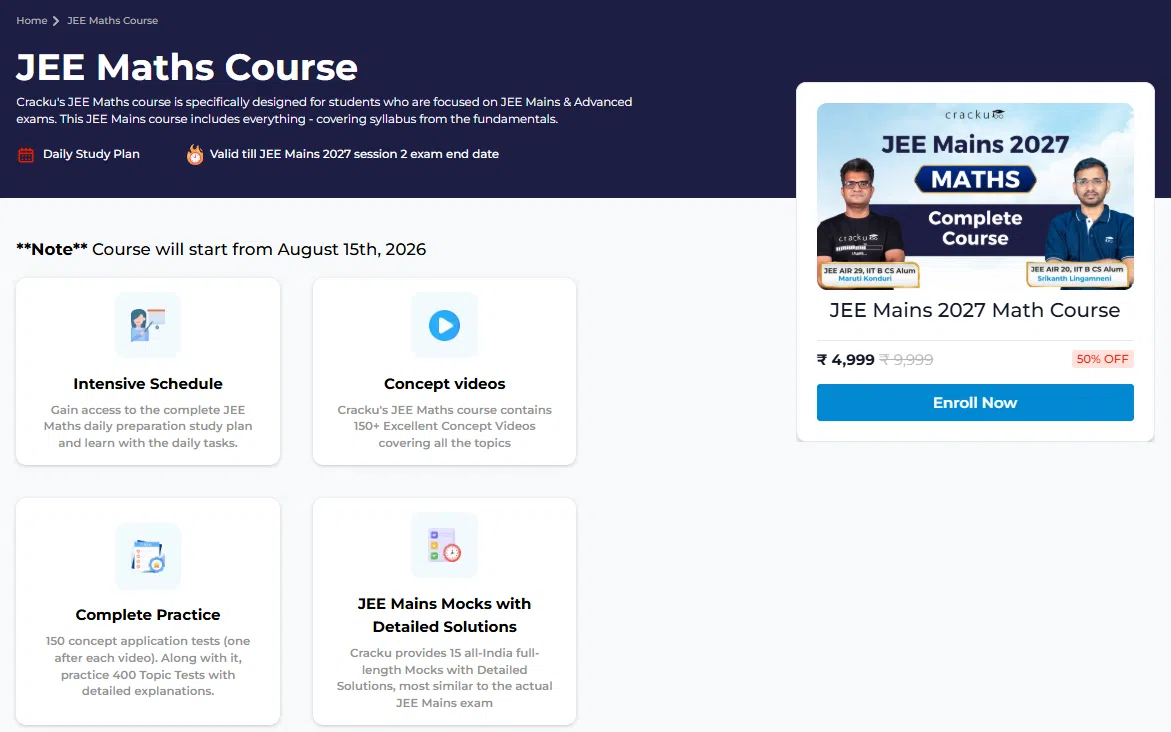
School Student’s Need | Cracku JEE Maths Course Feature Available |
Clear daily direction | Daily study plan |
Concept learning | Concept videos |
Immediate application | Concept tests |
Chapter-level practice | Topic-wise tests |
Exam practice | Full-length mocks |
Mistake review | Detailed solutions and analysis |
Doubt clarification | Doubt posting below questions or videos |
Long preparation cycle | Access through the stated exam session |
Also Read: What Does Cracku’s JEE Maths Course Offer? Check Now
Conclusion
Balancing a JEE Maths Course with school studies requires a flexible routine rather than an identical timetable every day. Students should connect overlapping school and JEE chapters, divide study time between lessons and independent practice, and reduce the workload during examination weeks without completely stopping preparation. Regular error analysis and weekly reviews can prevent missed tasks from becoming large backlogs.
An online JEE Maths course for school students works best when lessons are followed by immediate question practice, topic tests and solution review. Students should maintain a minimum task for busy days and use weekends for weak chapters, pending lessons and timed tests. A realistic routine that protects school performance, JEE preparation and adequate sleep is more sustainable than an excessive daily study target.