
 Group
Group
 Group
Group
What Does Cracku’s JEE Maths Course Offer?
Cracku’s JEE Maths Course combines a daily study plan with concept lessons, application tests, topic practice, and full-length mocks. It also includes detailed solutions, performance analysis, percentile information, and expert doubt support. These resources form a preparation sequence rather than a collection of separate study tools. You can check the current JEE Maths Course details before making an enrolment decision.
This course may suit students at different levels of preparation, but your class level alone does not decide suitability. You must consider current Maths skills, unfinished chapters, daily study time, and independent practice habits.
Who Should Join Cracku’s JEE Maths Course?
Cracku’s JEE Maths Course may suit Class 11 students, Class 12 students, droppers, and independent JEE aspirants. The format will be right fit if you can follow an online schedule and complete assigned practice without constant monitoring.
Course Fit for Class 11, Class 12, and Droppers
Whether you are in class 11, 12 or a dropper, it is necessary to invest enough daily time for lessons, tests, solution review, and doubt resolution. Course suitability depends on how you use the available structure. If you watch a recorded lecture but do not complete its test, the course value will reduce.
An Online JEE Maths Course works best when you attempt questions independently and review mistakes honestly.
Pointers below show how you can use the course based on your study level.
- Class 11 students can use the daily sequence to build concepts before backlogs become difficult to manage.
- Class 12 students can combine current chapters with planned revision of older topics.
- Droppers can use the course for complete revision, timed practice, and repeated error analysis.
Key Features of Cracku's JEE Maths Course
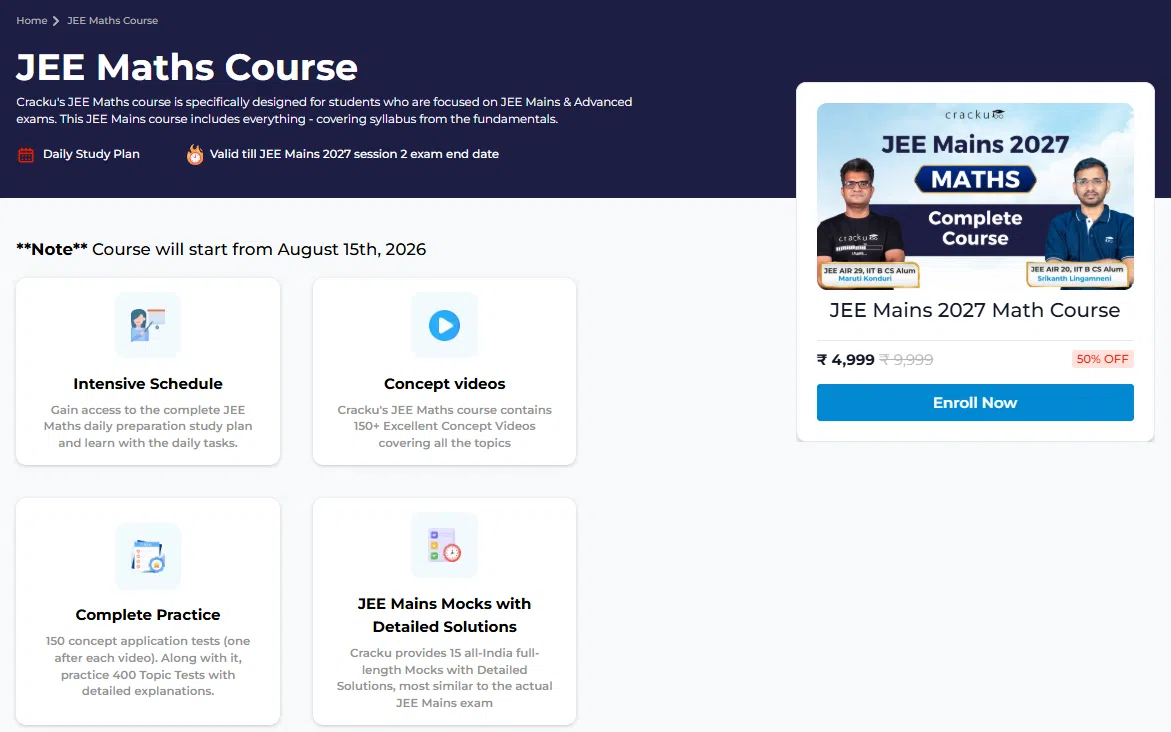
Cracku’s JEE Maths Course currently provides a daily plan, concept videos, application tests, topic tests, and full-length mocks. It also offers detailed solutions, analysis, percentile data, doubt support, and access through JEE Main 2027 Session 2.
These components help build a solid preparation strategy based on learning sequence. The lesson introduces a concept, the next test checks application, and topic practice develops depth. Mocks then assess execution across completed topics.
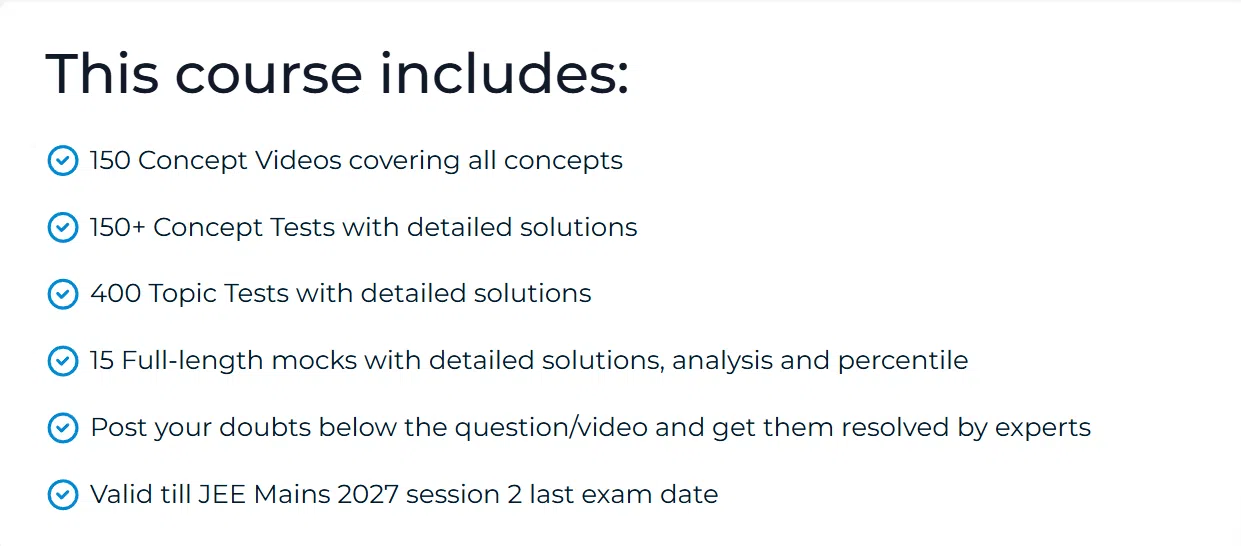
Radha Krishna Bandaru Sir is Cracku’s Head of Content for JEE and the head of the JEE Mathematics department. He has 15 years of teaching experience, and he holds a master’s degree in Applied Mathematics. Along with Radha Krishna Sir, Cracku co-founders Maruti Konduri and Srikanth Lingamneni have also helped prepare the JEE Maths Course. The table below explains how each feature helps students for JEE Maths preparation.
Talk to our expert now! Request a Callback
JEE Maths Course Feature | How to Use It |
Daily study plan | Follow the assigned order instead of choosing topics randomly. |
Concept videos | Learn the method before starting independent questions. |
Concept tests | Check immediate application after each related lesson. |
Topic tests | Build focused practice after the related concept test. |
Full-length JEE Mock Test | Test speed, accuracy, and question selection under time limits. |
Performance analysis | Identify weak topics and repeated exam-execution errors. |
Doubt support | Resolve confusion close to the related learning stage. |
Course validity | Revisit lessons and tests during later revision stages. |
How Cracku’s JEE Maths Course Helps to Build Strong Concepts?
Cracku’s JEE Maths Course follows a learn, apply, practise, test, and review sequence. Each stage checks whether you can use a concept independently rather than only understand the related lesson.
Concept Explanation and Immediate Application
A concept lesson should establish the formula, reasoning, method, and standard application. You must then attempt related questions without copying the demonstrated steps. The immediate concept test can expose misunderstandings before they affect broader topic practice.
Concept clarity develops through repeated application and correction. A video starts the process, but later stages determine whether the method remains usable under pressure.
Refer to the table below for clarity and use the course sequence in this order:
- Learn the concept and review the solving method.
- Attempt related questions without viewing solutions.
- Complete the immediate concept test.
- Practise the topic through focused tests.
- Review detailed solutions and record errors.
- Resolve doubts before starting dependent topics.
- Attempt timed mocks after completing enough syllabus.
- Revise weak areas identified through test analysis.
Learning Stage | Cracku Course Resource | What It Builds |
Initial learning | Concept video | Definitions, formulas, and solving methods |
Worked application | Examples within lessons | Use of the method in standard questions |
Immediate testing | Concept test | Independent use of the new concept |
Focused practice | Topic tests | Variety, speed, and error recognition |
Solution review | Detailed solutions | Correct method and missed reasoning |
Doubt resolution | Question or video comment area | Unresolved conceptual or procedural gaps |
Exam testing | Full-length mocks | Speed, accuracy, and question selection |
Performance review | Test analysis and percentile | Weak topics and execution patterns |
Topic Practice, Solutions, and Doubt Resolution
Organized JEE Study Material can include solved examples, practice sets, formula resources, and detailed explanations. These resources can support learning beyond the assigned course tests.
You must use JEE PYQs practice after completing theory and initial application. You must also attempt each question independently, use time limits, and analyze errors. We also recommend keeping an error notebook for revision.
Full-length mocks do not create initial concept clarity. They test whether completed concepts remain usable during a timed paper. Therefore, it is important to review weak topics, calculation errors, poor question selection, and time losses after each mock.
Is Cracku's JEE Maths Course Right for You?
Cracku’s JEE Maths Course may suit students who need an ordered online preparation sequence and regular Math topic testing. If you need continuous supervision, you may require additional support.
Check Your Preparation Habits
The online format does not determine results by itself. You must consider available study time, unfinished chapters, test discipline, solution-review habits, and comfort with recorded lessons. You must also check whether the access period covers your planned JEE Main attempt.
Verify the Course Details Before Enrolling
You must check the fee, start date, validity, device access, re-attempt options, refund terms, and extra charges. Also confirm the final topic-test count and the teaching responsibility of each expert faculty.
If you can follow the daily sequence and practise regularly, you may find this JEE Maths Course for JEE Main suitable. But if you require close monitoring, you must consider combining the course with personal mentoring.
Also Read: How to Choose the Best JEE Maths Course for Your Preparation?
Conclusion
Cracku’s JEE Maths Course provides an organised preparation sequence combining concept lessons, application tests, topic practice, detailed solutions, doubt support and full-length mocks. The daily study plan helps students progress systematically, while performance analysis and percentile information make it easier to identify weak topics, calculation errors and exam-execution problems.
The course may suit Class 11 students, Class 12 students and droppers who can follow an online schedule and practise independently. Before enrolling, students should verify the current fee, validity, start date, device access, test reattempt rules and refund terms. Consistent practice, honest error analysis and timely doubt resolution are essential for getting the best value from the course.
.webp)