
 Group
Group
 Group
Group


 Preferred Source

 Google Discover
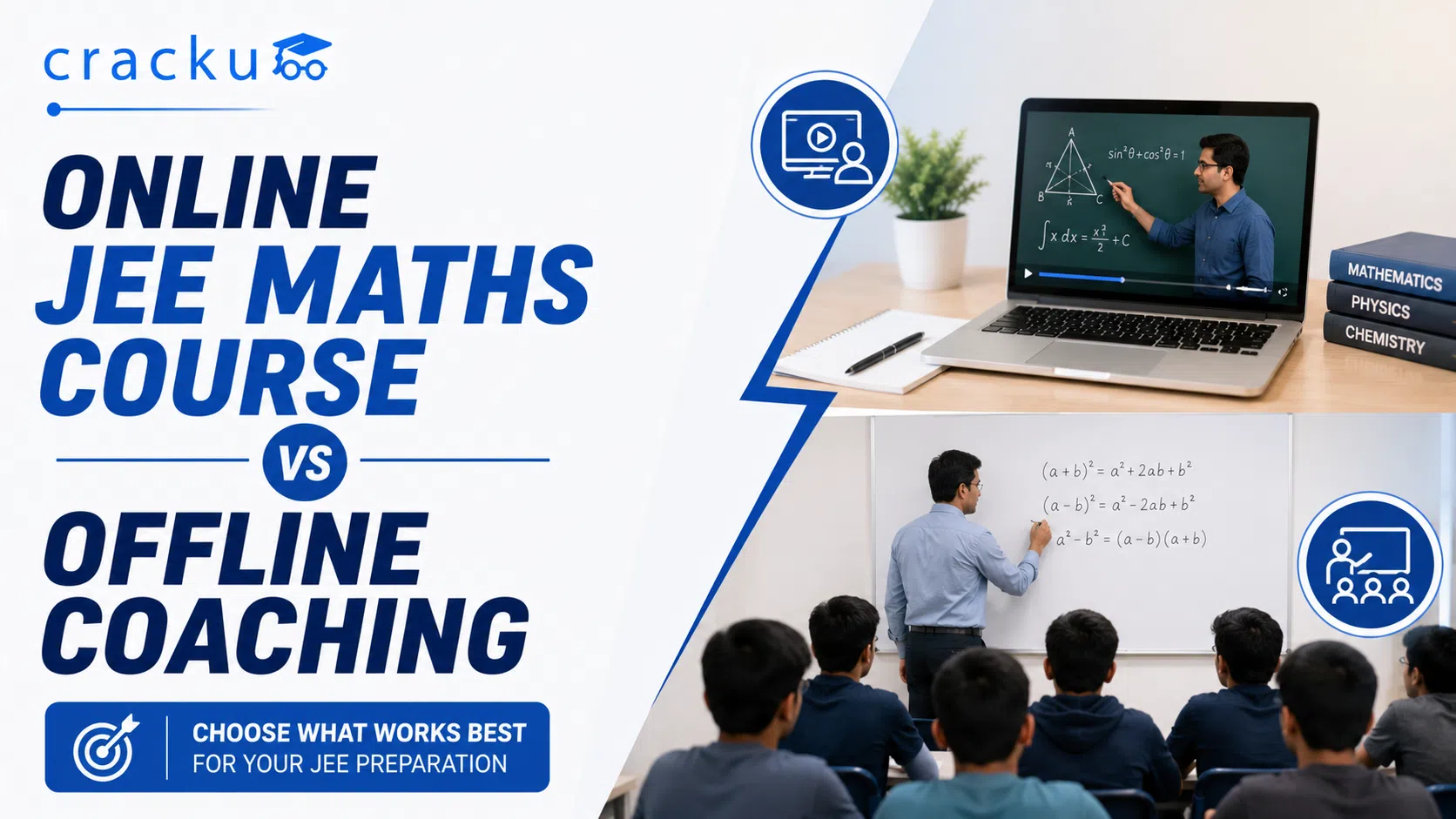
Online JEE Maths Course vs Offline Coaching
An Online JEE Maths Course is generally better for students who need flexible timings, repeated lesson access, and control over their learning pace. Offline coaching may be better for students who need fixed classroom routines, face-to-face interaction, and closer supervision. Neither format is automatically more effective. The right choice depends on how consistently the student learns, practises, takes tests, and reviews mistakes.
Before deciding, examine the complete learning process rather than comparing only recorded and classroom lectures. A useful course should connect concept explanation with independent practice, detailed solutions, doubt resolution, revision, and timed tests. Parents and students should also consider school timings, travel, study discipline, current backlogs, and the amount of supervision required.
Online JEE Maths Course vs Offline Coaching: Quick Comparison
The most visible difference is flexibility. Online courses allow students to study at suitable times and revisit difficult explanations. Offline coaching follows a shared classroom schedule and provides an external routine. The more important difference is how each format affects the student's actual practice and revision.
Decision Factor | Online JEE Maths Course | Offline Coaching |
Learning pace | Students can pause, replay, or accelerate lessons. | The class usually follows a common batch pace. |
Study schedule | Learning can be planned around school and other subjects. | Fixed timings create a regular external schedule. |
Concept revision | Recorded lessons can be revisited when access is available. | Revision depends on notes, repeat classes, or teacher support. |
Doubt solving | Doubts may be posted through course tools or scheduled sessions. | Students may ask during or around classroom sessions. |
Practice system | Concept tests and topic tests can follow lessons immediately. | Practice generally follows assignments and classroom test schedules. |
Supervision | Students manage attendance, practice, and revision more independently. | Teachers can monitor classroom participation more visibly. |
Travel | Home-based learning avoids regular coaching-centre travel. | Commute time and cost must be considered. |
Missed classes | Recordings can help students catch up. | Students may need notes or separate support. |
Distractions | Students must control phone, browser, and home distractions. | The classroom may provide a more focused study environment. |
Peer environment | Interaction depends on the platform and online community. | Students regularly study alongside the same batch. |
How to Choose the Right JEE Maths Course for Your Preparation
The right JEE Maths Course should support a complete learning cycle. Students must first understand a concept and observe how it is applied. They should then solve questions independently, examine incorrect attempts, resolve doubts, and revisit weak areas. A format that delivers good lectures but leaves practice disconnected is unlikely to produce dependable progress.
Use recent topic tests and mock performance to identify what is missing. If the main problem is concept clarity, examine teaching depth and worked examples. If the student understands concepts but solves slowly, prioritise timed practice and test analysis. If the problem is inconsistency, decide whether a digital study plan is sufficient or a fixed classroom routine is necessary.
Preparation Need | What the Course Should Provide |
Weak fundamentals | Clear explanations of prerequisites, formulas, and conditions. |
Difficulty applying concepts | Worked examples followed by independent concept tests. |
Insufficient practice | Topic-wise questions with gradual difficulty progression. |
Repeated mistakes | Detailed solutions and a system for error analysis. |
Slow problem solving | Timed topic tests, sectional tests, and mocks. |
Unresolved doubts | An accessible method for asking and reviewing doubts. |
Backlogs | Revision access and a manageable catch-up plan. |
Irregular preparation | Daily targets, progress tracking, or a fixed classroom schedule. |
Do not judge a course only by its number of lecture hours or questions. A smaller, well-sequenced system can be more useful than a very large content library that the student cannot finish or revise.
Also Read: JEE Maths Course vs Self-Study: Which Is Better for You?
Who Should Choose an Online JEE Maths Course?
An online JEE Maths course may suit students who can follow a regular routine without daily classroom supervision. It is especially useful when school, travel, or other subject commitments make fixed coaching timings difficult. Recorded access can also help students who need to revisit challenging topics such as Calculus, Algebra, Trigonometry, or Coordinate Geometry.
Online JEE Maths preparation may be suitable when the student:
- Can complete lessons and daily practice according to a planned schedule.
- Needs flexible study hours because of school or other JEE subjects.
- Spends substantial time travelling to an offline coaching centre.
- Benefits from pausing and replaying difficult explanations.
- Needs repeated revision while clearing Class 11 or Class 12 backlogs.
- Is comfortable attempting online tests and reviewing digital solutions.
- Can post doubts through an online support system without hesitation.
- Is a dropper who wants greater control over daily study blocks.
Flexibility is valuable only when it is used with discipline. Students should not watch several recorded lectures while postponing all practice. Each learning block should be followed by questions, error review, and revision. Otherwise, completed videos can create a false sense of progress.
Main Advantages of Online JEE Maths Preparation
- Lessons can be revisited during revision or backlog recovery.
- Students can learn at a pace suited to their current concept level.
- Travel time can be redirected toward practice, sleep, or other subjects.
- Concept tests and topic tests can be attempted soon after lessons.
- Performance data can help identify weak chapters and repeated errors.
- Students can plan Mathematics around school examinations and JEE preparation.
Possible Limitations of Online Learning
Online courses demand greater self-management. Students may postpone lectures, skip practice, or switch between resources too frequently. Home distractions can also reduce concentration. A student who repeatedly fails to follow a digital plan may need scheduled mentoring, parental check-ins, a study partner, or a more supervised learning environment.
Who Should Choose Offline JEE Coaching?
Offline coaching may suit students who work better with fixed timings, regular classroom interaction, and visible supervision. A physical class can reduce the number of daily planning decisions because the institute determines the teaching schedule, assignments, and test calendar.
Offline coaching may be more suitable when the student:
- Needs a fixed routine to attend classes and complete assignments.
- Finds it difficult to remain focused while studying online at home.
- Prefers asking doubts face to face during or after class.
- Benefits from studying alongside the same peer group regularly.
- Needs teachers or mentors to monitor participation and test performance.
- Can manage the coaching timetable without affecting school or sleep.
- Lives close enough for the commute to remain practical.
Main Advantages of Offline Coaching
- Fixed classes can create a regular study rhythm.
- Direct interaction may make doubt discussion easier for some students.
- Classroom competition can motivate students who respond well to peer environments.
- Supervised tests can help students follow a consistent examination routine.
- Teachers may notice participation or attendance problems quickly.
Possible Limitations of Offline Coaching
A common batch pace may be too fast for a student with foundation gaps or too slow for one who has already mastered a topic. Missed classes can be difficult to recover when recordings are unavailable. Travel may also reduce the time left for independent question solving, which remains essential even after attending a strong classroom programme.
How Cracku's JEE Maths Course Supports Online Preparation
Cracku's JEE Maths Course follows a structured online sequence that connects concept learning with practice and testing. Students receive a daily study plan along with concept videos, concept tests, topic-wise tests, detailed solutions, full-length mocks, performance analysis, and doubt support.
The course may suit students who want the flexibility of online learning but still need a defined order for daily preparation. Students can learn a concept, test its immediate application, move into topic-level practice, and later assess exam readiness through full-length mocks.
Course Feature | How Students Can Use It |
Daily study plan | Follow an assigned sequence of learning, practice, and revision. |
150+ concept videos | Understand concepts and revisit difficult explanations. |
150+ concept tests | Check immediate application after learning a concept. |
400 topic-wise tests | Practise varied questions after the core method is clear. |
Detailed solutions | Review reasoning after incorrect or slow attempts. |
15 full-length mocks | Attempt timed papers and analyse exam-level performance. |
Doubt posting | Raise questions below a video or problem for support. |
Access through JEE Main 2027 Session 2 | Revisit lessons and tests throughout the preparation cycle. |
The Cracku JEE Maths Course is priced at ₹4,999 and begins on August 15, 2026. Students enrolling for the course receive access until the final examination date of JEE Main 2027 Session 2. Since pricing, dates, and validity can change, students should confirm the latest details on the course page before purchasing.
Students can also use JEE Study Material for additional topic-wise practice. Extra resources should be added only when they support the existing plan. Completing the concept, attempting related questions, and analysing mistakes should come before collecting more material.
How to Use an Online JEE Maths Course Effectively
An online course should be treated as a working system rather than a collection of videos. The following sequence helps connect learning with application:
- Study the concept and identify its key conditions or formulas.
- Pause the lesson and work through the demonstrated calculations.
- Recreate the method without copying directly from notes.
- Attempt concept questions before checking their solutions.
- Identify the exact step where an incorrect attempt began failing.
- Resolve doubts that affect the understanding of the method.
- Practise topic-wise questions with different structures and difficulty levels.
- Solve relevant JEE Main previous-year questions.
- Take timed tests and classify conceptual, calculation, and time-management errors.
- Reattempt difficult questions during revision without viewing the earlier solution.
Students should track solved questions, accuracy, speed, and repeated errors rather than only completed lecture hours. A weekly backlog review can prevent missed lessons and tests from accumulating.
Can Students Combine Online and Offline JEE Preparation?
A blended approach can work when each resource has a separate purpose. For example, a student may attend offline coaching for a fixed routine and use recorded online lessons only for weak Mathematics topics or revision. Another student may follow an online Maths course and attend limited in-person doubt or test sessions.
The combination becomes harmful when both programmes teach the same syllabus at different speeds and create competing assignments. Students should avoid maintaining two complete parallel courses unless they have enough time to practise and revise both. One primary learning system with a clearly defined supplementary resource is usually easier to manage.
Also Read: What Does Cracku’s JEE Maths Course Offer? Check Now
Common Mistakes to Avoid While Choosing JEE Coaching
- Selecting a course only because a friend or topper uses it.
- Assuming online learning is easy because the schedule is flexible.
- Assuming offline coaching guarantees discipline without independent practice.
- Ignoring daily commute, school workload, sleep, and revision time.
- Comparing only the number of lectures, tests, or questions.
- Joining multiple overlapping programmes and creating a large backlog.
- Choosing a common batch pace that does not suit the student's concept level.
- Failing to check course validity, doubt support, and access conditions.
- Changing resources after every poor test instead of analysing the actual cause.
Online JEE Maths Course vs Offline Coaching: Which Should You Choose for JEE Main 2027?
For JEE Main 2027, choose the format that the student can follow consistently through concept learning, practice, testing, mistake analysis, and revision. Online learning may be more suitable when the student needs flexible hours, recorded revision, and control over pace. Offline coaching may be more suitable when fixed routines, direct interaction, and closer monitoring improve consistency.
Factor | Choose Online When | Choose Offline When |
Study discipline | The student follows plans independently. | The student needs a fixed external routine. |
Learning pace | The student wants control over lesson speed. | The student works well at the classroom pace. |
Revision | Recorded lessons support repeated revision. | The student prefers notes and classroom revision. |
Doubt support | The student is comfortable posting doubts online. | The student prefers face-to-face discussion. |
Schedule | School or other commitments require flexibility. | Fixed coaching timings fit the daily routine. |
Supervision | The student can monitor progress independently. | Regular teacher monitoring is beneficial. |
Travel | The commute would consume significant time. | The coaching centre is reasonably accessible. |
Backlogs | The student uses recordings to catch up. | The institute provides effective catch-up support. |
Practice | The student completes tests without reminders. | Regular prompting improves completion. |
Whichever format is chosen, previous-year questions should remain part of JEE Main Maths preparation. Cracku's JEE Maths Chapter-wise PYQs organise Mathematics questions by chapter and provide video solutions for review.
Also Read: How to Choose the Best JEE Maths Course for Your Preparation?
Online JEE Maths Course vs Offline Coaching: Conclusion
Choosing between an Online JEE Maths Course and offline coaching depends on the student’s learning style, discipline, school schedule and need for supervision. Online learning offers flexible timings, recorded revision and control over pace, while offline JEE coaching provides fixed classes, direct interaction and a regular classroom environment.
The right JEE Maths Course should connect clear concept teaching with topic-wise practice, previous-year questions, mock tests, doubt resolution and mistake analysis. Whether students choose online or offline coaching for JEE Main 2027, consistent practice and timely revision will determine their progress more than the learning format alone.