

 Group
Group
 Group
Group


 Preferred Source

 Google Discover
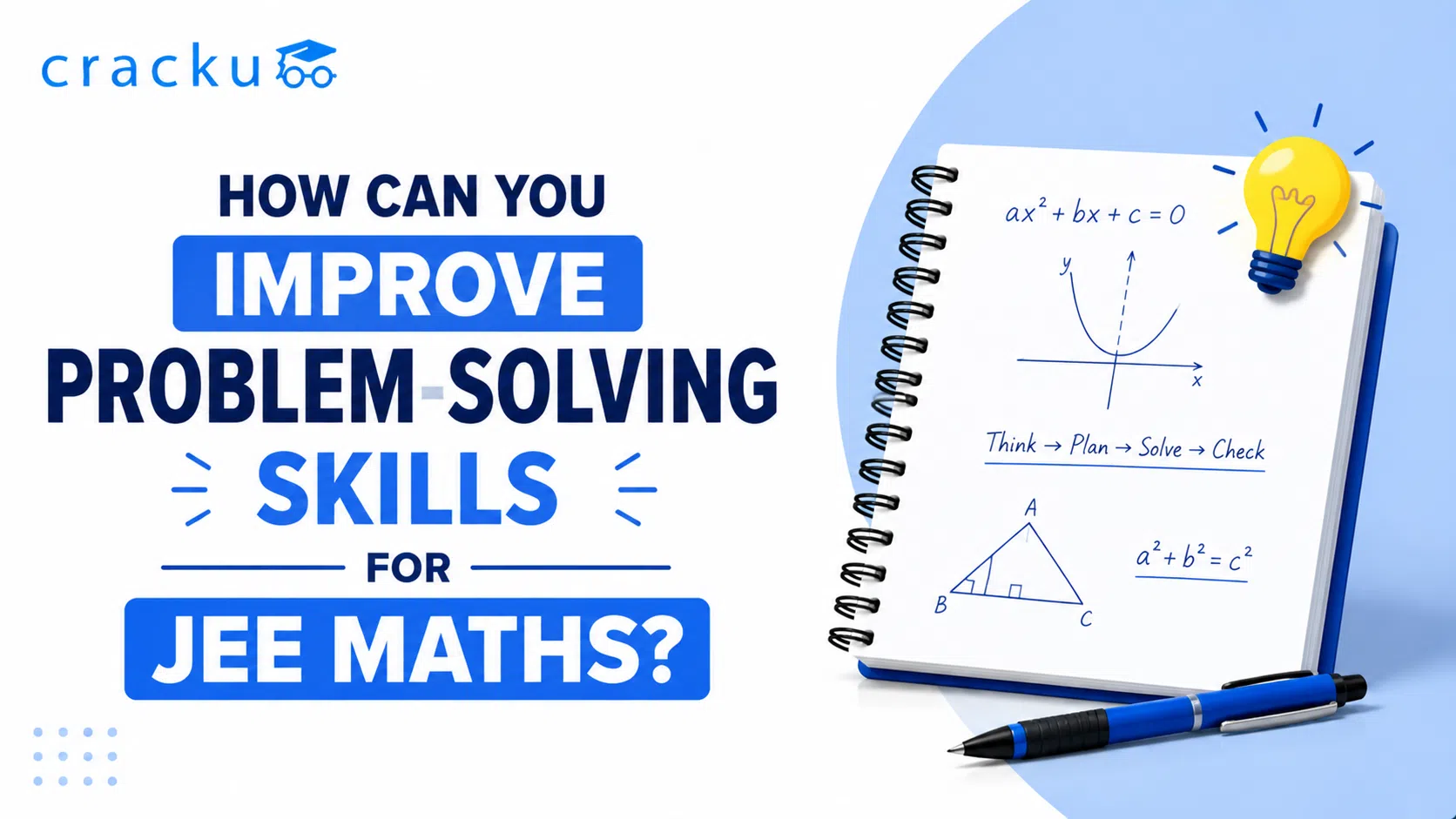
How Can You Improve Problem-Solving Skills for JEE Maths?
Maths is the first thing any student comes across: hundreds of formulas, but can JEE questions be solved just by memorizing formulas? What should you do when a familiar concept appears inside an unfamiliar question? Start by reading carefully, identifying the chapter, and connecting the given information with suitable formulas.
Regular practice can improve your speed, accuracy, and confidence across JEE Main and JEE Advanced. Solving JEE PYQs also shows how concepts can be applied and what type of tricks and problem-solving skills you can use in the questions.
With the right approach, every JEE Maths problem becomes another opportunity to sharpen your thinking.
How Does Cracku's JEE Maths Course Build Problem-Solving Skills?
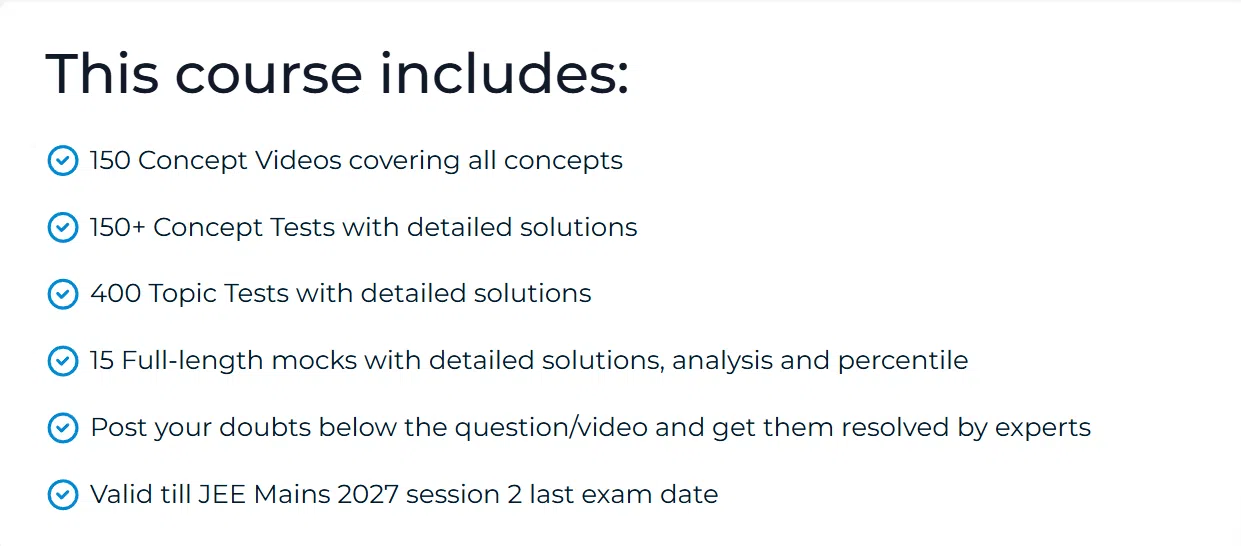
Good problem-solving starts when you understand the idea behind a formula. You should know what information a formula needs before applying it to questions. Cracku's JEE Maths Course focuses on concepts, practice, tests, and exam-level question solving.
The course can help you build a habit of connecting concepts with questions. This matters because JEE questions rarely follow one fixed pattern throughout the examination. A familiar formula could appear inside a completely different-looking problem.
While learning a topic, use this simple process to develop stronger thinking:
Stage | What You Should Do | Skill Developed |
Understand | Learn why the formula works | Concept clarity |
Identify | Find the chapter and concept | Question recognition |
Apply | Use the formula in a question | Practical understanding |
Check | Verify each calculation | Accuracy |
Review | Study mistakes after solving | Better problem-solving |
For example, consider a quadratic equation question from the JEE pattern.
Question: The roots of $$x² - 5x + k = 0 differ by 1. Find k.$$
Let the roots be $$α and β.$$
Use these formulas:
$$α + β = 5$$
$$αβ = k$$
The question gives:
$$|α - β| = 1$$
Now use:
$$(α - β)² = (α + β)² - 4αβ$$
Substitute the known values:
$$1² = 5² - 4k$$
$$1 = 25 - 4k$$
Therefore:
$$k = 6$$
The important part is recognizing the relationship between roots and coefficients. You should focus on the reason behind each step rather than memorising answers.
What Makes JEE Maths Practice More Effective?
Effective practice requires variety because different JEE questions test the same concept in different ways. JEE PYQs are especially useful because they show how actual examination questions use familiar concepts.
Start with questions directly connected to the topic you studied. Then attempt mixed questions without looking at the chapter name beforehand. This small change improves your ability to recognize concepts independently.
Use this method while solving JEE PYQs:
Step | What You Should Ask | Why It Helps |
Read | What information does the question provide? | Prevents reading mistakes |
Identify | Which topic from the JEE Maths syllabus applies? | Finds the right direction |
Recall | Which formula connects these values? | Saves unnecessary work |
Solve | Can the calculation become shorter? | Improves speed |
Verify | Does the answer satisfy every condition? | Improves accuracy |
Review | Why did this method work? | Builds stronger awareness |
Consider this trigonometry example:
$$If sin θ + cos θ = a, find sin θ cos θ.$$
Instead of expanding unrelated expressions, square both sides first.
Use:
$$(sin θ + cos θ)² = sin² θ + cos² θ + 2sin θ cos θ$$
Since:
$$sin² θ + cos² θ = 1$$
You get:
$$a² = 1 + 2sin θ cos θ$$
Therefore:
$$sin θ cos θ = (a² - 1)/2$$
This approach shows why recognising identities matters during JEE preparation. A short observation can save several calculation steps during timed practice.
How Can You Solve JEE Maths Questions Faster?
Speed improves when you recognise patterns quickly and avoid unnecessary calculations. However, speed should never come at the cost of accuracy during practice.
Keep important formulas in a simple JEE Maths formula sheet for quick revision. Instead of memorising formulas separately, attach a typical question to each important formula.
Topic | Formula | What To Notice |
Quadratic Equation | $$D = b² - 4ac$$ | Check the root condition |
Arithmetic Progression | $$aₙ = a + (n - 1)d$$ | Identify the common difference |
Geometric Progression | $$aₙ = arⁿ⁻¹$$ | Identify the common ratio |
Distance Formula | $$d = √[(x₂ - x₁)² + (y₂ - y₁)²]$$ | Compare both coordinates |
Probability | $$P(E)$$ = Favourable outcomes / Total outcomes | Define outcomes carefully |
Binomial Theorem | $$Tᵣ₊₁ = ⁿCᵣ aⁿ⁻ʳ bʳ$$ | Match the required term |
Suppose a coordinate geometry question gives two points and asks for their distance. Write the formula before inserting the values.
$$d = √[(x₂ - x₁)² + (y₂ - y₁)²]$$
Then substitute carefully and simplify after completing both differences. This method keeps your working organised and reduces sign-related mistakes.
During JEE Maths Mock Tests, track questions taking unusually long to solve. Mark those questions and review the exact reason afterwards. You might know the concept but still need better question recognition or calculation speed.
How Does Regular Practice Improve JEE Maths Accuracy?
Accuracy improves when you understand your mistakes instead of simply counting incorrect answers. Keep a short error record after completing JEE questions and practice tests.
Record four details: question type, mistake, correct method, and lesson learned. This process makes repeated errors easier to notice during future practice.
Common Mistake | What Happens | Better Practice |
Formula mistake | Wrong formula gets applied | Check the formula conditions |
Reading mistake | Important information gets missed | Underline key values |
Sign mistake | Positive becomes negative | Recheck calculations |
Concept mistake | Incorrect approach gets selected | Revise the related topic |
Time mistake | Too long on one question | Practise similar JEE questions |
For logarithms, remember the basic conditions before starting lengthy calculations.
For JEE Advanced, accuracy becomes even more important because questions can require deeper connections. You may need to combine concepts rather than apply a single formula directly.
Therefore, check whether your answer satisfies every condition given in the question. This habit can prevent avoidable marks lost through rushed calculations.
Also Read: How to Choose the Right Online JEE Maths Course for Your Child?
Is Cracku's JEE Maths Course Useful for JEE Preparation?
Begin each topic by understanding its basic ideas from the JEE Maths syllabus. Then solve direct questions before attempting questions with multiple concepts. After gaining confidence, move toward JEE Mains-level questions and timed practice.
Preparation Activity | How You Can Use It | Main Benefit |
Topic practice | Solve questions after learning | Builds application skills |
JEE PYQs | Solve previous examination questions | Understands question patterns |
Formula revision | Review formulas before practice | Improves recall |
JEE mock tests | Attempt timed papers | Builds speed and control |
Error review | Analyse incorrect questions | Reduces repeated mistakes |
JEE Advanced practice | Attempt deeper application questions | Strengthens logical thinking |
Do not judge your progress only by the number of questions completed. Check whether you can identify concepts faster and make fewer repeated mistakes.
Use JEE PYQs as a mirror for your preparation, because they reveal your actual strengths. Use mock tests as a clock, because they train you to manage limited examination time.
Conclusion
Most importantly, treat difficult JEE questions as practice for better thinking. Each mistake can expose a small gap that targeted practice can gradually close. With consistent effort, formulas become tools rather than isolated facts to memorise. With this, you can make JEE Maths your stronger section and achieve greater percentile growth.
.webp)