
 Group
Group
 Group
Group
Comparing JEE Maths courses is not easy as most of them offer similar features such as full syllabus coverage, recorded lectures, study material, tests and doubt clearance. Despite so many courses, you may still feel under-confident due to a lack of practice, deeper understanding and meaningful learning.
A suitable JEE Maths Course must combine teaching, solved examples, immediate application, chapter practice, PYQs, timed mocks, and mistake analysis. The right choice also depends on your current preparation level, stage and available time. This guide explains how to choose the best JEE Maths course for your preparation by assessing its structure, practice material, fees, etc before enrolling.
What Should You Look for in a JEE Maths Course?
A good JEE Maths Course should create a complete learning cycle. It should move from concept explanation to independent application, testing, feedback, and revision. Here are all the essential elements you must look for in a JEE Maths course.
Teaching Quality and Concept Sequence
Check whether the teacher explains the reasoning behind formulas and methods. Good lessons should connect definitions, worked examples, common errors, and independent questions. The sequence should also follow prerequisites. For example, a course should build basic algebra skills before using them in advanced applications.
Course Structure for Your Preparation Stage
Class 11 students need steady concept development and enough time for revision. Class 12 students need tighter links between current chapters and earlier gaps. Droppers usually need faster coverage, more testing, and regular mistake analysis. The schedule should match your available hours without forcing passive lecture completion.
Before paying, check the current structure of the JEE Maths Course. Also check sample lessons, test types, validity, doubt access, and the study schedule. These course components are important for your structured learning. Here are all the features of an ideal JEE Maths course that you must compare before you pay for it.
Course Factor | What You Should Check |
Concept teaching | Lessons explain definitions, methods, and common errors. |
Learning sequence | Topics progress from basics to related applications. |
Worked examples | Examples explain why each step works. |
Practice progression | Questions rise from basic application to timed exam level. |
Doubt support | Students can ask doubts near the relevant lesson or question. |
Test feedback | Reports identify accuracy, time use, and weak topics. |
Course validity | Access covers the student’s planned JEE Main attempts. |
Study schedule | The course assigns realistic daily or weekly tasks. |
What Practice Resources Should a Good JEE Maths Course Provide?
A strong course should provide different resources for each preparation stage. One question bank cannot replace concept tests, chapter practice, PYQs, timed mocks, and revision tools.
Resources for Learning and Immediate Application
Concept lessons should explain the method before asking you to solve independently. Immediate concept tests should then check whether you can apply the new idea. Detailed solutions must explain the approach, not only the final answer.
Students can use JEE Study Material 2027 for organised questions, previous papers, tests, formula resources, and targeted revision.
Resources for Exam-Level Practice
Topic tests should develop depth within one area before mixed practice begins. Chapter-wise JEE PYQs should follow concept learning and initial application. They show how completed topics appeared in actual examinations. Check whether your choice of course organises its Maths PYQs by chapter for focused practice.
Sectional tests and full-length JEE mocks should later measure speed, accuracy, stamina, and question selection. It is important to use each resource at the correct stage instead of collecting random questions from several platforms. The table below presents a guide on ‘how to use practice resources’.
Practice Resource | Purpose | When to Use It |
Concept lesson | Build understanding of one method or idea. | At the start of a new topic. |
Concept test | Check immediate application. | Directly after the related lesson. |
Topic test | Develop depth and variation. | After completing connected concepts. |
Chapter-wise practice | Combine several topics within one chapter. | Before attempting previous-year questions. |
JEE PYQ | Test actual examination applications. | After basic chapter mastery. |
Sectional test | Build timed subject-level performance. | After completing several chapters. |
Full-length JEE Mock Test | Test complete exam execution. | After substantial syllabus coverage. |
Error log and formula sheet | Support correction and revision. | After every test and during revision. |
How Much Does a Good JEE Maths Course Cost?
A good JEE Maths Course does not have a standard price. The right fee fits your budget and includes the required learning support. You must compare access, lessons, tests, solutions, doubt support, analysis, and extra charges.
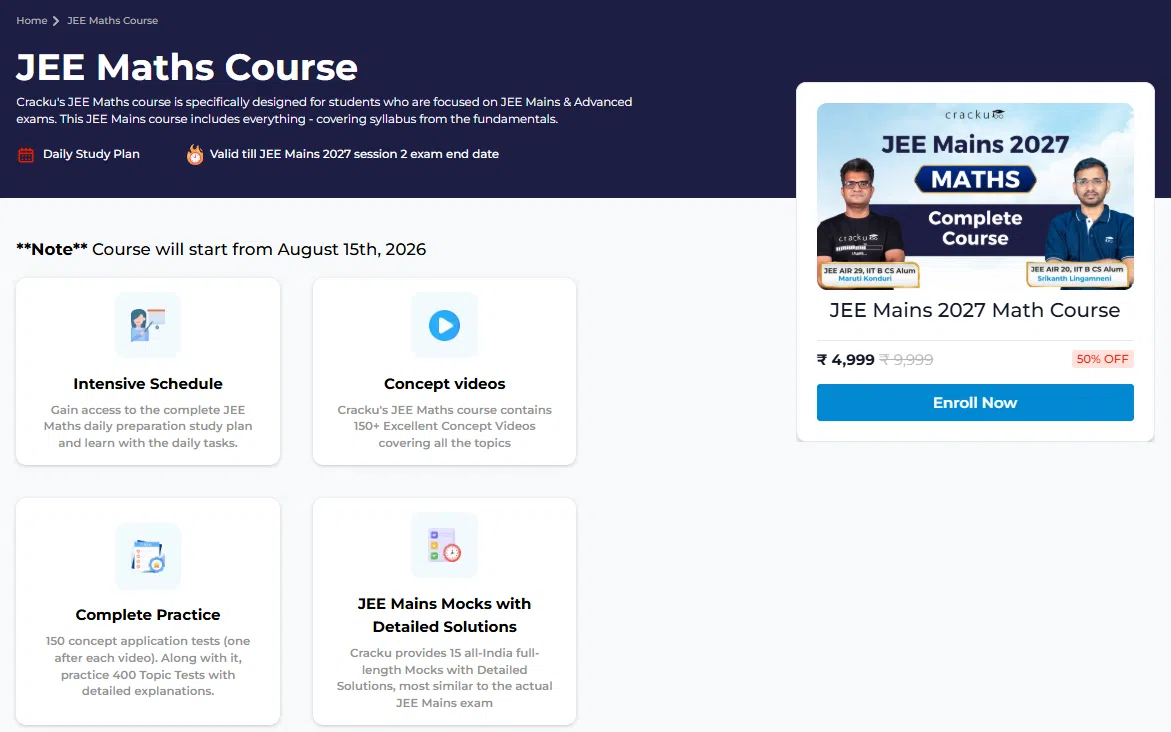
Here at Cracku, we charge ₹4,999 for our JEE Maths course. Before payment, make sure to check the discounts applicable. Remember, two courses with similar prices may provide different preparation value. The table below shows what you must confirm before comparing fees.
Fee Component | What Must Be Confirmed |
Course access period | Confirm the start date, expiry date, and revision access. |
Concept lessons | Check coverage, sequence, sample quality, and replay access. |
Practice tests | Confirm concept, topic, chapter, and timed test availability. |
Full-length mocks | Check solutions, analysis, and reattempt options. |
Detailed solutions | Confirm whether solutions explain methods and common errors. |
Doubt support | Check the method, scope, and expected response process. |
Performance analysis | Check accuracy, time, topic, and error reports. |
Additional charges | Confirm renewals, upgrades, refunds, and separate resources. |
Why Choose Cracku’s JEE Maths Course for Your Preparation?
Cracku’s JEE Maths Course follows a fixed cycle of learning, application, testing, and revision. This structure may help students who understand lectures but struggle to organize daily practice. Below are the main features of Cracku's JEE Maths course to help you decide why you should choose it for your preparation and how it can help you.
Structured Daily Maths Preparation
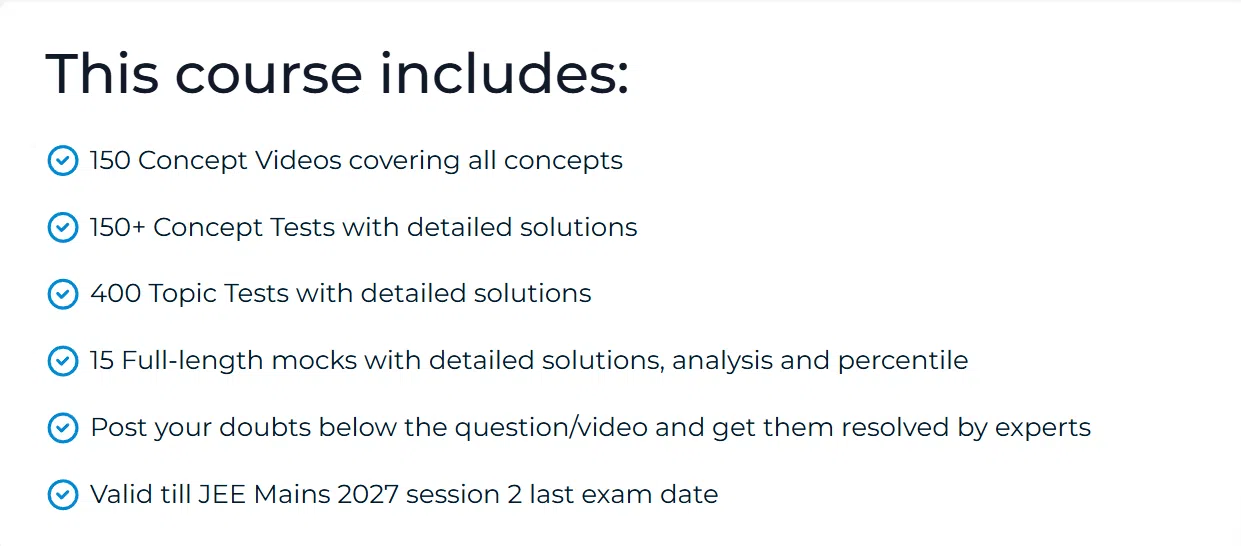
The course provides a daily study plan with assigned learning and practice tasks. You can use this sequence to decide what to learn, test, and revise each day. The current access period continues until the last JEE Main 2027 Session 2 examination date.
Concept Tests and Topic-Wise Practice
Concept videos introduce each topic before students attempt related application tests. These tests check whether you can use the concept without copying the demonstrated method. Topic-wise tests then provide focused practice with detailed explanations.
A feature only supports preparation when you use it at the correct stage. The following table connects each verified course feature with its practical purpose.
Cracku’s Course Features | How Students Use It | Preparation Problem Solved |
Daily study plan | The student follows assigned lessons and practice tasks in order. | It reduces confusion about what to study next. |
Concept videos | The student learns definitions, methods, and worked examples. | They support concept clarity before independent practice. |
Concept application tests | The student attempts questions after completing each related lesson. | They identify misunderstandings before the next topic begins. |
Topic-wise tests | The student practises several question forms within one topic. | They develop depth beyond basic concept recall. |
Detailed solutions | The student compares methods after making an independent attempt. | They show where the original approach failed. |
Full-length mocks | The student attempts to complete tests under fixed time limits. | They measure speed, accuracy, and question selection. |
Performance analysis | The student reviews topic performance and repeated mistakes. | It directs revision towards specific weak areas. |
Doubt resolution | The student posts doubts below the related question or video. | It prevents unresolved gaps from affecting later topics. |
Full-Length Mocks and Doubt Resolution
Cracku provides 15 full-length mocks with solutions, analysis, and percentile information. It also allows you to post doubts below questions or videos. These features support test review and timely doubt resolution.
The course structure may suit students who need a fixed study sequence and regular topic tests. It may also help online learners who want concept teaching followed by immediate application. You may review the current fee, access period, and complete inclusions on the official Cracku website.
Is an Online JEE Maths Course Enough for JEE Main Preparation?
An Online JEE Maths Course can support JEE Main preparation under clear conditions. You must follow the course sequence, practise independently, solve JEE Maths Chapter-wise PYQs, attempt mocks, analyse mistakes, and clear doubts.
Watching recorded lessons alone cannot develop exam-level problem-solving ability. You need timed practice to improve speed and question selection. You also need an error log to track conceptual, calculation, and time-management mistakes.
Online and offline formats do not determine preparation quality by themselves. Your use of teaching, testing, feedback, and revision determines whether the preparation system works. Refer to the table below to know when an online JEE Maths course is enough and when you may require more help.
Online Course Works Well When | More Support Is Needed When |
The student follows a fixed daily or weekly schedule. | The student cannot maintain a regular study routine. |
The student attempts every question before viewing its solution. | The student watches solutions before trying the questions. |
The student completes topic tests after each concept group. | The student repeatedly postpones tests until syllabus completion. |
The student solves chapter-wise JEE PYQs after initial practice. | The student struggles with basic school-level concepts. |
The student attempts full-length mocks under timed conditions. | The student avoids mocks due to low scores or incomplete preparation. |
The student reviews every incorrect and skipped question. | The student checks marks without analysing the cause of mistakes. |
The student uses doubt support before starting related topics. | The student carries unresolved doubts into later chapters. |
The student controls distractions during recorded lessons. | The student cannot study independently without regular supervision. |
JEE PYQs are not enough when students use them without prior concept learning. They work best after basic application and topic-wise practice. You must also study alternative methods and record mistakes after every attempt.
In conclusion, you may choose online preparation when you follow schedules and use tests consistently. But if you require continuous supervision, you must arrange mentoring or additional study support.
Conclusion
Choosing the best JEE Maths course requires more than comparing recorded lectures and fees. A suitable course should create a complete learning cycle covering concept explanation, immediate application, topic-wise practice, chapter-wise JEE PYQs, timed mock tests, mistake analysis and revision. Its study schedule and teaching pace should also match your preparation level and available time.
Before enrolling in an online JEE Maths course, review sample classes, course validity, practice resources, doubt support and test analysis. The course can support JEE Main and Advanced preparation only when you practise independently, attempt tests on schedule and analyse every mistake. Compare the complete preparation value instead of choosing a course based only on its price or number of lectures.