
 Group
Group
 Group
Group
Weightage of Chapters in JEE Mains 2027
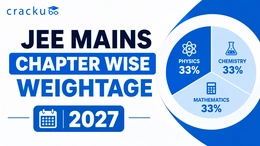
Knowing the weightage of chapters in JEE Main 2027 will allow the candidates to prepare themselves in a better manner. JEE Main Paper 1 includes Physics, Chemistry, and Mathematics subjects, having 25 questions from each of the subjects. But there is no official weightage provided by NTA for the chapters of JEE Main. Weightage is estimated based on past years’ papers. For JEE Main 2027 preparation, students are advised to emphasise high-frequency topics but continue studying the full syllabus. Some of the important chapters include Current Electricity, Modern Physics, Coordination Compounds, Chemical Bonding, Calculus, Matrices and Determinants, and Vector Algebra & 3D Geometry.
JEE Main Chapter Wise Weightage 2027
The chapter-wise weightage for JEE Main 2027 is based on previous-year paper trends and may change in different shifts. The table below highlights some of the important chapters students should prioritise.
Subject | High-Weightage Chapters | Expected Questions* |
Physics | Current Electricity | 1–2 |
Physics | Modern Physics | 2–3 |
Physics | Electrostatics | 1–2 |
Physics | Optics | 2–3 |
Physics | Semiconductor Electronics | 1–2 |
Chemistry | Chemical Bonding | 1–2 |
Chemistry | Coordination Compounds | 1–2 |
Chemistry | Thermodynamics | 1–2 |
Chemistry | Organic Chemistry | 3–5 combined |
Chemistry | Chemical Kinetics | 1–2 |
Mathematics | Calculus | 5–7 combined |
Mathematics | Coordinate Geometry | 3–4 |
Mathematics | Matrices & Determinants | 1–2 |
Mathematics | Vector & 3D Geometry | 2–3 |
Mathematics | Probability | 1–2 |
JEE Main Physics Chapter Wise Weightage
Physics questions in JEE Main tend to be based on concepts, formulas, and numerical problems. Certain topics have been more commonly asked in past papers.
Physics Chapter | Expected Importance |
Modern Physics | Very High |
Current Electricity | Very High |
Electrostatics & Capacitance | High |
Ray Optics | High |
Wave Optics | Moderate–High |
Semiconductor Electronics | High |
Electromagnetic Induction | Moderate–High |
Alternating Current | Moderate |
Rotational Motion | Moderate–High |
Thermodynamics | Moderate |
Gravitation | Moderate |
JEE Main Chemistry Chapter Wise Weightage
Chemistry is divided into Physical, Organic, and Inorganic Chemistry. The students’ performance in these topics can be improve by NCERT revision, conceptual study and regular PYQ practice.
Chemistry Chapter | Expected Importance |
Chemical Bonding | Very High |
Coordination Compounds | Very High |
Organic Chemistry – Basic Principles | High |
Thermodynamics | High |
Chemical Kinetics | High |
Electrochemistry | Moderate–High |
Solutions | Moderate–High |
Hydrocarbons | Moderate–High |
Periodic Table & Periodicity | Moderate |
Structure of Atom | Moderate |
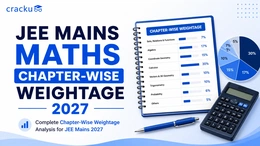
JEE Main Maths Chapter Wise Weightage
Mathematics mostly requires regular practice since the problems asked could contain more than one concept as well as calculations. Important topics include Calculus, Algebra, Coordinate Geometry, Vectors & 3D Geometry, etc.
Mathematics Chapter | Expected Questions/Trend |
Calculus | 5–7 combined |
Coordinate Geometry | 3–4 |
Vector Algebra | 1–2 |
3D Geometry | 1–2 |
Matrices & Determinants | 1–2 |
Complex Numbers | 1–2 |
Quadratic Equations | 1 |
Sequences & Series | 1–2 |
Probability | 1–2 |
Binomial Theorem | 1 |
Statistics | 1 |
Which Chapters Have the Highest Weightage in JEE Main?
There are no set chapters with high weightage for the JEE Main 2027 exam. There may be variations in the number of questions. Nevertheless, past trends have shown that certain chapters are always covered in the examination.
Subject | Frequently Asked Areas |
Physics | Modern Physics, Current Electricity, Electrostatics, Optics, Semiconductor |
Chemistry | Chemical Bonding, Coordination Compounds, Organic Chemistry, Thermodynamics |
Mathematics | Calculus, Coordinate Geometry, Matrices, Determinants, Vector & 3D Geometry |
Also Read: High Weightage Chapters for JEE Mains 2027: Check Now
How Many Questions Come From Each Chapter in JEE Main?
The number of questions asked in every chapter is not decided by NTA. For example, one chapter that has two questions in one shift might have only one question in another shift. Similarly, some chapters may contain questions in combination with some other topics as well. The approximate pattern can be understood as:
Subject | Chapter/Area | Approx. Questions |
Physics | Modern Physics | 2–3 |
Physics | Current Electricity | 1–2 |
Physics | Optics | 2–3 |
Chemistry | Chemical Bonding | 1–2 |
Chemistry | Coordination Compounds | 1–2 |
Chemistry | Organic Chemistry | 3–5 combined |
Mathematics | Calculus | 5–7 combined |
Mathematics | Coordinate Geometry | 3–4 |
Mathematics | Vector & 3D | 2–3 |
Mathematics | Matrices & Determinants | 1–2 |
Also Read: JEE Mains Revision Plan 2027: Timetable, Tips & Strategy
Weightage of Chapters in JEE Mains 2027: Conclusion
The JEE Main 2027 chapter-wise weightage can help students prioritise their preparation, but it should not be treated as an official NTA distribution. Based on previous-year trends, topics such as Modern Physics, Current Electricity and Optics are important in Physics, while Chemical Bonding, Coordination Compounds and Organic Chemistry are key areas in Chemistry. In Mathematics, Calculus, Coordinate Geometry, Matrices and Determinants, and Vector & 3D Geometry deserve consistent practice.
Students should use chapter-wise weightage as a preparation strategy rather than a shortcut to the syllabus. Since the number of questions can vary across JEE Main shifts, candidates should cover the complete syllabus, solve previous-year questions and regularly practise mock tests. This approach helps improve both conceptual understanding and the ability to handle different question patterns in JEE Main 2027.