91- 6303239042



 Group
Group
 Group
Group
RMO Important Topics 2026
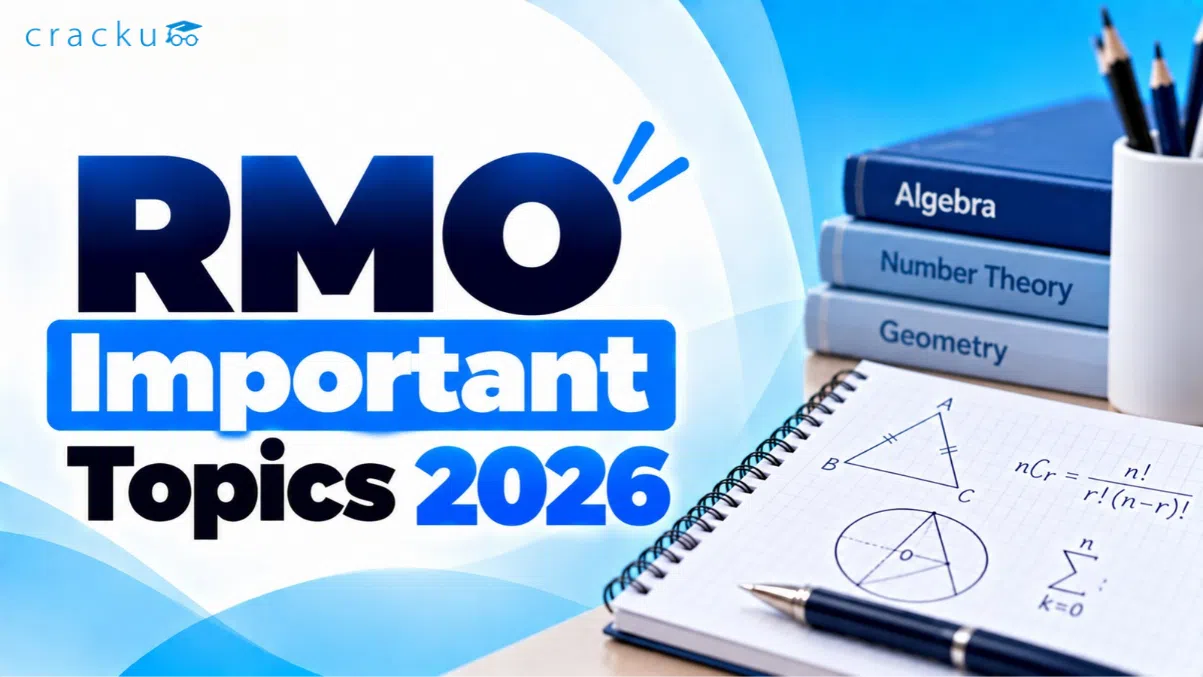
Students who aim to score high marks in the RMO exam should specifically focus on high-priority important topics. These important topics help students prioritise their studies and make plan accordingly. These important topics are found through the analysis of RMO previous years' papers, and knowing this beforehand can save you weeks of unfocused revision. The most important topics for RMO 2026 include Number Theory, Geometry, Combinatorics and Algebra, with special focus on concepts that require logical thinking and multi-step problem solving.
High-Weightage Topics for RMO 2026
Important topics and high-weightage topics in RMO are two different things, and students must understand the difference between them to prepare effectively. While important topics help build a strong conceptual foundation, high-priority or frequently appeared topics can help students focus their practice and improve their chances of scoring well in the RMO exam. The RMO exam does not follow a predictable chapter-wise pattern, and the same concepts may appear in different forms across the exam. Therefore, students should focus on understanding the underlying concepts and developing strong problem-solving skills rather than preparing for specific or repeated questions.
Topic | Key Areas to Focus On | Priority |
Number Theory | Divisibility, primes, modular arithmetic, remainders | High |
Geometry | Triangles, circles, angles, similarity | High |
Combinatorics | Counting, arrangements, pigeonhole principle | High |
Algebra | Equations, polynomials, sequences, identities | High |
Inequalities | AM-GM and basic inequality techniques | Medium |
How to Prepare Important Topics for RMO 2026?
RMO previous year papers are one of the most important resources for understanding the level and types of Olympiad mathematics questions. Students must use these papers to understand the style of questions, to identify weak areas, and to develop time management skills.
Number Theory and Geometry usually dominate, often together making up two to three of the six questions.
Within Number Theory, modular arithmetic and the Chinese Remainder Theorem appear every year.
In Geometry, triangle properties, circle theorems and concurrency problems are repeat favourites.
Combinatorics, particularly Pigeonhole Principle questions, is the third heavy hitter.
Algebra leans toward functional equations and polynomial roots rather than basic equation solving.
Inequalities is the smallest part but often appears as one standalone AM-GM or Cauchy-Schwarz question.
Begin with Conceptual Practice: First, complete all the concepts of each important RMO topic and solve questions without time pressure. Focus on understanding the logic and approach rather than simply reaching the answer.
Analyse Your PYQ Performance: Maintain a PYQ analysis sheet with the question, topic, difficulty level, your method, correct approach, and mistakes. This will help you find weak areas and improve your preparation systematically.
Reattempt Difficult Questions: Do not immediately memorise solutions to questions you cannot solve. Read the correct methods and steps, understand the concept, and reattempt the question after a few days to strengthen your problem-solving ability.
Combine PYQs With Topic-Wise Practice: Use previous year's questions to understand the exam pattern and find important concepts, then complement them with topic-wise practice. This will help you build both conceptual knowledge and problem-solving skills.
Use PYQs to Understand Patterns: Previous year papers should be used to understand repeating problem-solving patterns, concepts, and difficulty levels rather than to predict the exact questions that may appear in RMO 2026.
Also Read: RMO Syllabus 2026, Important Topics & Preparation Books
How to Prepare for RMO Using Previous Year Papers?
RMO Previous Year Papers are one of the most useful sources for understanding the type of mathematical problems expected in the RMO examination. It also helps in knowing the difficulty level of the exam. Solving RMO PYQs helps students find high-weightage and important topics for the RMO exam, understand repeating concepts, and become familiar with the difficulty level and problem-solving patterns of the examination. Treat these PYQs like a real exam and give your best effort while solving each question. Try to complete the paper within the given time limit without referring to solutions.
Students can first solve PYQs year-wise to know the complete RMO exam pattern and then identify individual problems from Algebra, Geometry, Number Theory and Combinatorics. After attempting a question, students should compare their solution with the correct answer and rewrite the proof independently. This method will help you improve both problem-solving ability and the quality of mathematical presentation. It helps you make a clear approach for the real RMO exam.
Also Read: RMO Exam Date 2026: Important Dates & Exam Day Guidelines
Common Mistakes to Avoid While Preparing Important RMO Topics
Treating the RMO exam like a regular school exam is one of the biggest mistakes students often make. This can become a major disadvantage, as Olympiad mathematics questions want a logical flow and consistency in their solution. Students must avoid these mistakes while preparing for the RMO important topics.
Common Mistake | What Students Should Do Instead |
Focusing on only one topic | Prepare all major topics such as Number Theory, Geometry, Algebra and Combinatorics. |
Preparing only interesting topics | Don't prepare only favourite or interesting topics. |
Memorising formulas and tricks | Focus on understanding concepts and applying them to unfamiliar problems. |
Practising only easy questions | Slowly include challenging Olympiad-level problems in your practice. |
Ignoring weak topics | Identify weak topics through PYQs and give them additional practice time. |
Looking at solutions too early | Spend enough time attempting the problem before checking the solution. |
Not revising difficult questions | Reattempt unsolved questions after a gap to improve problem-solving skills. |
Assuming high-priority topics guarantee questions | Use topic priority as a preparation guide, not as a prediction of the RMO paper. |
Also Read: RMO Preparation Strategy 2026, Best Books & Common Mistakes
RMO Important Topics 2026: Conclusion
Preparing RMO Important Topics 2026 requires a strong foundation in Number Theory, Geometry, Combinatorics and Algebra, along with practice in inequalities. Use topic priorities to organise your study time while maintaining balanced coverage of the major areas. Understanding why a method works and presenting a complete mathematical proof will make your practice more useful than memorising formulas or expecting repeated questions.
Make RMO previous year papers a regular part of your preparation. Attempt problems independently, review your mistakes and combine PYQs with topic-wise Olympiad practice. Revisit difficult questions and rewrite solutions clearly to strengthen your reasoning. A consistent routine of concept revision, problem solving and proof writing can help you approach unfamiliar RMO problems with greater confidence.