Group
 Group


 Preferred Source

 Google Discover
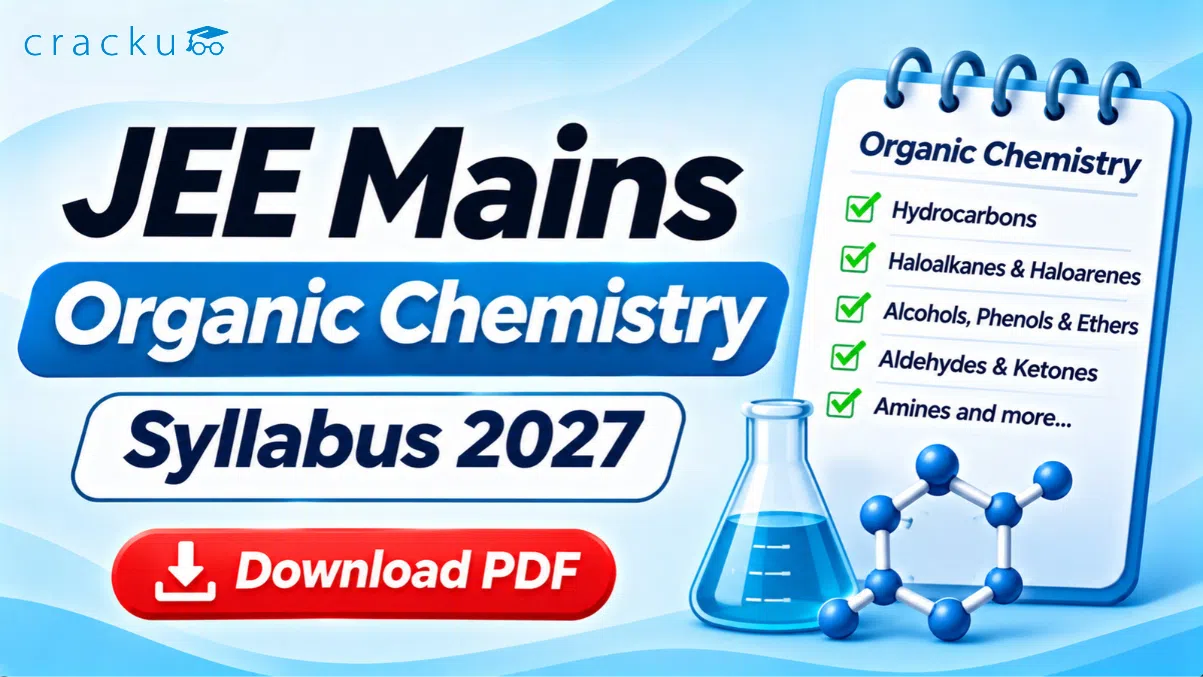
JEE Mains Organic Chemistry Syllabus 2027
The JEE Mains Organic Chemistry Syllabus 2027 is defined by NTA in Units 13 to 19 and Unit 20 (Practical Chemistry). The syllabus constitutes about 35.6% of Chemistry and contributed 169 questions for the total 475 questions in 2026.
Out of a total of 25 Chemistry questions in each shift, around 9 questions from Unit 20 contribute to around 35 marks. It can be seen that the JEE Main Organic Chemistry syllabus is based on the NCERT syllabus.
Now, read to know what topics to learn, which topics have to be given more importance, which topics are hard and what should be avoided.
High-weightage Topics from Organic Chemistry
High-scoring organic disciplines need to be covered at any cost, as these contributed to around 119 questions (70% of total organic questions) in the 2026 paper.
The list of important chapters is given below.
Unit 13: Purification and Characterisation of Organic Compounds
Topics to cover:
Crystallisation, sublimation, distillation, differential extraction, chromatography; detection of N, S, P, halogens; estimation of C, H, N, halogens, S, P (basic principles); empirical and molecular formula numericals.
Unit 14: Some Basic Principles of Organic Chemistry
Topics to cover:
Tetravalency, hybridisation (s and p), functional groups, isomerism (structural, stereo), nomenclature, bond fission, free radicals, carbocations, carbanions, electrophiles, nucleophiles, inductive, electromeric, resonance, hyperconjugation, and reaction types
Unit 15: Hydrocarbons
Topics to cover:
Alkanes (Newman and Sawhorse of ethane, halogenation); alkenes (geometrical isomerism, electrophilic addition, Markovnikov and peroxide effect, ozonolysis); alkynes (acidic character); benzene (aromaticity, halogenation, nitration, Friedel-Crafts, directive influence)
Unit 16: Organic Compounds Containing Halogens
Topics to cover:
Preparation, properties, C-X bond, mechanisms of substitution; uses and environmental effects of chloroform, iodoform, freons, DDT
Unit 17: Organic Compounds Containing Oxygen
Topics to cover:
Alcohols (1°, 2°, 3° identification, dehydration); phenols (acidity, Reimer-Tiemann); ethers (structure); carbonyls (nucleophilic addition, Grignard, Wolff-Kishner, Clemmensen, aldol, Cannizzaro, haloform, distinguishing tests); carboxylic acid strength
Unit 18: Organic Compounds Containing Nitrogen
Topics to cover:
Amines (classification, basic character, identification); diazonium salts in synthesis
Unit 19: Biomolecules
Topics to cover:
Carbohydrates, proteins, vitamins, nucleic acids, hormones (general)
Unit 20 (part): Principles Related to Practical Chemistry
Topics to cover:
Detection of N, S, halogens; hydroxyl, carbonyl, carboxyl, amino tests; preparation of acetanilide, p-nitroacetanilide, aniline yellow, and iodoform
Also Read: JEE Mains Inorganic Chemistry Syllabus 2027: Important Topics
Organic Chemistry Topic-Wise Weightage
Oxygen is an important unit as it generates the most questions. Aldehydes, ketones and carboxylic acids are among the top-scoring topics in Organic Chemistry. Hydrocarbons is another important chapter. It is mechanism-driven and tested on very alkene, alkyne and benzene pattern questions.
Top Organic Chapters by 2026 Question Count
Check the table below for topic-wise weightage of the top organic chapters in 2026 along with question count.
Chemistry Rank | Chapter | Ques (Jan + Apr) | % of Chemistry | Frequent Areas |
2nd | Organic Compounds Containing Oxygen | 22 + 14 = 36 | 7.58% | Alcohols, phenols, ethers, carbonyls, acids, named reactions, mechanisms |
3rd | Hydrocarbons | 13 + 17 = 30 | 6.32% | Alkenes, alkynes, aromaticity, electrophilic substitution, mechanisms |
Joint 4th | Organic Compounds Containing Nitrogen | 14 + 13 = 27 | 5.68% | Amines, diazonium salts, coupling, NaNO₂ + HCl |
Joint 6th | Some Basic Principles of Organic Chemistry | 14 + 12 = 26 | 5.47% | Nomenclature, isomerism, electronic effects, intermediates |
Organic Chemistry Chapter-wise Weightage 2026
The Organic Compounds Containing Oxygen chapter leads at 7.58% of Chemistry. Check the chapter-wise weightage for 2026 below.
Tier | Chapters | Questions | % of Chemistry |
1 | Oxygen + Hydrocarbons | 66 | 13.89% |
2 | Nitrogen + GOC | 53 | 11.16% |
3 | Biomolecules + Purification | 41 | 8.63% |
4 | Halogens | 9 | 1.89% |
Each 1% of Chemistry is around 1 mark in a 100-mark section. Also, oxygen is around 7.6 marks in an average paper.
Most-Asked Organic Topics
Here is a quick PYQ trend analysis of the most-asked organic topics in the JEE Mains paper.
Unit | Topic | Approx Questions |
14 and 15 | Stereoisomerism | 6 |
18 | Coupling reaction | 4 |
19 | Amino acids | 4 |
18 | Reaction with NaNO₂ + HCl | 3 |
19 | Proteins | 3 |
19 | Disaccharides and polysaccharides | 1 |
13 | Chromatography | 1 |
17 | Nucleophilic addition | 1 |
15 | Aromaticity | 1 |
Which is the toughest chapter in organic Chemistry?
The toughest chapter in organic chemistry depends on the person. Some Basic Principles of Organic Chemistry is mostly considered difficult because it is abstract. Oxygen compounds and Hydrocarbons are also tough comparatively. Below is an analysis of the main reasons why GOC is the toughest chapter in organic Chemistry.
- It teaches rules.
- It does not teach reactions.
- It is not easy to memorise
- It is prone to lots of errors
Refer to the table below for toughness by chapter.
Chapter | What is Tough Here |
GOC | Abstract rules; heavy on comparisons |
Oxygen compounds | Largest reaction volume; many named reactions |
Hydrocarbons | Mechanisms; directing effects; regiochemistry |
Nitrogen compounds | Basicity orders; diazonium reaction paths |
Check the tips to make the toughest chapters your most scoring sections.
- Study the GOC rule sets before any reaction chapter.
- Understand and explain the reactions using the electron-rich and electron-poor site concepts.
- Solve more chapter-wise PYQs and record errors.
- Re-study all concepts in GOC after Oxygen and Nitrogen
Sub-topics which you cannot Miss in Organic Chemistry
Do not skip the following:
- Electronic effects and stability orders
- Stereoisomerism and nomenclature
- Electrophilic reactions of alkenes and benzene
- Carbonyl chemistry
- Amine basicity and diazonium reactions
- NCERT facts in Biomolecules
- Unit 13 numericals
Common Mistakes to Avoid While Preparing Organic Chemistry
Do not memorize reactions without mechanisms or rush GOC. Also, do not treat Biomolecules and Purification as optional. These mistakes can cost a lot on your exam day. Here are the most common mistakes to avoid while preparing organic chemistry for JEE Main 2027.
- Rote-learning reactions
- Rushing GOC
- Confusing paired reactions
- Using the peroxide effect with HCl or HI
- Wrong amine basicity orders
- Misusing Friedel-Crafts
- IUPAC and stereo slips
- Skipping Biomolecules and Purification
- Neglecting Unit 13 numericals
- No revision loop
JEE Mains Organic Chemistry Syllabus 2027 Conclusion
Begin the JEE Mains Organic Chemistry syllabus 2027 with GOC, then apply electronic effects, stability rules and isomerism to reaction-based chapters. The 2026 papers give a useful guide to revision priorities. Organic Compounds Containing Oxygen, Hydrocarbons, Organic Compounds Containing Nitrogen and GOC together accounted for 119 of 169 Organic Chemistry questions, or about 70% of the total.
Use JEE chapter-wise PYQs to decide what to revise next. If you miss a carbonyl question, check whether the error came from identifying the functional group, recalling the reagent or predicting the product. Alongside reaction practice, set aside time for NCERT Biomolecules, purification methods and practical tests so your preparation covers the full syllabus.