JEE WhatsApp Group


JEE Mains Chemistry Syllabus 2027
The official NTA Chemistry syllabus for JEE Main is mainly based on NCERT Class 11 and 12 topics. Students preparing for board exams should focus on building strong concepts, as it also helps in JEE Main preparation. Referring to the JEE Mains Syllabus 2027 can help students understand all important topics and plan their studies more effectively.
Many students find the Chemistry section comparatively more direct than Physics and Mathematics. To score well, students should prepare Organic Chemistry properly, revise formulas regularly, practice questions daily, and focus on high-weightage chapters. Along with the syllabus, choosing the right books and maintaining consistent practice are equally important for improving scores in JEE Mains Chemistry 2027.
JEE Mains Chemistry Syllabus PDF
The JEE Main Chemistry syllabus 2027 is expected to remain similar to the latest NTA pattern. Based on the official JEE (Main) 2026 syllabus, the Chemistry section covers Physical Chemistry, Organic Chemistry, and Inorganic Chemistry.
Chemistry Section | Important Areas Covered |
Physical Chemistry | Mole Concept, Thermodynamics, Electrochemistry, Chemical Kinetics |
Organic Chemistry | Hydrocarbons, Alcohols, Aldehydes, Amines, Biomolecules |
Inorganic Chemistry | Coordination Compounds, Chemical Bonding, p-Block, d-Block |
Following is the official syllabus PDF for 2026, it helps avoid unnecessary topics during preparation.
JEE Mains Chemistry Chapter-Wise Syllabus 2027
The following tables have the detailed chapter-wise JEE Main Chemistry syllabus 2027 with important subtopics. These chapters are based on NCERT.
Physical Chemistry Chapters
Physical Chemistry needs regular formula practice and numerical solving. Most questions are direct and concept-based.
Chapter | Important Topics |
Some Basic Concepts of Chemistry | Mole concept, stoichiometry, concentration terms, empirical and molecular formulae |
Atomic Structure | Bohr model, quantum numbers, shapes of orbitals, electronic configuration, de Broglie relation, Heisenberg uncertainty principle |
Chemical Bonding & Molecular Structure | Hybridization, VSEPR theory, MOT, dipole moment, ionic and covalent bonding, resonance, hydrogen bonding |
Chemical Thermodynamics | Enthalpy, entropy, Gibbs energy, Hess's law, spontaneity, first and second law |
Solutions | Raoult's law, colligative properties, Van't Hoff factor, osmotic pressure |
Equilibrium | Le Chatelier's principle, Kp/Kc, ionic equilibrium, pH, buffer solutions, solubility product |
Redox Reactions & Electrochemistry | Oxidation numbers, balancing redox reactions, Nernst equation, conductivity, galvanic and electrolytic cells |
Chemical Kinetics | Rate law, order and molecularity, Arrhenius equation, half-life, activation energy |
Inorganic Chemistry Chapters
Inorganic Chemistry gives many direct NCERT-based questions. Ensure you make short notes while reading.
Chapter | Important Topics |
Classification of Elements & Periodicity | Modern periodic law, periodic trends, atomic/ionic radii, ionization enthalpy, electron gain enthalpy |
p-Block Elements (Groups 13-18) | Group-wise physical and chemical properties, reactions, unique behaviour of first element in each group |
d and f-Block Elements | Transition elements, oxidation states, catalytic behaviour, magnetic properties, preparation and properties of K₂Cr₂O₇ and KMnO₄, Lanthanoid contraction |
Coordination Compounds | Werner's theory, ligands, coordination number, IUPAC nomenclature, isomerism, VBT and CFT basics, biological importance |
Organic Chemistry Chapters
Organic Chemistry becomes easier when reaction mechanisms are clear. Daily revision helps retain reactions.
Chapter | Important Topics |
Purification & Characterisation | Crystallization, sublimation, distillation, chromatography; detection of N, S, halogens |
Basic Principles of Organic Chemistry | Hybridization, isomerism (structural and stereo), IUPAC nomenclature, electronic effects (inductive, resonance, hyperconjugation), reaction types |
Hydrocarbons | Alkanes, alkenes, alkynes, aromatic compounds; Markovnikov's rule, electrophilic substitution, Friedel-Crafts reactions |
Haloalkanes & Haloarenes | Nucleophilic substitution, elimination reactions, nature of C-X bond, environmental effects (freons, DDT) |
Alcohols, Phenols & Ethers | Acidity, dehydration mechanism, electrophilic substitution of phenols, Reimer-Tiemann reaction |
Aldehydes, Ketones & Carboxylic Acids | Nucleophilic addition, aldol condensation, Cannizzaro reaction, Haloform reaction, Wolf-Kishner and Clemmensen reduction, acidity of carboxylic acids |
Organic Compounds Containing Nitrogen (Amines) | Classification, basicity, primary/secondary/tertiary amines, diazonium salts and their synthetic uses |
Biomolecules | Carbohydrates (monosaccharides, disaccharides), proteins (structure, denaturation), vitamins, nucleic acids (DNA/RNA), hormones |
Practical Chemistry | Inorganic preparations (Mohr's salt, potash alum), organic preparations (acetanilide, iodoform), titrimetry, qualitative salt analysis |
JEE Mains Chemistry Topic-Wise Weightage
Understanding JEE Mains Chemistry topic-wise weightage helps you focus on high-scoring areas. The table below is based on previous year trend analysis of actual question papers.
Areas | Key Chapters Covered | Approx. Weightage |
Carbonyl & Nitrogen Compounds | Aldehydes, Ketones, Carboxylic Acids; Amines | 9 - 10% |
Coordination & Transition Metals | Coordination Compounds, d & f-Block Elements | 9 - 10% |
Block Elements (s & p) | s-Block (Groups 1–2), p-Block (Groups 13–18) | 8 - 9% |
Equilibrium & Solutions | Chemical + Ionic Equilibrium, Solutions, Colligative Properties | 8 - 9% |
Thermodynamics & Chemical Kinetics | Thermodynamics, Chemical Kinetics | 7 - 8% |
Electrochemistry & Redox | Electrochemistry, Redox Reactions | 5 - 6% |
Atomic Structure & Chemical Bonding | Atomic Structure, Chemical Bonding & Molecular Structure | 6 - 7% |
Haloalkanes & Hydrocarbons | Alkanes/Alkenes/Alkynes/Arenes, Haloalkanes & Haloarenes | 6 - 7% |
Biomolecules & Organic Foundations | Biomolecules, General Organic Chemistry, Purification | 6 - 7% |
Environmental, Practical & Surface Chemistry | Salt analysis, catalysis, colloids, practical preparations | 5 - 6% |
Important Notes on Weightage
- Aldehydes, Ketones & Carboxylic Acids is the single highest-scoring Organic chapter.
- Coordination Compounds is consistently among the top chapters overall -isomerism and nomenclature are heavily tested.
- Equilibrium + Solutions together account for nearly 1 in 10 Chemistry marks.
- Physical Chemistry as a whole has been increasing in weightage
- NCERT examples and in-text questions are directly lifted in Inorganic Chemistry.
- Numerical questions are almost exclusively from Physical Chemistry.
Important JEE Mains Chemistry Formulas
Formula revision improves speed during the exam. Here are the most important chapter-wise Chemistry formulas for JEE Main 2027.
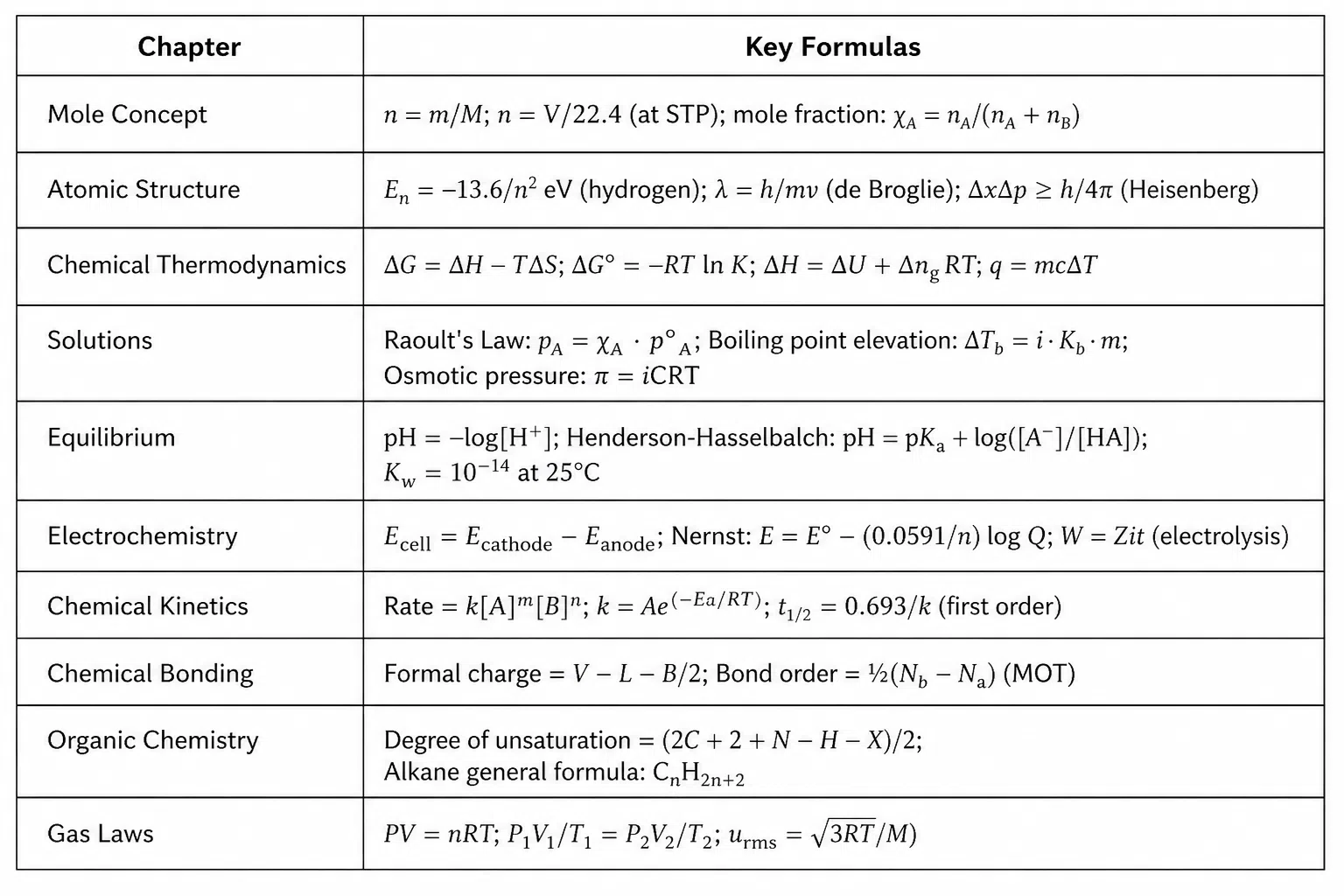
Quick Formula Tips
- Write formulas daily during revision.
- Keep one dedicated notebook for reactions and formulas.
- Revise Physical Chemistry formulas before every mock test.
- For Organic Chemistry, understand the derivation of degree of unsaturation -it saves time in MCQs.
Also Read: JEE Mains Chemistry Formulas
Best Books for JEE Mains Chemistry Preparation
The right books help improve concept clarity and question-solving speed. It is recommended combining the NCERT with an advanced practice book.
Category | Recommended Books and Resources | Best For |
Organic Chemistry | Advanced Problems in Organic Chemistry for JEE | Advanced problem practice |
Physical Chemistry | Problems in Physical Chemistry for JEE (Main & Advanced) | Numerical problem solving |
Inorganic Chemistry | A Textbook of Inorganic Chemistry (Vol. 1 & 2) for JEE (Main & Advanced) | Theory + reference |
Mock tests and PYQs | Cracku’ JEE Mains Question Bank | Mock Tests |
Chapter Wise Preparation | Cracku JEE Main Chemistry Practice Sets | Topic wise practice |
Book Selection Tips
- Start with the NCERT before using advanced books.
- Solve previous year questions regularly.
- Avoid using too many books together.
- Revise one book multiple times instead of switching sources.
Also Read: JEE Mains Formula Sheet PDF
Preparation Tips for JEE Mains Chemistry
A proper preparation strategy can improve Chemistry scores quickly. Consistency matters more than long study hours.
Preparation Area | Smart Strategy |
NCERT Reading | Read NCERT daily for Inorganic Chemistry -line by line |
Formula Revision | Revise formulas every morning |
Organic Chemistry | Practice named reactions regularly |
Mock Tests | Attempt weekly full-length tests |
PYQ Practice | Solve at least 10 years of questions |
Time Management | Give equal attention to all three sections |
Notes Preparation | Make short reaction and formula notes |
Revision | Keep one revision day every week |
JEE Mains Chemistry Syllabus 2027: Conclusion
A clear understanding of the JEE Mains Chemistry syllabus 2027 is crucial for scoring well. Focus on NCERT topics first, especially high-weightage chapters like Organic Chemistry’s Aldehydes, Ketones & Carboxylic Acids, and Inorganic Coordination Compounds. Regular formula revision, solving PYQs, and structured daily practice helps build strong conceptual clarity and problem-solving speed.
Combining chapter-wise preparation with effective time management and dedicated formula notes improves performance significantly. Advanced practice books, mock tests, and Cracku JEE Mains Chemistry question sets supplement NCERT learning and prepare students for exam-oriented challenges. Consistency, analysis, and strategic revision are the keys to mastering Chemistry for JEE Mains 2027.
.webp)