
 Group
 Group


 Preferred Source

 Google Discover
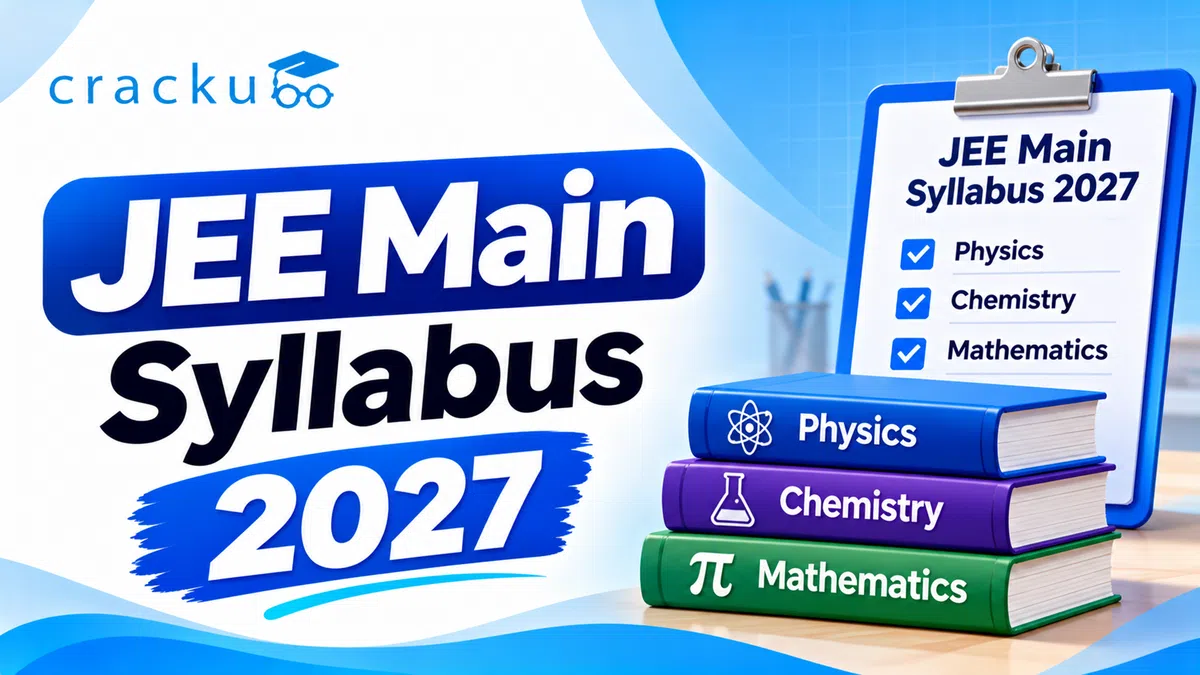
The JEE Main Syllabus 2027, released by the National Testing Agency (NTA), outlines the topics that candidates need to prepare for admission to undergraduate engineering programmes such as B.E. and B.Tech. The Paper 1 syllabus covers three subjects: Physics and Chemistry, with 20 units each, and Mathematics, with 14 units. These subjects include concepts from the NCERT Class 11 and Class 12 curriculum.
Before starting their preparation, candidates should understand the complete JEE Main 2027 syllabus and identify the topics they need to cover. Having a clear understanding of the syllabus helps students organise their study schedule, prioritise important chapters, allocate time across subjects and plan revision more effectively. It also helps them avoid spending unnecessary time on topics that are outside the prescribed syllabus.
JEE Main Syllabus 2027 OUT
The JEE Main 2027 Paper 1 syllabus consists of 54 units across Physics, Chemistry and Mathematics. It covers fundamental concepts from Class 11 and Class 12, including Mechanics, Electrostatics, Organic Chemistry, Calculus and Coordinate Geometry.
Students can use the subject-wise syllabus along with previous years' question papers to understand the topics covered in the examination. The following table highlights the important details of the JEE Main syllabus 2027.
| Particulars | Details |
| Exam Name | JEE Main 2027 |
| Conducting Body | National Testing Agency (NTA) |
| Official Syllabus | Download from NTA |
| Subjects for Paper 1 | Physics, Chemistry and Mathematics |
| Physics Units | 20 |
| Chemistry Units | 20 |
| Mathematics Units | 14 |
| Total Units in Paper 1 | 54 |
| Class Level | Class 11 and Class 12 |
| Exam Mode | Computer-Based Test for Paper 1 |
| Official Website | jeemain.nta.nic.in |
JEE Main Syllabus 2027 PDF Download
The National Testing Agency has published the JEE Main syllabus 2027 on its official website. Candidates can download the syllabus PDF to access the complete list of prescribed units and topics in Physics, Chemistry and Mathematics. Keeping the official document handy helps students follow the prescribed syllabus throughout their preparation.
Follow these steps to download the JEE Main 2027 syllabus PDF:
- Visit the official JEE Main website.
- Navigate to the syllabus section on the website.
- Select the JEE Main 2027 syllabus link.
- Open the syllabus PDF and download it to your device.
- Check the topics prescribed for your selected examination paper.
Preparation Tip: Save the downloaded syllabus alongside your study materials. Divide each subject into individual chapters and mark them as completed only after finishing the concepts, solving practice questions and revising the important topics. This gives you a practical way to monitor your preparation and identify chapters that need additional attention.
JEE Main 2027 Syllabus for Physics, Chemistry and Mathematics
The JEE Main 2027 Paper 1 syllabus is divided into three subjects: Physics, Chemistry and Mathematics. Each subject tests a different set of concepts and problem-solving abilities. Physics focuses on mechanics, electricity, magnetism, optics and modern physics. Chemistry includes Physical Chemistry, Inorganic Chemistry and Organic Chemistry, while Mathematics covers Algebra, Calculus, Coordinate Geometry and other topics.
Understanding the structure of each subject makes it easier to plan preparation and distribute study time effectively. The following sections provide the subject-wise syllabus and the major topics included in each unit.
JEE Main 2027 Physics Syllabus
The JEE Main Physics syllabus 2027 comprises 20 units covering concepts from both Class 11 and Class 12. Major areas include Mechanics, Thermodynamics, Electricity, Magnetism, Optics and Modern Physics.
Physics requires a combination of conceptual understanding, formula application and numerical problem-solving. Students should focus on understanding the underlying principles instead of relying only on memorising formulas. Practising numerical questions after completing each chapter can help improve accuracy and familiarity with different question patterns.
| No. | Unit | Main Topics |
| 1 | Units and Measurements | SI units, dimensions, significant figures and errors |
| 2 | Kinematics | Motion in a straight line, motion in a plane and projectile motion |
| 3 | Laws of Motion | Newton's laws, momentum, friction and circular motion |
| 4 | Work, Energy and Power | Work-energy theorem, potential energy, power and collisions |
| 5 | Rotational Motion | Torque, angular momentum, moment of inertia and centre of mass |
| 6 | Gravitation | Gravitational force, potential, satellites and escape velocity |
| 7 | Properties of Solids and Liquids | Elasticity, fluid pressure, viscosity, surface tension and heat-related properties |
| 8 | Thermodynamics | Laws of thermodynamics, heat and work |
| 9 | Kinetic Theory of Gases | Gas laws, molecular motion and kinetic energy |
| 10 | Oscillations and Waves | Simple harmonic motion, wave motion and sound |
| 11 | Electrostatics | Electric charges, electric fields, potential and capacitance |
| 12 | Current Electricity | Electric current, resistance, circuits and Kirchhoff's laws |
| 13 | Magnetic Effects of Current and Magnetism | Magnetic fields, moving charges and magnetic materials |
| 14 | Electromagnetic Induction and Alternating Currents | Faraday's law, Lenz's law, inductance and AC circuits |
| 15 | Electromagnetic Waves | Electromagnetic spectrum and wave properties |
| 16 | Optics | Ray optics, wave optics, lenses, mirrors and interference |
| 17 | Dual Nature of Matter and Radiation | Photoelectric effect and de Broglie wavelength |
| 18 | Atoms and Nuclei | Atomic models, nuclear physics and radioactivity |
| 19 | Electronic Devices | Semiconductors, diodes and logic gates |
| 20 | Experimental Skills | Measurement, instruments, experiments and practical concepts |
Preparation Insight: Physics preparation should include regular numerical practice and formula revision. Students can maintain a separate formula notebook containing important equations, SI units, dimensions and the conditions under which each formula applies. Solving previous-year questions after completing individual units can also help identify areas that require more practice.
JEE Main 2027 Chemistry Syllabus
The JEE Main Chemistry syllabus 2027 consists of 20 units covering Basic Concepts of Chemistry, Physical Chemistry, Inorganic Chemistry, Organic Chemistry and Practical Chemistry.
The subject requires students to develop conceptual clarity, understand chemical reactions and remember important facts, equations and exceptions. Physical Chemistry involves numerical problem-solving, while Organic and Inorganic Chemistry require a combination of conceptual understanding and regular revision.
| No. | Unit | Main Topics |
| 1 | Some Basic Concepts in Chemistry | Mole concept, atomic mass, molecular mass and stoichiometry |
| 2 | Atomic Structure | Atomic models, quantum numbers and electronic configuration |
| 3 | Chemical Bonding and Molecular Structure | Ionic and covalent bonds, molecular shapes and hybridisation |
| 4 | Chemical Thermodynamics | Enthalpy, entropy, Gibbs energy and thermodynamic processes |
| 5 | Solutions | Concentration, solubility and colligative properties |
| 6 | Equilibrium | Chemical equilibrium, ionic equilibrium, pH and buffer solutions |
| 7 | Redox Reactions and Electrochemistry | Oxidation, reduction, electrochemical cells and electrode potential |
| 8 | Chemical Kinetics | Rate of reaction, order, molecularity and activation energy |
| 9 | Classification of Elements and Periodicity in Properties | Periodic table, atomic size and periodic trends |
| 10 | p-Block Elements | Properties and compounds of prescribed p-block elements |
| 11 | d- and f-Block Elements | Transition elements, lanthanoids and actinoids |
| 12 | Coordination Compounds | Ligands, coordination number, nomenclature and bonding |
| 13 | Purification and Characterisation of Organic Compounds | Purification methods and organic compound analysis |
| 14 | Some Basic Principles of Organic Chemistry | Organic nomenclature, isomerism and reaction basics |
| 15 | Hydrocarbons | Alkanes, alkenes, alkynes and aromatic hydrocarbons |
| 16 | Organic Compounds Containing Halogens | Haloalkanes, haloarenes and their reactions |
| 17 | Organic Compounds Containing Oxygen | Alcohols, phenols, ethers, aldehydes, ketones and carboxylic acids |
| 18 | Organic Compounds Containing Nitrogen | Amines and related prescribed compounds |
| 19 | Biomolecules | Carbohydrates, proteins, vitamins and nucleic acids |
| 20 | Principles Related to Practical Chemistry | Salt analysis, chemical tests and practical concepts |
Preparation Insight: NCERT textbooks are a useful starting point for JEE Main Chemistry preparation. Students should pay particular attention to definitions, chemical equations, reaction mechanisms, named reactions, exceptions and important properties. For Physical Chemistry, practise numerical questions regularly. For Organic Chemistry, revise reaction patterns and concepts, while Inorganic Chemistry benefits from repeated revision of prescribed NCERT content.
JEE Main 2027 Mathematics Syllabus
The JEE Main Mathematics syllabus 2027 contains 14 units, covering Algebra, Calculus, Coordinate Geometry, Trigonometry, Vector Algebra and Statistics and Probability.
Mathematics requires consistent problem-solving practice and a clear understanding of formulas, identities and mathematical techniques. Topics such as Calculus, Algebra and Coordinate Geometry form important parts of the syllabus and require students to become comfortable with different question-solving methods.
| No. | Unit | Main Topics |
| 1 | Sets, Relations and Functions | Sets, relations, functions and their properties |
| 2 | Complex Numbers and Quadratic Equations | Complex numbers, quadratic equations and roots |
| 3 | Matrices and Determinants | Matrix operations, determinants and linear equations |
| 4 | Permutations and Combinations | Counting methods, arrangements and selections |
| 5 | Binomial Theorem | Binomial expansion and its applications |
| 6 | Sequence and Series | Arithmetic and geometric progressions and series |
| 7 | Limits, Continuity and Differentiability | Limits, continuity, derivatives and differentiability |
| 8 | Integral Calculus | Indefinite and definite integrals and their applications |
| 9 | Differential Equations | Formation and solutions of differential equations |
| 10 | Coordinate Geometry | Straight lines, circles and conic sections |
| 11 | Three-Dimensional Geometry | Lines, planes and three-dimensional coordinates |
| 12 | Vector Algebra | Vector operations, dot product and cross product |
| 13 | Statistics and Probability | Statistical measures, probability and related concepts |
| 14 | Trigonometry | Trigonometric identities, equations and functions |
Preparation Insight: Students should practise Mathematics questions immediately after completing the concepts in each chapter. Merely memorising formulas is not sufficient to solve application-based questions. Maintaining a formula sheet, revisiting difficult problems and practising questions under timed conditions can help improve both speed and accuracy.
JEE Main 2027 Chapter-Wise Syllabus for Class 11 and 12
The JEE Main 2027 syllabus includes topics from both Class 11 and Class 12. Understanding how the examination syllabus corresponds to the NCERT curriculum helps students connect their school studies with entrance examination preparation.
Some units in the JEE Main syllabus cover concepts from multiple NCERT chapters. Therefore, students should use the official NTA syllabus as their primary reference rather than depending only on chapter titles in their school textbooks. The following tables provide a subject-wise mapping of the important Class 11 and Class 12 chapters.
Class 11 Chapters for JEE Main 2027
| Subject | Important Chapters and Topics |
| Physics | Units and Measurements, Motion in a Straight Line, Motion in a Plane, Laws of Motion, Work, Energy and Power, System of Particles and Rotational Motion, Gravitation, Mechanical Properties of Solids, Mechanical Properties of Fluids, Thermal Properties of Matter, Thermodynamics, Kinetic Theory, Oscillations and Waves |
| Chemistry | Some Basic Concepts of Chemistry, Structure of Atom, Classification of Elements and Periodicity in Properties, Chemical Bonding and Molecular Structure, Chemical Thermodynamics, Equilibrium, Redox Reactions, Organic Chemistry: Some Basic Principles and Techniques, Hydrocarbons |
| Mathematics | Sets, Relations and Functions, Trigonometric Functions, Complex Numbers, Quadratic Equations, Permutations and Combinations, Binomial Theorem, Sequences and Series, Straight Lines, Conic Sections, Introduction to Three-Dimensional Geometry, Limits and Derivatives, Statistics, Probability |
Class 12 Chapters for JEE Main 2027
| Subject | Important Chapters and Topics |
| Physics | Electric Charges and Fields, Electrostatic Potential and Capacitance, Current Electricity, Moving Charges and Magnetism, Magnetism and Matter, Electromagnetic Induction, Alternating Current, Electromagnetic Waves, Ray Optics, Wave Optics, Dual Nature of Radiation and Matter, Atoms, Nuclei, Semiconductor Electronics |
| Chemistry | Solutions, Electrochemistry, Chemical Kinetics, d- and f-Block Elements, Coordination Compounds, Haloalkanes and Haloarenes, Alcohols, Phenols and Ethers, Aldehydes, Ketones and Carboxylic Acids, Amines, Biomolecules |
| Mathematics | Relations and Functions, Inverse Trigonometric Functions, Matrices, Determinants, Continuity and Differentiability, Applications of Derivatives, Integrals, Applications of Integrals, Differential Equations, Vector Algebra, Three-Dimensional Geometry, Probability |
JEE Main 2027 Deleted Topics and Syllabus Changes
The NTA revised the JEE Main syllabus in 2024, removing certain topics from the earlier syllabus. The revised syllabus continued to be followed for the 2025 and 2026 examinations. The official JEE Main 2027 syllabus also remains the same as the 2026 syllabus, with no changes to the published units or topics.
Students should be careful when referring to older textbooks, coaching notes and preparation materials, as these may contain topics that are no longer included in the prescribed syllabus. Following the latest official NTA document helps candidates keep their preparation aligned with the examination requirements.
What Should Students Know About Deleted Topics?
Students should compare their existing study materials with the latest NTA syllabus before spending time on additional topics. The following table highlights the areas where older study materials may contain content outside the current prescribed syllabus.
| Subject | Areas to Review Carefully |
| Physics | Older chapters or subtopics that are absent from the current NTA syllabus |
| Chemistry | Removed portions of older inorganic, organic and physical chemistry syllabi |
| Mathematics | Topics from older versions that do not appear in the current prescribed units |
Important: The absence of a topic from an older preparation resource does not automatically mean that it is excluded from the current examination. Students should verify individual topics against the official JEE Main 2027 syllabus before removing them from their study schedule.
Important Chapters for JEE Main 2027: Subject-Wise Weightage
Understanding chapter-wise weightage can help students decide how to distribute their preparation time across different topics. However, the NTA does not prescribe fixed chapter-wise weightage for JEE Main 2027. The number of questions from individual chapters may vary across examination shifts.
Based on previous years' question paper patterns, students can identify chapters that deserve additional practice. However, weightage should be treated as a preparation reference rather than a guarantee of the number of questions that will appear in the examination.
JEE Main Physics Chapter-Wise Weightage
Physics preparation involves both conceptual understanding and numerical application. Students can prioritise the following chapters for additional practice while ensuring that they cover the complete prescribed syllabus.
| Important Chapter | Topics to Prioritise |
| Optics | Ray optics, lenses, mirrors, interference and wave optics |
| Electrostatics | Electric fields, electric potential, capacitors and Gauss's law |
| Current Electricity | Ohm's law, Kirchhoff's laws, resistance and circuits |
| Magnetic Effects of Current and Magnetism | Magnetic fields, moving charges and magnetic forces |
| Electromagnetic Induction and Alternating Currents | Faraday's law, Lenz's law and AC circuits |
| Rotational Motion | Torque, angular momentum and moment of inertia |
| Oscillations and Waves | Simple harmonic motion and wave motion |
| Atoms and Nuclei | Atomic models, nuclear energy and radioactivity |
| Thermodynamics | Laws of thermodynamics and heat engines |
| Electronic Devices | Semiconductors, diodes and logic gates |
JEE Main Chemistry Chapter-Wise Weightage
Chemistry includes numerical, theoretical and application-based questions. Students should balance their preparation across Physical, Organic and Inorganic Chemistry instead of concentrating on only one section. The following chapters can be considered for additional revision and question practice.
| Important Chapter | Topics to Prioritise |
| Coordination Compounds | Nomenclature, bonding, isomerism and properties |
| Chemical Bonding and Molecular Structure | Bond types, molecular shapes and hybridisation |
| Organic Compounds Containing Oxygen | Alcohols, phenols, ethers, aldehydes and ketones |
| Redox Reactions and Electrochemistry | Redox equations, cells and electrode potential |
| Chemical Kinetics | Reaction rate, order and rate equations |
| Chemical Thermodynamics | Enthalpy, entropy and Gibbs energy |
| Equilibrium | Chemical equilibrium, ionic equilibrium and pH |
| Some Basic Principles of Organic Chemistry | Isomerism, nomenclature and reaction mechanisms |
| Hydrocarbons | Alkanes, alkenes, alkynes and aromatic compounds |
| Atomic Structure | Atomic models, quantum numbers and electronic configuration |
JEE Main Mathematics Chapter-Wise Weightage
Mathematics requires regular practice because questions often involve multiple steps and the application of different concepts. Students should focus on understanding the methods used to solve problems and improving their calculation speed. The following chapters are useful areas to prioritise during revision.
| Important Chapter | Topics to Prioritise |
| Coordinate Geometry | Straight lines, circles and conic sections |
| Integral Calculus | Definite and indefinite integrals |
| Limits, Continuity and Differentiability | Limits, derivatives and continuity |
| Complex Numbers and Quadratic Equations | Complex number operations and roots |
| Matrices and Determinants | Matrix operations and determinants |
| Vector Algebra | Dot product, cross product and applications |
| Three-Dimensional Geometry | Lines, planes and spatial coordinates |
| Sequence and Series | AP, GP and series problems |
| Probability | Basic probability and prescribed probability topics |
| Differential Equations | Formation and solutions of differential equations |
How to Complete the JEE Main 2027 Syllabus Before the Exam
Completing the entire JEE Main 2027 syllabus requires a structured study plan and consistent practice. Students should divide the syllabus into smaller targets instead of attempting to cover several chapters without a clear schedule.
A balanced preparation strategy should include concept learning, numerical practice, previous-year questions, mock tests and regular revision. The following steps can help candidates organise their preparation and track their progress.
1. Make a Chapter-wise Schedule of Study
Start by creating a complete list of the prescribed Physics, Chemistry and Mathematics units. Divide the chapters into three categories: completed, partially completed and yet to be started. This will help you understand how much of the syllabus remains and where additional study time is required.
Allocate more time to chapters that involve difficult concepts or require repeated practice. At the same time, continue revising familiar topics so that you do not lose touch with concepts you have already studied.
Set weekly targets rather than trying to complete too many chapters in a single day. Smaller and achievable targets make it easier to maintain consistency.
2. Work On Your Basics Through NCERT Books
NCERT textbooks provide a useful foundation for understanding the concepts included in the JEE Main syllabus. Students should first develop clarity on the basic principles, definitions and examples before moving to more challenging questions.
NCERT is particularly useful for Chemistry, while Physics and Mathematics require additional numerical and problem-solving practice after the fundamental concepts are understood.
Once you have completed the theory of a chapter, begin solving JEE Main-level questions. Gradually increase the difficulty of the questions as your understanding and accuracy improve.
3. Practice Past Year Questions
Previous Year Questions (PYQs) help students understand how the NTA tests different concepts and applies them in examination questions. Solving chapter-wise PYQs after completing each unit can help identify recurring question patterns and areas that require more attention.
While practising, maintain a record of questions that take too much time or that you are unable to solve correctly. Revisit the underlying concepts before attempting similar questions again.
Rather than simply checking the correct answers, analyse why a particular approach works. This helps improve conceptual clarity and makes it easier to apply the same concepts to unfamiliar questions.
4. Regular Revision of Formulas and Reactions
Maintaining separate revision notes for Physics, Chemistry and Mathematics can make the revision process more organised. Instead of going through entire textbooks repeatedly, students can use these notes to revisit important formulas, reactions and problem-solving techniques.
Physics: Maintain a collection of important formulas, units, graphs and the conditions under which different equations can be applied.
Chemistry: Revise important reactions, NCERT facts, exceptions, chemical equations and reaction mechanisms.
Mathematics: Keep track of formulas, identities, important results and techniques used to solve different question types.
Spend some time revisiting these notes every day. Regular revision helps improve recall and reduces the need to relearn previously completed topics closer to the examination.
5. Take Mock Tests at Regular Intervals
JEE Mains Mock Test help candidates practise answering questions within the examination time limit. Students can begin with chapter-wise tests after completing individual units and gradually move to full-length mock tests as more of the syllabus is covered.
Mock tests should be used to evaluate preparation rather than just measure scores. After every test, analyse your performance to identify:
- Chapters where you are consistently making mistakes.
- Questions that consume more time than expected.
- Concepts that need additional revision.
- Calculation errors and incorrect question selection.
- Areas where your accuracy needs improvement.
Analysing these mistakes after every test helps students make targeted improvements instead of repeatedly practising the same types of questions.
6. Stick to a Weekly Revision Schedule
A weekly revision routine helps students retain previously studied concepts while continuing with new chapters. Without regular revision, it can become difficult to recall formulas, reactions and problem-solving techniques during the examination.
One possible weekly preparation schedule is:
- 5 days: Focus on learning new concepts and solving practice questions.
- 1 day: Revise previously completed chapters and important formulas.
- 1 day: Attempt a test and analyse mistakes.
Students can adjust this schedule according to their school timetable, preparation level and the number of chapters remaining. The important thing is to maintain a balance between learning new topics and revisiting completed ones.
7. Importance of Speed and Accuracy Both
Solving questions quickly is useful only when the answers are accurate. Students should first understand what a question is asking, identify the relevant concept and select an appropriate solving method before beginning calculations.
During mock test analysis, identify the reason behind each incorrect or unanswered question. Mistakes may occur because of a conceptual gap, calculation error, incorrect formula selection or rushing through the question.
Working on the specific reason behind each mistake can gradually improve both speed and accuracy. Students looking for a structured preparation timeline can also refer to the JEE Main 2027 Three Month Study Plan.
JEE Main Syllabus 2027: Conclusion
The JEE Main Syllabus 2027 covers 54 units across Physics, Chemistry and Mathematics, including topics from Class 11 and Class 12. Students preparing for the examination should understand the complete JEE Main Physics Syllabus, Chemistry Syllabus and Maths Syllabus before starting their preparation. Downloading the JEE Main 2027 syllabus PDF and following the official topic list can help candidates organise their study schedule, identify important chapters and avoid spending time on topics outside the prescribed syllabus.
To prepare effectively, students should focus on building strong concepts through NCERT textbooks, practising chapter-wise previous-year questions and revising important formulas and reactions regularly. They should also take JEE Main mock tests to evaluate their preparation, identify weak areas and improve speed and accuracy. Although chapter-wise weightage can help prioritise topics, covering the complete JEE Main 2027 syllabus should remain the primary preparation goal.