91- 6303239042


 Group
Group
 Group
Group


 Preferred Source

 Google Discover
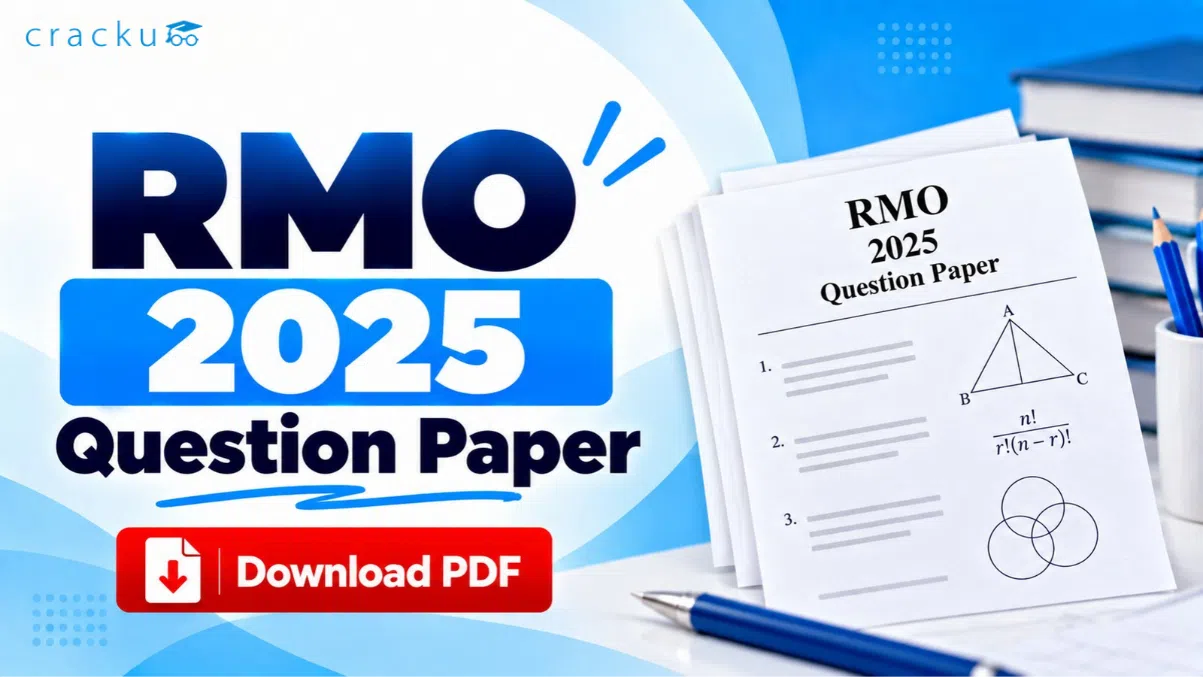
RMO 2025 Question Paper
The RMO 2025 question paper is one of the most valuable sources for understanding the actual exam pattern, proof-writing requirements, and difficulty level of the Regional Mathematical Olympiad (RMO). Practicing with the RMO 2025 paper helps aspirants strengthen mathematical reasoning, develop rigorous proof-writing skills, improve time management, and gain confidence across core topics such as Geometry, Number Theory, Algebra, and Combinatorics. Solve the RMO 2025 paper as a full-length 3-hour descriptive test, and analyse your solutions to identify strengths, correct logical gaps, and improve your chances of qualifying for the Indian National Mathematical Olympiad (INMO). Solving this paper will help students get familiar with the upcoming RMO 2026 exam.
RMO 2025 Question Paper Analysis
The RMO 2025 Question Paper is an important resource for students preparing for the Mathematical Olympiad. The Regional Mathematical Olympiad was conducted on 16 November 2025, and the paper consisted of six descriptive questions carrying 17 marks each. Students had three hours to solve the paper, with detailed proof required for every question. The paper was moderately tough with concept-heavy problems. RMO 2025 paper consists of geometry, algebra, number theory, and combinatorics and the level is of Moderate level. Key challenges involved symmetry handling, cubic expressions, and configuration logic. This analysis summarises every question, conceptual approaches, and preparation lessons for the upcoming Olympiad stages.
The RMO 2025 paper was moderately tough, particularly due to
- substitutions
- maintaining symmetry
- dealing with cubic forms
Compared to 2024, RMO 2025 felt more concept-heavy
RMO 2025 Question Paper Difficulty Level
The difficulty level of each question is different; some were moderately tough, and some were tough. RMO 2025 was a concept-heavy paper. Questions involving direct calculation were more doable, while geometry and number theory and problems requiring multiple deductions demanded more time and careful reasoning.
Difficulty Level | Approximate Share |
Moderate | 40–50% |
Higher Difficulty | 50–60% |
NOTE: Students needed strong conceptual understanding, creative thinking and experience with unfamiliar mathematical problems.
Also Read: RMO Syllabus 2026, Important Topics & Preparation Books
RMO 2025 Exam Pattern
RMO 2025 stands for Regional Mathematical Olympiad 2025. RMO 2025 was the second stage of the Indian Mathematical Olympiad programme, with students reaching this stage after qualifying through IOQM 2025. The RMO was a 3-hour examination containing six problems that required detailed mathematical proofs. Each problem required students to provide a detailed mathematical solution rather than simply choosing an answer from multiple choices. Students needed logical steps, valid mathematical arguments, and sufficient justification for each conclusion. The table below shows the RMO 2025 exam format students needed to prepare for.
Exam Feature | RMO 2025 Detail |
Mode | Written examination |
Duration | 3 hours |
Main Areas | Algebra, Geometry, Number Theory and Combinatorics |
Number of Problems | 6 |
Question Type | Descriptive and proof-based |
Response Method | Detailed written solutions |
Main Skill | Mathematical reasoning and proof writing |
Languages | English, Hindi and applicable regional languages |
How to Use the RMO 2025 Question Paper for Preparation?
Students can use the RMO 2025 Question Paper as a full-length mock test before the real RMO 2026 exam. After attempting all six problems, they should compare their solution structure with the official solutions, identify mistakes in reasoning, steps and reattempt unsolved questions after revision. Below is the complete step-by-step process the students must follow before solving RMO 2025:
Steps | What to Do | Key Points |
Step 1 | Attempt the Paper | Set a 3-hour timer, sit in quite place, avoid hints and solutions, and create actual exam-like conditions. |
Step 2 | Analyse Your Attempts | Check which questions you solved correctly and find whether your mistakes were due to concepts or proof construction. |
Step 3 | Compare with Solutions | Compare your approach and proof, not just the final answer. Look for simpler or more elegant methods. |
Step 4 | Maintain an Error Log | Note conceptual mistakes, wrong assumptions, algebraic mistakes, incomplete proofs and time-management issues. |
Step 5 | Reattempt Difficult Questions | After a few days, try the difficult or unsolved questions again without checking the solution. |
Common Mistakes to Avoid While Solving RMO Previous Papers
Students can lose marks because of incomplete reasoning, unclear explanations or poor time management, even when they understand the concepts. While solving RMO previous year papers, avoid these common mistakes:
- Attempting the paper without understanding the RMO exam pattern.
- Starting calculations before identifying what the question asks you to prove.
- Writing a solution without planning a clear logical approach.
- Spending too much time on one difficult problem.
- Assuming a pattern holds in every case without proving it.
- Giving only the final answer without the required explanation.
- Checking solutions before making a serious, independent attempt.
- Calculating your score without reviewing mistakes and incomplete proofs.
To make the most of RMO previous year papers, including the RMO 2025 question paper, follow a simple cycle: attempt, analyse, revise and reattempt. This approach helps you strengthen mathematical reasoning, improve proof writing and build confidence in solving unfamiliar problems.
Also Read: RMO Exam Date 2026: Important Dates & Exam Day Guidelines
RMO 2025 Question Paper: Conclusion
The RMO 2025 question paper is a useful resource for understanding the types of mathematical problems students need to practise. Downloading the RMO 2025 paper is the most relevant to material practice before the exam. This approach can help you identify gaps in conceptual understanding and improve the clarity of your written explanations.
Use RMO 2025 in your preparation alongside regular revision, and carefully solve this as a real exam-like condition. After solving this, analyse mistakes, revise the concepts involved and solve difficult questions again without help. Following this method can strengthen your mathematical reasoning, time management and confidence when approaching unfamiliar problems.