
 Group
Group
 Group
Group
Is Cracku's JEE Maths Course Suitable for Beginners?
In India, JEE is one of the top competitive exams, with over 15 lakh candidates dreaming of entering one of the 23 IITs. However, the dream is not difficult if you have strong basics and the right JEE preparation strategy. Can beginners really build strong Maths skills through an online course? Yes, provided your preparation follows a clear structure from basics to application. Cracku’s JEE Mains Maths Course follows this path through videos, concept tests, topic tests and mocks. Mentors also provide expert help with doubts and detailed explanations at every stage of practice. Therefore, your preparation can gradually shift from understanding formulas to confidently solving questions.
How Can Beginners Start JEE Maths Preparation?
Beginners should first understand the JEE Maths syllabus instead of immediately attempting difficult questions. Starting with random chapters can make preparation feel like assembling furniture without instructions.
A better approach divides preparation into three simple stages: learning, practising and testing.
| Preparation Stage | What You Should Do | Main Objective |
|---|---|---|
| Concept Building | Watch concept videos and note important formulas | Build basic understanding |
| Guided Practice | Attempt concept and topic tests | Apply ideas correctly |
| Exam Practice | Solve JEE questions and JEE Maths PYQs | Understand actual exam patterns |
| Mock Practice | Attempt full-length mocks regularly | Improve speed and accuracy |
Start with chapters where your school-level understanding feels reasonably comfortable. This gives you early confidence while creating momentum for harder chapters.
Avoid spending hours memorising formulas without understanding their actual applications. Mathematics rewards understanding because a single concept can appear in several differently worded questions.
A JEE foundation course approach can help if you start preparing early. However, your foundation should include regular question practice rather than relying solely on videos.
Also Read: How to Choose the Right Online JEE Maths Course for Your Child?
Does the Course Cover JEE Maths From the Basics?
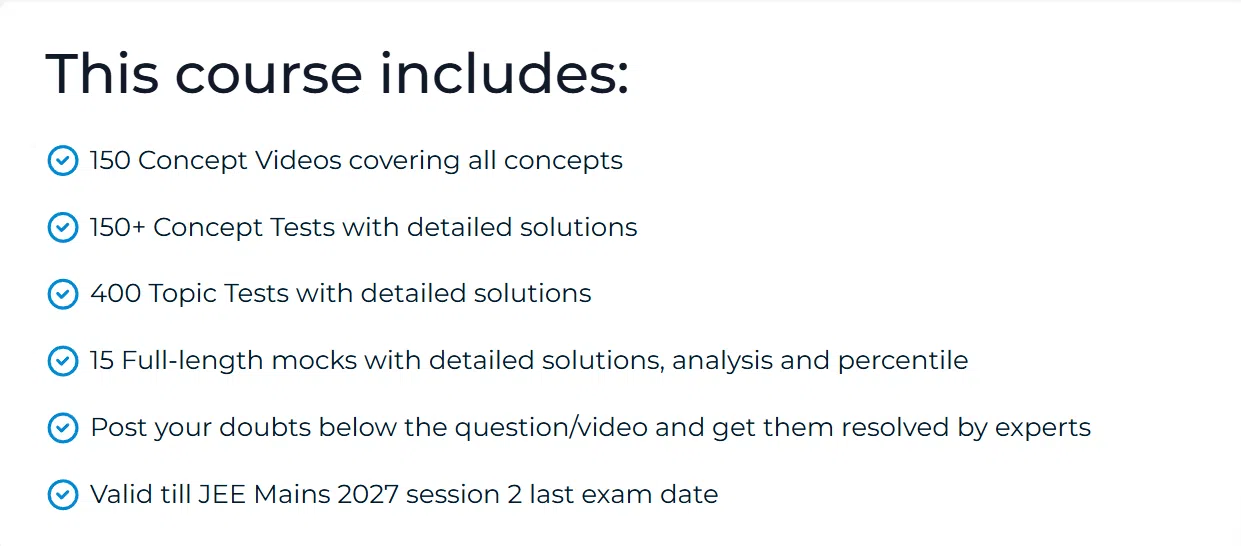
Yes, the course is structured to support learners who need systematic concept building. Its 150 concept videos cover the concepts required for structured JEE Mains Maths preparation.
You may think, “I understood everything,” until the first question arrives and suddenly your confidence takes a tea break. That is why RK Sir is there to solve your doubts and strengthen your concepts.
| Course Component | Beginner Benefit |
|---|---|
| 150 Concept Videos | Learn concepts systematically |
| 150+ Concept Tests | Check understanding immediately |
| 400 Topic Tests | Build repetition and confidence |
| 15 Full-Length Mocks | Practise complete exam conditions |
| Detailed Solutions | Understand the reasoning behind answers |
| Expert Doubt Resolution | Clear obstacles without prolonged confusion |
| Percentile Analysis | Measure performance against exam expectations |
The course can help you build a habit of connecting concepts with questions. This matters because JEE questions rarely follow one fixed pattern throughout the examination. A familiar formula could appear inside a completely different-looking problem.
What Topics Should Beginners Focus on in JEE Maths?
Your priority should follow the JEE Maths syllabus, chapter weightage and your current comfort level. Calculus, coordinate geometry and algebra deserve consistent attention because they occupy substantial portions of JEE Mains Maths.
The approximate JEE Main distribution can help you decide where to focus your practice.
| Chapter | Approx. Questions per Paper | Weightage |
|---|---|---|
| Calculus | 6–8 | 24–32% |
| Coordinate Geometry | 4–5 | 16–20% |
| Algebra | 4–5 | 16–20% |
| Vectors & 3D Geometry | 2–3 | 8–12% |
| Probability & Statistics | 2–3 | 8–12% |
| Trigonometry | 1–2 | 4–8% |
| Permutations & Combinations | 1–2 | 4–8% |
Calculus deserves attention because limits, differentiation, integration and continuity repeatedly test conceptual understanding. Algebra is equally important because matrices, determinants, complex numbers and binomial concepts connect across question types.
Coordinate geometry can become scoring once formulas and standard approaches become familiar. Meanwhile, vectors and three-dimensional geometry can offer useful marks after regular visual and formula-based practice.
If your long-term goal includes JEE Advanced, your preparation should eventually move beyond routine application. Advanced-level questions often combine concepts and demand deeper reasoning.
| JEE Advanced Mathematics Topics | Approx. Weightage |
|---|---|
| Calculus | 28–32% |
| Algebra | 22–26% |
| Coordinate Geometry | 16–20% |
| Vectors & 3D Geometry | 10–12% |
| Trigonometry | 6–8% |
| Probability & Statistics | 5–8% |
| Sets, Relations & Functions | 3–5% |
Use these figures as guidance for preparation rather than as rigid predictions for every paper.
Also Read: How Can You Improve Problem-Solving Skills for JEE Maths?
How Can Beginners Improve Their JEE Maths Skills?
Improvement comes from repeating the right process, not repeatedly staring at the same difficult question. Begin by solving basic questions before moving towards mixed and time-bound problems.
After every test, spend time checking mistakes instead of immediately chasing another score. Maintain a short error log containing formulas, calculation errors, misunderstood concepts and incorrect approaches.
| Practice Habit | What It Improves |
|---|---|
| Daily question practice | Consistency and confidence |
| Formula revision | Recall speed |
| Topic tests | Accuracy within individual chapters |
| JEE Maths PYQs | Exam awareness |
| Error analysis | Reduction of repeated mistakes |
| Timed practice | Speed and decision-making |
| Mock analysis | Overall exam strategy |
JEE Maths PYQs are especially valuable because they reveal how familiar concepts are tested under actual exam conditions. While solving them, focus on identifying patterns rather than memorising individual solutions.
Try solving questions independently before checking detailed explanations. If you get stuck, identify the exact step where your reasoning stopped working.
This habit develops mathematical independence, which becomes increasingly valuable as questions become harder. Moreover, regular testing helps you discover weak chapters before they become expensive exam-day surprises.
Is an Online JEE Maths Course Good for Beginners?
An online JEE Maths course can work well if your routine remains consistent. You get structured lessons without having to spend additional time travelling to a physical coaching centre.
The bigger advantage comes from combining learning material with frequent testing. Cracku’s course creates this progression through concept videos, concept tests, topic tests and full-length mocks.
For beginners, that structure can remove the biggest preparation problem: wondering what to study next.
| Feature | Why It Helps Beginners |
|---|---|
| Concept Videos | Provides structured starting points |
| Concept Tests | Checks learning immediately |
| Topic Tests | Strengthens individual chapters |
| Full-Length Mocks | Builds complete-paper readiness |
| Detailed Solutions | Explains the logic behind answers |
| Doubt Support | Prevents confusion from piling up |
| Percentile Analysis | Tracks competitive performance |
The course can therefore suit beginners who prefer guided preparation with regular practice. However, watching lessons passively will not create the improvement you need. Your results depend on solving questions, checking for mistakes, revising concepts and consistently repeating the process.
If you are starting from basics, focus on steady progress rather than chasing difficult questions immediately. Build the foundation first, sharpen your skills next and let mock tests reveal your readiness for the exam.
Is Cracku's JEE Maths Course Suitable for Beginners: Conclusion
Cracku’s JEE Maths Course can be suitable for beginners who need a structured path from basic concepts to exam-level practice. Its concept videos, concept tests, topic tests, detailed solutions and mock tests help students learn a topic, apply it through questions and measure their progress.
However, improvement depends on consistent practice rather than simply watching videos. Beginners should follow the JEE Maths syllabus, revise formulas, solve topic-wise questions, practise PYQs and analyse every mock test. A steady progression from basic questions to timed exam-level practice can help students improve their accuracy, speed and confidence.
.webp)