
 Group
Group
 Group
Group
Work, Energy and Power JEE Notes: Important Concepts
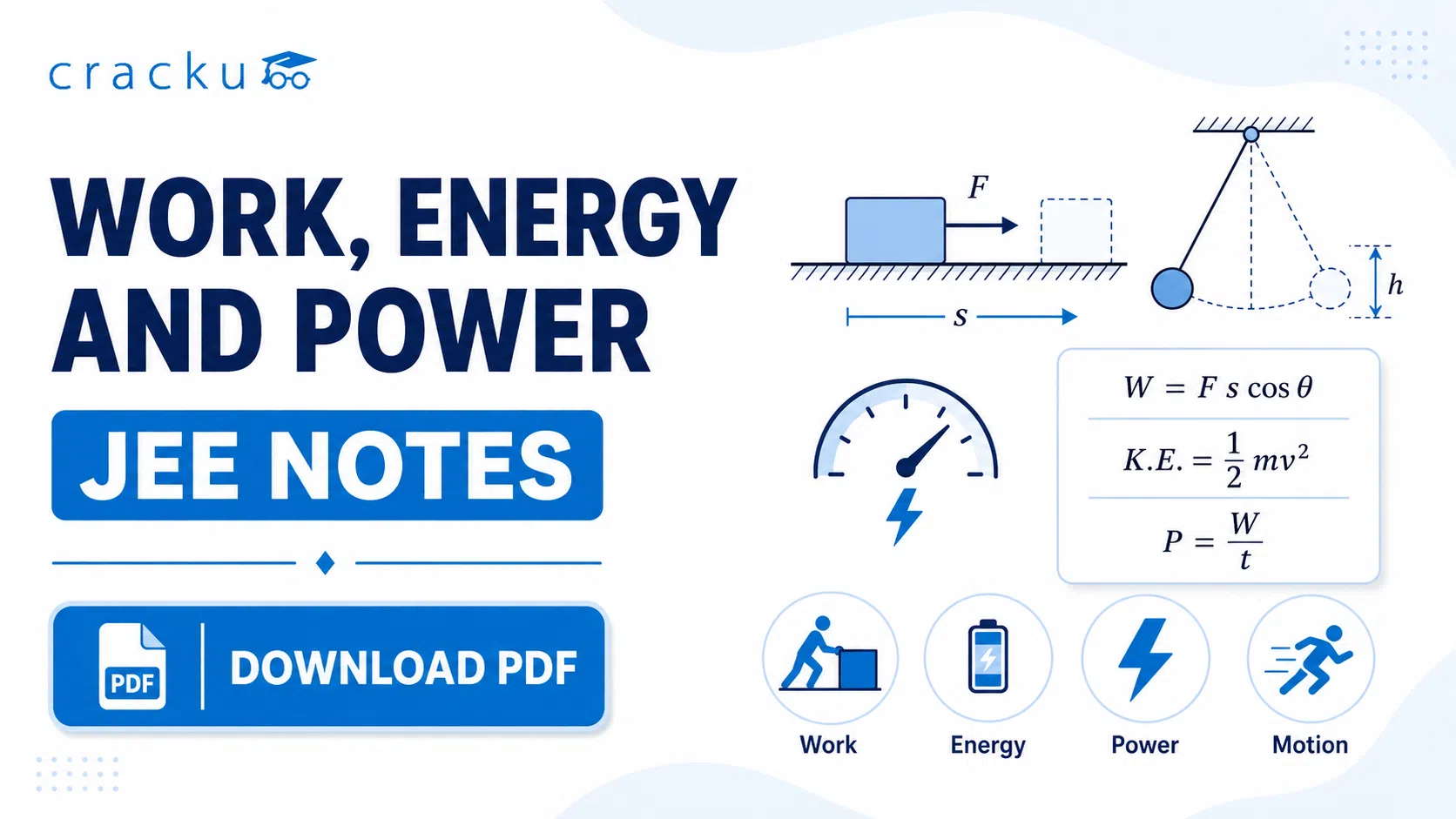
Work, Energy and Power is one of the most important chapters in JEE Physics because it provides a faster approach to many mechanics problems. Instead of tracking every force using Newton's laws, energy methods allow you to directly connect the initial and final states of a system. These concepts are frequently used in problems involving springs, inclined planes, collisions, circular tracks and variable forces. Practising JEE questions on Work, Energy and Power helps students master concepts such as work done by forces, kinetic energy, potential energy, work-energy theorem, conservation of energy and power. These Work, Energy and Power JEE notes cover all important concepts, formulas, solved examples and revision points required for JEE preparation.
What is Work in Physics?
In physics, work has a specific meaning. Work is done only when a force causes displacement of an object. Applying force without displacement does not result in any work being done.
Work: Work is the product of the component of force along the direction of displacement and the displacement of the object.
Work is a scalar quantity and its SI unit is joule (J).
1 joule: Work done when a force of 1 N produces a displacement of 1 m in the direction of the force.
Work Done by a Constant Force
When a constant force acts on an object and produces displacement, the work done depends on the angle between force and displacement.
$$W=Fd\cos\theta$$
where:
- F = magnitude of force
- d = displacement
- θ = angle between force and displacement
| Angle Between Force and Displacement | Nature of Work |
|---|---|
| θ = 0° | Maximum positive work |
| θ = 90° | Zero work |
| θ = 180° | Negative work |
Positive work: When force acts in the same direction as displacement, energy is transferred to the object.
Negative work: When force acts opposite to displacement, energy is removed from the object.
Zero work: When force is perpendicular to displacement, the force does not transfer energy.
Worked example: A person pulls a box with a force of 50 N through 10 m at an angle of 60° with the horizontal. Find the work done.
Given:
F = 50 N, d = 10 m, θ = 60°
Work done:
$$W=Fd\cos\theta$$
$$W=50\times10\times\cos60^\circ$$
$$W=50\times10\times0.5$$
W = 250 J
Work Done by Friction
Friction always opposes the direction of motion, so the work done by friction is generally negative.
Worked example: A 5 kg block moves 4 m on a rough surface. The coefficient of kinetic friction is 0.3. Find the work done by friction. Take g = 10 m/s².
Friction force:
$$f_k=\mu_kmg$$
$$f_k=0.3\times5\times10$$
$$f_k=15N$$
Since friction acts opposite to displacement:
$$W=-fd$$
$$W=-15\times4$$
Work done by friction = -60 J
The negative sign indicates that friction removes mechanical energy from the system.
Work Done by Normal Force and Gravity
The work done by a force depends on the angle between force and displacement.
- Normal force does zero work when displacement is horizontal because it acts perpendicular to displacement.
- Gravity does zero work during horizontal motion.
- Gravity does positive work when an object moves downward.
- Gravity does negative work when an object moves upward.
Work Done by Variable Force
When the force changes with position, the simple formula Fd cannot be used. The work done is calculated by adding small amounts of work over small displacements.
$$W=\int_{x_1}^{x_2}F(x)dx$$
Graphically, work done by a variable force is equal to the area under the force-displacement graph.
Important:
- Area above the x-axis represents positive work.
- Area below the x-axis represents negative work.
Worked example: A force F = 3x² N acts on a particle from x = 0 to x = 4 m. Find the work done.
Using:
$$W=\int_0^4 3x^2 dx$$
$$W=3\left[\frac{x^3}{3}\right]_0^4$$
$$W=[x^3]_0^4$$
W = 64 J
Work Done by Spring Force
Hooke's Law
A spring produces a restoring force that tries to bring it back to its natural length.
$$F=-kx$$
where:
- k = spring constant
- x = displacement from natural length
The negative sign indicates that the spring force acts opposite to displacement.
Practising Work, Energy and Power PYQ helps students understand frequently tested concepts and improve problem-solving speed for JEE Main and Advanced.
| Situation | Work Done |
|---|---|
| Spring stretched from natural length | Negative work by spring |
| Spring returning to natural length | Positive work by spring |
| External agent stretching spring | Positive work |
Work done by spring force:
$$W_{spring}=\frac12k(x_1^2-x_2^2)$$
Elastic potential energy stored in a spring:
$$PE=\frac12kx^2$$
Worked example: A spring with spring constant 200 N/m is compressed by 0.1 m. Find the energy stored.
$$PE=\frac12kx^2$$
$$PE=\frac12\times200\times(0.1)^2$$
$$PE=100\times0.01$$
PE = 1 J
Kinetic Energy and Work-Energy Theorem
Kinetic Energy
Kinetic energy is the energy possessed by an object because of its motion.
$$KE=\frac12mv^2$$
Important properties:
- Kinetic energy is always positive or zero.
- It is a scalar quantity.
- Kinetic energy increases with the square of velocity.
- Doubling speed increases kinetic energy four times.
Worked example: Find the kinetic energy of a 2 kg ball moving at 5 m/s.
$$KE=\frac12mv^2$$
$$KE=\frac12\times2\times25$$
KE = 25 J
Work-Energy Theorem
The work-energy theorem states that the net work done on an object is equal to the change in its kinetic energy.
$$W_{net}=\Delta KE$$
This theorem is one of the most useful tools in JEE mechanics because it connects force and displacement directly with change in speed.
Worked example: A 4 kg block initially at rest is pushed by a net force of 20 N through 10 m. Find the final speed.
Work done:
$$W=Fd$$
$$W=20\times10=200J$$
Using work-energy theorem:
Final kinetic energy = 200 J
$$\frac12mv^2=200$$
$$\frac12\times4\times v^2=200$$
v = 10 m/s
Potential Energy and Mechanical Energy
Potential Energy
Potential energy is the energy possessed by an object due to its position or configuration. It depends on the arrangement of objects and the forces acting between them.
Potential energy is associated with conservative forces such as gravitational force and spring force.
Gravitational Potential Energy
Near the surface of Earth, when an object is raised to a height, work is done against gravity. This stored energy is called gravitational potential energy.
$$PE=mgh$$
where:
- m = mass of the object
- g = acceleration due to gravity
- h = height from the reference level
Important points:
- Potential energy depends on the chosen reference level.
- The change in potential energy is physically meaningful.
- Raising an object increases its gravitational potential energy.
- During free fall, potential energy converts into kinetic energy.
Worked example: Find the potential energy of a 5 kg object placed at a height of 10 m. Take g = 10 m/s².
$$PE=mgh$$
$$PE=5\times10\times10$$
PE = 500 J
Gravitational Potential Energy at Large Heights
For objects far from the Earth's surface, gravitational potential energy cannot be calculated using mgh. The general expression is:
$$U=-\frac{GMm}{r}$$
The negative sign indicates that the gravitational force is attractive and the reference point of zero potential energy is taken at infinity.
Important:
- Closer objects have lower gravitational potential energy.
- At infinity, gravitational potential energy is considered zero.
- The total mechanical energy of a satellite remains constant when only gravity acts.
Conservation of Mechanical Energy
The total mechanical energy of a system remains constant when only conservative forces act on it.
$$Mechanical\ Energy=Kinetic\ Energy+Potential\ Energy$$
Therefore:
$$KE_i+PE_i=KE_f+PE_f$$
This principle is called the law of conservation of mechanical energy.
Examples:
- Object falling under gravity.
- Mass attached to an ideal spring.
- Motion of planets around the Sun.
Worked example: A ball is dropped from a height of 20 m. Find its speed just before reaching the ground. Ignore air resistance.
Initially:
Potential energy = Kinetic energy gained
Using conservation of energy:
$$mgh=\frac12mv^2$$
Mass cancels:
$$v=\sqrt{2gh}$$
$$v=\sqrt{2\times10\times20}$$
v = 20 m/s
Conservative and Non-Conservative Forces
Conservative Forces
A force is conservative if the work done by it depends only on the initial and final positions and not on the path followed.
Examples:
- Gravitational force
- Spring force
- Electrostatic force
For conservative forces:
- Work done over a closed path is zero.
- Potential energy can be defined.
- Mechanical energy remains conserved.
Non-Conservative Forces
A non-conservative force depends on the path followed by the object.
Examples:
- Friction
- Air resistance
- Viscous forces
For non-conservative forces:
- Mechanical energy is converted into heat or other forms.
- Total mechanical energy is not conserved.
- Work depends on the path taken.
| Conservative Force | Non-Conservative Force |
|---|---|
| Path independent | Path dependent |
| Potential energy exists | No unique potential energy |
| Mechanical energy conserved | Mechanical energy decreases |
| Example: Gravity | Example: Friction |
Power and Efficiency
Power
Power represents the rate at which work is done or energy is transferred.
$$P=\frac{W}{t}$$
The SI unit of power is watt (W).
1 watt: One joule of work done per second.
Instantaneous Power
When force and velocity are involved, power can be written as:
$$P=Fv\cos\theta$$
where θ is the angle between force and velocity.
| Condition | Power |
|---|---|
| Force along velocity | Maximum positive power |
| Force perpendicular to velocity | Zero power |
| Force opposite velocity | Negative power |
Worked example: A motor applies a force of 100 N and moves an object with velocity 5 m/s in the same direction. Find power.
$$P=Fv$$
$$P=100\times5$$
P = 500 W
Efficiency
Efficiency measures how effectively input energy is converted into useful output energy.
$$Efficiency=\frac{Useful\ Output}{Total\ Input}\times100$$
Efficiency is always less than or equal to 100% because some energy is lost due to friction and other factors.
Collisions and Conservation of Momentum
Collision
A collision is an event in which two or more objects interact for a short duration and experience large forces.
During collision:
- Momentum is always conserved if external forces are negligible.
- Kinetic energy may or may not be conserved.
Types of Collisions
| Type | Momentum | Kinetic Energy |
|---|---|---|
| Elastic collision | Conserved | Conserved |
| Inelastic collision | Conserved | Not conserved |
| Perfectly inelastic collision | Conserved | Maximum energy loss |
Conservation of Momentum
When no external force acts on a system, the total momentum before and after collision remains constant.
$$Initial\ Momentum=Final\ Momentum$$
Worked example: A 2 kg body moving at 5 m/s collides with a stationary 3 kg body. They stick together. Find their common velocity.
Using conservation of momentum:
Initial momentum:
$$=2\times5+3\times0$$
Final momentum:
$$=(2+3)v$$
Therefore:
$$10=5v$$
v = 2 m/s
Coefficient of Restitution
The coefficient of restitution measures the elasticity of a collision. It compares the relative speed of separation with the relative speed of approach.
$$e=\frac{Relative\ speed\ of\ separation}{Relative\ speed\ of\ approach}$$
| Value of e | Type of Collision |
|---|---|
| e = 1 | Perfectly elastic |
| 0 < e < 1 | Partially elastic |
| e = 0 | Perfectly inelastic |
Important:
- Coefficient of restitution depends on the materials involved.
- It does not depend on mass.
- It determines how much kinetic energy is retained after collision.
Potential Energy and Mechanical Energy
Potential Energy
Potential energy is the energy possessed by an object due to its position or configuration. It depends on the arrangement of objects and the forces acting between them.
Potential energy is associated with conservative forces such as gravitational force and spring force.
Gravitational Potential Energy
Near the surface of Earth, when an object is raised to a height, work is done against gravity. This stored energy is called gravitational potential energy.
$$PE=mgh$$
where:
- m = mass of the object
- g = acceleration due to gravity
- h = height from the reference level
Important points:
- Potential energy depends on the chosen reference level.
- The change in potential energy is physically meaningful.
- Raising an object increases its gravitational potential energy.
- During free fall, potential energy converts into kinetic energy.
Worked example: Find the potential energy of a 5 kg object placed at a height of 10 m. Take g = 10 m/s².
$$PE=mgh$$
$$PE=5\times10\times10$$
PE = 500 J
Gravitational Potential Energy at Large Heights
For objects far from the Earth's surface, gravitational potential energy cannot be calculated using mgh. The general expression is:
$$U=-\frac{GMm}{r}$$
The negative sign indicates that the gravitational force is attractive and the reference point of zero potential energy is taken at infinity.
Important:
- Closer objects have lower gravitational potential energy.
- At infinity, gravitational potential energy is considered zero.
- The total mechanical energy of a satellite remains constant when only gravity acts.
Conservation of Mechanical Energy
The total mechanical energy of a system remains constant when only conservative forces act on it.
$$Mechanical\ Energy=Kinetic\ Energy+Potential\ Energy$$
Therefore:
$$KE_i+PE_i=KE_f+PE_f$$
This principle is called the law of conservation of mechanical energy.
Examples:
- Object falling under gravity.
- Mass attached to an ideal spring.
- Motion of planets around the Sun.
Worked example: A ball is dropped from a height of 20 m. Find its speed just before reaching the ground. Ignore air resistance.
Initially:
Potential energy = Kinetic energy gained
Using conservation of energy:
$$mgh=\frac12mv^2$$
Mass cancels:
$$v=\sqrt{2gh}$$
$$v=\sqrt{2\times10\times20}$$
v = 20 m/s
Conservative and Non-Conservative Forces
Conservative Forces
A force is conservative if the work done by it depends only on the initial and final positions and not on the path followed.
Examples:
- Gravitational force
- Spring force
- Electrostatic force
For conservative forces:
- Work done over a closed path is zero.
- Potential energy can be defined.
- Mechanical energy remains conserved.
Non-Conservative Forces
A non-conservative force depends on the path followed by the object.
Examples:
- Friction
- Air resistance
- Viscous forces
For non-conservative forces:
- Mechanical energy is converted into heat or other forms.
- Total mechanical energy is not conserved.
- Work depends on the path taken.
| Conservative Force | Non-Conservative Force |
|---|---|
| Path independent | Path dependent |
| Potential energy exists | No unique potential energy |
| Mechanical energy conserved | Mechanical energy decreases |
| Example: Gravity | Example: Friction |
Power and Efficiency
Power
Power represents the rate at which work is done or energy is transferred.
$$P=\frac{W}{t}$$
The SI unit of power is watt (W).
1 watt: One joule of work done per second.
Instantaneous Power
When force and velocity are involved, power can be written as:
$$P=Fv\cos\theta$$
where θ is the angle between force and velocity.
| Condition | Power |
|---|---|
| Force along velocity | Maximum positive power |
| Force perpendicular to velocity | Zero power |
| Force opposite velocity | Negative power |
Worked example: A motor applies a force of 100 N and moves an object with velocity 5 m/s in the same direction. Find power.
$$P=Fv$$
$$P=100\times5$$
P = 500 W
Efficiency
Efficiency measures how effectively input energy is converted into useful output energy.
$$Efficiency=\frac{Useful\ Output}{Total\ Input}\times100$$
Efficiency is always less than or equal to 100% because some energy is lost due to friction and other factors.
Collisions and Conservation of Momentum
Collision
A collision is an event in which two or more objects interact for a short duration and experience large forces.
During collision:
- Momentum is always conserved if external forces are negligible.
- Kinetic energy may or may not be conserved.
Types of Collisions
| Type | Momentum | Kinetic Energy |
|---|---|---|
| Elastic collision | Conserved | Conserved |
| Inelastic collision | Conserved | Not conserved |
| Perfectly inelastic collision | Conserved | Maximum energy loss |
Conservation of Momentum
When no external force acts on a system, the total momentum before and after collision remains constant.
$$Initial\ Momentum=Final\ Momentum$$
Worked example: A 2 kg body moving at 5 m/s collides with a stationary 3 kg body. They stick together. Find their common velocity.
Using conservation of momentum:
Initial momentum:
$$=2\times5+3\times0$$
Final momentum:
$$=(2+3)v$$
Therefore:
$$10=5v$$
v = 2 m/s
Coefficient of Restitution
The coefficient of restitution measures the elasticity of a collision. It compares the relative speed of separation with the relative speed of approach.
$$e=\frac{Relative\ speed\ of\ separation}{Relative\ speed\ of\ approach}$$
| Value of e | Type of Collision |
|---|---|
| e = 1 | Perfectly elastic |
| 0 < e < 1 | Partially elastic |
| e = 0 | Perfectly inelastic |
Important:
- Coefficient of restitution depends on the materials involved.
- It does not depend on mass.
- It determines how much kinetic energy is retained after collision.
Work, Energy and Power Formula Sheet at a Glance
| Concept | Formula |
|---|---|
| Work done by constant force | $$W=Fd\cos\theta$$ |
| Work done by variable force | $$W=\int F(x)dx$$ |
| Kinetic Energy | $$KE=\frac12mv^2$$ |
| Work-Energy Theorem | $$W_{net}=\Delta KE$$ |
| Potential Energy near Earth's surface | $$PE=mgh$$ |
| Gravitational Potential Energy | $$U=-\frac{GMm}{r}$$ |
| Spring Force | $$F=-kx$$ |
| Spring Potential Energy | $$PE=\frac12kx^2$$ |
| Mechanical Energy | $$E=KE+PE$$ |
| Conservation of Mechanical Energy | $$KE_i+PE_i=KE_f+PE_f$$ |
| Power | $$P=\frac{W}{t}$$ |
| Instantaneous Power | $$P=Fv\cos\theta$$ |
| Efficiency | $$\eta=\frac{Useful\ Output}{Input}\times100$$ |
| Coefficient of restitution | $$e=\frac{Relative\ speed\ of\ separation}{Relative\ speed\ of\ approach}$$ |
| Momentum Conservation | $$Initial\ momentum=Final\ momentum$$ |
JEE Important Points, Common Mistakes and Quick Revision
Points JEE Repeatedly Tests
- Work is done only when a force produces displacement.
- Work is a scalar quantity and can be positive, negative or zero.
- The angle between force and displacement determines the nature of work.
- Work done by a perpendicular force is always zero.
- Friction generally does negative work because it opposes motion.
- The area under a force-displacement graph represents work done.
- Kinetic energy depends on the square of velocity.
- The work-energy theorem connects force-based and energy-based approaches.
- Mechanical energy remains conserved only when conservative forces act.
- Gravity and spring force are examples of conservative forces.
- Friction converts mechanical energy into heat energy.
- Power represents how quickly work is done.
- Momentum is conserved during collisions when external force is negligible.
- Kinetic energy is conserved only in elastic collisions.
- Perfectly inelastic collisions involve maximum loss of kinetic energy.
- The coefficient of restitution determines the elasticity of collision.
Common Mistakes to Avoid
- Assuming force always does work. A force must produce displacement for work to occur.
- Ignoring the direction of force. Work depends on the angle between force and displacement.
- Considering normal force as always doing work. Normal force does zero work only when displacement is perpendicular to it.
- Using conservation of mechanical energy when friction is present. Energy is lost due to non-conservative forces.
- Confusing momentum conservation with energy conservation. Momentum is conserved in all isolated collisions, but kinetic energy is conserved only in elastic collisions.
- Forgetting the sign of potential energy. Only changes in potential energy are physically important.
- Applying the work-energy theorem without considering net work. Only the total work done by all forces changes kinetic energy.
- Confusing power with energy. Power measures the rate of energy transfer, not the total energy transferred.
- Ignoring the reference level in gravitational potential energy. The chosen reference affects the value of potential energy.
- Using the coefficient of restitution incorrectly. It depends on relative velocities before and after collision.
Quick Revision Notes for Work, Energy and Power
- Work is done when force produces displacement.
- Work can be positive, negative or zero.
- Work depends on force, displacement and angle between them.
- Kinetic energy is the energy due to motion.
- Work-energy theorem states that net work changes kinetic energy.
- Potential energy is stored due to position or configuration.
- Mechanical energy is the sum of kinetic and potential energy.
- Mechanical energy remains constant for conservative forces.
- Gravity and spring forces are conservative forces.
- Friction is a non-conservative force.
- Power measures the rate of doing work.
- Efficiency measures useful energy conversion.
- Momentum remains conserved in isolated collision systems.
- Elastic collision conserves both momentum and kinetic energy.
- Inelastic collision conserves momentum but loses kinetic energy.
- Coefficient of restitution measures collision elasticity.
Problem-solving routine: Begin Work, Energy and Power questions by identifying whether the problem is better solved using forces or energy methods. For displacement-based problems, check the work done by each force and apply the work-energy theorem. For height, spring and collision problems, identify the energy transformations involved before applying equations. Use a JEE formula sheet during revision to quickly recall important work-energy relations, power formulas, conservation laws and collision concepts.

.webp)