
 Group
Group
 Group
Group


 Preferred Source

 Google Discover
Complex Numbers JEE Notes
Complex Numbers is one of the highest-scoring chapters in JEE Mathematics, and also one of the most formula-dense, since it mixes algebra, trigonometry and coordinate geometry inside a single topic. It begins with a simple problem: x² + 1 = 0 forces x² = −1, and no real number squares to a negative. As part of your JEE Study Material, these Complex Numbers JEE notes cover the imaginary unit and powers of i, the Argand plane, modulus and argument, polar and Euler forms, algebra and conjugates, square roots, De Moivre’s theorem, cube roots of unity and complex-number geometry in a format built for fast revision.
Complex Numbers JEE Notes: Basics and Powers of i
Imaginary unit (i): defined by i = √−1, so that i² = −1.
Complex number: any number of the form z = a + bi with a and b real. Here a is the real part, written Re(z), and b is the imaginary part, written Im(z).
Powers of i
The powers of i repeat in a cycle of four:
| Power | Value |
|---|---|
| i⁰ | 1 |
| i¹ | i |
| i² | −1 |
| i³ | −i |
| i⁴ | 1 |
| i⁵ | i |
| i⁶ | −1 |
| i⁷ | −i |
| i⁸ | 1 |
General rule: divide n by 4 and use the remainder r, so iⁿ = iʳ where r = n mod 4. Also i⁰ = 1 and i⁻¹ = 1/i = i/i² = −i.
Worked example: find i²⁰²³. 2023 = 4 × 505 + 3, so the remainder is 3, giving i²⁰²³ = i³ = −i.
JEE tip: Map the remainder straight to the answer: 0 gives 1, 1 gives i, 2 gives −1, 3 gives −i. Also i + i² + i³ + i⁴ = 0, so any four consecutive powers of i sum to zero. After revising the cycle, practise topic-wise JEE Complex Numbers Questions to strengthen speed and accuracy.
The Argand Plane
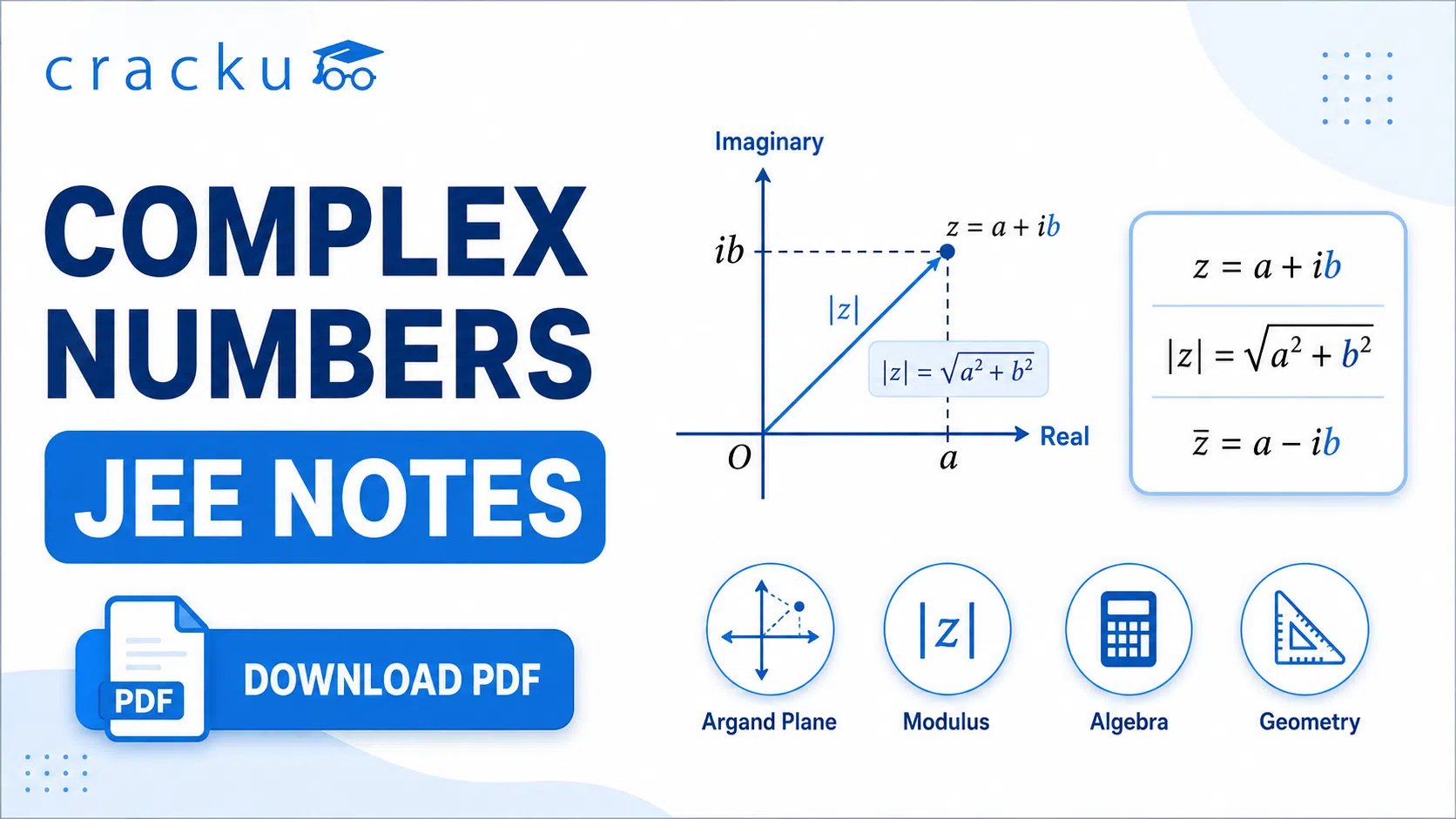
Real numbers live on a line; complex numbers live on a plane called the Argand plane or complex plane. The horizontal axis is the real axis and the vertical axis is the imaginary axis, so z = a + bi is plotted as the point (a, b). This is what makes every algebraic statement about z also a geometric statement.
Modulus, Argument, Polar and Euler Forms
Modulus and Argument
Modulus: |z| = √(a² + b²), the distance of z from the origin in the Argand plane.
Argument: the angle θ with tan θ = b/a. The principal argument, written arg(z), is the unique value in (−π, π].
Finding the principal argument: for z = a + bi with z ≠ 0, first compute α = tan⁻¹(|b|/|a|), then place it by quadrant.
| Quadrant | Signs of (a, b) | Principal argument θ |
|---|---|---|
| I | (+, +) | θ = α |
| II | (−, +) | θ = π − α |
| III | (−, −) | θ = −(π − α) |
| IV | (+, −) | θ = −α |
Worked example: modulus and principal argument of z = −1 + i.
- a = −1, b = 1, so |z| = √((−1)² + 1²) = √2
- α = tan⁻¹(1/1) = π/4
- a < 0 and b > 0 puts z in Quadrant II, so θ = π − π/4 = 3π/4
Polar and Euler Forms
Polar form: z = r(cos θ + i sin θ), where r = |z| and θ = arg(z) Euler form: z = re^(iθ), from Euler’s formula e^(iθ) = cos θ + i sin θ
Conversions: Cartesian to polar uses r = √(a² + b²) with θ = arg(z); polar to Cartesian uses a = r cos θ and b = r sin θ. Two special cases worth memorising are e^(iπ) = −1, Euler’s identity, and e^(iπ/2) = i.
Worked example: express z = 1 + i√3 in polar and Euler form.
- r = √(1² + (√3)²) = √4 = 2
- α = tan⁻¹(√3/1) = π/3, and z lies in Quadrant I, so θ = π/3
- Polar: z = 2(cos π/3 + i sin π/3), Euler: z = 2e^(iπ/3)
Properties of Modulus
- |z| ≥ 0, with |z| = 0 if and only if z = 0
- |z| = |z̄|
- |z₁z₂| = |z₁| · |z₂|
- |z₁/z₂| = |z₁|/|z₂| for z₂ ≠ 0
- |zⁿ| = |z|ⁿ
- Triangle inequality: |z₁ + z₂| ≤ |z₁| + |z₂|
- Reverse triangle inequality: |z₁ − z₂| ≥ ||z₁| − |z₂||
- Parallelogram law: |z₁ + z₂|² + |z₁ − z₂|² = 2(|z₁|² + |z₂|²)
Worked example: if |z₁| = 3 and |z₂| = 5, find the range of |z₁ + z₂|.
- Triangle inequality gives |z₁ + z₂| ≤ 3 + 5 = 8
- Reverse triangle inequality gives |z₁ + z₂| ≥ |3 − 5| = 2
- So 2 ≤ |z₁ + z₂| ≤ 8
Properties of Argument
- arg(z₁z₂) = arg(z₁) + arg(z₂), modulo 2π
- arg(z₁/z₂) = arg(z₁) − arg(z₂)
- arg(zⁿ) = n arg(z)
- arg(z̄) = −arg(z)
- arg(z) = 0 exactly when z is a positive real number
- arg(z) = π exactly when z is a negative real number
- arg(z) = π/2 exactly when z is a positive pure imaginary number
Algebra, Conjugate and Square Root of a Complex Number
Arithmetic Operations
With z₁ = a + bi and z₂ = c + di:
| Operation | Result |
|---|---|
| Addition | (a + c) + (b + d)i |
| Subtraction | (a − c) + (b − d)i |
| Multiplication | (ac − bd) + (ad + bc)i |
| Division | [(ac + bd) + (bc − ad)i] / (c² + d²), obtained by multiplying numerator and denominator by z̄₂ |
Worked example: compute (3 + 2i)(1 − 4i). = 3 − 12i + 2i − 8i² = 3 − 10i − 8(−1) = 11 − 10i
Worked example: compute (2 + 3i)/(1 − i). Multiply top and bottom by the conjugate 1 + i.
- Numerator: (2 + 3i)(1 + i) = 2 + 2i + 3i + 3i² = −1 + 5i
- Denominator: (1 − i)(1 + i) = 1² + 1² = 2
- Result: (−1 + 5i)/2 = −1/2 + (5/2)i
JEE tip: To divide, always multiply the numerator and denominator by the conjugate of the denominator. That single step makes the denominator real.
Conjugate and Its Properties
Conjugate: if z = a + bi then z̄ = a − bi. Geometrically it is the reflection of z across the real axis.
- (z̄)‾ = z
- z + z̄ = 2 Re(z) = 2a
- z − z̄ = 2i Im(z) = 2bi
- z z̄ = |z|² = a² + b², always real and non-negative
- (z₁ + z₂)‾ = z̄₁ + z̄₂
- (z₁ · z₂)‾ = z̄₁ · z̄₂
- (z₁/z₂)‾ = z̄₁/z̄₂
- (zⁿ)‾ = (z̄)ⁿ
- z is purely real when z = z̄, and purely imaginary when z = −z̄
Worked example: for z = 3 − 4i, verify z z̄ = |z|². z̄ = 3 + 4i, so z z̄ = (3 − 4i)(3 + 4i) = 9 + 16 = 25, while |z|² = 3² + (−4)² = 25. Both give 25.
Square Root of a Complex Number
Every non-zero complex number has exactly two square roots, differing only in sign. Writing √(a + bi) = x + yi gives x² − y² = a, 2xy = b and x² + y² = √(a² + b²), which solve to
x = ±√((|z| + a)/2) and y = ±√((|z| − a)/2), with signs chosen so that 2xy carries the same sign as b
Worked example: find √(3 + 4i).
- a = 3, b = 4, |z| = √(9 + 16) = 5
- x = √((5 + 3)/2) = √4 = 2 and y = √((5 − 3)/2) = √1 = 1
- b = 4 > 0, so x and y take the same sign, giving √(3 + 4i) = ±(2 + i)
- Check: (2 + i)² = 4 + 4i − 1 = 3 + 4i ✓
De Moivre’s Theorem, nth Roots and Cube Roots of Unity
De Moivre’s Theorem
For z = r(cos θ + i sin θ) and any integer n:
zⁿ = rⁿ(cos nθ + i sin nθ), or in short (cos θ + i sin θ)ⁿ = cos nθ + i sin nθ
Worked example: compute (1 + i)¹⁰.
- Polar form: |1 + i| = √2 and arg(1 + i) = π/4, so 1 + i = √2(cos π/4 + i sin π/4)
- Apply De Moivre: (1 + i)¹⁰ = (√2)¹⁰(cos 10π/4 + i sin 10π/4) = 2⁵(cos 5π/2 + i sin 5π/2)
- Since 5π/2 = 2π + π/2, this is 32(cos π/2 + i sin π/2) = 32(0 + i) = 32i
Practise similar applications using JEE Complex Numbers PYQs with detailed solutions.
nth Roots of a Complex Number
Every non-zero complex number has exactly n distinct nth roots, spaced evenly around a circle in the Argand plane:
z_k = r^(1/n) [cos((θ + 2kπ)/n) + i sin((θ + 2kπ)/n)], for k = 0, 1, 2, …, n − 1
The n roots sit on a circle of radius r^(1/n), separated by angles of 2π/n.
Cube Roots of Unity
The three solutions of z³ = 1 are among the most tested ideas in the chapter. One is real and the other two are conjugates, written ω and ω².
z = 1, ω = (−1 + i√3)/2, ω² = (−1 − i√3)/2
Key properties
- 1 + ω + ω² = 0, the sum of the cube roots of unity is zero
- ω³ = 1
- ω = e^(2πi/3) and ω² = e^(4πi/3)
- ω̄ = ω², so the two are conjugates of each other
- |ω| = |ω²| = 1
- ω and ω² are the roots of z² + z + 1 = 0
Worked example: simplify (1 + ω)³ + (1 + ω²)³. Since 1 + ω + ω² = 0, we get 1 + ω = −ω² and 1 + ω² = −ω. So the expression becomes (−ω²)³ + (−ω)³ = −ω⁶ − ω³ = −(ω³)² − ω³ = −1 − 1 = −2
JEE tip: The identity 1 + ω + ω² = 0 does most of the work. It lets you swap 1 + ω for −ω² or ω + ω² for −1 on sight.
Geometry of Complex Numbers and Standard Loci
Every point in the plane is a complex number, so distance, midpoint, rotation and collinearity all get compact complex-number forms.
Key Geometric Formulas
Let z₁ and z₂ represent points P and Q.
| Quantity | Formula |
|---|---|
| Distance PQ | |z₁ − z₂| |
| Midpoint of PQ | (z₁ + z₂)/2 |
| Section formula, ratio m : n | (mz₂ + nz₁)/(m + n) |
| Centroid of triangle z₁, z₂, z₃ | (z₁ + z₂ + z₃)/3 |
| Rotation of z about the origin by θ | ze^(iθ) |
Collinearity: z₁, z₂, z₃ are collinear when the determinant of the rows (z₁, z̄₁, 1), (z₂, z̄₂, 1) and (z₃, z̄₃, 1) equals zero.
Standard Loci
| Equation | Locus |
|---|---|
| |z − z₀| = r | Circle with centre z₀ and radius r |
| |z − z₁| = |z − z₂| | Perpendicular bisector of the segment joining z₁ and z₂ |
| |(z − z₁)/(z − z₂)| = k, k ≠ 1 | A circle, called the Apollonius circle |
| arg((z − z₁)/(z − z₂)) = θ | An arc of a circle through z₁ and z₂ |
Worked example: find the locus of z such that |z − 2| = |z + 2i|. Let z = x + iy.
- |z − 2| = √((x − 2)² + y²) and |z + 2i| = √(x² + (y + 2)²)
- Equate and square: (x − 2)² + y² = x² + (y + 2)²
- Expand: x² − 4x + 4 + y² = x² + y² + 4y + 4, so −4x = 4y
- Locus: x + y = 0, the perpendicular bisector of the segment joining (2, 0) and (0, −2)
Worked example: rotate z = 3 + 4i by 90° counterclockwise about the origin. Rotation by θ = π/2 means multiplying by e^(iπ/2) = i, so z′ = (3 + 4i)(i) = 3i + 4i² = −4 + 3i
JEE tip: Three results save time repeatedly: |z − z₀| = r is a circle, |z − z₁| = |z − z₂| is a perpendicular bisector, and multiplying by i rotates a point 90° counterclockwise. Also, the triangle formed by 0, z and iz is always right-angled isosceles.
Complex Numbers Formula Sheet and JEE Important Points
Formula Sheet at a Glance
Use this chapter summary along with the complete JEE Mains Formula Sheet for quick revision across Physics, Chemistry and Mathematics.
| Concept | Formula |
|---|---|
| Imaginary unit | i = √−1, i² = −1, iⁿ = iʳ with r = n mod 4 |
| Modulus | |z| = √(a² + b²) |
| Principal argument | tan θ = b/a, with θ in (−π, π] |
| Polar form | z = r(cos θ + i sin θ) |
| Euler form | z = re^(iθ), e^(iθ) = cos θ + i sin θ |
| Conjugate | z̄ = a − bi, with zz̄ = |z|² |
| Triangle inequality | |z₁ + z₂| ≤ |z₁| + |z₂| |
| Reverse triangle inequality | |z₁ − z₂| ≥ ||z₁| − |z₂|| |
| Parallelogram law | |z₁ + z₂|² + |z₁ − z₂|² = 2(|z₁|² + |z₂|²) |
| Square root | x = ±√((|z| + a)/2), y = ±√((|z| − a)/2) |
| De Moivre’s theorem | zⁿ = rⁿ(cos nθ + i sin nθ) |
| nth roots | z_k = r^(1/n)[cos((θ + 2kπ)/n) + i sin((θ + 2kπ)/n)] |
| Cube roots of unity | 1, ω = (−1 + i√3)/2, ω² = (−1 − i√3)/2 |
| Omega identities | 1 + ω + ω² = 0, ω³ = 1 |
| Distance and midpoint | |z₁ − z₂|, (z₁ + z₂)/2 |
| Rotation | ze^(iθ) |
| Circle | |z − z₀| = r |
Points JEE Repeatedly Tests
- The principal argument must lie in (−π, π], so the quadrant of z decides the sign and the exact expression.
- Any four consecutive powers of i add to zero, which collapses long summations instantly.
- 1 + ω + ω² = 0 and ω³ = 1 solve nearly every question involving cube roots of unity.
- Triangle and reverse triangle inequalities together bound |z₁ + z₂| from both sides.
- Multiplying by i is a 90° counterclockwise rotation, and multiplying by e^(iθ) is a rotation by θ.
- |z − z₁| = |z − z₂| always gives a perpendicular bisector, never a circle.
Common Mistakes to Avoid
- Taking arg(z) as tan⁻¹(b/a) without checking the quadrant, which sends Quadrant II and III answers to the wrong sign.
- Writing i³ as i instead of −i when the remainder work is rushed.
- Forgetting that a complex number has two square roots, and reporting only +(2 + i) for √(3 + 4i).
- Choosing signs independently for x and y in the square-root formula. They must satisfy 2xy having the sign of b.
- Applying De Moivre without converting to polar form first, or forgetting to reduce nθ modulo 2π at the end.
- Listing n roots but repeating one, since k runs from 0 to n − 1 and not 1 to n.
- Dividing without using the conjugate, which leaves an imaginary denominator.
- Confusing the Apollonius circle with the perpendicular bisector. The ratio k = 1 gives the bisector; any other k gives a circle.
Quick Revision Notes for Complex Numbers
- z = a + bi, with i² = −1 and iⁿ determined by n mod 4.
- |z| = √(a² + b²), and arg(z) is fixed by the quadrant table with α = tan⁻¹(|b|/|a|).
- Polar z = r(cos θ + i sin θ) and Euler z = re^(iθ) make powers and roots easy.
- z z̄ = |z|², and division works by multiplying through by the conjugate.
- √(a + bi) = ±(x + yi) with x = √((|z| + a)/2), y = √((|z| − a)/2) and 2xy matching the sign of b.
- De Moivre: zⁿ = rⁿ(cos nθ + i sin nθ); the n distinct nth roots sit 2π/n apart on a circle of radius r^(1/n).
- Cube roots of unity: 1, ω, ω², with 1 + ω + ω² = 0, ω³ = 1 and ω̄ = ω².
- Geometry: distance |z₁ − z₂|, midpoint (z₁ + z₂)/2, centroid (z₁ + z₂ + z₃)/3, rotation z e^(iθ).
- Loci: |z − z₀| = r is a circle, |z − z₁| = |z − z₂| is a perpendicular bisector, |(z − z₁)/(z − z₂)| = k with k ≠ 1 is an Apollonius circle.
.webp)