
 Group
Group
 Group
Group


 Preferred Source

 Google Discover
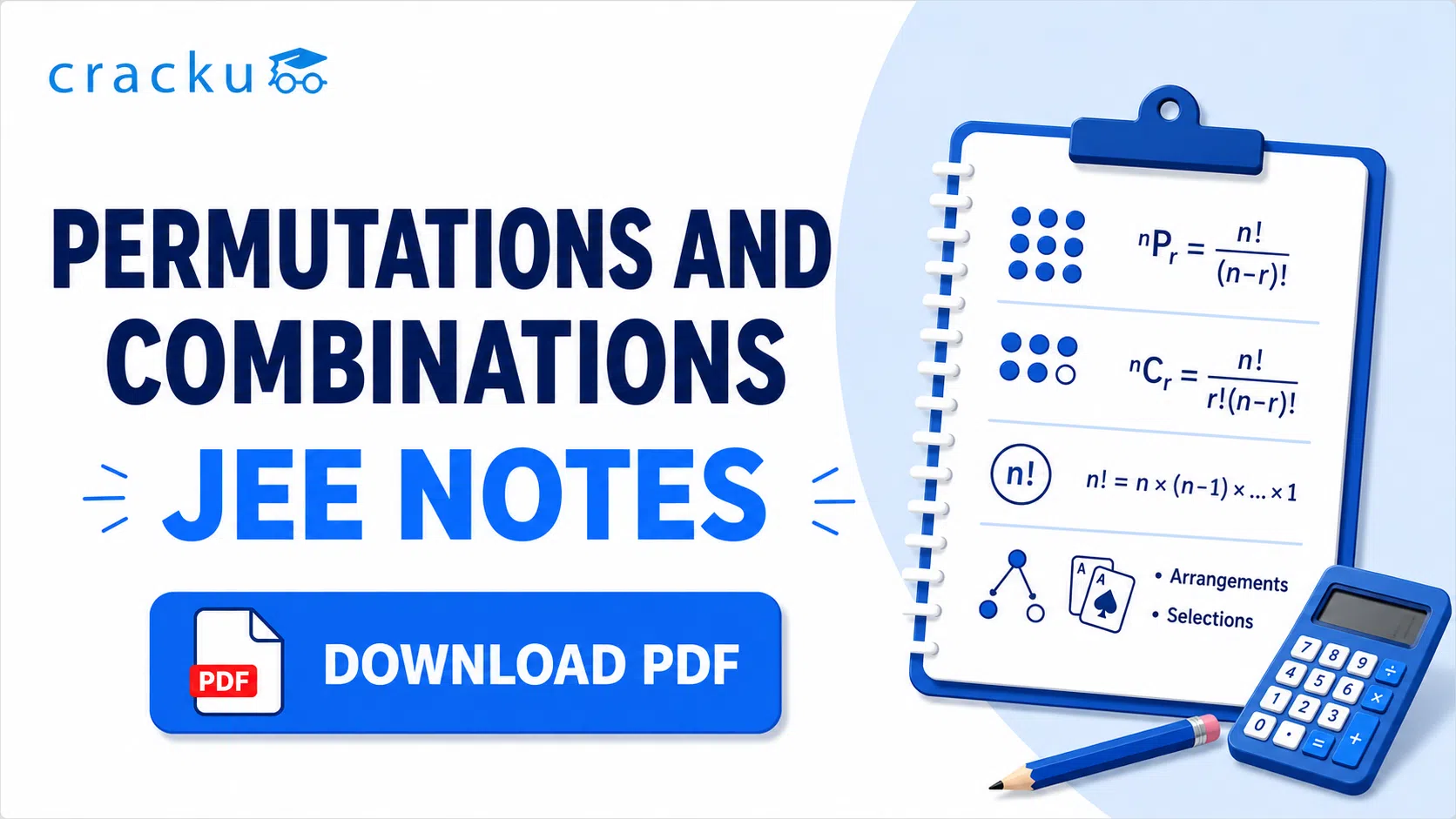
How many ways can five books be arranged on a shelf? How many different teams can be formed from a group of students? How many possible passwords can be created using a given set of characters? Permutations and combinations provide a systematic approach to solve such counting problems without listing every possible outcome.
The entire chapter depends on one important distinction: when order matters, we use permutations, and when order does not matter, we use combinations. These Permutations and Combinations JEE notes cover counting principles, factorials, arrangements, selections, identical objects, circular permutations, distribution problems, and derangements with important examples for quick revision.
Permutations and Combinations JEE Notes: Important Concepts
Most questions in this chapter are based on identifying the correct counting method. Before applying any formula, first decide whether the problem involves arranging objects or simply selecting objects.
Fundamental Counting Principle
Two basic rules form the foundation of all counting problems.
Multiplication Principle (AND Rule)
If one task can be completed in m ways and another task can be completed in n ways, then both tasks together can be completed in:
$$\text{Number of ways}=m\times n$$
This rule is used when different choices happen together.
Worked example: A restaurant offers 3 starters and 4 main courses. In how many ways can a customer select one starter and one main course?
Using the multiplication principle:
$$3\times4=12$$
Hence, there are 12 possible meal combinations.
Addition Principle (OR Rule)
If one task can be completed in m ways or another independent task can be completed in n ways, then the total number of choices is:
$$\text{Number of ways}=m+n$$
Worked example: A person can travel from city A to city B by 3 bus routes or 2 train routes.
$$3+2=5$$
Therefore, there are 5 possible travel options.
Factorial
Factorial is one of the most important concepts used throughout permutations and combinations.
$$n!=n(n-1)(n-2)...3\times2\times1$$
By convention:
$$0!=1$$
| n | 0 | 1 | 2 | 3 | 4 | 5 | 6 | 7 |
|---|---|---|---|---|---|---|---|---|
| $$n!$$ | 1 | 1 | 2 | 6 | 24 | 120 | 720 | 5040 |
JEE Tip: Remember factorial values up to $$7!$$ as these values appear frequently in counting problems.
Permutations
A permutation is an arrangement of objects where the order of objects matters.
For example, ABC and BAC are different arrangements because changing the order creates a new possibility.
$$^nP_r=\frac{n!}{(n-r)!}$$
Here:
- $$n$$ represents the total number of objects.
- $$r$$ represents the number of objects being arranged.
Special Cases of Permutations
- When all objects are arranged: $$^nP_n=n!$$
- When no object is selected: $$^nP_0=1$$
- When one object is arranged: $$^nP_1=n$$
Worked Example
In how many ways can first, second and third positions be awarded among 8 students?
Since first, second and third positions are different, order matters. Therefore, this is a permutation problem.
$$^8P_3=\frac{8!}{(8-3)!}$$
$$=\frac{8!}{5!}$$
$$=8\times7\times6$$
$$=336$$
Hence, the positions can be awarded in 336 ways.
Permutations with Repetition Allowed
When repetition is allowed, every position can be filled independently.
$$\text{Number of arrangements}=n^r$$
Worked example: How many 4-digit PINs can be formed using digits 0 to 9 when repetition is allowed?
Each position has 10 possible choices.
$$10^4=10000$$
Therefore, 10,000 PINs are possible.
Combinations
A combination is a selection where the order of objects does not matter.
For example, selecting students for a team gives the same result whether we select A, B, C or C, B, A.
$$^nC_r=\frac{n!}{r!(n-r)!}$$
Important Combination Values
- $$^nC_0=1$$
- $$^nC_n=1$$
- $$^nC_1=n$$
Relation Between Permutations and Combinations
$$^nC_r=\frac{^nP_r}{r!}$$
Permutations count all possible arrangements, while combinations count only selections. Dividing by $$r!$$ removes the different arrangements of the same selected objects.
Worked Example
A committee of 4 members is to be formed from 10 people. How many committees are possible?
Since the order of members does not matter, this is a combination problem.
$$^{10}C_4=\frac{10!}{4!6!}$$
$$=\frac{10\times9\times8\times7}{4\times3\times2\times1}$$
$$=210$$
Hence, 210 committees can be formed.
Identical Objects and Circular Permutations
Permutations of Objects Not All Distinct
When some objects are identical, considering them as different objects leads to overcounting. In such cases, we divide by the factorial of each repeated object.
$$\text{Number of arrangements}=\frac{n!}{p_1!p_2!...p_k!}$$
Here, $$p_1,p_2,...,p_k$$ represent the number of times each identical object appears.
Worked example: How many distinct arrangements can be made using the letters of MISSISSIPPI?
- Total letters = 11
- M appears once
- I appears four times
- S appears four times
- P appears twice
$$\text{Number of arrangements}=\frac{11!}{1!4!4!2!}$$
$$=34650$$
Hence, the number of distinct arrangements is 34,650.
Circular Permutations
In circular arrangements, there is no fixed starting point. Rotating the entire arrangement does not create a new arrangement.
For arranging $$n$$ distinct objects around a circle:
$$\text{Number of circular arrangements}=(n-1)!$$
For necklaces and garlands where clockwise and anticlockwise arrangements are considered identical:
$$\text{Number of arrangements}=\frac{(n-1)!}{2}$$
| Situation | Number of Arrangements |
|---|---|
| $$n$$ distinct objects around a circle | $$(n-1)!$$ |
| Necklace or garland | $$\frac{(n-1)!}{2}$$ |
Worked example: In how many ways can 6 people sit around a circular table?
$$=(6-1)!$$
$$=5!$$
$$=120$$
Therefore, 6 people can sit around the table in 120 ways.
Distribution Problems
Combinations with Repetition
Sometimes the same object can be selected multiple times. For example, selecting multiple ice cream scoops from different flavours.
$$\text{Number of ways}=^{n+r-1}C_r$$
This concept is also used in distributing identical objects among different groups.
Worked example: How many ways can 4 ice cream scoops be selected from 3 flavours when repetition is allowed?
Here:
- Number of flavours $$n=3$$
- Number of selections $$r=4$$
$$=^{3+4-1}C_4$$
$$=^6C_4$$
$$=15$$
Hence, there are 15 possible selections.
Division into Groups
The formula depends on whether the groups are labelled or identical.
| Case | Formula |
|---|---|
| Distinct labelled groups | $$\frac{n!}{r_1!r_2!...r_k!}$$ |
| Equal unlabelled groups | $$\frac{n!}{r_1!r_2!...r_k! \times m!}$$ |
JEE Tip: Always check whether groups have different identities. Dividing students into Team A and Team B is different from simply forming two identical groups.
Derangements
A derangement is a permutation where no object remains in its original position.
For example, when letters are placed into envelopes, a derangement occurs when every letter goes into the wrong envelope.
$$D_n=n!\sum_{k=0}^{n}\frac{(-1)^k}{k!}$$
| Number of Objects | Derangements |
|---|---|
| $$3$$ | $$2$$ |
| $$4$$ | $$9$$ |
| $$5$$ | $$44$$ |
Worked example: Four letters are placed randomly into four addressed envelopes. In how many ways can every letter go into the wrong envelope?
This is a derangement problem:
$$D_4=9$$
Hence, the answer is 9 ways.
Permutations and Combinations Formula Sheet
| Concept | Formula |
|---|---|
| Factorial | $$n!=n(n-1)(n-2)...1$$ |
| Permutation | $$^nP_r=\frac{n!}{(n-r)!}$$ |
| Combination | $$^nC_r=\frac{n!}{r!(n-r)!}$$ |
| Relation between permutation and combination | $$^nC_r=\frac{^nP_r}{r!}$$ |
| Permutation with repetition | $$n^r$$ |
| Identical objects | $$\frac{n!}{p_1!p_2!...p_k!}$$ |
| Circular permutation | $$(n-1)!$$ |
| Necklace/Garland | $$\frac{(n-1)!}{2}$$ |
| Combination with repetition | $$^{n+r-1}C_r$$ |
| Derangement | $$D_n=n!\sum_{k=0}^{n}\frac{(-1)^k}{k!}$$ |
JEE Important Points, Common Mistakes and Quick Revision
Points JEE Repeatedly Tests
- Always identify whether the question requires an arrangement or a selection before applying any formula.
- If changing the order creates a different outcome, the problem involves permutation. If order does not affect the outcome, it involves combination.
- The multiplication principle is used when multiple choices happen together, while the addition principle is used when choices are alternatives.
- Repeated objects require division by the factorial of identical objects to avoid overcounting.
- Circular arrangement problems require fixing one position because rotation does not create a new arrangement.
- In distribution problems, always check whether groups are labelled or identical before applying the formula.
- Derangement problems require every object to move from its original position.
Common Mistakes to Avoid
- Using permutation instead of combination: Selecting a team or committee does not depend on order, so it requires combination.
- Ignoring repetition: Arrangements with repetition allowed follow a different approach compared to arrangements without repetition.
- Forgetting identical objects: Treating identical objects as different leads to incorrect counting.
- Using linear permutation for circular arrangements: Circular arrangements do not have a fixed starting point.
- Ignoring group identity: Dividing people into labelled groups and identical groups gives different answers.
- Confusing derangements with normal permutations: A derangement requires that no object stays in its original position.
- Missing symmetry in combinations: Many combination questions can be simplified by recognising equivalent selections.
Quick Revision Notes for Permutations and Combinations
- Order matters → Permutation.
- Order does not matter → Combination.
- AND situations require multiplication, while OR situations require addition.
- Factorials are the foundation of arrangement-based problems.
- Repeated objects require special counting methods to avoid overcounting.
- Circular arrangements are solved by removing rotational symmetry.
- Distribution problems depend on whether objects and groups are identical or distinct.
- Derangements count arrangements where no object remains in its original position.
Problem-solving routine: Start by identifying whether the question is about arranging or selecting objects. Then check for repetition, identical objects, circular arrangements, or group formation. Practising different patterns through JEE questions helps develop faster recognition of the correct method.
.webp)