
 Group
Group
 Group
Group


 Preferred Source

 Google Discover
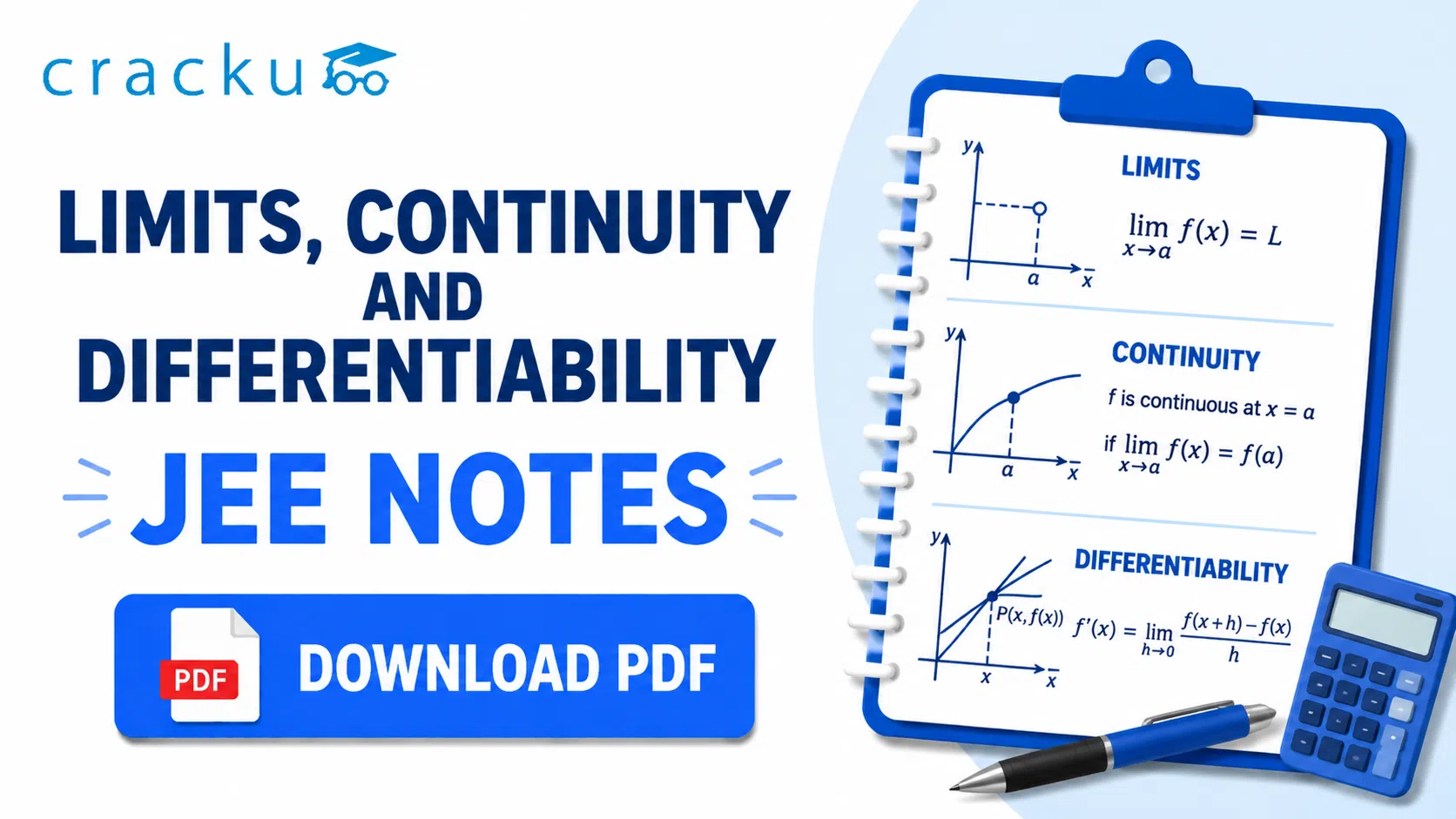
Limits, Continuity and Differentiability JEE Notes condense the entire chapter into a revision-first sheet. Keep this tab open while solving papers: every core idea, result and pitfall sits in one place below.
Limits, Continuity and Differentiability JEE Notes: Important Concepts
Limit of a function at a point $$x=a$$ is the value that $$f(x)$$ approaches as $$x$$ approaches $$a$$. When left-hand and right-hand limits coincide we write $$\displaystyle\lim_{x\to a}f(x)=L$$.
Continuity at $$x=a$$ needs three boxes ticked: (i) $$f(a)$$ exists, (ii) both one-sided limits exist, (iii) limit equals the value of the function.
Differentiability at $$x=a$$ needs the derivative $$f'(a)=\displaystyle\lim_{h\to 0}\frac{f(a+h)-f(a)}{h}$$ to exist. Every differentiable function is continuous, but the converse is false (classic JEE trap!).
- Neighbourhood symbols: $$x\to 0^+$$ (approach from right), $$x\to 0^-$$ (from left).
- Indeterminate forms: $$\tfrac{0}{0},\;\tfrac{\infty}{\infty},\;0\cdot\infty,\;\infty-\infty,\;0^0,\;1^\infty,\;\infty^0$$. Handling them is a key scoring area.
- NCERT coverage spans up to first-order Taylor expansion; JEE Advanced often pushes to second order.
Standard Limits and Evaluation Techniques
Must-Know Standard Limits
| Limit | Result |
|---|---|
| $$\displaystyle\lim_{x\to 0}\frac{\sin x}{x}$$ | 1 |
| $$\displaystyle\lim_{x\to 0}\frac{\tan x}{x}$$ | 1 |
| $$\displaystyle\lim_{x\to 0}\frac{1-\cos x}{x^2}$$ | $$\tfrac12$$ |
| $$\displaystyle\lim_{x\to 0}\frac{e^x-1}{x}$$ | 1 |
| $$\displaystyle\lim_{x\to 0}(1+x)^{1/x}$$ | $$e$$ |
| $$\displaystyle\lim_{x\to 0}\frac{\ln(1+x)}{x}$$ | 1 |
| $$\displaystyle\lim_{x\to 0}\frac{a^x-1}{x}$$ | $$\ln a$$ (for $$a\gt0$$) |
$$\lim_{x\to 0}\frac{\sin x}{x}=1\qquad\text{and}\qquad \lim_{x\to 0}(1+x)^{1/x}=e$$ are the two limits you absolutely must recall under pressure.
Techniques that Save Time
- Factor and cancel: remove the culprit factor creating $$\tfrac00$$.
- Rationalisation: multiply by conjugate when radicals appear.
- Substitution: convert to a standard limit, e.g., set $$x=h/a$$.
- Series expansion: first two terms are usually enough.
- L’Hopital’s Rule: differentiate numerator and denominator once the form is $$\tfrac00$$ or $$\tfrac\infty\infty$$ (see Section 4).
Worked Example 1 (Basic)
Evaluate $$\displaystyle\lim_{x\to 0}\frac{\sqrt{1+2x}-\sqrt{1+x}}{x}$$.
Multiply numerator and denominator by the conjugate $$\sqrt{1+2x}+\sqrt{1+x}$$:
$$\frac{(\sqrt{1+2x}-\sqrt{1+x})(\sqrt{1+2x}+\sqrt{1+x})}{x(\sqrt{1+2x}+\sqrt{1+x})} =\frac{(1+2x)-(1+x)}{x(\sqrt{1+2x}+\sqrt{1+x})} =\frac{x}{x(\sqrt{1+2x}+\sqrt{1+x})}.$$
Cancel $$x$$ and put $$x\to 0$$:
Denominator $$\to 2\sqrt1 =2$$, so the limit is $$\tfrac12$$.
Once you finish this section, attempt a mixed set inside the JEE Questions archive to lock the ideas.
Continuity: Conditions, Testing and Discontinuities
Three Conditions in One Line
At $$x=a$$ the function is continuous iff $$\displaystyle\lim_{x\to a^-}f(x)=\lim_{x\to a^+}f(x)=f(a)$$. Missing any one breaks continuity.
Types of Discontinuities
| Type | What breaks? | Typical example |
|---|---|---|
| Removable | Function not defined at limit value | $$f(x)=\tfrac{\sin x}{x}$$ at $$x=0$$ |
| Jump | One-sided limits unequal | $$f(x)=\operatorname{sgn}(x)$$ at $$x=0$$ |
| Infinite | Limit $$\to\pm\infty$$ | $$f(x)=\tfrac1{x^2}$$ at $$x=0$$ |
Piecewise Continuity Checklist
- Check interior points of every sub-interval: direct substitution works.
- Check boundary points from both sides.
- At any removable discontinuity, redefine $$f(a)=\lim_{x\to a}f(x)$$ to make the function continuous (JEE likes asking this correction value).
Worked Example 2 (Boundary)
Let $$f(x)=\begin{cases}kx^2+3x & x\lt1\\2x+k & x\ge1\end{cases}$$. Find $$k$$ for which $$f(x)$$ is continuous at $$x=1$$.
Continuity demands left limit = right limit:
Left: $$k(1)^2+3(1)=k+3$$.
Right: $$2(1)+k=2+k$$.
Equate: $$k+3=2+k\implies3=2$$ which is impossible!
Hence no real $$k$$ makes it continuous; common distractor cleared.
Differentiability, L’Hopital Rule and Series Approximations
From Continuity to Differentiability
At $$x=a$$, differentiability needs the left and right derivatives to match:
$$\displaystyle\lim_{h\to 0^-}\frac{f(a+h)-f(a)}{h}= \lim_{h\to 0^+}\frac{f(a+h)-f(a)}{h}=f'(a).$$
Every differentiable function is continuous but not vice-versa. Modulus and greatest-integer produce the usual non-differentiable sharp corners.
L’Hopital’s Rule (JEE Favourite)
If $$\displaystyle\lim_{x\to a}f(x)=\lim_{x\to a}g(x)=0$$ or $$\pm\infty$$ and derivatives exist near $$a$$ with $$g'(x)\ne0$$, then
$$\displaystyle\lim_{x\to a}\frac{f(x)}{g(x)} =\lim_{x\to a}\frac{f'(x)}{g'(x)}$$ provided the latter limit exists.
Keep differentiating until the indeterminate form disappears.
Maclaurin Expansion up to $$x^2$$
| Function | Series | Useful Range |
|---|---|---|
| $$\sin x$$ | $$x-\frac{x^3}{6}+O(x^5)$$ | $$|x|\lt0.3$$ rad |
| $$\cos x$$ | $$1-\frac{x^2}{2}+O(x^4)$$ | Any small $$x$$ |
| $$e^x$$ | $$1+x+\frac{x^2}{2}+O(x^3)$$ | $$|x|\lt1$$ |
| $$\ln(1+x)$$ | $$x-\frac{x^2}{2}+O(x^3)$$ | $$|x|\lt1$$ |
Worked Example 3 (L’Hopital)
Compute $$\displaystyle\lim_{x\to 0}\frac{e^{2x}-1-2x}{x^2}$$.
Direct substitution gives $$\tfrac00$$. Differentiate numerator and denominator twice:
First derivative: $$\frac{2e^{2x}-2}{2x}= \frac{2(e^{2x}-1)}{2x}$$ still $$\tfrac00$$.
Second derivative: $$\frac{4e^{2x}}{2}=2e^{2x}$$.
Put $$x=0$$: $$2e^{0}=2$$. Hence the limit equals 2.
Worked Example 4 (Series)
Evaluate $$\displaystyle\lim_{x\to 0}\frac{\sin x - x + \tfrac{x^3}{6}}{x^5}$$.
Series for $$\sin x$$ up to $$x^5$$: $$x-\tfrac{x^3}{6}+\tfrac{x^5}{120}+O(x^7)$$.
Numerator $$=(x-\tfrac{x^3}{6}+\tfrac{x^5}{120})-x+\tfrac{x^3}{6}= \tfrac{x^5}{120}+O(x^7).$$
Divide by $$x^5$$ and let $$x\to0$$: limit = $$\tfrac1{120}$$.
For an organised PDF of these series, grab them from the printable JEE Formula Sheets right after revising this table.
Important Formulas and Results at a Glance
| Topic | Formula / Result |
|---|---|
| Definition of derivative | $$f'(x)=\displaystyle\lim_{h\to0}\frac{f(x+h)-f(x)}{h}$$ |
| Chain Rule | $$\frac{dy}{dx}=\frac{dy}{du}\cdot\frac{du}{dx}$$ |
| Inverse Trig Derivatives | $$\frac{d}{dx}\arcsin x=\frac1{\sqrt{1-x^2}},\;\frac{d}{dx}\arctan x=\frac1{1+x^2}$$ |
| Exponent & Log | $$\frac{d}{dx}a^x=a^x\ln a,\;\frac{d}{dx}\ln x=\frac1x$$ |
| Parametric Form | $$\frac{dy}{dx}=\frac{dy/dt}{dx/dt}$$ |
| Higher-order | $$f''(x)=\frac{d^2y}{dx^2}= \bigl(f'(x)\bigr)'$$ |
| Mean Value Theorem | $$\exists c\in(a,b):\;f'(c)=\frac{f(b)-f(a)}{b-a}$$ |
| Indeterminate Power | If $$y=[f(x)]^{g(x)}$$, $$\ln y=g(x)\,\ln f(x)$$ then differentiate. |
Pin this table near your study desk. Before the weekly mock, skim it, then attempt limits or derivative questions from recent papers—the habit links formulas to actual exam patterns.
JEE Important Points, Common Mistakes and Quick Revision
- Weightage: 3-4 questions in JEE Main almost every year, often totalling 12-16 marks; JEE Advanced combines limits with continuity inside paragraph questions.
- Don’t jump to L’Hopital if factoring removes $$\tfrac00$$ faster: differentiating thrice wastes time.
- Modulus and greatest-integer kill differentiability at integers; always split the domain first.
- Rewrite $$0^0$$ type as $$e^{\ln(\,)}$$ to convert the exponent into a product; many aspirants forget this step.
- Unit check: continuity problems are dimensionless but applied rate of change questions need units—write them to avoid silly errors.
- Last-minute drill: pick five previous JEE Main limits questions and solve under 10 min. The archive inside JEE Mains Previous Papers is ideal.
.webp)