
 Group
Group
 Group
Group


 Preferred Source

 Google Discover
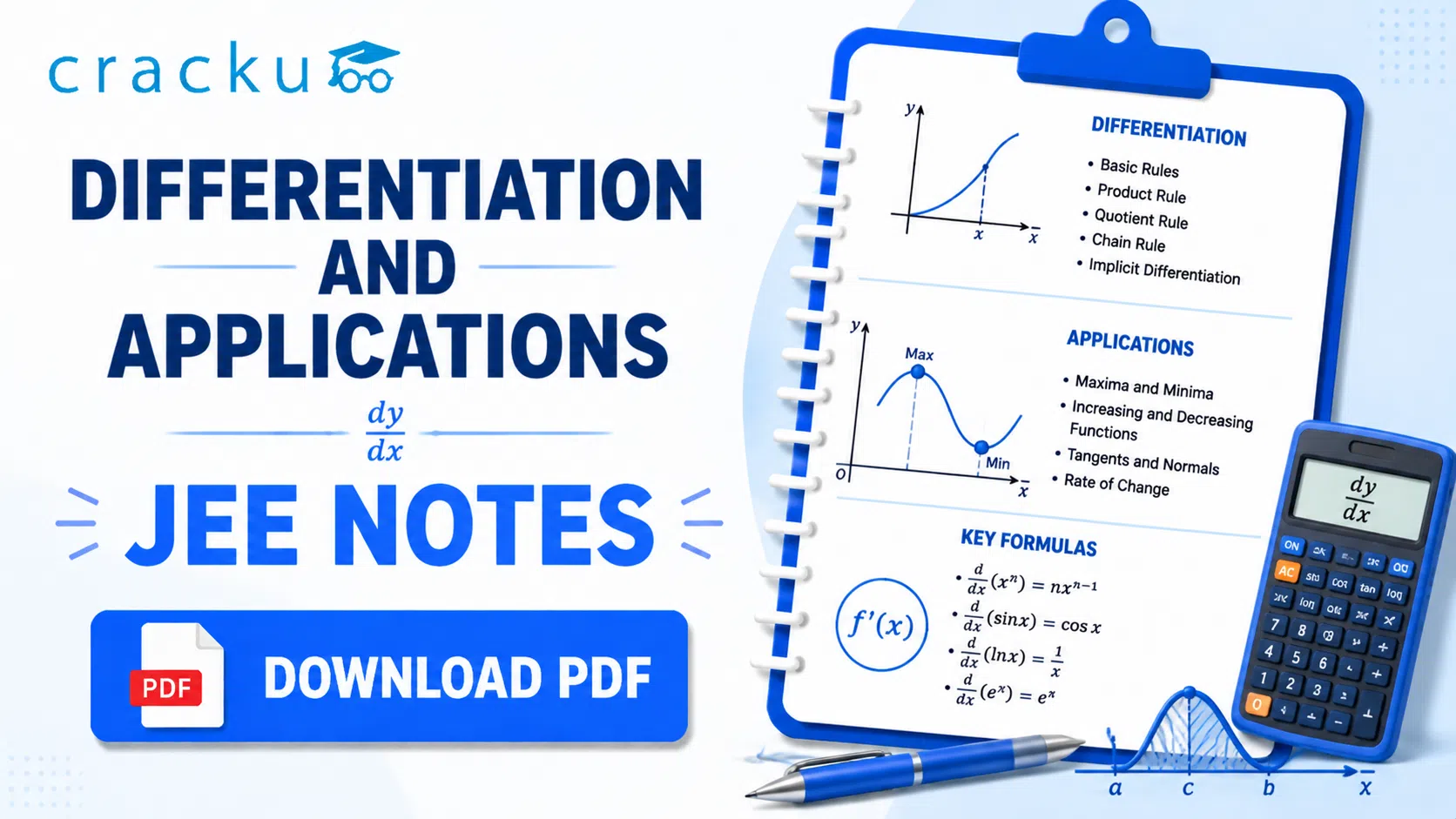
Differentiation and Applications JEE Notes give you every derivative formula, theorem and problem pattern the exam has asked in the last decade in one place. Use this condensed sheet for the final fortnight of practice and nothing will feel unseen in the hall.
Differentiation and Applications JEE Notes: Important Concepts
The chapter sits at the core of calculus. JEE tests two things repeatedly: how fast you can differentiate almost any combination of elementary functions, and whether you can translate that derivative into geometry or optimisation on the spot. Keep the following pillars clear:
- Derivative at a point: $$f'(a)=\lim_{h\to0}\dfrac{f(a+h)-f(a)}{h}$$ whenever the limit exists.
- Continuity implies differentiability? Not necessarily, but differentiability always implies continuity.
- Standard derivative values: $$\dfrac{d}{dx}\sin x=\cos x,\; \dfrac{d}{dx}\ln x=\dfrac1x,\; \dfrac{d}{dx}e^{kx}=ke^{kx}$$ etc. Memorise the full list in the next section.
- Order of a derivative: First derivative gives rate, second derivative gives curvature or acceleration, higher ones appear in Maclaurin series questions.
- Applications spectrum: Tangent–normal, angle between curves, local maxima–minima, points of inflexion, rate of change, error propagation, and curve sketching.
Theorems frequently asked
- Rolle’s Theorem (three-step check: continuity, differentiability, equal end values) produces at least one $$c$$ in $$(a,b)$$ where $$f'(c)=0$$.
- Lagrange’s Mean Value Theorem triggers many parameter hunts: $$f'(c)=\dfrac{f(b)-f(a)}{b-a}$$.
- Cauchy’s MVT arrives in Advanced as $$\dfrac{f'(c)}{g'(c)}=\dfrac{f(b)-f(a)}{g(b)-g(a)}$$. Remember that $$g'(x)\neq0$$ throughout.
Techniques of Differentiation and Shortcut Results
You must differentiate composite, implicit, parametric and logarithmic forms in under a minute. The quickest way is to classify the integrand and fix the rule immediately.
Standard derivative table
| Function | Derivative | Typical JEE use |
|---|---|---|
| $$\sin x$$ | $$\cos x$$ | Angle questions |
| $$\cos x$$ | $$-\sin x$$ | Integration back-tracking |
| $$\tan x$$ | $$\sec^2 x$$ | Tangent slope at $$\tan^{-1}$$ points |
| $$e^{kx}$$ | $$ke^{kx}$$ | Radioactive decay, growth |
| $$\ln x$$ | $$1/x$$ | Error propagation |
| $$a^x$$ | $$a^x\ln a$$ | Log conversion |
| $$\sin^{-1}x$$ | $$1/\sqrt{1-x^2}$$ | Inverse-trig differentiation |
| $$\tanh x$$ | $$\operatorname{sech}^2x$$ | Hyperbolic curve sketch |
Core rules
- Product rule: $$(uv)'=u'v+uv'$$
- Quotient rule: $$\left(\dfrac u v\right)'=\dfrac{u'v-uv'}{v^2}$$
- Chain rule: $$\dfrac{dy}{dx}=\dfrac{dy}{du}\cdot\dfrac{du}{dx}$$ applied mentally for speed.
- Logarithmic differentiation: Take $$\ln$$ on both sides when the variable sits in both base and exponent, e.g. $$y=x^{x^2}\Rightarrow\ln y=x^2\ln x$$.
- Parametric form: If $$x=f(t),\;y=g(t)$$ then $$\dfrac{dy}{dx}=\dfrac{dy/dt}{dx/dt}$$ evaluated at the required $$t$$.
$$\dfrac{d}{dx}(\ln|f(x)|)=\dfrac{f'(x)}{f(x)},\qquad \dfrac{d}{dx}\bigl[\arctan f(x)\bigr]=\dfrac{f'(x)}{1+f^2(x)}$$
Shortcut identities worth 3–4 seconds
- $$\dfrac{d}{dx}\sin^{-1}\bigl(\sqrt x\bigr)=\dfrac1{2\sqrt{x(1-x)}}$$ directly.
- For $$y=f(ax+b)$$, $$y' = af'(ax+b)$$: pull the constant outside first.
- If $$f(x) \cdot g(x)=1$$ then $$f'(x)=-\dfrac{g'(x)}{g^2(x)}$$.
Print this rule set and stick it inside your formula notebook. The complete downloadable set is clubbed with our JEE Formula Sheets so you never chase scattered notes the night before the exam.
Applications of Derivatives: Geometrical and Physical
After differentiation comes interpretation. JEE turns a slope into geometry or optimisation almost instantly. Master these five patterns:
Tangent and Normal
- Equation of tangent at $$x=a$$: $$y=f(a)+f'(a)(x-a)$$.
- Equation of normal: $$y=f(a)-\dfrac{1}{f'(a)}(x-a)$$ if $$f'(a)\neq0$$.
- Length of tangent, subtangent for $$y=f(x)$$ at $$x=a$$: $$LT=\sqrt{1+[f'(a)]^2}\;|x-a|$$, $$ST=\dfrac{y}{f'(a)}$$.
Angle between two curves
At an intersection $$\bigl(x_0,y_0\bigr)$$, slopes are $$m_1=f_1'(x_0)$$ and $$m_2=f_2'(x_0)$$. The acute angle $$\theta$$ satisfies $$\tan\theta=\left|\dfrac{m_2-m_1}{1+m_1m_2}\right|$$.
Rate of change and related rates
- Differentiation translates one rate into another, e.g. growth of radius into volume increase in kinetics questions.
- Follow the chain: $$\dfrac{dV}{dt}=\dfrac{dV}{dr}\dfrac{dr}{dt}$$.
Error approximation
Relative error $$\dfrac{\Delta y}{y}\approx\dfrac{dy}{y}$$. Instrument-based questions usually insert ±0.01 cm and ask percentage error in area.
Curvature and radius of curvature
Formula at point $$P(x,y)$$: $$\rho=\dfrac{\bigl(1+(dy/dx)^2\bigr)^{3/2}}{|d^2y/dx^2|}$$. Appears once every two Advanced papers.
Worked example 1: Tangent-normal
Find the equation of the normal to $$y=\ln(x+1)$$ at the point where the tangent makes an angle of $$45^\circ$$ with the x-axis.
Solution: $$\tan45^\circ=1=f'(x)=1/(x+1)\Rightarrow x+1=1\Rightarrow x=0$$. Point is $$(0,0)$$. Slope of normal $$m_n=-1/m_t=-1$$. Equation: $$y=-x$$. Answer: \(y=-x\).
Worked example 2: Rate of change
The radius of a spherical droplet increases at $$2\times10^{-5}\,\text{m s}^{-1}$$. At radius $$1\,\text{cm}$$, find the rate of increase of its surface area $$S=4\pi r^2$$.
Solution: $$\dfrac{dS}{dt}=8\pi r\dfrac{dr}{dt}=8\pi(0.01)(2\times10^{-5})=1.6\times10^{-6}\pi\;\text{m}^2\text{s}^{-1}$$. Answer: \(1.6\pi\times10^{-6}\,\text{m}^2\text{s}^{-1}\).
Practise the full spectrum of mixed-concept questions by solving the calculus section of JEE Advanced Previous Papers once timing yourself strictly at 90 seconds per problem.
Increasing/Decreasing Functions, Maxima–Minima and Curve Sketching
Optimisation embodies half the marks of this chapter. Keep the derivative sign chart process automatic.
Monotonicity test
- $$f'(x)\gt0$$ on an interval ⇒ function strictly increasing there.
- $$f'(x)\lt0$$ ⇒ strictly decreasing.
First derivative test for extrema
- Find critical points where $$f'(x)=0$$ or undefined.
- Create an open-interval sign table around each point.
- Sign change $$+ \to -$$ ⇒ local maximum, $$-\to +$$ ⇒ local minimum.
Second derivative test
If $$f'(a)=0$$ and $$f''(a)\gt0$$ ⇒ local minimum. If $$f''(a)\lt0$$ ⇒ local maximum. If $$f''(a)=0$$, revert to first test.
Global maximum/minimum on closed interval
Evaluate $$f$$ at critical points plus end points and pick the largest/smallest value.
Inflection point
Occurs where $$f''(x)=0$$ and $$f'''(x)\neq0$$ or the sign of $$f''$$ changes.
Curve sketching checklist
- Intercepts and symmetry.
- Asymptotes from $$\lim_{x\to\pm\infty}f(x)$$ and denominators.
- Critical points and concavity.
- Join everything with smooth strokes.
Worked example 3: optimisation
Find the minimum value of $$f(x)=x^4-8x^3+18x^2+5$$.
Solution. $$f'(x)=4x^3-24x^2+36x=4x(x^2-6x+9)=4x(x-3)^2$$.
Critical points: $$x=0$$ and $$x=3$$. Compute second derivative $$f''(x)=12x^2-48x+36$$.
- At $$x=0$$: $$f''(0)=36\gt0$$ ⇒ local minimum: $$f(0)=5$$.
- At $$x=3$$: $$f''(3)=12(9)-48(3)+36=108-144+36=0$$, inconclusive. Inspect neighbourhood or use first test: sign of $$f'$$ changes from negative to positive through $$x=0$$ only. Hence absolute minimum is $$5$$ at $$x=0$$.
Answer: The least value of the function is 5.
Worked example 4: mean value theorem application
Show that $$f(x)=x^3-3x+1$$ satisfies Rolle’s Theorem on $$[-1,1]$$ and find the point(s) $$c$$ where $$f'(c)=0$$.
Check: $$f(-1)=f(1)= -1+3+1=3$$. Continuous and differentiable for all real $$x$$, so conditions hold.
Derivative $$f'(x)=3x^2-3$$; set to zero → $$x=\pm1$$. Both lie in $$[-1,1]$$.
Answer: \(c=-1,1\).
Important Formulas and Results at a Glance
| Concept | Formula/Result |
|---|---|
| Derivative definition | $$f'(x)=\lim_{h\to0}\dfrac{f(x+h)-f(x)}{h}$$ |
| Derivative of $$a^x$$ | $$a^x\ln a$$ |
| Derivative of $$\log_a x$$ | $$\dfrac1{x\ln a}$$ |
| Derivative of $$\sin^{-1}x$$ | $$\dfrac1{\sqrt{1-x^2}}$$ |
| Parametric derivative | $$\dfrac{dy}{dx}=\dfrac{dy/dt}{dx/dt}$$ |
| Implicit derivative | If $$F(x,y)=0$$ then $$\dfrac{dy}{dx}=-\dfrac{F_x}{F_y}$$ |
| Tangent to $$y=f(x)$$ | $$y=f(a)+f'(a)(x-a)$$ |
| Normal to $$y=f(x)$$ | $$y=f(a)-\dfrac{1}{f'(a)}(x-a)$$ |
| Rate relation | $$\dfrac{dy}{dt}=f'(x)\dfrac{dx}{dt}$$ |
| Lagrange MVT | $$\exists c:\;f'(c)=\dfrac{f(b)-f(a)}{b-a}$$ |
| Taylor expansion (up to $$x=a$$) | $$f(x)=f(a)+f'(a)(x-a)+\dfrac{f''(a)}{2!}(x-a)^2+\dots$$ |
| Radius of curvature | $$\rho=\dfrac{(1+(dy/dx)^2)^{3/2}}{|d^2y/dx^2|}$$ |
Most repeated JEE derivative: $$\dfrac{d}{dx}\bigl[\ln(\sin x)\bigr]=\cot x$$.
Re-write the above grid thrice in your own handwriting. The kinesthetic memory helps under pressure. For more such distilled grids reach the unlimited question bank inside JEE Questions and attempt at least 40 quick-fire derivatives in a single sitting.
JEE Important Points, Common Mistakes and Quick Revision
- Sign of derivative forgotten: Many aspirants forget the negative with $$\cos x$$ and inverse trigs. Mark it in red in the notebook.
- Chain rule direction: Always differentiate the outermost layer first.
- Log bases: $$\log x$$ in JEE means $$\log_{10}x$$ unless the natural log is explicitly written as $$\ln x$$. Don’t mix them.
- Over-using second derivative: If $$f''(x)=0$$, switch to the first derivative test instead of guessing.
- Inequality endpoints: While using MVT in inequalities, remember that $$c$$ lies strictly inside $$(a,b)$$, not at endpoints.
- Revision sprint (48 hours before exam):
- Read every formula once.
- Orally differentiate 25 random composite functions.
- Solve three past-paper optimisation problems.
- Sketch two curves without a calculator.
If stuck with theory at the last minute, watch the one-hour recap inside JEE Mains Online Coaching and then jump straight into timed mocks.
.webp)