
 Group
Group
 Group
Group


 Preferred Source

 Google Discover
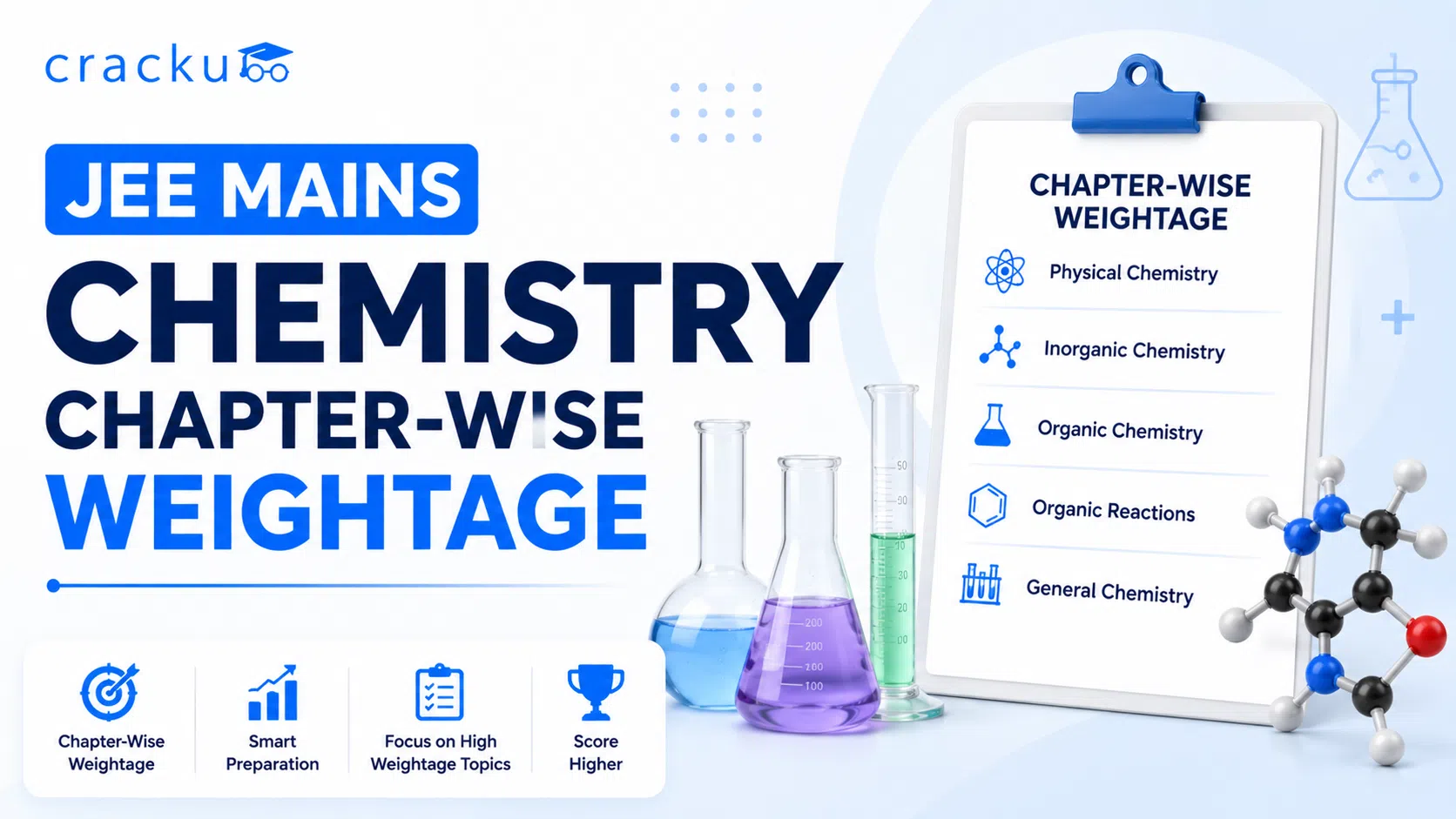
JEE Mains Chemistry Chapter-Wise Weightage
Chemistry is widely regarded as the most scoring subject in JEE Main, provided you have a clear understanding of concepts and strong command over reactions and formulas. With the right preparation strategy built around chapter-wise weightage, Chemistry can be a significant score booster for JEE Main 2027 aspirants.
The JEE Main Chemistry section comprises 25 questions worth 100 marks, divided into Physical Chemistry, Organic Chemistry, and Inorganic Chemistry. The section has 20 MCQs in Section A and 5 compulsory Numerical Value Questions in Section B, both of which carry negative marking. Understanding the distribution across these three branches is the first step toward targeted preparation.
Chemistry Chapter-Wise Weightage
Chemistry's 25 questions are split across Organic, Physical, and Inorganic branches, with Organic Chemistry alone accounting for nearly one-third of the section. Several topics including States of Matter, Hydrogen, s-block Elements, Polymers, and Everyday Life Chemistry have been officially removed from the NTA syllabus.
| Chapter | Expected Questions | Chapter Share (%) | Priority |
|---|---|---|---|
| Organic Chemistry (GOC, Reactions, Functional Groups) | 7–9 | 28–36% | High |
| Chemical Equilibrium and Ionic Equilibrium | 2–3 | 8–12% | High |
| Electrochemistry | 2–3 | 8–12% | High |
| Coordination Compounds | 2–3 | 8–12% | High |
| Chemical Bonding and Molecular Structure | 2–3 | 8–12% | Medium |
| p-Block, d-Block and f-Block Elements | 2–3 | 8–12% | Medium |
| Thermodynamics and Chemical Kinetics | 2–3 | 8–12% | Medium |
| Solutions, Surface Chemistry and Atomic Structure | 1–2 | 4–8% | Low–Medium |
JEE Mains Chemistry Syllabus PDF
The NTA-prescribed JEE Main Chemistry syllabus covers topics from both Class 11 and Class 12. It spans Physical Chemistry, Organic Chemistry, and Inorganic Chemistry sections. Note that NTA has officially removed several topics from the syllabus; these are clearly marked below so students do not waste preparation time on chapters that will not be tested.
Physical Chemistry topics include: Some Basic Concepts in Chemistry, Atomic Structure, Chemical Bonding and Molecular Structure, Chemical Thermodynamics, Solutions, Equilibrium, Redox Reactions, Electrochemistry, Chemical Kinetics, and Surface Chemistry. Note: States of Matter has been officially removed from the NTA syllabus and should not be prioritized.
Inorganic Chemistry covers: Classification of Elements and Periodicity, p-block Elements, d and f block Elements, and Coordination Compounds. Note: Hydrogen and its compounds and s-block Elements have been officially removed from the current NTA syllabus.
Organic Chemistry includes: Basic Principles of Organic Chemistry, Hydrocarbons, Organic Compounds with Halogens, Oxygen-containing and Nitrogen-containing compounds, and Biomolecules. Note: Polymers and Chemistry in Everyday Life (Environmental Chemistry) have been officially removed from the NTA syllabus. Do not include these in your preparation plan.
JEE Mains Chemistry Important Chapters
Among the three branches, Organic Chemistry generally carries the highest weightage, followed by Physical Chemistry, and then Inorganic Chemistry. The removal of several Inorganic topics means the remaining Inorganic chapters carry proportionally higher importance.
| Chapter | Branch | Expected Weightage | Priority Level |
|---|---|---|---|
| Organic Chemistry (Overall) | Organic | 30–35% | High |
| Coordination Compounds | Inorganic | 8–10% | High |
| Chemical Equilibrium and Ionic Equilibrium | Physical | 8–10% | High |
| Electrochemistry | Physical | 6–8% | High |
| Chemical Bonding and Molecular Structure | Inorganic | 6–8% | Medium |
| Thermodynamics | Physical | 5–7% | Medium |
| p-Block Elements | Inorganic | 5–7% | Medium |
| Chemical Kinetics | Physical | 4–6% | Medium |
| Biomolecules | Organic | 3–5% | Low–Medium |
Also Read: JEE Mains Chapter-wise Weightage 2027, Topic-wise Analysis
JEE Mains Chemistry Topic-Wise Weightage
Within each chapter, specific topics carry greater importance and are tested more frequently. The following table outlines the key topics within high-weightage chapters and their expected contribution in the 25-question format.
| Topic | Chapter/Branch | Expected Questions | Difficulty Level |
|---|---|---|---|
| Reaction Mechanisms (SN1, SN2, EAS) | Organic Chemistry | 2–3 | Moderate–Hard |
| Named Reactions | Organic Chemistry | 1–2 | Easy–Moderate |
| IUPAC Nomenclature | Organic Chemistry | 1–2 | Easy |
| Crystal Field Theory | Coordination Compounds | 1–2 | Moderate |
| pH Calculations and Buffers | Equilibrium | 1–2 | Moderate |
| Electrochemical Cell EMF | Electrochemistry | 1–2 | Moderate |
| Colligative Properties | Solutions | 1–2 | Moderate |
| Rate Law and Order of Reaction | Chemical Kinetics | 1–2 | Moderate |
| Periodic Trends | Periodic Table | 1 | Easy |
JEE Mains Chemistry Trends and Weightage Analysis
Chemistry in JEE Main has seen some important shifts in recent years. Organic Chemistry questions have become increasingly application-based, moving away from direct fact recall toward mechanism and synthesis problems. This trend is expected to continue in 2027.
The official removal of States of Matter, Hydrogen, s-block Elements, Polymers, and Everyday Life Chemistry from the NTA syllabus has streamlined the Chemistry section. This means the remaining chapters within Physical and Inorganic Chemistry now carry greater relative importance. Students should redirect the time they would have spent on removed chapters toward Electrochemistry, Equilibrium, and Coordination Compounds.
| Branch | 2022 Avg. Questions | 2023 Avg. Questions | 2024 Avg. Questions | 2027 Projected |
|---|---|---|---|---|
| Physical Chemistry | 8–9 | 8–9 | 8–9 | 8–9 |
| Organic Chemistry | 8–10 | 8–10 | 9–10 | 9–10 |
| Inorganic Chemistry | 6–8 | 6–8 | 6–7 | 6–8 |
The data confirms that Physical and Organic Chemistry together dominate the paper. Students who give roughly equal time to Physical and Organic Chemistry while using NCERT thoroughly for the retained Inorganic Chemistry chapters tend to score the best.
Also Read: JEE Mains Physics Chapter-Wise Weightage 2027, Check Now
JEE Mains Chemistry Chapter-Wise Weightage: Conclusion
Understanding the JEE Mains Chemistry Chapter-Wise Weightage 2027 can help aspirants prepare more strategically by identifying chapters that are expected to contribute the highest number of questions. Organic Chemistry, Equilibrium, Electrochemistry and Coordination Compounds should receive greater attention, while Chemical Bonding, Thermodynamics, Chemical Kinetics and p-Block Elements must also be thoroughly revised. Students should combine chapter priority with concept clarity, formula revision and regular question practice.