Group
Group
 Group
Group


 Preferred Source

 Google Discover
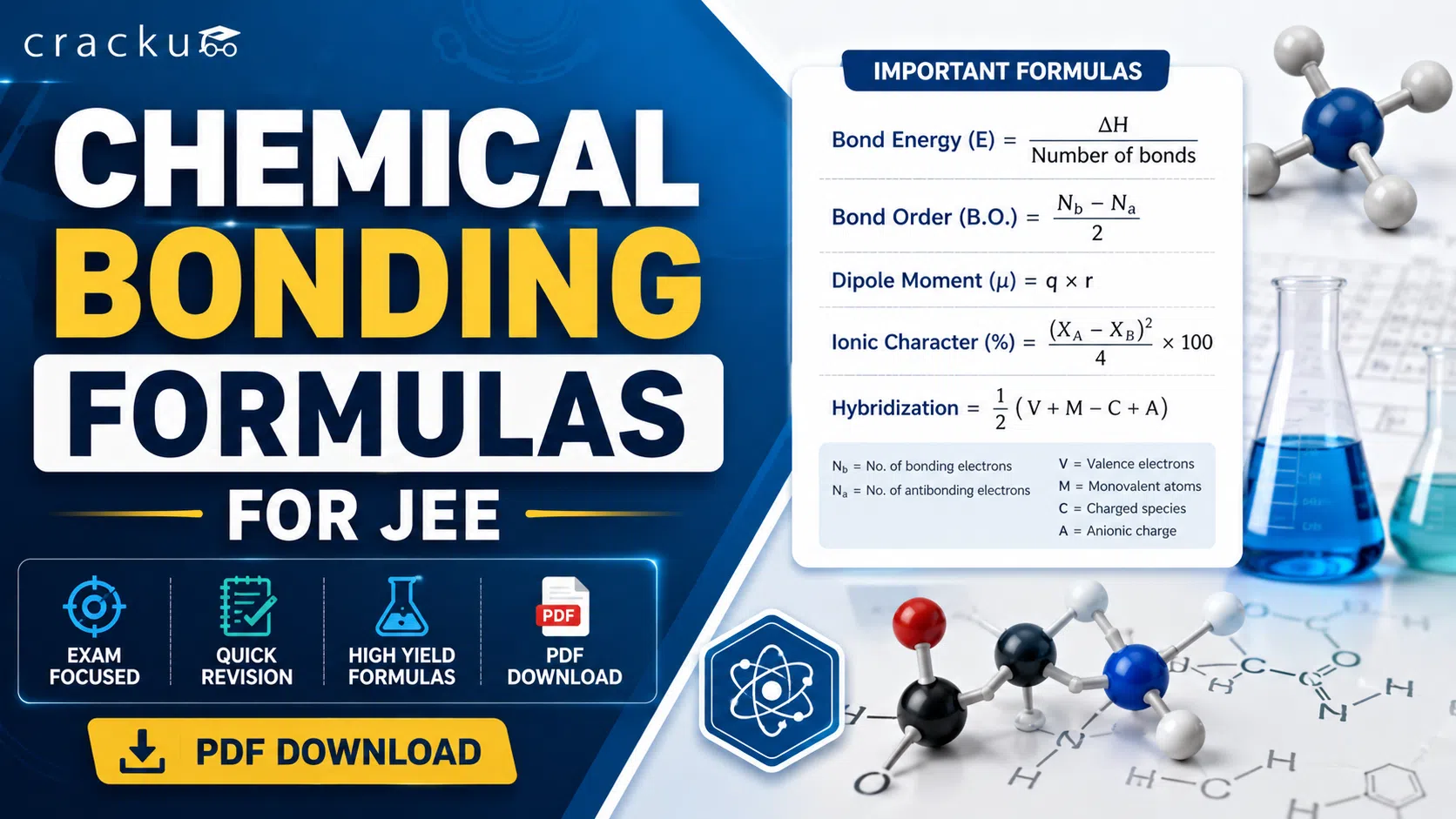
Chemical Bonding Formulas For JEE 2027
Chemical Bonding and Molecular Structure explains how atoms combine to form molecules and compounds, and how bonding affects their shapes, stability, and properties. The chapter covers ionic and covalent bonding, Lewis structures, VSEPR theory, hybridization, and molecular geometry. As a foundational part of the JEE Chemistry syllabus, these concepts help students predict molecular shapes, compare bond properties, and understand chemical behaviour.
The chapter also explores molecular orbital theory, hydrogen bonding, and intermolecular forces. These concepts help explain bond order, magnetic behaviour, and differences in physical properties such as boiling points. A JEE Mains Formula sheet can support quick revision of key equations, bonding rules, and standard molecular shapes. Combine this revision with worked examples and previous year questions to strengthen your understanding and improve accuracy in JEE Chemistry.
Ionic Bond and Lattice Energy Formulas for JEE
Definition: Ionic Bond
The electrostatic force of attraction between a positively charged cation and a negatively charged anion. Ionic bonds typically form between metals (low ionisation energy) and non-metals (high electron affinity).
Conditions Favouring Ionic Bond Formation
- Low ionisation energy of the metal — typically Group 1 and 2 elements
- High electron affinity of the non-metal — typically Group 16 and 17 elements
- Large electronegativity difference between the two atoms ($$> 1.7$$ on the Pauling scale)
Factors Affecting Lattice Energy
$$$U \propto \frac{q^+ \times q^-}{r^+ + r^-}$$$
where $$q^+$$ and $$q^-$$ are the charges on the cation and anion, and $$r^+$$, $$r^-$$ are their ionic radii.
Higher lattice energy when:
- Charges are larger (e.g., MgO $$>$$ NaCl because Mg$$^{2+}$$O$$^{2-}$$ vs Na$$^+$$Cl$$^-$$)
- Ionic radii are smaller (ions are closer together)
Born–Haber Cycle
Born–Haber Cycle for NaCl
The formation of NaCl(s) from Na(s) and $$\frac{1}{2}$$Cl$$_2$$(g) is broken into steps:
- Sublimation of Na(s) → Na(g): $$+\Delta H_{\text{sub}}$$
- Ionisation of Na(g) → Na$$^+$$(g) + $$e^-$$: $$+IE$$
- Dissociation of $$\frac{1}{2}$$Cl$$_2$$(g) → Cl(g): $$+\frac{1}{2}\Delta H_{\text{diss}}$$
- Electron affinity: Cl(g) + $$e^-$$ → Cl$$^-$$(g): $$-EA$$
- Lattice formation: Na$$^+$$(g) + Cl$$^-$$(g) → NaCl(s): $$-U$$
By Hess's law:
$$$\Delta H_f = \Delta H_{\text{sub}} + IE + \frac{1}{2}\Delta H_{\text{diss}} - EA - U$$$
Worked Example: Lattice Energy
Calculate the lattice energy of NaCl given: $$\Delta H_f = -411$$ kJ/mol, $$\Delta H_{\text{sub}} = 108$$ kJ/mol, $$IE = 496$$ kJ/mol, $$\frac{1}{2}\Delta H_{\text{diss}} = 121$$ kJ/mol, $$EA = 349$$ kJ/mol.
$$U = \Delta H_{\text{sub}} + IE + \frac{1}{2}\Delta H_{\text{diss}} - EA - \Delta H_f$$
$$U = 108 + 496 + 121 - 349 - (-411) = 108 + 496 + 121 - 349 + 411 = \textbf{787 kJ/mol}$$
Covalent Bond and Lewis Structures Formulas for JEE
Types of Covalent Bonds
| Type | Shared Pairs | Representation | Example |
|---|---|---|---|
| Single bond | 1 | A − B | H−H (H$$_2$$) |
| Double bond | 2 | A = B | O=O (O$$_2$$) |
| Triple bond | 3 | A ≡ B | N≡N (N$$_2$$) |
Bond strength: Triple $$>$$ Double $$>$$ Single
Bond length: Triple $$<$$ Double $$<$$ Single
Steps to Draw Lewis Structures
- Count total valence electrons. For ions, add electrons for negative charge, subtract for positive charge.
- Place the least electronegative atom in the centre (H is always terminal).
- Draw single bonds from the central atom to each surrounding atom (each bond uses 2 electrons).
- Distribute remaining electrons as lone pairs, starting with outer atoms, to complete their octets.
- If the central atom lacks an octet, convert lone pairs on outer atoms into double or triple bonds.
Formal Charge
$$$\text{Formal Charge} = V - L - \frac{B}{2}$$$
where $$V$$ = valence electrons of the free atom, $$L$$ = lone pair electrons on the atom, $$B$$ = bonding electrons around the atom.
Worked Example: Formal Charge
Find the formal charges on each atom in CO.
Carbon: $$V = 4$$, lone pair electrons $$= 2$$, bonding electrons $$= 6$$ (triple bond)
FC on C $$= 4 - 2 - \frac{6}{2} = 4 - 2 - 3 = -1$$
Oxygen: $$V = 6$$, lone pair electrons $$= 2$$, bonding electrons $$= 6$$
FC on O $$= 6 - 2 - \frac{6}{2} = 6 - 2 - 3 = +1$$
VSEPR Theory and Molecular Shapes Formulas for JEE
VSEPR Molecular Shapes
| Electron Pairs | Lone Pairs | Shape | Example |
|---|---|---|---|
| 2 BP, 0 LP | 0 | Linear ($$180°$$) | BeCl$$_2$$, CO$$_2$$ |
| 3 BP, 0 LP | 0 | Trigonal planar ($$120°$$) | BF$$_3$$, SO$$_3$$ |
| 2 BP, 1 LP | 1 | Bent / V-shape ($$< 120°$$) | SO$$_2$$, SnCl$$_2$$ |
| 4 BP, 0 LP | 0 | Tetrahedral ($$109.5°$$) | CH$$_4$$, CCl$$_4$$ |
| 3 BP, 1 LP | 1 | Trigonal pyramidal ($$107°$$) | NH$$_3$$, PCl$$_3$$ |
| 2 BP, 2 LP | 2 | Bent / V-shape ($$104.5°$$) | H$$_2$$O, H$$_2$$S |
| 5 BP, 0 LP | 0 | Trigonal bipyramidal | PCl$$_5$$ |
| 4 BP, 1 LP | 1 | See-saw | SF$$_4$$ |
| 3 BP, 2 LP | 2 | T-shaped | ClF$$_3$$ |
| 2 BP, 3 LP | 3 | Linear | XeF$$_2$$ |
| 6 BP, 0 LP | 0 | Octahedral ($$90°$$) | SF$$_6$$ |
| 5 BP, 1 LP | 1 | Square pyramidal | BrF$$_5$$ |
| 4 BP, 2 LP | 2 | Square planar | XeF$$_4$$ |
BP = bond pairs, LP = lone pairs on the central atom.
Worked Example: VSEPR Shape
Predict the shape of NH$$_3$$.
N has 5 valence electrons. Each H contributes 1. Total = $$5 + 3(1) = 8$$ electrons = 4 pairs.
3 pairs are bonding (N–H), 1 pair is a lone pair on N.
4 electron pairs → tetrahedral electron geometry. But 1 lone pair means molecular shape is trigonal pyramidal with bond angle $$\approx 107°$$ (less than $$109.5°$$ due to LP–BP repulsion).
Hybridization Formulas for JEE
Types of Hybridization
| Hybridization | Orbitals Mixed | Hybrid Orbitals | Geometry | Angle |
|---|---|---|---|---|
| $$sp$$ | 1s + 1p | 2 | Linear | $$180°$$ |
| $$sp^2$$ | 1s + 2p | 3 | Trigonal planar | $$120°$$ |
| $$sp^3$$ | 1s + 3p | 4 | Tetrahedral | $$109.5°$$ |
| $$sp^3d$$ | 1s + 3p + 1d | 5 | Trigonal bipyramidal | $$90°, 120°$$ |
| $$sp^3d^2$$ | 1s + 3p + 2d | 6 | Octahedral | $$90°$$ |
Tip: Quick trick to determine hybridization: Count the number of electron domains (bond pairs + lone pairs) on the central atom. 2 domains → $$sp$$, 3 → $$sp^2$$, 4 → $$sp^3$$, 5 → $$sp^3d$$, 6 → $$sp^3d^2$$.
Steric Number Formula
$$$\text{Steric Number} = \frac{1}{2}(V + M - C + A)$$$
where $$V$$ = valence electrons of central atom, $$M$$ = number of monovalent atoms bonded, $$C$$ = charge (for cations), $$A$$ = charge (for anions).
Worked Example: Hybridization
Find the hybridization of the central atom in XeF$$_4$$.
Xe has 8 valence electrons. 4 bonding pairs (with 4 F atoms) + lone pairs.
Steric number $$= \frac{1}{2}(8 + 4 - 0 + 0) = \frac{12}{2} = 6$$
→ $$sp^3d^2$$ hybridization, octahedral electron geometry.
With 4 BP + 2 LP: the shape is square planar.
Molecular Orbital Theory (MOT) Formulas for JEE
MO Energy Order
For $$\text{O}_2$$, $$\text{F}_2$$, and heavier diatomics ($$Z > 7$$):
$$$\sigma 1s < \sigma^* 1s < \sigma 2s < \sigma^* 2s < \sigma 2p_z < \pi 2p_x = \pi 2p_y < \pi^* 2p_x = \pi^* 2p_y < \sigma^* 2p_z$$$
For $$\text{B}_2$$, $$\text{C}_2$$, $$\text{N}_2$$ (lighter diatomics, $$Z \leq 7$$):
$$$\sigma 1s < \sigma^* 1s < \sigma 2s < \sigma^* 2s < \pi 2p_x = \pi 2p_y < \sigma 2p_z < \pi^* 2p_x = \pi^* 2p_y < \sigma^* 2p_z$$$
(Key difference: for $$Z \leq 7$$, $$\pi 2p$$ comes before $$\sigma 2p_z$$.)
Bond Order
$$$\text{Bond Order} = \frac{N_b - N_a}{2}$$$
where $$N_b$$ = electrons in bonding MOs, $$N_a$$ = electrons in antibonding MOs.
- Bond order $$> 0$$: molecule is stable
- Bond order $$= 0$$: molecule does not exist
- Higher bond order → shorter bond, stronger bond
Worked Example: MOT for O$$_2$$
Find the bond order and magnetic nature of O$$_2$$ (16 electrons).
MO filling (for $$Z > 7$$ order):
$$\sigma 1s^2 \; \sigma^* 1s^2 \; \sigma 2s^2 \; \sigma^* 2s^2 \; \sigma 2p_z^2 \; \pi 2p_x^2 \; \pi 2p_y^2 \; \pi^* 2p_x^1 \; \pi^* 2p_y^1$$
Bonding electrons $$N_b = 10$$, Antibonding electrons $$N_a = 6$$
Bond Order $$= \dfrac{10 - 6}{2} = 2$$ (double bond)
There are 2 unpaired electrons (one in each $$\pi^*$$), so O$$_2$$ is paramagnetic.
Important Note
The paramagnetism of O$$_2$$ is one of the great successes of MOT — neither Lewis structures nor VSEPR can explain why O$$_2$$ is attracted to a magnet. JEE frequently tests this.
Hydrogen Bonding and Dipole Moment Formulas for JEE
Definition: Hydrogen Bond
An electrostatic attraction between a H atom bonded to F, O, or N and a lone pair on another F, O, or N atom. Strength: $$5$$–$$40$$ kJ/mol.
Dipole Moment
$$$\mu = q \times d$$$
Units: Debye (D), where 1 D $$= 3.336 \times 10^{-30}$$ C·m.
Key rules for molecular dipole moment:
- For diatomic molecules: $$\mu \neq 0$$ if the two atoms are different (e.g., HCl)
- For polyatomic molecules: find the vector sum of all individual bond dipoles
- Symmetrical molecules have $$\mu = 0$$ even if individual bonds are polar (e.g., CO$$_2$$, BF$$_3$$, CCl$$_4$$, SF$$_6$$)
Worked Example: Dipole Moment
Why does CO$$_2$$ have zero dipole moment despite having polar C=O bonds?
CO$$_2$$ is linear: O=C=O. The two C=O bond dipoles point in opposite directions and are equal in magnitude. Their vector sum is zero.
By contrast, H$$_2$$O is bent ($$104.5°$$), so the two O–H dipoles do not cancel: $$\mu_{\text{H}_2\text{O}} = 1.85$$ D.
Fajan's Rules Formulas for JEE
Fajan's Rules — Covalent Character Increases When:
- The cation is small and highly charged (high charge density → strong polarising power)
- The anion is large and highly charged (easily polarised / deformed)
- The cation has a pseudo noble gas configuration ($$d^{10}$$) rather than a true noble gas configuration ($$s^2p^6$$)
Tip: Fajan's rules can be summarised as: small cation + large anion = more covalent. JEE often asks you to arrange compounds in order of covalent character — just check the cation size and charge.
Worked Example: Fajan's Rules
Arrange LiCl, NaCl, KCl in order of increasing covalent character.
All have Cl$$^-$$ as the anion. The cation sizes: Li$$^+ <$$ Na$$^+ <$$ K$$^+$$.
Smaller cation → greater polarising power → more covalent character.
Order of increasing covalent character: KCl $$<$$ NaCl $$<$$ LiCl.
Chemical Bonding Formulas For JEE 2027: Conclusion
A strong understanding of Chemical Bonding helps students explain molecular shapes, bond properties, polarity, and stability. Use a JEE Chemistry Formula Sheet to revise key equations and concepts, including VSEPR theory, hybridization, molecular orbital theory, dipole moments, and hydrogen bonding. Focus on the reasoning behind each rule and its exceptions to reduce mistakes in conceptual and numerical questions.
As you review JEE Mains Chemistry Chapter-wise weightage to plan your preparation, give Chemical Bonding regular revision time because it supports many other Chemistry topics. Combine revision with previous year questions and practice on Fajan’s rules, lattice energy, and bond order. Analysing mistakes and revisiting difficult concepts can improve accuracy and build confidence for JEE 2027.