
 Group
Group
 Group
Group

Equilibrium Formulas For JEE 2027
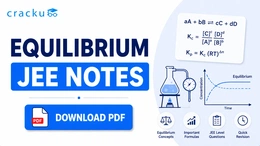
Equilibrium is an important chapter in JEE Chemistry because it explains how chemical reactions reach a balanced state where the forward and reverse reactions occur at the same rate. In this topic, students learn key concepts of chemical equilibrium, including the equilibrium constant and Le Chatelier’s principle. These ideas help in understanding how changes in temperature, pressure, or concentration can affect the direction of a reaction.
The chapter also includes ionic equilibrium, which covers topics such as pH calculations, buffer solutions, and solubility product (Ksp). These concepts are often used in numerical problems in the exam. When students understand these formulas clearly, solving questions related to reaction direction, acidity, and precipitation reactions becomes much easier. For quick revision, students can also refer to a well-organized JEE Mains Chemistry Formula PDF to review important formulas and key concepts.
Chemical Equilibrium
Equilibrium Constant $$K_c$$
For the reaction: $$aA + bB \rightleftharpoons cC + dD$$
$$$K_c = \frac{[C]^c [D]^d}{[A]^a [B]^b}$$$
- $$K_c$$ is constant at a given temperature
- $$K_c$$ changes only with temperature
- Pure solids and pure liquids are not included (activity = 1)
$$K_p$$ and Its Relation to $$K_c$$
$$$K_p = \frac{(P_C)^c (P_D)^d}{(P_A)^a (P_B)^b}$$$
$$$K_p = K_c (RT)^{\Delta n_g}$$$
where $$\Delta n_g = (c + d) - (a + b)$$ = change in moles of gas.
- If $$\Delta n_g = 0$$: $$K_p = K_c$$
- If $$\Delta n_g > 0$$: $$K_p > K_c$$
- If $$\Delta n_g < 0$$: $$K_p < K_c$$
Worked Example: $$K_p$$ from $$K_c$$
For $$\text{N}_2(g) + 3\text{H}_2(g) \rightleftharpoons 2\text{NH}_3(g)$$, $$K_c = 0.5$$ at 400 K. Find $$K_p$$.
$$\Delta n_g = 2 - 4 = -2$$
$$K_p = 0.5 \times (0.0821 \times 400)^{-2} = 0.5 \times (32.84)^{-2}$$
Rules for Manipulating Equilibrium Constants
- Reaction reversed: $$K' = \dfrac{1}{K}$$
- Reaction multiplied by $$n$$: $$K' = K^n$$
- Reaction divided by $$n$$: $$K' = K^{1/n}$$
- Two reactions added: $$K' = K_1 \times K_2$$
Reaction Quotient
Reaction Quotient and Predicting Direction
$$$Q_c = \frac{[C]^c [D]^d}{[A]^a [B]^b} \quad \text{(using current concentrations)}$$$
- $$Q < K$$: Reaction proceeds forward
- $$Q = K$$: System is at equilibrium
- $$Q > K$$: Reaction proceeds backward
Le Chatelier's Principle
Effects of Different Changes on Equilibrium
| Change Applied | Shift Direction | Effect on $$K$$ |
|---|---|---|
| Add reactant | Forward | No change |
| Remove product | Forward | No change |
| Add product | Backward | No change |
| Increase pressure | Toward fewer moles of gas | No change |
| Increase $$T$$ (exothermic) | Backward | $$K$$ decreases |
| Increase $$T$$ (endothermic) | Forward | $$K$$ increases |
| Add catalyst | No shift | No change |
| Add inert gas (const. $$V$$) | No shift | No change |
Important Note
A catalyst does not shift equilibrium — it speeds up both forward and reverse reactions equally. Temperature is the only factor that changes $$K$$.
Degree of Dissociation
Calculating $$K$$ from Degree of Dissociation ($$\alpha$$)
For $$\text{PCl}_5(g) \rightleftharpoons \text{PCl}_3(g) + \text{Cl}_2(g)$$, starting with $$a$$ moles in volume $$V$$:
$$$K_c = \frac{a\alpha^2}{V(1-\alpha)}$$$
Total moles at equilibrium = $$a(1 + \alpha)$$
Worked Example: Degree of Dissociation
1 mol of PCl$$_5$$ in a 1 L container, $$\alpha = 0.2$$. Find $$K_c$$.
At equilibrium: PCl$$_5$$ = 0.8 mol, PCl$$_3$$ = 0.2 mol, Cl$$_2$$ = 0.2 mol
$$K_c = \dfrac{(0.2)(0.2)}{0.8} = \dfrac{0.04}{0.8} = \textbf{0.05}$$
Ionic Equilibrium: pH and pO
Theories of Acids and Bases
| Theory | Acid | Base |
|---|---|---|
| Arrhenius | Gives H$$^+$$ in water | Gives OH$$^-$$ in water |
| Brønsted–Lowry | Proton (H$$^+$$) donor | Proton (H$$^+$$) acceptor |
| Lewis | Electron pair acceptor | Electron pair donor |
Ionic Product of Water
$$$K_w = [\text{H}^+][\text{OH}^-] = 1.0 \times 10^{-14} \quad \text{at 25°C}$$$
In pure water: $$[\text{H}^+] = [\text{OH}^-] = 1.0 \times 10^{-7}$$ M
pH and pOH
$$$\text{pH} = -\log[\text{H}^+] \qquad \text{pOH} = -\log[\text{OH}^-]$$$
$$$\text{pH} + \text{pOH} = 14 \quad \text{(at 25°C)}$$$
- pH $$< 7$$: Acidic
- pH $$= 7$$: Neutral
- pH $$> 7$$: Basic
Worked Example: pH of Strong Acid
Find the pH of 0.01 M HCl.
HCl ionizes completely: $$[\text{H}^+] = 0.01 = 10^{-2}$$ M
$$\text{pH} = -\log(10^{-2}) = \textbf{2}$$
Weak Acid and Weak Base Ionization
Ionization of Weak Acid ($$K_a$$)
For HA $$\rightleftharpoons$$ H$$^+$$ + A$$^-$$:
$$$K_a = \frac{c\alpha^2}{1 - \alpha}$$$
When $$\alpha \ll 1$$:
$$$K_a \approx c\alpha^2 \qquad \alpha \approx \sqrt{K_a / c} \qquad [\text{H}^+] = \sqrt{K_a \cdot c}$$$
Ionization of Weak Base ($$K_b$$)
When $$\alpha \ll 1$$:
$$$K_b \approx c\alpha^2 \qquad [\text{OH}^-] = \sqrt{K_b \cdot c}$$$
Conjugate pair relation:
$$$K_a \times K_b = K_w = 10^{-14} \qquad \text{p}K_a + \text{p}K_b = 14$$$
Worked Example: pH of Weak Acid
Find the pH of 0.1 M acetic acid ($$K_a = 1.8 \times 10^{-5}$$).
$$[\text{H}^+] = \sqrt{1.8 \times 10^{-5} \times 0.1} = \sqrt{1.8 \times 10^{-6}} = 1.34 \times 10^{-3}$$ M
$$\text{pH} = -\log(1.34 \times 10^{-3}) = 3 - 0.127 = \textbf{2.87}$$
Tip: Ostwald's dilution law: on dilution, $$c$$ decreases so $$\alpha$$ increases (more ionization) but $$[\text{H}^+]$$ decreases (pH increases toward 7). JEE tests this frequently.
Buffer Solutions
Henderson–Hasselbalch Equation
For acidic buffer (weak acid + salt):
$$$\text{pH} = \text{p}K_a + \log \frac{[\text{Salt}]}{[\text{Acid}]}$$$
For basic buffer (weak base + salt):
$$$\text{pOH} = \text{p}K_b + \log \frac{[\text{Salt}]}{[\text{Base}]}$$$
Worked Example: Buffer pH
pH of buffer with 0.1 M CH$$_3$$COOH and 0.1 M CH$$_3$$COONa ($$\text{p}K_a = 4.74$$).
$$\text{pH} = 4.74 + \log\dfrac{0.1}{0.1} = 4.74 + 0 = \textbf{4.74}$$
When [Salt] = [Acid], pH equals pK$$_a$$.
Solubility Product
Solubility Product Calculations
For a salt $$A_xB_y$$ with molar solubility $$s$$:
$$$K_{sp} = x^x \cdot y^y \cdot s^{(x+y)}$$$
Common cases:
- AB type (AgCl): $$K_{sp} = s^2$$, so $$s = \sqrt{K_{sp}}$$
- AB$$_2$$ type (PbCl$$_2$$): $$K_{sp} = 4s^3$$, so $$s = (K_{sp}/4)^{1/3}$$
- A$$_2$$B type (Ag$$_2$$CrO$$_4$$): $$K_{sp} = 4s^3$$
- AB$$_3$$ type: $$K_{sp} = 27s^4$$
Predicting Precipitation
- IP $$< K_{sp}$$: No precipitate (unsaturated)
- IP $$= K_{sp}$$: At equilibrium (saturated)
- IP $$> K_{sp}$$: Precipitation occurs
Worked Example: Solubility and Common Ion Effect
$$K_{sp}$$ of AgCl = $$1.8 \times 10^{-10}$$. Find solubility in pure water and in 0.1 M NaCl.
In pure water: $$s = \sqrt{1.8 \times 10^{-10}} = 1.34 \times 10^{-5}$$ M
In 0.1 M NaCl: $$s = K_{sp}/0.1 = 1.8 \times 10^{-9}$$ M
Solubility drops by ~7500 times due to the common ion effect.
Hydrolysis of Salts
pH Formulas for Salt Hydrolysis
Weak acid + Strong base (e.g., CH$$_3$$COONa):
$$$\text{pH} = 7 + \frac{1}{2}\text{p}K_a + \frac{1}{2}\log c$$$
Strong acid + Weak base (e.g., NH$$_4$$Cl):
$$$\text{pH} = 7 - \frac{1}{2}\text{p}K_b - \frac{1}{2}\log c$$$
Weak acid + Weak base (e.g., CH$$_3$$COONH$$_4$$):
$$$\text{pH} = 7 + \frac{1}{2}\text{p}K_a - \frac{1}{2}\text{p}K_b$$$
Worked Example: Salt Hydrolysis pH
Find pH of 0.1 M sodium acetate ($$\text{p}K_a = 4.74$$).
$$\text{pH} = 7 + \frac{1}{2}(4.74) + \frac{1}{2}\log(0.1) = 7 + 2.37 - 0.5 = \textbf{8.87}$$
Summary of Key Formulas
Quick Reference — Chemical Equilibrium
- $$K_c = \dfrac{[\text{Products}]}{[\text{Reactants}]}$$ (each raised to stoichiometric power)
- $$K_p = K_c(RT)^{\Delta n_g}$$
- Reversed: $$K' = 1/K$$; multiplied by $$n$$: $$K' = K^n$$
Quick Reference — Ionic Equilibrium
- $$K_w = [\text{H}^+][\text{OH}^-] = 10^{-14}$$; pH + pOH = 14
- Weak acid: $$[\text{H}^+] = \sqrt{K_a \cdot c}$$; Weak base: $$[\text{OH}^-] = \sqrt{K_b \cdot c}$$
- $$K_a \times K_b = K_w$$ for conjugate pairs
- Henderson–Hasselbalch: $$\text{pH} = \text{p}K_a + \log\dfrac{[\text{Salt}]}{[\text{Acid}]}$$
- $$K_{sp} = [A^{y+}]^x[B^{x-}]^y$$
Equilibrium Formulas For JEE 2027: Conclusion
Equilibrium is one of the most important chapters in JEE Chemistry because it explains how chemical reactions reach a balanced state where forward and reverse reactions occur simultaneously. Understanding concepts such as equilibrium constants, reaction quotient, and Le Chatelier’s principle helps students predict how different factors influence the direction of a reaction.
In addition, ionic equilibrium concepts such as pH calculations, buffer solutions, and solubility product play a crucial role in solving many numerical problems in exams. A clear understanding of these principles allows students to analyze reaction conditions effectively and improve their accuracy while solving equilibrium-based questions in competitive exams like JEE.
.webp)