JEE WhatsApp Group



Alcohols, phenols and ethers form a high-yield segment of organic chemistry from which the JEE routinely asks mechanisms, conversions and property-based multiple-choice questions. This note condenses the chapter into ready-to-revise blocks, worked examples and a last-minute checklist.
These JEE Chemistry Notes summarize classification, nomenclature, preparation, physical trends, characteristic reactions and key name reactions of alcohols, phenols and ethers. You will also find a formula sheet, exam-focussed pointers and common traps so that you can cross-check every concept quickly before attempting practice sets.
Alcohols, Phenols and Ethers JEE Notes
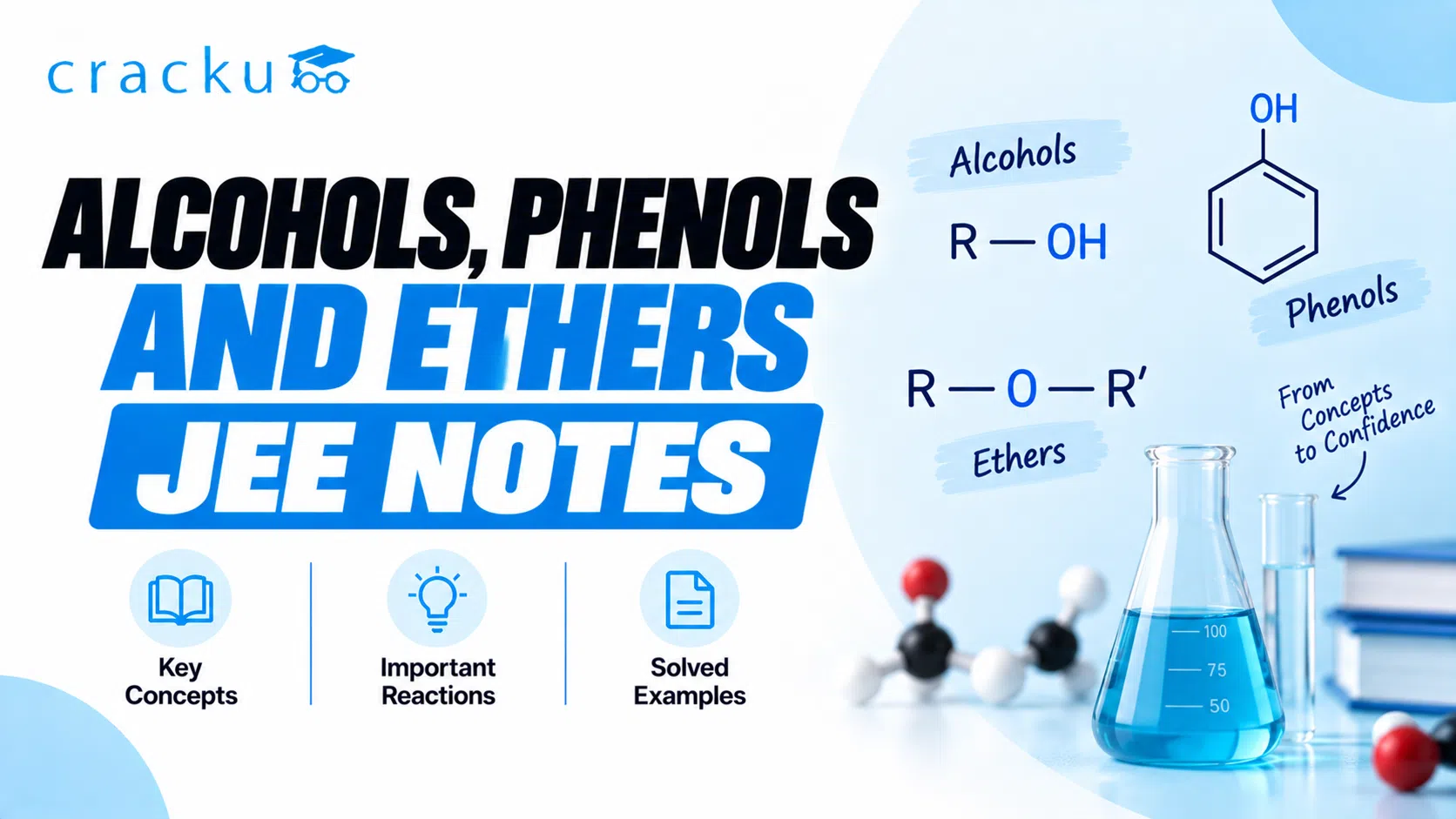
The chapter is broadly divided into three functional groups:
- Alcohols: $$\text{R–OH}$$ where –OH is attached to sp3 hybridised carbon
- Phenols: $$\text{Ar–OH}$$ where –OH is on an aromatic ring
- Ethers: $$\text{R–O–R'}$$ or $$\text{Ar–O–R}$$ having an alkoxy group
JEE asks questions on IUPAC naming (1–2 marks), boiling point comparisons, acidity/basicity order, Lucas test observations, Kolbe’s reaction, Williamson synthesis, and reaction mechanisms involving carbocation rearrangements. Understanding the electronic effects (inductive, resonance and hydrogen bonding) behind the properties saves you time on MCQs.
After revising, attempt 15 mixed problems from JEE Questions and tally timing with JEE pace. Refer to solved sets in JEE Mains Previous Papers to check framing style, then replicate the difficulty level through a timed JEE Mains Mock Test.
Core Topic Cluster 1: Preparations and Mechanisms
1.1 Preparation of Alcohols
- Hydration of alkenes: acid-catalysed, oxymercuration–demercuration, hydroboration-oxidation (anti-Markovnikov)
- From carbonyl compounds: reduction of aldehydes/ketones with $$\text{LiAlH}_4$$ or $$\text{NaBH}_4$$; Grignard reagent addition to $$\text{C=O}$$
- Via substitution: hydrolysis of alkyl halides (conc. $$\text{KOH}$$ aqueous)
- Fermentation of sugars (industrial)
1.2 Preparation of Phenols
- Cumene process (industrial): benzene → isopropylbenzene → cumene hydroperoxide → phenol + acetone
- From diazonium salts: $$\text{ArN}_2^+ \text{Cl}^- + \text{H}_2\text{O} \rightarrow \text{ArOH} + \text{N}_2 + \text{HCl}$$
- Hydrolysis of chlorobenzene under harsh conditions (Dow process) $$\text{NaOH (623 K, 300 atm)}$$
1.3 Preparation of Ethers
- Williamson Ether Synthesis: $$\text{R–X + R'O}^- \rightarrow \text{R–O–R'} + \text{X}^-$$ (SN2, best with primary halide)
- Dehydration of alcohols: symmetrical ethers from excess alcohol + conc. $$\text{H}_2\text{SO}_4$$ at 413 K
1.4 Key Mechanistic Points
- Carbocation rearrangement in dehydration of secondary/tertiary alcohols
- Anti-Markovnikov addition via hydroboration gives primary alcohols without rearrangement
- Phenoxide ion stability explains higher acidity of phenol compared to aliphatic alcohols
Core Topic Cluster 2: Physical & Chemical Properties
2.1 Physical Trends
- Boiling point order (for isomeric compounds): $$\text{Alcohol} \gt \text{Isomeric Phenol} \gt \text{Ether}$$ due to intermolecular hydrogen bonding
- Solubility of lower alcohols up to butanol in water; solubility decreases with alkyl chain length
2.2 Acidic Nature
| Compound | $$\text{p}K_a$$ (approx.) | Reason |
|---|---|---|
| Water | 15.7 | Reference |
| Primary Alcohol | 16-18 | Weak electron-releasing alkyl group destabilises $$\text{RO}^-$$ |
| Phenol | 10 | Resonance stabilisation of phenoxide ion |
| p-Nitrophenol | 7.1 | –NO2 withdraws electron density (–M, –I) |
2.3 Chemical Reactions of Alcohols
- With HX: $$\text{R–OH + HX} \rightarrow \text{R–X + H}_2\text{O}$$, order of reactivity $$3^\circ \gt 2^\circ \gt 1^\circ$$ (via $$\text{S}_\text{N}1$$ vs $$\text{S}_\text{N}2$$)
- Lucas test: differentiates $$1^\circ, 2^\circ, 3^\circ$$ alcohols using ZnCl2/HCl based on turbidity time
- Oxidation: $$1^\circ$$ → aldehyde → acid; $$2^\circ$$ → ketone; $$3^\circ$$ not oxidised without C–C cleavage
2.4 Reactions of Phenols
- Electrophilic substitution: ortho/para directing –OH activates ring (bromination gives 2,4,6-tribromophenol in water)
- Kolbe reaction: sodium phenoxide + $$\text{CO}_2$$ at 400 K → salicylic acid
- Reimer–Tiemann: phenol + chloroform/NaOH → salicylaldehyde
2.5 Reactions of Ethers
- C-O bond cleavage with hot conc. $$\text{HI}$$ or $$\text{HBr}$$ (ethers are otherwise inert)
- Acidic cleavage obeys: aryl–alkyl ether → phenol + alkyl halide (aryl C–O bond stronger)
- Peroxide formation on exposure to dry air – safety angle often asked
Important Formulas and Results at a Glance
| Concept/Result | Expression |
|---|---|
| Zaitsev rule for dehydration | Major alkene is the more substituted one |
| Victor Meyer test colour | $$1^\circ$$ → red, $$2^\circ$$ → blue, $$3^\circ$$ → colourless |
| Bordwell-Pitzer relation (acidity) | Lower $$\text{p}K_a$$ → stronger acid; phenol ≈ $$10$$ |
| Williamson ether feasibility | Use primary halide to avoid elimination |
| Number of constitutional isomers of alcohol with formula $$\text{C}_4\text{H}_{10}\text{O}$$ | 4 |
JEE Important Points, Common Mistakes and Quick Revision
Important Points
- In conversion questions, use protecting groups to avoid over-reaction, e.g., convert alcohol to tosylate before strong base.
- Check carbocation rearrangement possibility whenever an alcohol is protonated under warm acidic conditions.
- For electrophilic substitution on phenol, remember that dil. bromine water gives white ppt of 2,4,6-tribromophenol instantly.
- In Williamson synthesis, phenoxide reacts with ethyl bromide faster than ethyl chloride because $$\text{Br}^-$$ is a better leaving group.
Common Mistakes
- Writing anisole + HI → $$\text{CH}_3\text{I + CH}_3\text{OH}$$ (correct product is phenol + $$\text{CH}_3\text{I}$$)
- Forgetting that hydroboration-oxidation adds –OH to the less substituted carbon of the alkene.
- Confusing Kolbe reaction (carboxylation) with Reimer-Tiemann (formylation).
- Applying Lucas test results of room temperature blindly—temperature affects turbidity time.
Quick Revision
- Phenol acidity order: p-nitro > o-nitro > m-nitro > phenol > cyclohexanol
- $$\text{HI}$$ splits ethers; cleavage sequence: $$3^\circ \gt 2^\circ \gt 1^\circ$$ alkyl group ruptures first.
- Grignard + formaldehyde → $$1^\circ$$ alcohol; with any other aldehyde → $$2^\circ$$; with ketone → $$3^\circ$$.
- B.P. comparison: butan-1-ol (117 °C) > sec-butanol > tert-butanol (82 °C) due to branching lowering surface area.
Alcohols, Phenols and Ethers JEE Notes: Conclusion
Alcohols, phenols and ethers are an important part of JEE Organic Chemistry, with questions commonly testing preparation methods, reaction mechanisms, acidity, physical properties and named reactions. Understanding the effects of resonance, hydrogen bonding, steric hindrance and carbocation stability will make reaction-based questions easier to solve.
During revision, focus on the Lucas test, oxidation of alcohols, Williamson ether synthesis, Kolbe reaction, Reimer-Tiemann reaction and ether cleavage. Practise previous-year questions and multi-step conversions regularly to recognise reaction patterns, avoid errors involving rearrangements and improve speed and accuracy in the JEE examination.