
 Group
Group
 Group
Group
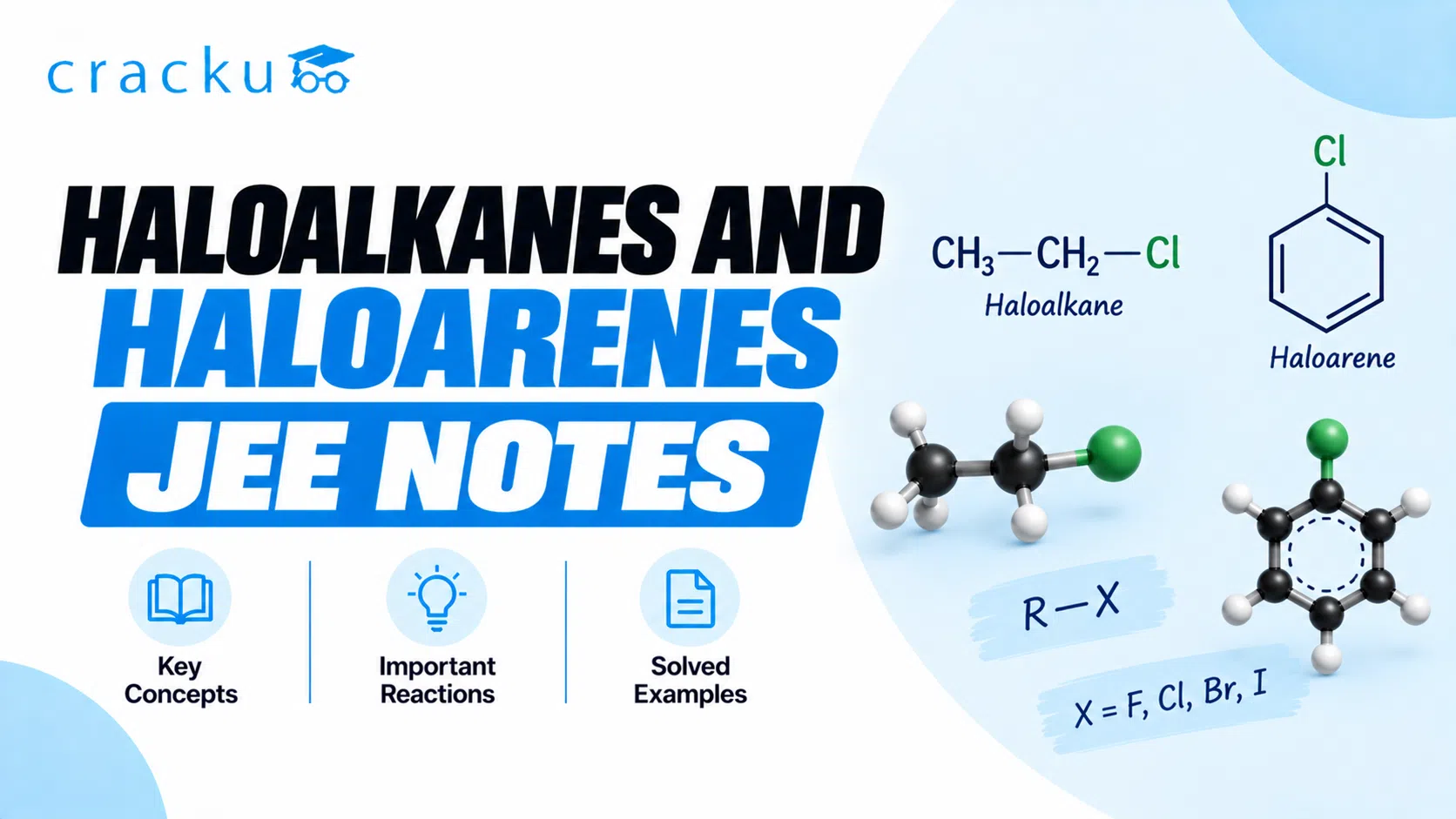
Haloalkanes and haloarenes dominate the JEE questions on organic reaction mechanisms, trends in physical properties and synthetic applications. This compiles all core reactions, mechanistic insights, common pitfalls and last-minute facts in one place so you can revise the entire chapter quickly and accurately.
Below is a crisp overview of what haloalkanes and haloarenes are, why they matter for JEE and what the article covers. These JEE Chemistry Notes walk you through preparation methods, key mechanisms such as $$\text{S}_\text{N}1$$ and $$\text{S}_\text{N}2$$, essential formulae, quick-fire revision points and FAQs driven by previous paper trends.
Haloalkanes and Haloarenes JEE Notes
Definition: Compounds in which one or more hydrogen atoms of alkanes or arenes are replaced by halogens (F, Cl, Br, I).
Nomenclature: Follow IUPAC rules, locant + prefix (fluoro, chloro, bromo, iodo) + parent chain/aryl system.
Classification: Primary, secondary, tertiary (based on the carbon bearing X); mono-, di-, poly-halogenated; allylic, benzylic, vinylic, aryl.
Physical Trends: Density and boiling point rise with atomic mass and number of halogens; solubility in water is low but increases with polar halogens.
| Carbon–Halogen Bond Energy (kJ mol-1) | C–F | C–Cl | C–Br | C–I |
|---|---|---|---|---|
| Haloalkane | 485 | 340 | 280 | 240 |
| Trend | Bond strength decreases down the group ⇒ reactivity increases from R–F to R–I | |||
Preparation of Haloalkanes & Haloarenes
From Alcohols
- $$\text{R–OH} + \text{HX} \xrightarrow[\text{reflux}]{\text{anhyd. ZnCl}_2} \text{R–X} + \text{H}_2\text{O}$$ (Lucas test differentiates 1°, 2°, 3° alcohols).
- Phosphorus halides: $$\text{3 R–OH} + \text{PCl}_3 \rightarrow \text{3 R–Cl} + \text{H}_3\text{PO}_3$$.
- Thionyl chloride (SOCl2): $$\text{R–OH} + \text{SOCl}_2 \rightarrow \text{R–Cl} + \text{SO}_2\uparrow + \text{HCl}\uparrow$$ (gaseous by-products make purification easy, favourite of JEE setters).
Halogenation of Alkanes (Free Radical)
Example: $$\text{CH}_4 + \text{Cl}_2 \xrightarrow{h\nu} \text{CH}_3\text{Cl} + \text{HCl}$$.
Key points: chain initiation, propagation, termination; order of reactivity $$\text{F}_2 \gt \text{Cl}_2 \gt \text{Br}_2 \gg \text{I}_2$$.
Electrophilic Substitution of Arenes
Chlorination/Bromination of benzene: $$\text{C}_6\text{H}_6 + \text{Cl}_2 \xrightarrow{\text{FeCl}_3} \text{C}_6\text{H}_5\text{Cl} + \text{HCl}$$.
Deactivating halogen directs ortho/para due to –I and +M effects; o:p ratio ≈ 1:1 under controlled conditions.
From Diazonium Salts (Sandmeyer & Gattermann)
- Sandmeyer: $$\text{Ar–N}_2^+ \text{Cl}^- + \text{CuCl} \rightarrow \text{Ar–Cl} + \text{N}_2\uparrow$$.
- Gattermann: $$\text{Ar–N}_2^+ \text{Cl}^- + \text{Cu} + \text{HCl} \rightarrow \text{Ar–Cl} + \text{N}_2\uparrow$$.
Halide Exchange Reactions
Finkelstein: $$\text{R–Cl/Br} + \text{NaI} \xrightarrow{\text{acetone}} \text{R–I} + \text{NaCl/Br}$$ (precipitation drives equilibrium).
Swarts: $$\text{R–Cl} + \text{AgF} \rightarrow \text{R–F} + \text{AgCl}$$.
Reactions and Mechanisms
Substitution Nucleophilic Bimolecular ($$\text{S}_\text{N}2$$)
- One-step back-side attack, inversion of configuration (Walden inversion).
- Rate $$k[\text{R–X}][\text{Nu}^-]$$; order: methyl > 1° > 2°; 3° almost impossible.
- Polar aprotic solvents (DMSO, DMF) favour $$\text{S}_\text{N}2$$.
Substitution Nucleophilic Unimolecular ($$\text{S}_\text{N}1$$)
- Two-step via carbocation; racemisation with slight retention.
- Rate $$k[\text{R–X}]$$; order: 3° > 2° > 1°.
- Polar protic solvents (H2O, ROH) stabilise carbocation.
Elimination Reactions (E1 & E2)
Compete with substitution; Zaitsev (Saytzeff) product major unless bulky base ⇒ Hoffman product.
Special Mechanisms in Haloarenes
- $$\text{S}_\text{N}Ar$$ (addition–elimination): Requires –NO2 at ortho/para.
- Benzyne mechanism: Strong base, high temperature; leads to cine substitution.
Organometallic Formation
Grignard reagent: $$\text{R–Br} + \text{Mg} \xrightarrow{\text{dry ether}} \text{R–MgBr}$$ - highly reactive nucleophile for C–C bond formation.
Worked Example
Predict the major product of $$\text{(CH}_3)_3\text{C–Br} + \text{aq. KOH}$$ at 25 °C.
Because the substrate is 3°, a polar protic solvent and moderate temperature favour $$\text{S}_\text{N}1$$. Carbocation forms, leading to $$\text{(CH}_3)_3\text{C–OH}$$ with slight rearrangement unlikely (already stable). Hence tert-butyl alcohol is the product.
Important Formulas and Results at a Glance
| Concept | Key Result / Formula |
|---|---|
| Relative rate of free-radical halogenation (alkane) | 3° H : 2° H : 1° H = 5 : 3.8 : 1 (chlorination); 160 : 82 : 1 (bromination) |
| IUPAC Priority for Naming | Multiple halogens numbered to give lowest set; alphabetical order in prefix |
| Reactivity toward $$\text{S}_\text{N}2$$ | $$\text{RI} \gt \text{RBr} \gt \text{RCl} \gt \text{RF}$$ |
| Bond Length Order | $$C–I > C–Br > C–Cl > C–F$$ |
| Optical Activity Lost | $$\text{S}_\text{N}1$$ gives racemic mixture due to planar carbocation |
| Wurtz Reaction | $$2\text{R–Cl} + \text{2 Na} \xrightarrow{\text{dry ether}} \text{R–R} + 2\text{NaCl}$$; limited to symmetric alkanes |
JEE Important Points, Common Mistakes and Quick Revision
High-Yield Facts
- $$\text{S}_\text{N}2$$ always inverts configuration; if starting centre is $$R$$, product becomes $$S$$.
- Benzylic/allylic halides undergo both substitution and elimination faster due to resonance-stabilised carbocations.
- Vinyl and aryl halides do NOT undergo $$\text{S}_\text{N}1$$/$$\text{S}_\text{N}2$$ due to partial double-bond character (sp2 C).
- Boiling point order among isomeric haloalkanes: straight chain > branched (greater surface area).
- Ctrl+F in your memory: chloroform + O2 + light ⇒ phosgene (toxic); hence stored with ethanol.
Common Mistakes
- Ignoring solvent effect while deciding $$\text{S}_\text{N}1$$ vs $$\text{S}_\text{N}2$$.
- Forgetting rearrangements in $$\text{S}_\text{N}1$$ - especially hydride & methyl shifts.
- Using Wurtz for unsymmetrical coupling - gives mixture, rarely asked as direct route.
- Assuming ortho/para ratio is always 2:1 for halogenation of arenes; it depends on temperature and catalyst.
Quick Revision Flow
- List preparation reactions; write reagents and conditions on one flashcard.
- On another, jot rate orders and stereochemistry outcomes.
- Solve 10 mixed problems from JEE Questions focusing on mechanism identification.
- Glance at halogen derivative section in your JEE Formula Sheets for bond energies and trends.
- Finally, attempt a previous-year problem set to cement timing.
Haloalkanes and Haloarenes JEE Notes: Conclusion
Haloalkanes and haloarenes form an important part of JEE Organic Chemistry, combining reaction mechanisms, stereochemistry, physical-property trends and synthetic applications. Students should thoroughly understand their preparation methods, substitution and elimination reactions, solvent effects, reactivity orders and the special behaviour of vinyl and aryl halides.
During revision, focus on identifying the reaction mechanism from the substrate, reagent, solvent and temperature. Regularly practise product-prediction and mechanism-based questions from previous JEE papers to recognise common patterns, avoid errors involving rearrangements and stereochemistry, and improve accuracy in the examination.
.webp)