
 Group
Group
 Group
Group
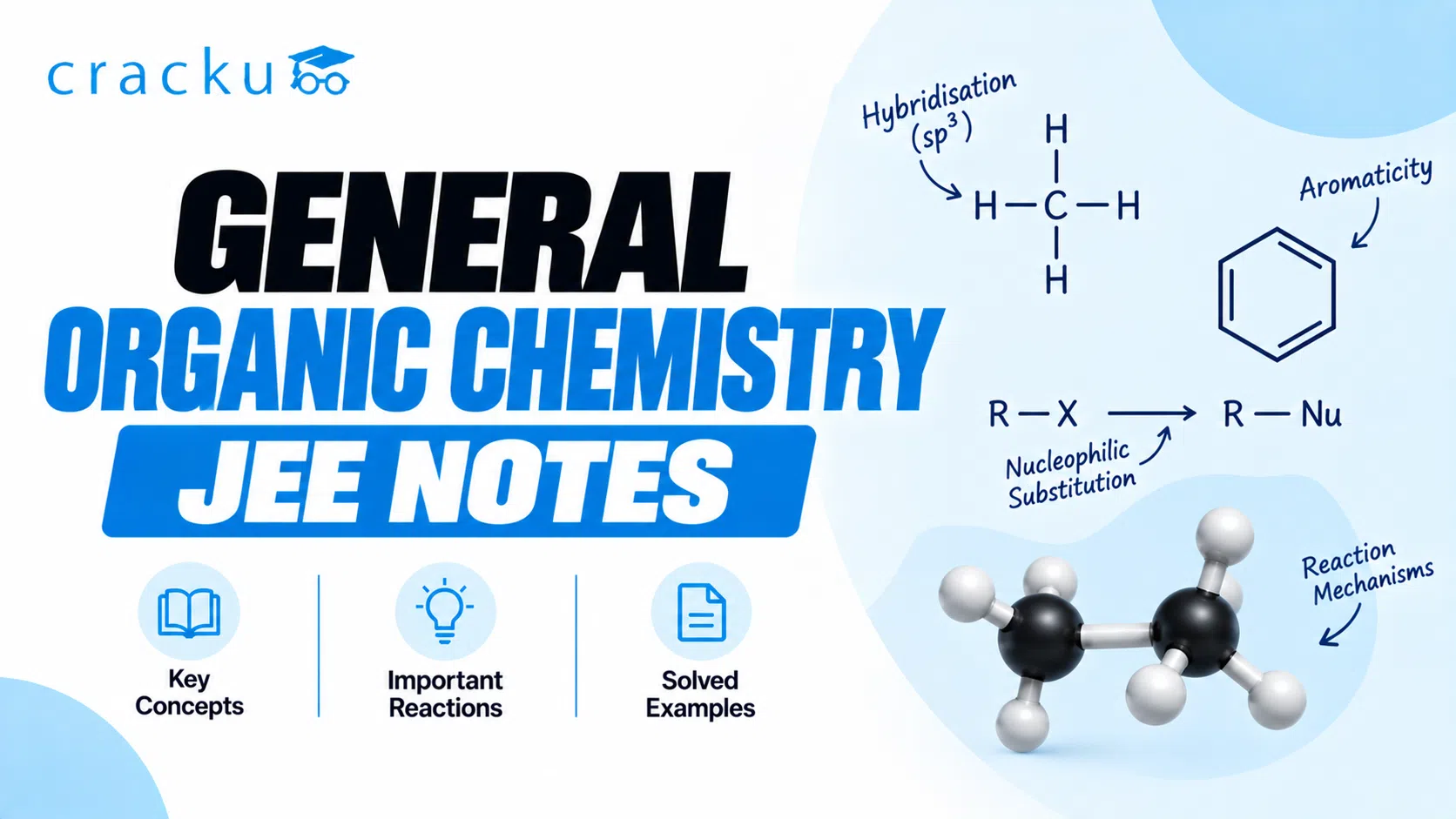
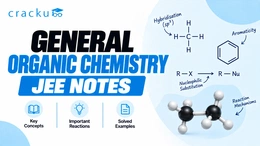
General Organic Chemistry (GOC) sets the language for the entire organic syllabus in JEE. Mastering electronic effects, reactive intermediates and acid–base behaviour here makes reaction mechanisms in later chapters effortless.
General Organic Chemistry JEE Notes
GOC carries 2-3 direct questions almost every year, and its concepts silently decide answers in Alkyl Halides, Alcohols and even Biomolecules. The chapter splits broadly into:
- Electronic effects: inductive, electromeric, resonance, hyperconjugation
- Reactive intermediates: carbocations, carbanions, free radicals, carbenes, nitrenes
- Acidity–basicity of organic compounds
- Nucleophiles, electrophiles and reaction mechanism terminology
Weightage pattern from the last five JEE Main papers shows one easy theory question (4 marks) and one moderate application question (4 marks). JEE Advanced typically hides a multi-concept MCQ or integer type based on stability orders.
Electronic Effects, Intermediates & Stability
Inductive (−I, +I)
Permanent shift of σ-electrons along the chain. Strength falls sharply with distance.
- −I groups: $$\text{NO}_{2}\gt\text{CN}\gt\text{F}\gt\text{Cl}\gt\text{Br}\gt\text{I}\gt\text{OH}$$
- +I groups: $$\text{(CH}_{3})_{3}\text{C}\gt\text{(CH}_{3})_{2}\text{CH}\gt\text{CH}_{3}\gt\text{H}$$
Resonance (Mesomeric)
Delocalisation of π or lone-pair electrons through overlap. Remember the rules: same skeleton, valid Lewis structures, conserve spin. Resonance increases stability, lowers potential energy but never breaks the σ framework.
Hyperconjugation
No bond resonance involving α-C–H σ electrons with an adjacent vacant p, π or radical centre. Number of hyperconjugative structures equals the count of α-hydrogens.
Stability order derived from hyperconjugation: $$3^{\circ}\;{\rm carbocation}\gt2^{\circ}\gt1^{\circ}\gt{\rm methyl}$$
Electromeric (Temporary) Effect
Complete transfer of π electrons under an attacking reagent. Two types: +E (towards reagent) and −E (away from reagent). Operates only at the moment of attack, unlike inductive.
Reactive Intermediates Summary
| Intermediate | Geometry | Stabilised by | Order of Stability |
|---|---|---|---|
| Carbocation | Trigonal planar, sp2 | +R, +I, hyperconjugation | $$3^{\circ}\gt2^{\circ}\gt1^{\circ}\gt\text{benzylic}\gt\text{allylic}$$ |
| Carbanion | Trigonal pyramidal, sp3 | −I, −R | $$\text{methyl}\gt1^{\circ}\gt2^{\circ}\gt3^{\circ}$$ (reverse of cations) |
| Free Radical | Planar/sp2 with slight pyramidal tendency | Hyperconjugation, +R | Same as carbocation |
Worked Example: Predicting Major Carbocation
Problem: Arrange $$\text{CH}_{3}CH_{2}^{+},\; (CH_{3})_{2}CH^{+},\; (CH_{3})_{3}C^{+}$$ in decreasing stability.
Solution: Count hyperconjugative hydrogens: 2, 6 and 9 respectively. More hyperconjugation = higher stability. So order is $$ (CH_{3})_{3}C^{+} \gt (CH_{3})_{2}CH^{+} \gt CH_{3}CH_{2}^{+}$$.
This directly decides the major product in rearrangement or addition reactions.
Acid–Base Strength, Mechanisms & Stereochemistry Basics
Organic Acids and Bases
- Acidity of carboxylic acids: Enhanced by −I/−R groups, decreased by +I groups.
- Phenols vs alcohols: Phenoxide ion resonance stabilisation makes phenols $$10^{5}$$ times more acidic.
- Basicity of amines in gas phase: $$3^{\circ}\gt2^{\circ}\gt1^{\circ}\gt \text{NH}_{3}$$ due to +I effect.
- In water: $$2^{\circ}\gt1^{\circ}\gt3^{\circ}$$ because steric hindrance hampers solvation of $$3^{\circ}$$ amine.
Nucleophiles and Electrophiles
Nucleophiles are electron-rich; electrophiles are electron-deficient. Strength depends on charge, electronegativity, solvent and steric bulk. For example, $$\text{OH}^{-}$$ is a stronger base but $$\text{I}^{-}$$ is a better nucleophile in protic solvents because of polarizability.
Reaction Mechanism Terms
- Homolysis vs Heterolysis: Even vs uneven bond breaking.
- Substitution, Addition, Elimination: Learn notation $$\text{S}_{\text{N}}1$$, $$\text{S}_{\text{N}}2$$, E1, E2.
- Rate deciding step: Slowest elementary step; transition state cannot be isolated.
Basic Stereochemistry Touchpoints in GOC
Configuration (R/S), conformation (eclipsed, staggered) and chirality are formally taught later, but JEE often club them with GOC. Remember: molecules with no chiral centre can still be optically active (allenes, biphenyls).
Worked Example: Predicting Acidity Order
Problem: Arrange $$\text{CH}_{3}COOH, ClCH_{2}COOH, Cl_{3}C COOH$$ in increasing $$K_{a}$$.
Solution: More –I groups withdraw electron density, stabilising $$\text{COO}^{-}$$.
- $$\text{CH}_{3}COOH$$ : no –I
- $$ClCH_{2}COOH$$ : one $$−I$$
- $$Cl_{3}CCOOH$$ : three $$−I$$ (strongest)
Hence $$\text{CH}_{3}COOH \lt ClCH_{2}COOH \lt Cl_{3}CCOOH$$.
Important Formulas and Results at a Glance
| Concept | Formula / Key Result |
|---|---|
| Number of hyperconjugative structures | No. of α-H atoms |
| pKa and acidity | Lower pKa ⇒ higher acidity; $$pK_{a} = -\log K_{a}$$ |
| Hammond Postulate | Transition state resembles the nearest energetic species |
| Arrhenius relationship | $$k = A e^{-E_{a}/RT}$$ (activation energy concept for mechanism) |
| Rate law $$\text{S}_{\text{N}}1$$ | Rate $$\propto [\text{RX}]$$ only (unimolecular) |
| Rate law $$\text{S}_{\text{N}}2$$ | Rate $$\propto [\text{RX}][\text{Nu}^{-}]$$ (bimolecular) |
JEE Important Points, Common Mistakes and Quick Revision
High-yield Points
- Benzylic and allylic positions stabilise all three intermediates via resonance, always check for rearrangements.
- Carbanions prefer sp>sp2> sp3 (more s-character, more electronegativity).
- In $$\text{S}_{\text{N}}1$$, polar protic solvents accelerate, while in $$\text{S}_{\text{N}}2$$ they slow down reaction.
- Acidic strength of phenols increases when ortho/para positions have −R or −I substituents.
Common Student Errors
- Confusing inductive (σ, permanent) with resonance (π, delocalised).
- Assuming more alkyl groups always increase basicity; forgets solvation effect in aqueous medium.
- Ignoring hyperconjugation count for substituted alkenes, leading to wrong stability order.
- Forgetting that mesomeric effect is distance-independent within the conjugated system.
60-Second Recap Checklist
- Write −I and +I order once.
- Recall stability order of all intermediates.
- Remember acidity/basicity trends with solvent.
- Note the rate laws for $$\text{S}_{\text{N}}1$$ and $$\text{S}_{\text{N}}2$$.
- Scan one page of JEE Formula Sheets for GOC before mock tests.
After revising, solve 10 mixed JEE Questions from past papers to cement the concepts.
General Organic Chemistry JEE Notes: Conclusion
General Organic Chemistry is the foundation of the entire organic chemistry syllabus for JEE Main and Advanced. Topics such as electronic effects, resonance, acidity and basicity, reaction intermediates, isomerism and reaction mechanisms frequently appear in direct questions and are also applied across other organic chemistry chapters.
Focus on understanding why a reaction occurs instead of relying only on memorisation. Revise the important orders and trends regularly, practise mechanism-based questions and solve previous years’ JEE papers to identify recurring concepts. Consistent revision and mixed-question practice will help you approach unfamiliar organic chemistry problems with greater speed, accuracy and confidence.