JEE WhatsApp Group



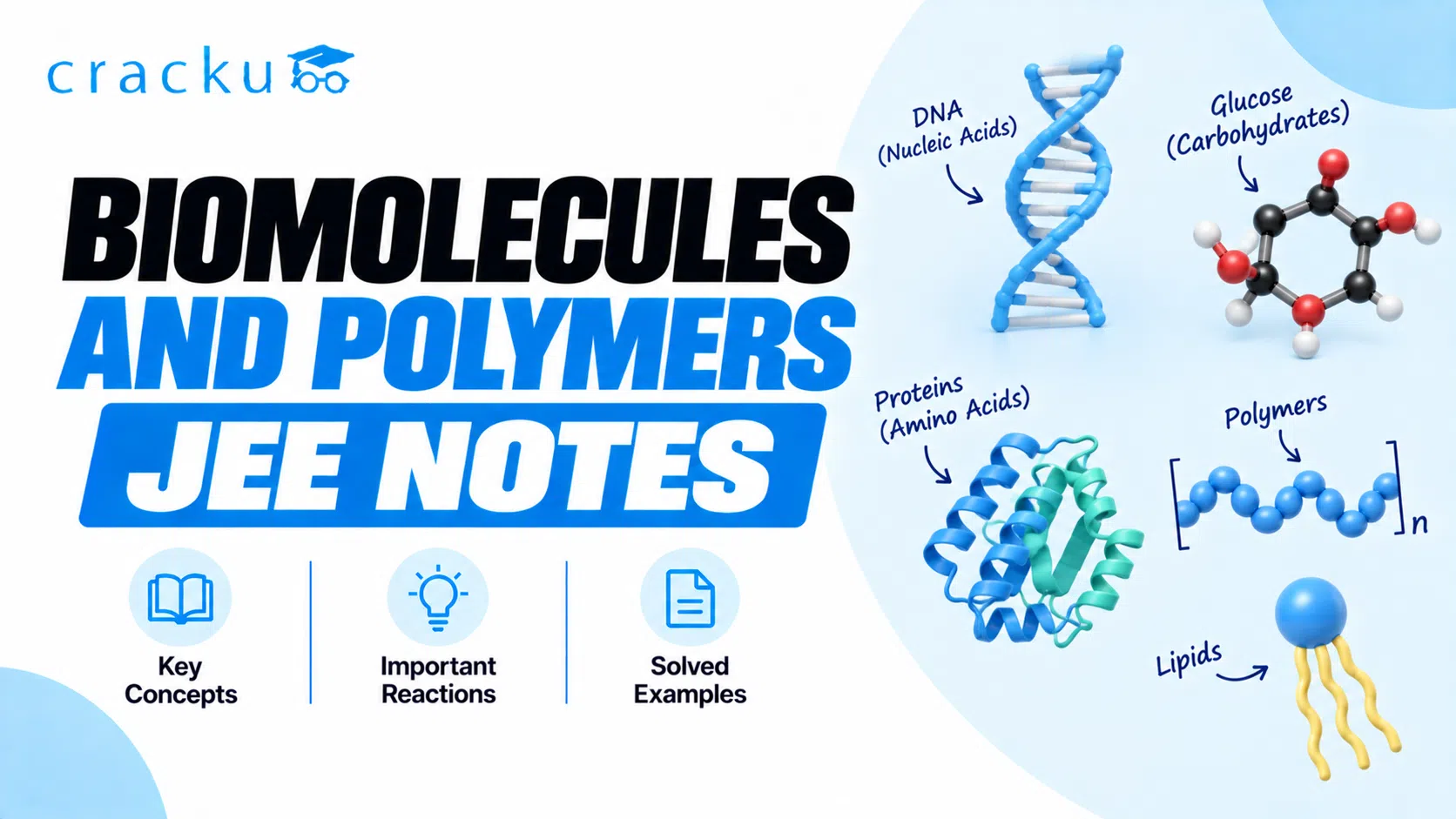
Biomolecules and polymers connect chemistry with living systems and everyday materials. Biomolecules include carbohydrates, proteins, vitamins and nucleic acids, while polymers include substances such as plastics, fibres and rubber. Understanding their structures, properties and uses helps you link familiar examples with key chemical concepts.
These Biomolecules and Polymers JEE Notes cover carbohydrate classification, reducing sugars, peptide bonds, protein structures, vitamins and the differences between DNA and RNA. They also explain polymer classification, polymerisation methods, common monomers and important commercial polymers. Use the notes, comparison tables and revision points to strengthen your understanding and practise relevant questions.
Biomolecules and Polymers JEE Notes
Although JEE designates biomolecules and polymers as two separate units, their common thread is the presence of functional groups such as amines, amides, hydroxyls, and esters. Questions typically fall into four buckets:
- Name, structure, or configuration of a biomolecule (glucose, fructose, amino acids).
- Mechanistic or conceptual questions on polymerisation-types, initiators, degree of polymerisation.
- Reactivity or tests of functional groups, especially amine-based reactions like diazotisation.
- Numerical or matching-type on average molecular weight, monomer identification or defect calculation.
Across recent JEE Mains Previous Papers, the combined chapter carries 1–2 questions (4–8 marks) in JEE Main and often a single but conceptually deep question in Advanced.
Core Topic Cluster 1: Biomolecules (Carbohydrates, Proteins, Vitamins, Nucleic Acids)
Carbohydrates
- Definition: Optically active polyhydroxy aldehydes or ketones.
- Classification: Monosaccharides (glucose), disaccharides (sucrose), polysaccharides (starch, cellulose).
- Key reactions: Osazone formation, bromine water oxidation, mutarotation, Killiani–Fischer synthesis.
- Configuration: D/L based on the chiral carbon farthest from carbonyl.
- Important conversions: Glucose ⇌ Fructose (enediol rearrangement in basic medium).
Amino acids & Proteins
- α-Amino acids: Contain –NH2 and –COOH on the same carbon; exist as zwitterions at isoelectric point ($$pI$$).
- Classification: Essential vs non-essential, acidic/basic/neutral depending on extra –COOH or –NH2.
- Peptide bond: $$ –CO–NH– $$ linkage formed by condensation; dipeptide, tripeptide, polypeptide definitions.
- Protein structure: Primary (sequence), secondary (α-helix, β-sheet), tertiary (folding), quaternary (sub-units).
- Denaturation: Loss of higher-order structure by heat, pH change; reversibility is limited.
Vitamins
Organic compounds required in trace amounts. Fat-soluble (A, D, E, K) and water-soluble (B-complex, C). Deficiency diseases are popular one-liners.
Nucleic Acids
- Nucleotide = Base + Sugar + Phosphate.
- DNA: Deoxyribose sugar, A-T & G-C base pairing; double helix.
- RNA: Ribose sugar; single-stranded; roles in protein synthesis.
Worked Example
Question: Glucose does not react with Schiff’s reagent although it contains an aldehyde group. Explain.
Solution: In aqueous solution glucose exists mainly in cyclic hemi-acetal (pyranose) form, so the free –CHO is unavailable. Therefore it fails the aldehyde test but still reduces Tollens’ reagent after opening of the ring under basic conditions.
Core Topic Cluster 2: Polymers (Types, Mechanisms, Properties)
Classification
| Basis | Categories | Examples |
|---|---|---|
| Origin | Natural, Semi-synthetic, Synthetic | Cellulose, Rayon, PVC |
| Mode of formation | Addition, Condensation | Polyethylene, Nylon-6,6 |
| Structure | Linear, Branched, Cross-linked | HDPE, Low-density PE, Bakelite |
| Tacticity | Isotactic, Syndiotactic, Atactic | Isotactic PP, Syndiotactic PS |
Polymerisation mechanisms
- Free-radical addition: Initiation (peroxides), propagation, termination. Example: $$nCH_2=CH_2 \rightarrow –[CH_2–CH_2]_n–$$
- Anionic & Cationic addition: Works for electron-deficient/excess monomers, respectively (e.g., PVC via cationic route).
- Condensation polymerisation: Step-growth; elimination of small molecules (water, HCl). Example: Nylon-6,6 from adipic acid and hexamethylene diamine.
Important commercial polymers
- Thermoplastics: PVC, Teflon (PTFE), Polypropene.
- Thermosetting: Bakelite, Melamine-formaldehyde resin.
- Elastomers: Natural rubber (cis-1,4-polyisoprene), Buna-S, Buna-N.
- Fibre polymers: Nylon-6,6, Dacron (PET).
Molecular weight averages
Number-average $$\overline{M}_n$$ and weight-average $$\overline{M}_w$$ are calculated as:
$$\overline{M}_n = \dfrac{\sum N_i M_i}{\sum N_i}, \qquad \overline{M}_w = \dfrac{\sum N_i M_i^2}{\sum N_i M_i}$$
The ratio $$\overline{M}_w/\overline{M}_n$$ is the polydispersity index (PDI); for perfect monodisperse polymer PDI = 1.
Worked Example
Question: Identify the repeating unit and classify the given polymer: $$ –NH–(CH_2)_6–NH–CO–(CH_2)_4–CO– $$
Solution: Repeating unit corresponds to Nylon-6,6, formed by condensation of hexamethylene diamine and adipic acid; it is a linear, synthetic, fibre-forming, condensation polymer.
Important Formulas and Results at a Glance
| Concept | Expression/Key Point |
|---|---|
| Specific rotation | $$[\alpha] = \dfrac{\alpha_{\text{obs}}}{l c}$$ where $$l$$ in dm, $$c$$ in g mL−1 |
| Mutarotation of glucose | $$\alpha$$ changes from +112° (α-form) to an equilibrium value of +52.5° |
| Degree of polymerisation (DP) | $$DP = \dfrac{M_{\text{polymer}}}{M_{\text{repeat unit}}}$$ |
| Carothers equation | $$p = 1 - \dfrac{1}{DP}$$ where $$p$$ is extent of reaction |
| Diazotisation of primary aromatic amine | $$ArNH_2 + NaNO_2 + 2HCl \rightarrow ArN_2^+Cl^- + 2H_2O + NaCl$$ (0–5 °C) |
JEE Important Points, Common Mistakes and Quick Revision
Important Points
- Carbohydrate reactions: Kiliani–Fischer synthesis increases the carbon chain length of aldoses, while Ruff degradation shortens it by one carbon.
- Reducing and non-reducing sugars: Lactose is a reducing sugar, whereas sucrose is non-reducing. Understand how the glycosidic linkage affects this property.
- Peptide naming: Read and name peptide chains from the N-terminus, which has a free amino group, to the C-terminus, which has a free carboxyl group.
- Polymer properties: Thermoplastics, such as PVC, soften on heating and can be reshaped. Thermosetting polymers, such as Bakelite, cannot be remoulded after setting.
Common Mistakes to Avoid
- Confusing polymer categories: Distinguish between addition and condensation polymers, and between thermoplastics and thermosetting polymers.
- Using inconsistent units: When calculating the degree of polymerisation, express the molar masses of the polymer and its repeating unit in the same units.
- Writing incomplete mechanisms: Include initiation, propagation and termination when explaining free-radical polymerisation.
- Overgeneralising chemical tests: Fehling’s test is not positive for every aldehyde. Learn the scope and exceptions of each identification test.
- Assuming fixed chapter weightage: Question counts vary across papers. Prioritise conceptual understanding and practice rather than expecting a guaranteed number of marks.
Quick Revision
- Use comparison tables to revise carbohydrates, protein structures and DNA versus RNA.
- Create a chart linking common polymers with their monomers, polymerisation methods and uses.
- Make flashcards for vitamins, their solubility and associated deficiency diseases.
- Revise key identification tests, including Molisch’s test for carbohydrates and the ninhydrin test for amino acids.
- Practise five previous-year questions daily and review every incorrect answer. Use JEE Questions for additional practice.
Biomolecules and Polymers JEE Notes: Conclusion
Biomolecules and polymers become easier to revise when you connect structures with their properties and functions. Focus on carbohydrates, proteins, vitamins and nucleic acids, along with polymer classification, common monomers and polymerisation methods. Use these Biomolecules and Polymers JEE Notes to organise important concepts and clear up common points of confusion.
Revisit comparison tables, practise relevant previous-year questions and review your mistakes regularly. Consistent revision will help you recall key facts and apply them confidently in exam questions.