
 Group
Group
 Group
Group
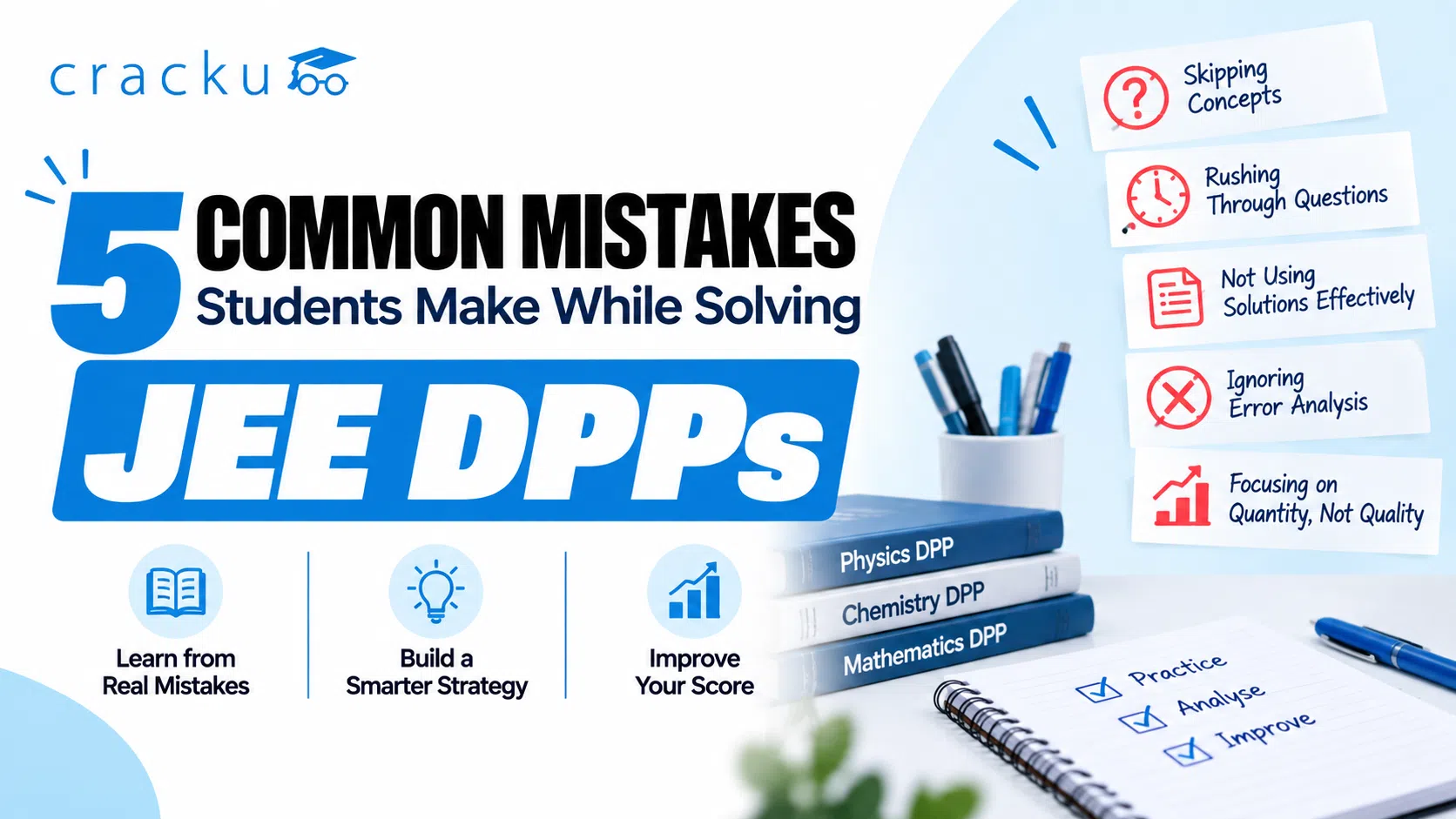
5 Common Mistakes Students Make While Solving JEE DPPs
Regular DPP practice becomes ineffective when students focus only on finishing the set. A completed DPP is not the finish line, it might still hide your weak concepts, rushed calculations, guessed answers, or inefficient methods. These problems may continue as students move to the next set without examining their solving process.
The most common JEE DPP mistakes involve concept readiness, speed, solution use, error analysis, and question volume. Correcting these habits helps students use each DPP as feedback. The goal is not only to get answers right. The attempt must show what needs revision, better method selection, or another independent attempt.
Solving JEE DPPs Without Understanding the Concepts
JEE DPPs work best when students first understand the basic concept behind the questions. Perfect mastery is not required before practice. But repeated inability to identify a starting approach typically points to a concept or application gap.
A student may remember a formula but still struggle to decide when to use it. Also, random formula substitution does not build reliable problem-solving ability. After studying a topic, JEE DPP practice helps test whether the concept can be applied independently.
One difficult question does not prove weak fundamentals. Repeated trouble with standard applications is a stronger sign. In that case, revise the weak concept first, then return to related questions.
Practice Situation | What It Indicates | Correct Action |
Cannot identify the concept | Concept gap | Revise the topic |
Knows theory but cannot start | Application gap | Solve basic applications |
Repeats the same error | Weak understanding | Revise and reattempt |
Focusing on Speed Instead of Accuracy While Solving DPPs
Speed helps only when the solving method remains reliable. Rushing can create reading errors, calculation mistakes, poor method selection, and unnecessary guessing. Students should first understand why a question takes too long.
A slow attempt may come from weak concept recognition or an inefficient method. Another question may simply need lengthy calculations. Students should diagnose the cause before trying to increase JEE DPP speed.
Also, timed practice must reveal inefficient solving, not create pressure to race. Build JEE DPP accuracy through clear reasoning first. Then work on faster concept recognition, cleaner calculations, and better method selection.
DPP Pattern | Identify the Problem | Next Practice Priority |
Fast with frequent errors | Rushing | Improve accuracy |
Correct but consistently slow | Inefficient method | Compare approaches |
Correct through guessing | Weak reasoning | Reattempt independently |
Slow start on most questions | Weak concept recognition | Revise application |
Checking JEE DPP Solutions Too Quickly
Students should make a genuine independent attempt before opening JEE DPP solutions. A displayed method can look obvious after someone else has shown the key step. That feeling does not prove independent understanding.
Reading a solution mainly tests recognition. While solving the question without help tests recall, concept application, and method selection. Students should use solutions as feedback rather than as the starting point.
A useful sequence is as follows:
- Step 1: Attempt
- Step 2: Identify where you are stuck
- Step 3: Review the solution
- Step 4: Close it
- Step 5: Reattempt independently
Do not open the solution just because the first approach fails. Next, only compare methods when a correct answer requires excessive work. Lastly, reattempt difficult questions without keeping the solution visible.
Also Read: Are JEE DPPs Enough for JEE Mains 2027? Check Now
Not Analysing Mistakes After Solving a JEE DPP
Checking only the final score gives limited information. A wrong answer shows what happened, but JEE DPP mistake analysis explains why it happened. Two incorrect answers may require completely different corrections.
Students should classify important errors by cause. Cracku’s detailed JEE DPP analysis process can help separate wrong, guessed, slow, and unattempted questions. Repeated concept errors need targeted revision rather than extra question volume.
Mistake Type | How to Identify It | Corrective Action |
Concept error | Principle was unclear | Revise the concept |
Formula error | Formula use was wrong | Review formula conditions |
Calculation error | Method was right, calculation failed | Check written steps |
Reading error | A condition was missed | Re-read key requirements |
Inefficient method | Answer was correct but slow | Compare valid approaches |
Guessing | Reasoning was incomplete | Reattempt independently |
Also Read: How to Analyse Your JEE DPP After Solving It? Check Now
Focusing on the Number of Questions Instead of Quality Practice
Question count feels useful because students can measure it easily. But a large total does not show whether the student understood the method. It also hides guessing, repeated errors, skipped difficult questions, and premature solution use.
Students should monitor whether repeated mistakes reduce over time. They should also check whether weak concepts become easier to apply independently. Question volume matters, but it should follow useful solving and correction.
Practice Pattern | What It Measures | Better Progress Indicator |
Questions completed | Volume | Reliable independent solving |
Correct answers | Result | Correct reasoning |
More DPPs completed | Consistency | Fewer repeated errors |
Difficult questions revisited | Correction | Successful reattempts |
Also Read: Are JEE DPPs Enough for JEE Mains 2027? Check Now
How to Avoid These Common JEE DPP Mistakes
A better JEE DPP practice strategy uses a simple feedback cycle. Students should learn, attempt, check, analyse, revise, and reattempt. They can then track repeated errors before increasing pace, difficulty, or question volume.
The purpose of a JEE DPP is not only to finish a question set. A useful attempt should show which concepts are reliable, which methods need improvement, and which errors keep returning. That information should decide what the student practises or revises next.
Stage | What the Student Should Do | What to Avoid |
Learn | Understand the concept and basic application | Starting blindly |
Attempt | Solve independently | Opening solutions early |
Check | Verify answer and method | Checking only the score |
Analyse | Identify the actual error cause | Calling every error conceptual |
Revise | Correct the identified weakness | Revising unrelated material |
Reattempt | Solve again independently | Memorising the solution |
Track | Watch repeated error patterns | Counting only questions |
Progress | Increase pace or difficulty gradually | Rushing progression |
5 Common Mistakes Students Make While Solving JEE DPPs: Conclusion
Avoiding common JEE DPP mistakes begins with changing how you approach daily practice. Understand the basic concepts, solve questions independently, and prioritise accuracy before increasing speed. Use JEE DPP solutions to review your reasoning and learn better methods after a genuine attempt. These habits help you identify weaknesses that a completed question set or final score may hide.
Make JEE DPP mistake analysis a regular part of your preparation. Review incorrect, guessed, slow, and unattempted questions, then revise the specific concepts or methods that need attention. Reattempt difficult questions without help and track whether the same errors return. A consistent cycle of practice, analysis, revision, and reattempts makes each DPP more useful for JEE preparation.
.webp)