JEE WhatsApp Group



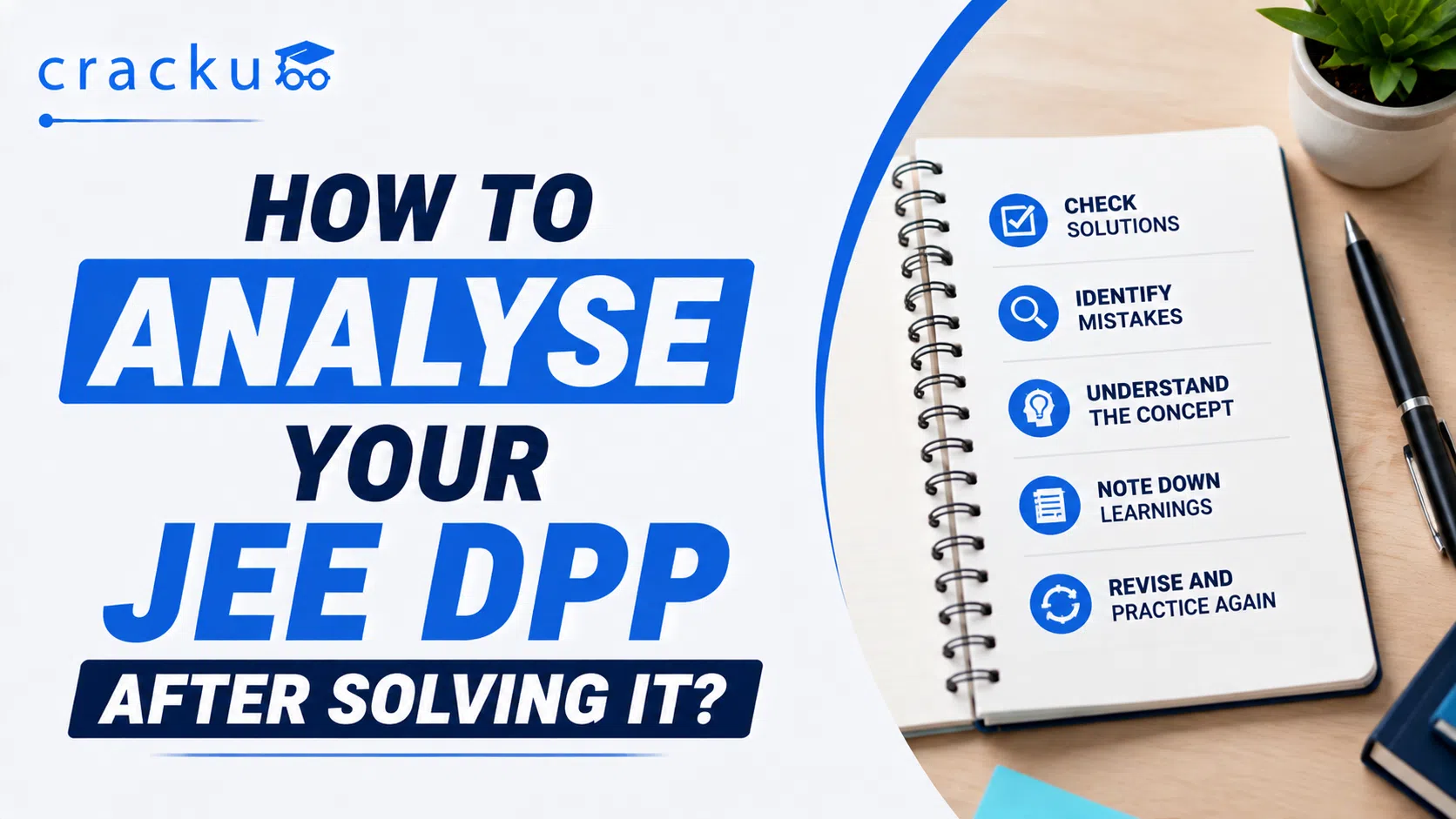
How to Analyse Your JEE DPP After Solving It?
Finishing a JEE DPP and checking only your score reveals limited information. Your score alone does not shed light upon a weak concept or an inefficient method. It also cannot reveal whether a correct answer came from guesswork. A proper JEE DPP analysis examines your complete solving process.
It is important to review correct, wrong, and unattempted questions after each practice set. Also, check accuracy and time taken to complete JEE DPP You will also need to classify important mistakes by their actual cause. And lastly, it is essential to revise weak areas or reattempt selected questions independently. Maintaining a short mistake log can help reveal errors that keep repeating across several DPPs.
What Should You Check After Completing a JEE DPP?
After completing a JEE DPP, review every question by its outcome and solving process. Do not use the total score as the only measure. A correct answer can still reveal a slow method or uncertain concept.
Start by recording the number of attempted, correct, wrong, and unattempted questions. You can use the JEE DPP resource for practice before using this review process. Also separate confident answers from answers reached through guessing or trial and error.
Check correct answers when the solving process needs attention. Compare your method with the detailed solution when a question took too long. A shorter valid method may reveal an opportunity to improve question-solving speed.
Use these checks immediately after completing the practice set:
- Mark correct answers where you felt unsure about the concept or formula.
- Identify correct answers that required much more calculation than expected.
- Mark questions where you guessed before reaching the correct answer.
- Check wrong answers before assuming that every error came from weak concepts.
- Record unattempted questions and identify why you left each one.
- Compare lengthy methods with the provided solution where a shorter approach exists.
Your final score cannot separate confident answers from lucky answers. The following table gives each question type a specific next action.
Question Status | What to Check | Next Action |
Correct and efficient | Concept and method were clear | No detailed review needed |
Correct but slow | Method or calculation took excessive time | Compare with a shorter valid method |
Correct through guesswork | Reasoning was incomplete | Solve again without guessing |
Incorrect | Identify the actual error type | Correct the cause before reattempting |
Unattempted | Identify why you left it | Revise or reattempt based on the reason |
Excessive calculation | Check whether the method created extra work | Practise a more efficient approach |
Also Read: JEE Mains Exam Pattern 2027, Negative Marking, Duration
How to Identify Mistakes in Your JEE DPP Practice
Classify each important mistake according to its actual cause. JEE DPP mistakes can include concept, formula, calculation, reading, recall, method, or time errors. Different causes require different corrective actions.
Concept and Formula Errors
A concept error occurs when you misunderstand or incorrectly apply the required principle. A formula error occurs when you recall or use the wrong relation. These errors usually need targeted revision before another attempt.
Physics mistakes may involve the wrong concept, diagram, equation, or physical assumption. In Chemistry, the error may involve a calculation, reaction, reagent, fact, trend, or exception. Identify the exact source instead of labelling every wrong answer as a concept error.
Calculation and Question-Reading Errors
A calculation error occurs after you choose a valid solving approach. Common examples include arithmetic, sign, unit, or algebra errors. Repeated calculation mistakes can suggest that your written process needs better checking.
A ‘question reading’ error has a different cause. You may miss a condition, interpret a value incorrectly, or answer something the question did not ask. Reading the theory again may not correct this JEE practice mistake.
Inefficient Method and Time-Management Errors
Mathematics requires close attention to method selection during JEE mistake analysis. A correct answer may still involve excessive algebra or unnecessary variables. Time problems can also start before calculation begins. Continuing with an inefficient approach can consume time even when your final answer is correct.
Look for error patterns across several JEE DPP practice sessions. One calculation mistake may be isolated. Repeated calculation errors need a more deliberate correction process.
Mistake Type | How to Identify It | Corrective Action |
Concept error | Required principle was misunderstood | Revise the concept and basic application |
Formula error | Formula was forgotten or used incorrectly | Revise the formula and its conditions |
Calculation error | Correct method produced a numerical mistake | Check written calculation steps |
Question reading error | A condition or requirement was missed | Mark important information before solving |
Recall error | Required fact, reaction, or relation was forgotten | Add the item to focused revision |
Incorrect assumption | Solution started from an invalid condition | Check assumptions before applying equations |
Inefficient method | Correct approach required unnecessary work | Compare with a shorter valid method |
Time management error | Excessive time went to one question | Practise question selection and timed solving |
Guessing error | Correct answer lacked complete reasoning | Reattempt without relying on the earlier answer |
Also Read: Why Students Should Start JEE Preparation Early?
How to Analyse Accuracy and Time Taken in JEE DPPs
Analyse JEE DPP accuracy together with attempts and time taken. High accuracy is not the only factor that describes the complete attempt. You may achieve high accuracy after attempting only a small part of the practice set.
Calculate Accuracy from Attempted Questions
Calculate ‘attempted question’ accuracy with this formula:
Accuracy = Correct Answers ÷ Attempted Questions × 100
Do not count unattempted questions as wrong attempts in this calculation. Review them separately instead. Otherwise, the accuracy percentage will not measure how reliably your attempted questions became correct answers.
Avoid using one fixed percentage as a universal accuracy target. Chapter difficulty and practice purpose can change the meaning of the result. Compare accuracy with your earlier work on similar questions.
Review Time Spent Per Question
JEE DPP time analysis should identify where time went during the practice set. Record average time per attempted question when timing data is available. Then identify questions that took much longer than the rest.
Check whether slow solving came from concept recognition or calculation. Weak formula recall can also create delays. Repeated checking may indicate low confidence even when the method is correct.
Identify Correct Questions That Took Too Long
Correct but slow questions deserve review because the final answer hides inefficiency. Compare your method with the detailed solution. Check whether you recognised the approach late or selected a lengthy method.
The same score can result from different combinations of speed and accuracy. These metrics help separate knowledge gaps from inefficient solving patterns.
Metric | What to Measure | What It May Indicate |
Questions attempted | Number of questions you tried | Attempt volume |
Correct answers | Successful attempted questions | Reliable concept application |
Wrong answers | Incorrect attempted questions | Errors requiring classification |
Accuracy percentage | Correct answers among attempts | Reliability of attempted answers |
Average time per attempt | Time divided across attempted questions | General solving pace |
Questions taking excessive time | Attempts much slower than others | Slow recognition or inefficient methods |
Correct but slow questions | Correct answers requiring extra time | Efficiency problems |
Abandoned questions | Questions left after spending time | Weak question selection |
Unattempted questions | Questions never attempted | Knowledge, confidence, or time issues |
Also Read: Is August Too Late to Start JEE Main 2027 Preparation?
How to Revise Wrong and Unattempted JEE DPP Questions
For a wrong question, identify the error before starting revision. Review only the concept, formula, reaction, or method that caused the mistake. Then reattempt the question without looking at the solution.
Revise the Cause Before Reattempting
Start with the reason behind the wrong answer. A concept error requires concept revision. A calculation error needs careful examination of the solving steps instead.
Use JEE Study Material when a conceptual weakness needs targeted theory or solved examples. Return to the relevant practice question after correcting the weak area. Avoid rereading an entire chapter for one isolated arithmetic mistake.
Reattempt Wrong Questions Without the Solution
Read the detailed solution only after making a genuine attempt to correct the question. Understand where your approach changed from the correct method. Then close the solution before attempting the problem again.
Decide Why a Question Was Left Unattempted
An unattempted question does not automatically represent a knowledge gap. You may know the concept but fail to identify the starting method. You may also skip a difficult question for valid time-management reasons.
Classify unattempted questions using the actual reason:
- Revise the concept when you could not identify the principle required.
- Review formula revision when missing recall prevented an attempt.
- Study the solution approach when you could not identify a starting step.
- Practise timed question selection when other questions consume available time.
- Reattempt later when you skipped a difficult question strategically.
- Return after concept completion when the topic has not yet been studied.
Wrong and unattempted JEE DPP questions need different forms of revision. Establish the cause first and choose the next action from that cause.
Question Type | What to Review | When to Reattempt |
Conceptual error | Required concept and basic application | After concept revision |
Formula error | Formula and conditions for its use | After formula revision |
Calculation error | Exact calculation step that failed | After checking the process |
Misread question | Missed condition or requirement | After identifying the reading error |
Approach unclear | Starting method and key reasoning | After understanding the approach |
Ran out of time | Question selection and time use | During later timed practice |
Unfamiliar concept | Required theory and examples | After studying the concept |
Solved after viewing solution | Independent reasoning | After closing the solution |
How to Maintain a Mistake Log for JEE DPP Practice
A JEE DPP mistake log should record recurring errors and their corrected approaches. Do not turn the log into another collection of complete solutions. Keep each entry short enough for regular review.
What to Record in a JEE DPP Mistake Log
Record the date or DPP reference and the relevant topic. Add the mistake category and a brief reason. Then note the correct concept, formula, or approach.
Useful entries can include:
- Record the subject or topic so repeated weak areas become easier to identify.
- Add the question reference instead of copying the entire question.
- State the mistake category so similar errors can be grouped later.
- Write one clear reason explaining why the mistake occurred.
- Record the corrected concept or approach needed for another attempt.
- Mark whether the independent reattempt succeeded.
- Note when the same error has appeared in an earlier DPP.
The purpose of a JEE error log is to make recurring weaknesses visible. The format should remain simple enough to maintain after regular practice.
Topic | Error Details | Correction and Reattempt Status |
Physics topic | Wrong concept selected | Revise concept and reattempt |
Chemistry topic | Formula or reaction recalled incorrectly | Review required information and solve again |
Mathematics topic | Excessive algebra increased solving time | Practise a shorter valid approach |
Current DPP topic | Sign or arithmetic mistake | Check written steps during reattempt |
Current DPP topic | Important condition was misread | Mark key conditions before solving |
How to Review Repeated Errors
Review the JEE mistake log across several DPPs. Look for repeated error categories and chapters producing several mistakes. Check whether errors already marked as corrected appear again. Keep repeated mistakes active in your revision priority. A mistake notebook works best as an ‘error tracking’ system.
How to Use JEE DPP Analysis to Improve Your Score
Use JEE DPP analysis to decide what should change in the next practice cycle. The findings should affect revision, reattempts, topic selection, or timed practice. JEE DPP analysis does not guarantee JEE score improvement.
Turn Analysis into the Next Practice Plan
Repeated conceptual errors need focused concept revision before harder practice. Solve basic application questions again where required. Return to DPP-level practice after your understanding becomes reliable.
Repeated calculation errors require a different response. Review written steps and reduce unnecessary mental calculation. Track common arithmetic, sign, algebra, or unit errors during later practice.
Correct but consistently slow questions need efficient work. Compare problem solving approaches and practise method recognition. Use timed practice after learning a shorter valid approach.
The next action should match the findings from your performance analysis.
Analysis Finding | What It Means | Next Practice Action |
Low accuracy in one chapter | The chapter may contain unresolved gaps | Revise weak concepts and practise again |
Repeated concept errors | Understanding or application remains weak | Return to basic concept application |
Frequent calculation mistakes | The solving process needs better checking | Practise written calculations carefully |
Correct answers take too long | Method selection may be inefficient | Compare approaches and use timed practice |
Many questions remain unattempted | Knowledge or time use may limit attempts | Identify the exact cause first |
Same error keeps returning | Earlier correction has not become reliable | Reattempt related questions after revision |
Strong accuracy but slow completion | Speed needs attention | Practise controlled timed sets |
Fast solving with low accuracy | Rushing may reduce reliability | Slow down and check reasoning |
Track Whether the Same Errors Are Reducing
Repeated patterns matter more than one isolated mistake. Bring a weak chapter back into JEE practice when the same problem continues. Reattempt relevant DPP questions after completing the required revision.
After correcting a weakness, use JEE PYQ practice to test the concept through previous-year questions. After every JEE DPP, identify what went wrong and why. Check whether you used time efficiently. Decide what needs revision and what you should practise next. Focus the review on preventing important mistakes and inefficient methods from repeating.
How to Analyse Your JEE DPP After Solving It: Conclusion
A JEE DPP becomes more valuable when you analyse your performance after solving it. Checking only the final score does not reveal the actual reason behind mistakes. A proper analysis helps you identify conceptual gaps, calculation errors, inefficient methods, time-management issues, and areas that need revision.
After every DPP, review correct, wrong, and unattempted questions, maintain a mistake log, and reattempt important problems independently. Focus on correcting the cause of mistakes rather than simply solving more questions. Consistent DPP analysis, targeted revision, and regular improvement of solving methods can help build stronger concepts, improve accuracy, and make your JEE preparation more effective.
.webp)