
 Group
Group
 Group
Group
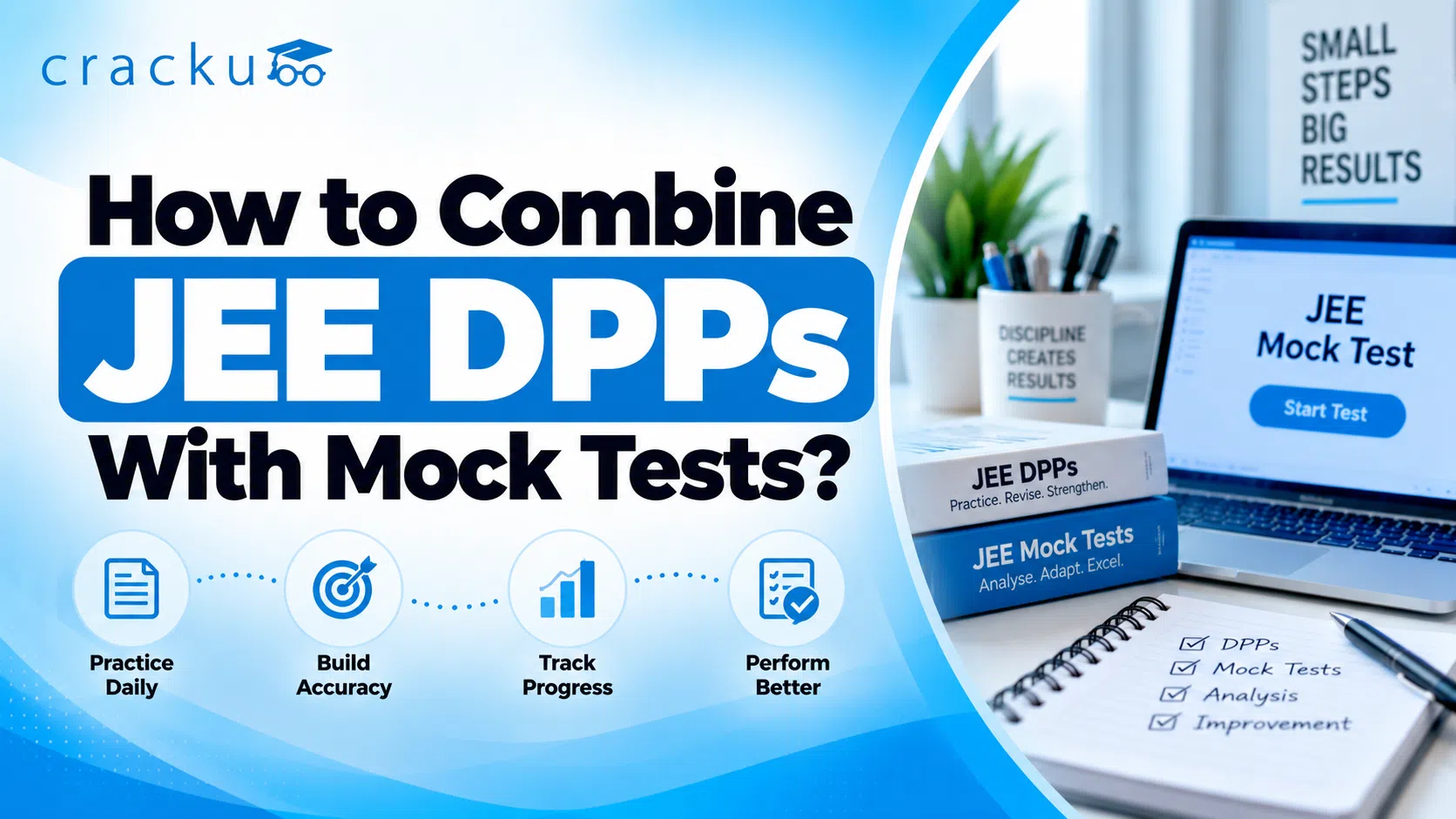
How to Combine JEE DPPs With Mock Tests?
JEE preparation involves practicing, revising, and analysing performance on a continuous basis. Two effective methods for JEE preparation include DPPs (Daily Practice Problems) and mock tests. DPPs help students practice concepts on a continuous basis, whereas mock tests allow them to implement these concepts in a real test atmosphere. Usage of any of the two methods might lead to a weakness in your preparation. It is better to use both of them effectively in order to make your concepts strong.
JEE DPPs vs Mock Tests
Before combining JEE DPP and mock tests, it is important to understand how they are different. Both are important for JEE preparation, but they serve different purposes.
JEE DPPs | JEE Mock Tests |
Focus on daily practice | Focus on complete exam practice |
Usually based on specific topics or chapters | Covers multiple chapters and subjects |
Helps strengthen concepts | Tests overall preparation |
Improves question-solving skills | Improves speed and time management |
Can be solved regularly | Usually taken at fixed intervals |
Helps identify topic-level weaknesses | Helps identify overall exam weaknesses |
Also Read: Are JEE DPPs Enough for JEE Mains 2027? Check Now
When to Solve DPPs and When to Take Mock Tests?
DPPs must form a consistent element in your JEE studies every day. The DPPs may be solved right after reading any topic or chapter to test if you can implement the concepts learnt into solving questions. For example, if you read Chemical Bonding in Chemistry today, you could solve the DPP related to that topic either today or tomorrow. You could then find out if there are any weak areas that need improvement before proceeding with more complex topics. However, mock tests should be done less often, particularly during the initial stages of preparation. You may start with taking chapter-wise or part-syllabus tests at first, but gradually progress to full-length JEE Main mock tests.A simple approach can be:
- Early preparation: Focus more on DPPs and occasional tests.
- Middle phase: Continue DPPs while increasing mock-test frequency.
- Final phase: Reduce new learning and focus heavily on mock tests, revision, and analysis.
Also Read: What is JEE DPP? Complete Guide for JEE Mains & Advanced
How DPP Practice Improves Mock Test Performance?
DPPs help in improving your performance in mock tests. This is because DPP gives you the opportunity to face different types of questions repeatedly, thus making you comfortable in solving them. Some ways DPP helps you include:
1. Strengthens Concepts
DPPs will enable you to test your understanding by solving problems on concepts immediately after studying them. In this way, it becomes easy for you to find out the areas in which you do not understand well enough.
2. Increase in Speed of Solving Questions
Since you practice each day, you will be able to recognize patterns of the questions easily. With daily practice, you will be able to save time in determining the method.
3. Increase in Accuracy
By solving questions regularly, you will be able to avoid errors like miscalculation, misinterpretation, wrong formulae, etc.
4. Builds Confidence
When you solve questions of various topics regularly, you will be prepared to face difficult questions in mock tests.
5. Helps in Revising
In addition to that, DPPs may also prove useful when revising for examinations. Rather than going through the same topics again, one may revise the topics through practice questions. Thus, practicing DPPs cannot be considered independent of mock test preparation. It lays the groundwork necessary to excel in full-scale tests.
Also Read: How to Analyse Your JEE DPP After Solving It? Check Now
How to Use Mock Test Analysis to Improve Your DPP Practice?
Mock tests are not the entire process, as there is an equally significant analysis of the test that needs to be done. Mock-test errors will reveal those topics on which you need to work on DPPs. Following each mock test, classify your errors into different categories:
- Conceptual mistakes: You did not understand the concept.
- Calculation mistakes: You knew the concept but made an arithmetic error.
- Silly mistakes: You misread the question or selected the wrong option.
- Time-management issues: You could not solve the question within the available time.
- Unattempted questions: You knew the topic but could not reach or solve the question.
Ideal DPP and Mock Test Schedule for JEE Preparation
The right balance between DPPs and mock tests can help make your JEE preparation more systematic and productive. While the use of DPPs is a must to gain mastery in the concepts and improve your skills in solving questions, the use of mock tests is also necessary to ensure that you have prepared well for the exam. As the exam gets closer, you can gradually increase the frequency of mock tests and focus more on analysing your performance
Preparation Stage | DPP Practice | Mock Tests | Main Goal |
Early Preparation | Daily | 1 every 2 weeks | Build concepts and solve questions |
Middle Preparation | 5–6 days a week | 1 every 1–2 weeks | Improve application and accuracy |
Final Preparation | Targeted DPPs | 2–3 per week | Improve speed and time management |
Last 1–2 Weeks | Weak-topic DPPs + revision | 3–4 per week | Exam practice and final revision |
How to Maintain the Right Balance?
The best possible approach to integrating DPPs and mock tests in your preparation strategy is by assigning a distinct purpose to each of them. DPPs can help you practice what you have studied, evaluate topic-based weaknesses,, and hone your problem-solving skills. On the other hand, mock tests will help you evaluate your preparation levels, develop time-management skills, and analyze your performance under examination pressure. However, you should refrain from constantly comparing your test scores with those of others. It is better to compare your previous performance with the current one and look out for improvements in terms of accuracy, timing, attempts, and repeated errors. As your exam approaches, gradually shift from learning and practising → testing and analysing → revising and improving.
How to Combine JEE DPPs With Mock Tests: Conclusion
JEE DPPs and mock tests serve different but complementary purposes in JEE preparation. DPPs help strengthen concepts, develop problem-solving skills, improve accuracy, and identify topic-wise weaknesses, while mock tests evaluate overall preparation, speed, time management, and performance under exam conditions. Using both consistently can make JEE preparation more structured and effective.
The ideal approach is to gradually shift your focus as the exam approaches: begin with regular DPP practice, introduce mock tests as your syllabus progresses, and use mock-test analysis to guide further practice and revision. This cycle of practice, testing, analysis, and improvement can help you strengthen weak areas and perform with greater confidence in the actual JEE exam